Hi, what do you want to do?






National Endowment for the Humanities
The Greek Alphabet: More Familiar Than You Think!
For this Greek alphabet lesson, pupils explore the Phoenician origins to the Greek alphabet. Learners compare Greek letters to current letters and write a paragraph about the life of students in ancient Greece. They also identify...

Curated OER
It's All Greek to Me
Introduce your class to the Greek alphabet and language. Examine how the Greek language influenced the English language. Study the history, timeline of achievements, and the role oral history played in Greece.

Curated OER
The Greek Alphabet
Tenth graders examine the history and origins of the Greek alphabet. They take notes while listening to a teacher-led lecture, and read and interpret common Greek words on the board. Students then create a decorated name plate with...

National Endowment for the Humanities
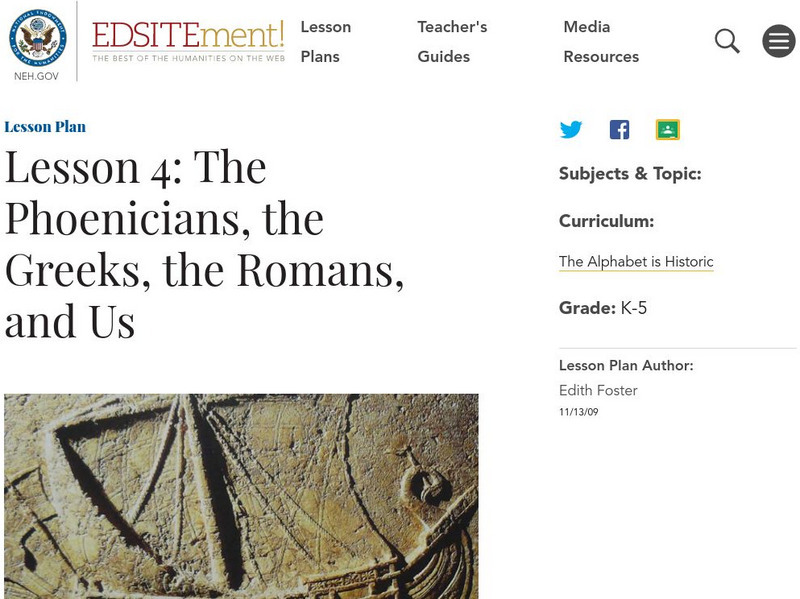
Lesson 4: The Phoenicians, the Greeks, the Romans, and Us
Learners review knowledge gained in the three-part unit on the history of the alphabet. Using maps and images, learners consolidate their understanding of ancient Greece, the Romans and the Phoenicians, and their respective impacts...

Curated OER
The Olympic Medal: It's All Greek to Us!
Students view a graphic of the Athens of 2004 Olympic medal. They discuss the symbols on the medal. Students view the "Greek Alphabet animation" and name the letters in the two Greek words on the medal, They transcribe Greek text by...

Curated OER
Daily Life and Schooling
Students compare the ancient Greek method of schooling and writing to contemporary methods and learn the Greek alphabet on wax tablets.

Curated OER
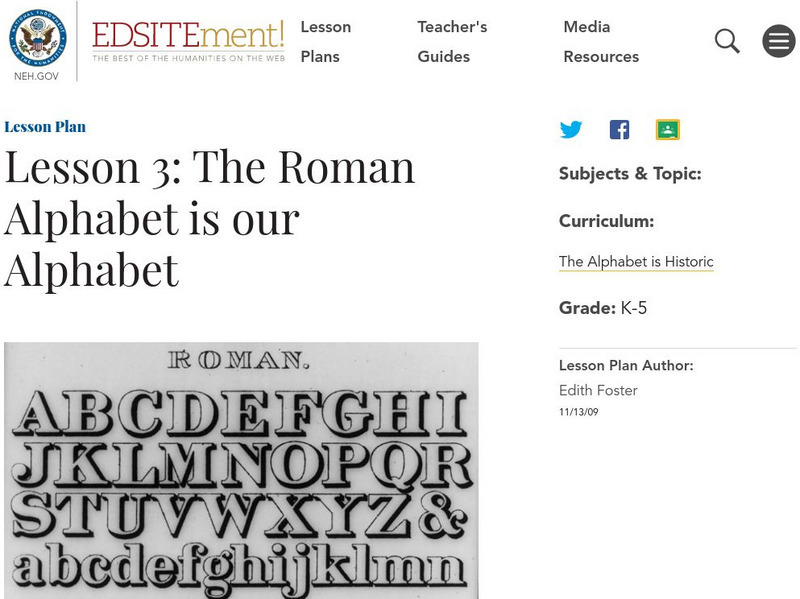
The Alphabet is Historic: The Roman Alphabet is our Alphabet
Young scholars show that the Greeks, Phoenicians and Romans lived in the Mediterranean area. They give reasons why the alphabet was important for the Romans. and say that the Romans developed the alphabet they are learning in school.

Curated OER
The Alphabet is Historic
Young scholars describe how the Phoenicians, Greeks and Romans passed down the alphabet through the generations. They compare and contrast the letters from early alphabets to the one of today and discuss how they are different. Using a...

Curated OER
Ancient Refuge in the Holy Land - International Phonetic Alphabet
Students research the uses and symbols of the International Phonetic Alphabet. They complete a worksheet to translate and transcribe phrases of English into the International Phonetic Alphabet.

Newspaper in Education
The Iliad: A Young Reader Adventure
Is The Iliad part of your curriculum? Check out a resource that offers something for those new to teaching the classic and those with lots of experience using Homer's epic. Plot summaries, discussion questions, activities abound in...

Curated OER
Cracking Codes and Ciphers
Students explore different codes and ciphers including Morse Code, Egyptian Hieroglyphs, and the Alphabet. They discuss how and why codes are used. Students create their own code and message to exchange with classmates.

Curated OER
Science Hits Activity
Students listen to a song that teaches the elements of the periodic table and write their own song to be used as an aid in remembering scientific information.

Curated OER
In Search of Cosmic Rays
Students compare rates to altitude. They conduct a class discussion about the results.

Curated OER
Introduction To Latin
In this language arts worksheet, students examine the 101 reasons for taking a class in Latin. The syllabus has classical art for background on the cover page.
National Endowment for the Humanities
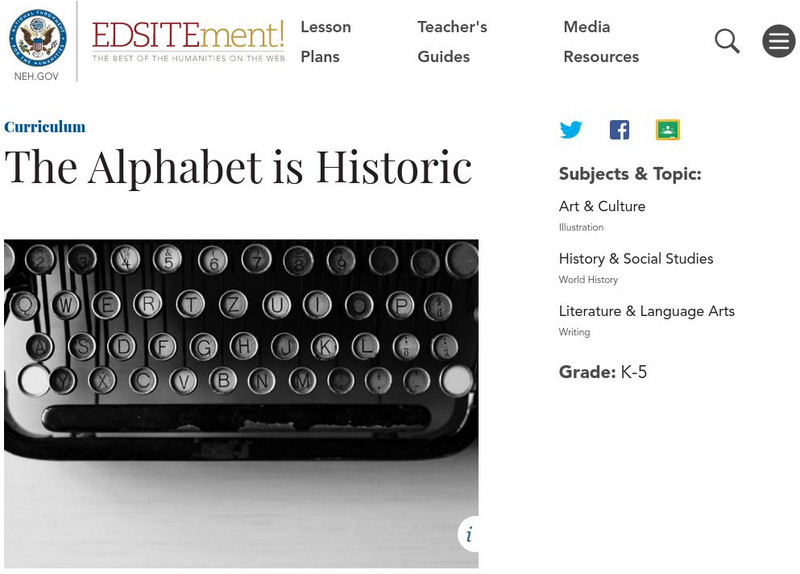
Neh: Edsit Ement: The Alphabet Is Historic
Great lesson plans for grades K-2 on the history of the alphabet. Includes guiding question, objectives, and four lessons with activities and assessments. With links to various websites containing information on alphabet history.
National Endowment for the Humanities
Neh: Edsit Ement: Lesson 4: The Phoenicians, the Greeks, the Romans, and Us
In this lesson plan, students will consider Lesson 4: The Phoenicians, the Greeks, the Romans, and Us. Worksheets and other supporting materials can be found under the Resources tab.
National Endowment for the Humanities
Neh: Edsit Ement: Lesson 3: The Roman Alphabet Is Our Alphabet
In this lesson plan, students will consider Lesson 3: The Roman Alphabet is our Alphabet. Worksheets and other supporting materials can be found under the Resources tab.