Hi, what do you want to do?






A&E Television
History.com: How John Marshall Expanded the Power of the Supreme Court
When John Marshall was appointed chief justice of the U.S. Supreme Court in 1801, the nation's highest court occupied a lowly position. There was no Supreme Court Building in the newly completed capital, Washington, D.C., so the six...

Mayflower History
Mayflower history.com: The End of the Mayflower
Explains what is known about what happened to the Mayflower, the ship that brought the Pilgrims to the New World. Popular belief is that it ended up as the building materials of a barn in England but no evidence has been found to support...

University of New Brunswick (Canada)
Henry George Clopper Ketchum the Railway to Glory or Despair
This is a fascinating, largely forgotten piece of Canadian history. In the late 19th century, Henry Ketchum, an engineer from Fredericton, New Brunswick, envisioned the building of a railway to transport ships from the Bay or Fundy to...
Other
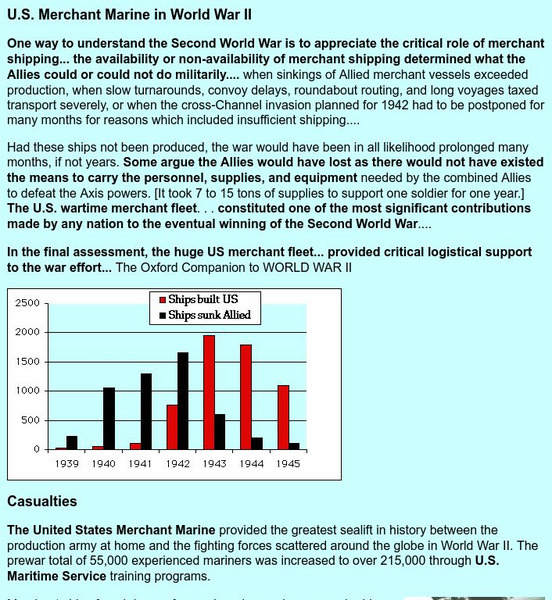
American Merchant Marine at War: u.s. Merchant Marine in World War Ii
Gives an excellent history of the sailing ships and sailors of the Merchant Marine in both the Atlantic and Pacific. Links on the page include many firsthand accounts of the sailors and their experiences during the war.
Curated OER
National Park Service: Fort Raleigh: Search for the Lost Colony
The history of the Lost Colony of Roanoke Island is outlined as well as attempts that were made over the ensuing years to locate it, and ways that the colony was remembered.
Mariners' Museum and Park
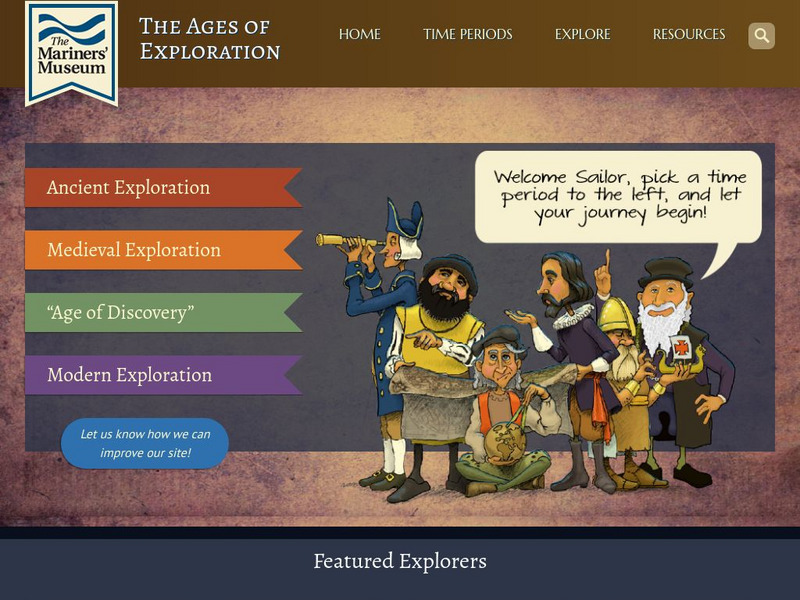
Mariners' Museum: Exploration Through the Ages
A history of the world from the perspective of those who sailed the seas in great waves of exploration, from ancient times through the nineteenth century. Learn about the explorers, their ships, the tools they navigated by, and their...
Curated OER
National Park Service: Fort Raleigh: The Roanoke Voyages: A Mystery Story for Young People
The history of the Lost Colony of Roanoke Island is told in story form. It tells of the conflict between England and Spain to establish a foothold in the New World, the voyages arranged by Sir Walter Raleigh, the establishment of a...
University of Groningen
American History: Essays: The Iron Horse: The Granger Laws
From a lengthy essay on the history of the railroad in the United States. This section describes the Granger movement, its success in pushing for state regulation of railroad shipping rates, the Granger Cases, and subsequent court cases...
Mocomi & Anibrain Digital Technologies
Mocomi: Titanic Facts and History
Description of the Titanic with details on its collision with an iceberg in 1912 where almost 1500 people died.

Smithsonian Institution
National Museum of American History: Where's Everyone Going?
A great resource from the National Museum of American History that shows various modes and uses of transportation in the 19th and 20th centuries.
Independence Hall Association
U.s. History: Historic Philadelphia: Philadelphia History
Reading through the beginning of this article will show the role shipping and ship building played in Philadelphia's economy.
Digital History
Digital History: Middle Passage
The number of Africans who died or were enslaved as a result of slave trading both across the Atlantic and into the Arabian peninsula is truly shocking. Read about the Middle Passage which brought millions of slaves to the New World, see...
Digital History
Digital History: The Slave Trade [Pdf]
Read Olaudah Equiano's account of being captured in his village in Africa, and placed on a slave ship to be taken to America. He describes the middle passage of the triangular trade route, as well as the leg from Europe to Africa. [pdf]
Ibis Communications
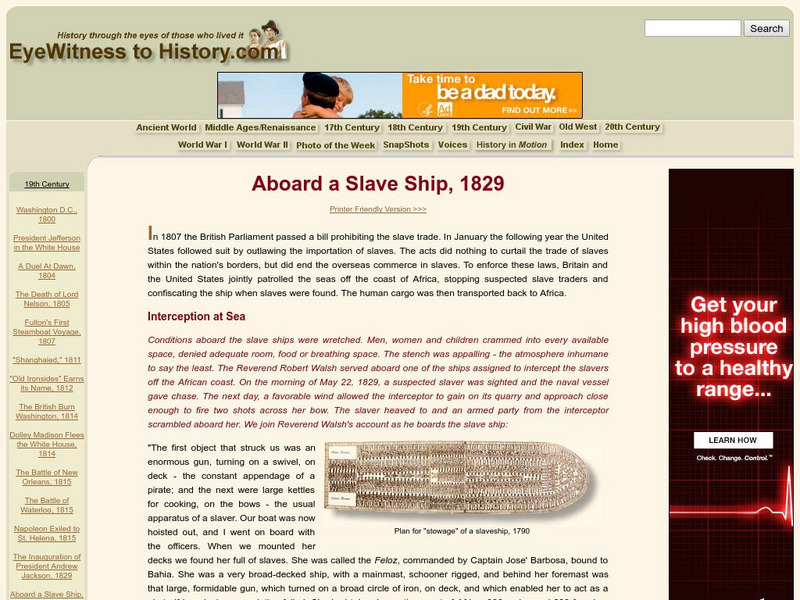
Eyewitness to History: Aboard a Slave Ship, 1829
A historically significant account of what Reverend Robert Walsh observed on a slave ship off the African coast in 1829.
Texas State Library and Archives Commission
Texas State Library and Archives Commission: The Texas Navy: Founding of the Second Navy
By 1837, the Texas needed new ships, as the first ships were either "wrecked, captured, or seized by creditors." Learn how the second navy was formed by reading primary texts from this time in Texas' history: "S. Rhodes Fisher, the...

Canadian Museum of History
Cmc: Voyages of Martin Frobisher: Ships of the Third Voyage
A description of the ships used by Martin Frobisher during his third voyage: the Aid, the Thomas Allen, and the Gabriel. The description includes drawn images of the exteriors and the drawn images of the skeletons of the ships' interiors.
Ibis Communications
Eye Witness to History: Loose Lips Sink Ships
This site discusses article discusses the rules of conduct regarding disclosure of personal and military information that may have compromised military efforts during World War II.
Mayflower History
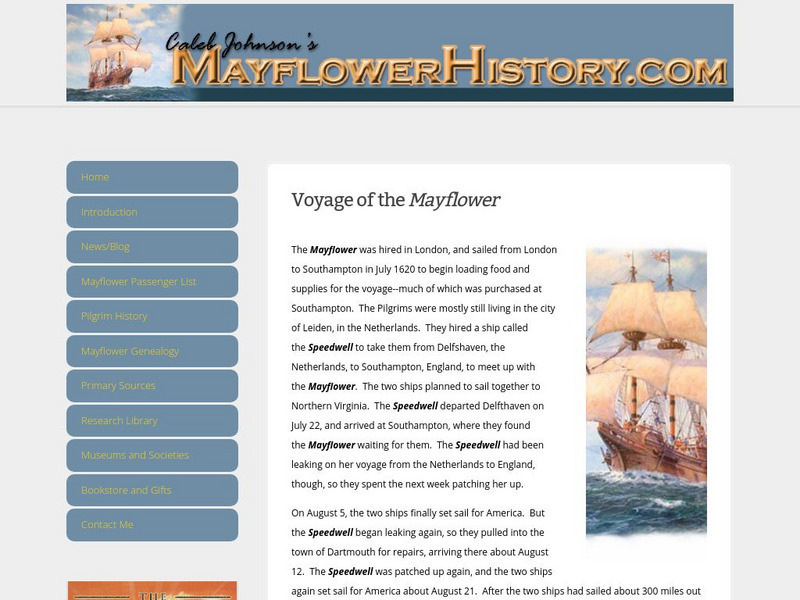
Mayflower history.com: Voyage of the Mayflower
Describes the difficulty the Mayflower had in setting off for America, due to the second ship that was to accompany it, Speedwell. This ship repeatedly sprang leaks so they decided to leave it in England. The Mayflower hit rough weather...
University of Calgary
University of Calgary: Ming Dynasty's Maritime History
This site provides a discussion from the University of Calgary of the extensive maritime voyages taken during the Ming dynasty. A map is included.
The History Cat
The History Cat: Ellis Island
Tells the story of Ellis Island, the first stop for immigrants arriving in New York City beginning in 1890. Describes the process would-be immigrants to America had to go through before being allowed to board a trans-Atlantic ship, the...
Other
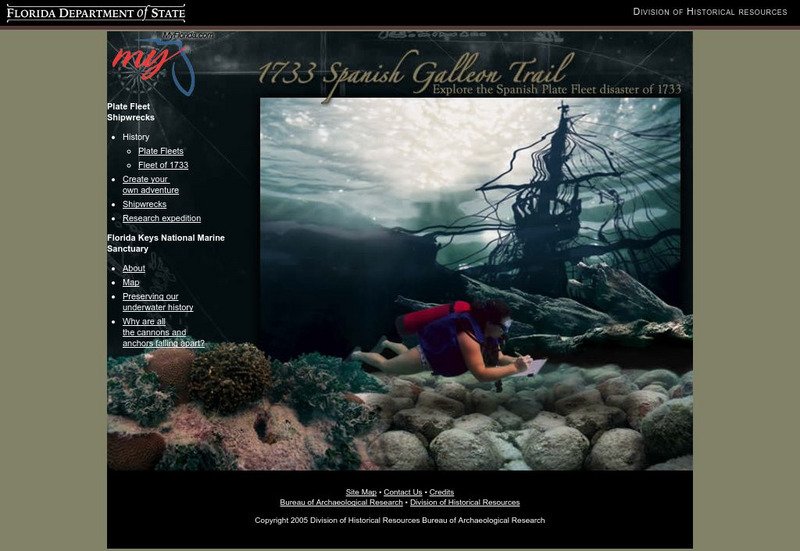
Florida.com: Division of Historical Resources: Archaeology: Galleon Trail
In 1733 a fleet of many ships set sail from Havana for Spain. After a bout of wind changes and bad weather most of the ships were swamped or sunk covering a span of approximately 80 miles in the Florida Keys. The shipwrecks created many...
Digital History
Digital History: Roots of American Economic Growth: Speeding Communications
Find out the many reasons why communication speed increased in the early 19th century. It wasn't just because of the telegraph.
University of Groningen
American History: Outlines: Women and Minorities
Although the colonial period produced several women writers of note, the revolutionary era did not further the work of women and minorities, despite the many schools, magazines, newspapers, and literary clubs that were springing up....
Yale University
Yale New Haven Teachers Institute: Black Emancipators of the 19th Century
A lesson unit on the people and movements that fought to abolish slavery. Looks at the Triangular Trade, and at the Underground Railroad and famous abolitionists. Includes a play about emancipation, a black history rap and a trivia quiz...