Hi, what do you want to do?





University of Groningen
American History: Outlines: The British Move South
With the French now involved, the British stepped up their efforts in the southern colonies since they felt that most Southerners were Loyalists. A campaign began in late 1778, with the capture of Savannah, Georgia. Shortly thereafter,...
Black Past
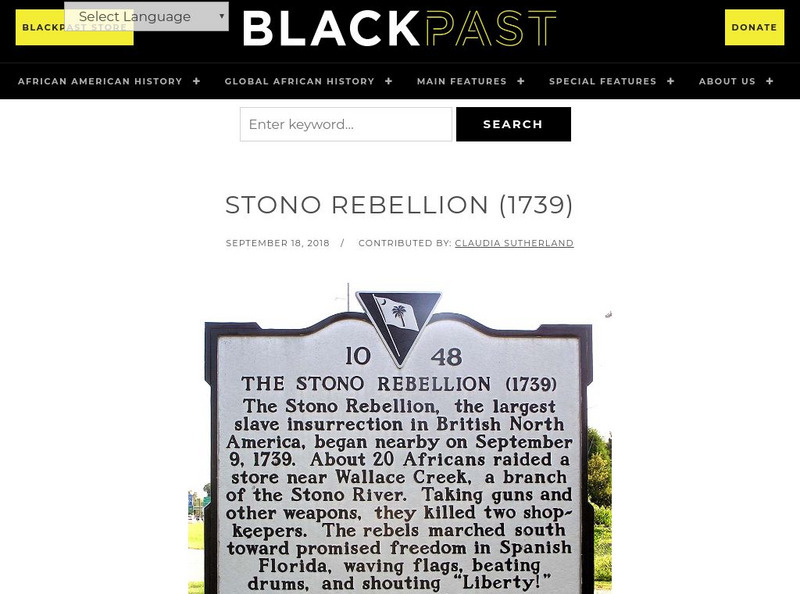
Black Past: Stono Rebellion
This encyclopedia article gives information about the Stono Rebellion by South Carolina slaves, and the outcome of the revolt.
Soylent Communications
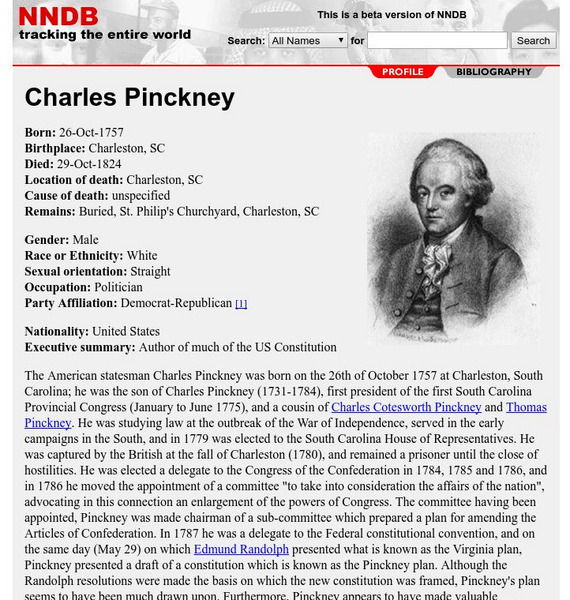
Nndb: Charles Pinckney
A short but detailed biography of this delegate from South Carolina to the Constitutional Convention. He later served as governor of the state.
![National Park Service: Resource Study: Charles Pinckney National Historic Site [Pdf] Handout](https://static.lp.lexp.cloud/images/attachment_defaults/resource/large/FPO-knovation.png "National Park Service: Resource Study: Charles Pinckney National Historic Site [Pdf] Handout")
Curated OER
National Park Service: Resource Study: Charles Pinckney National Historic Site [Pdf]
A scholarly publication which examines the archaeological findings of Snee Farm, the plantation and house owned by Charles Pinckney, a delegate to the Constitutional Convention from South Carolina. Click on "Table of Contents" to get a...
University of Groningen
American History: Outlines: Southern Colonies
In contrast to New England and the middle colonies were the predominantly rural southern settlements: Virginia, Maryland, North and South Carolina, and Georgia.
Digital History
Digital History: The Civil War Begins [Pdf]
The election of 1860 showed the deep divisions that split the country. With four candidates representing four very different approaches to the issue of slavery, the outcome resulted in the secession of South Carolina, followed eventually...
Henry J. Sage
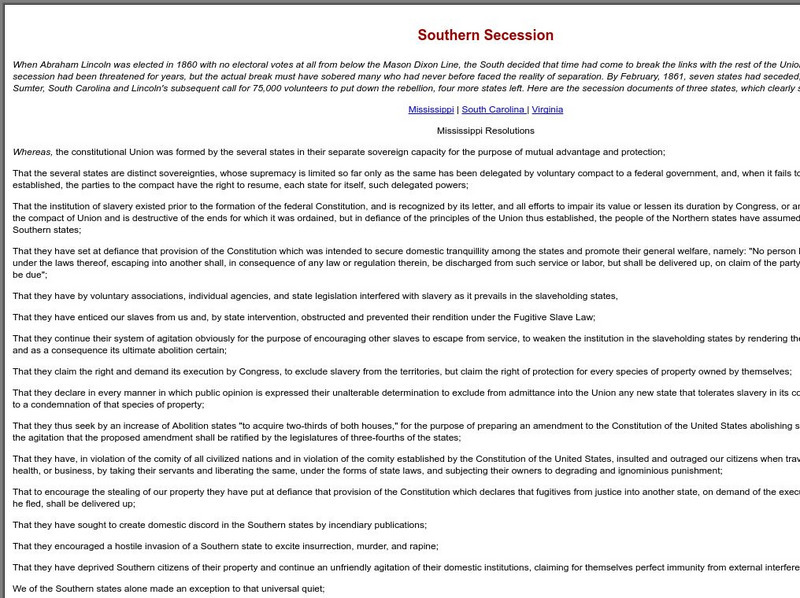
Sage American History: Southern Secession
Article with primary source secession resolutions from three states including, South Carolina, Virginia and Mississippi. Each declaring intent to secede from the Union and outlining reasons for doing so.
Curated OER
History Matters: Shut the Door: A Senator Speaks for Immigration Restriction
Read the speech by a senator from South Carolina who used racist theories to support his argument for the Immigration Act of 1924. He was not alone in the Senate inhis support for restrictive immigration policies.
Curated OER
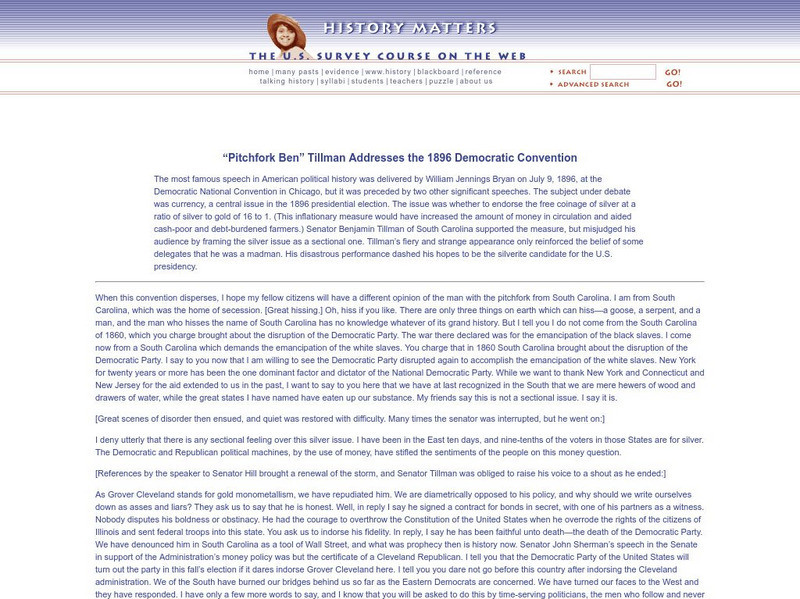
History Matters:"pitchfork Ben" Tillman Addresses the 1896 Democratic Convention
Ben Tillman, senator from South Carolina, gave a speech at the Democratic Convention in 1896, advocating for the free coinage of silver, the same issue addressed in a later speech by William Jennings Bryan. Read Tillman's speech here,...
Black Past
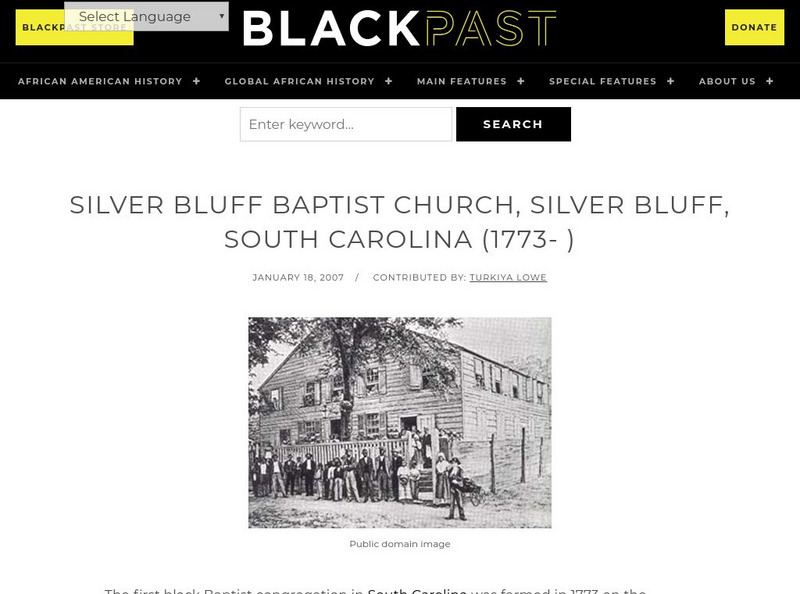
Black Past: Silver Bluff Baptist Church, Silver Bluff, South Carolina
This encyclopedia entry gives information about the Silver Bluff Baptist Church, whose black congregation became the Springfield Baptist Church, which is still in existence.
Digital History
Digital History: The Crisis of 1833: Tariffs and Nullification [Pdf]
Andrew Jackson became president at a contentious time with strains already showing between the interests of the North and South. Read about the Tariff of Abominations, South Carolina's reaction to it, and Andrew Jackson's handling of the...

PublicBookshelf Corporation
Public Book Shelf: The North Carolina Regulators
PublicBookShelf.com offers an excerpt from "The Great Republic by the Master Historians," a book published in the early 1900s that covers the history of the United States. Excerpt provides the reasons behind the Regulators revolt in 1771.
University of Groningen
American History: Outlines: The British Move South
Brief overview of the Revolutionary War in the South including campaigns of Savannah, Charleston and the significant battle at Cowpens, South Carolina.

Khan Academy
Khan Academy: Us History: 1800 1848: The Cotton Kingdom
During the first half of the nineteenth century, demand for cotton led to the expansion of plantation slavery. By 1850, enslaved people were growing cotton from South Carolina to Texas.
University of Groningen
American History: Outlines: New Peoples
Most settlers who came to America in the 17th century were English, but there were also Dutch, Swedes and Germans in the middle region, a few French Huguenots in South Carolina and elsewhere, slaves from Africa, primarily in the South,...
Tennessee History For Kids
Tennessee History for Kids: Kings Mountain
It was the most famous road trip and the most important victory in Tennessee history. During the American Revolution, a British commander named Patrick Ferguson led an army through South Carolina. Along the way, he sent a threatening...
Other
Charleston County Public Library: Charles Pinckney and the U. S. Constitution
A good biography on Pinckney and his role in the formation of the Constitution.
A&E Television
History.com: 7 Famous Loyalists of the Revolutionary War Era
From a son of Benjamin Franklin to a Mohawk leader to the governor of Massachusetts, these men chose to side with the British. In a way, the American Revolution was also a civil war. By 1774, American colonists were divided into two...
South Carolina Educational Television
Etv: Gullah Net: Gullah Music
Explore aspects of African music as reflected in the songs and music of slaves who lived in coastal South Carolina.
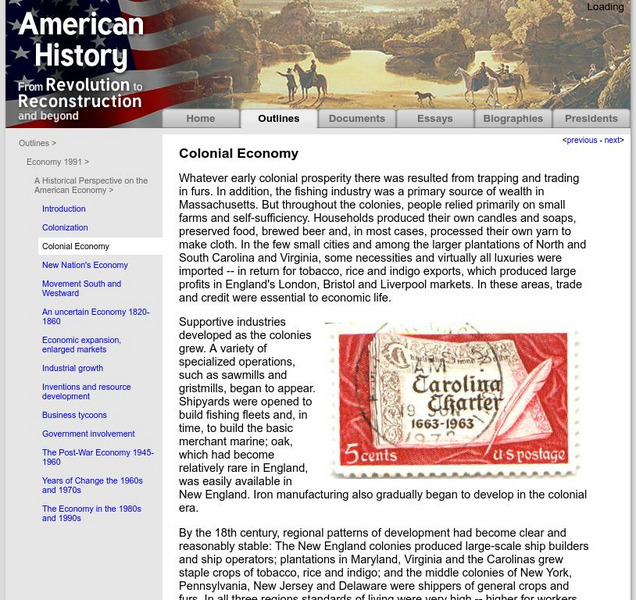
University of Groningen
American History: Outlines: Colonial Economy
Whatever early colonial prosperity there was resulted from trapping and trading in furs. In addition, the fishing industry was a primary source of wealth in Massachusetts. But throughout the colonies, people relied primarily on small...
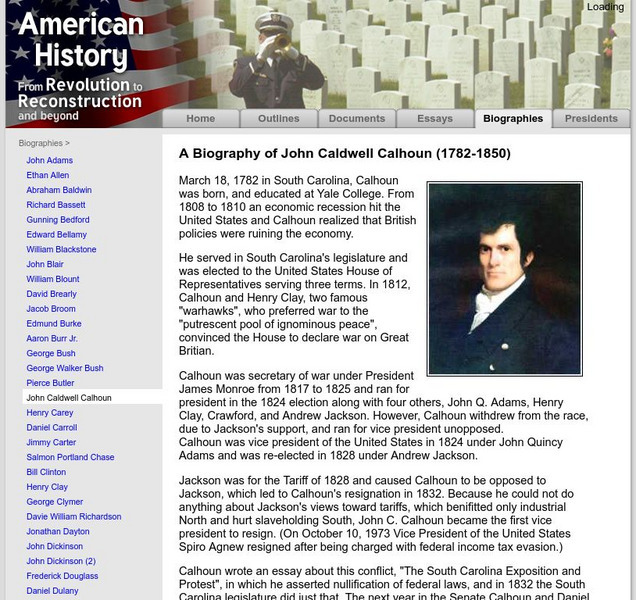
University of Groningen
American History: Biographies: John Caldwell Calhoun
This biographical resource on John Calhoun points out Calhoun's resignation, the first vice-president to resign from active office. Calhoun opposed Jackson's affirmative stand on the Tariff of 1828 which favored the Industrial North over...
University of Groningen
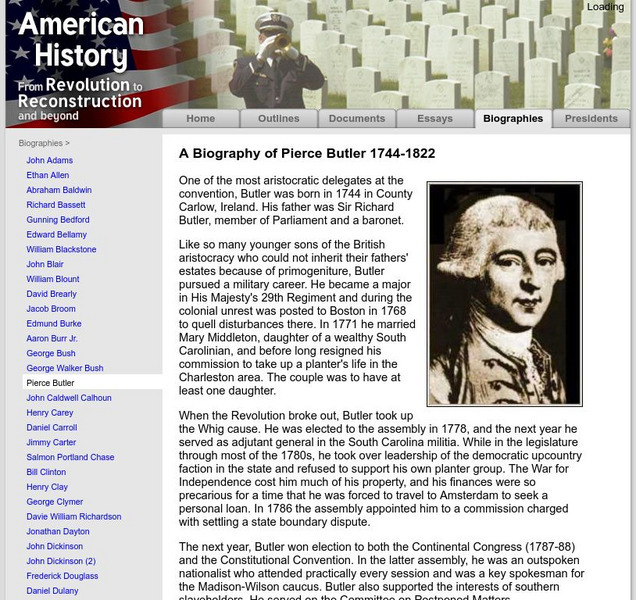
American History: Biographies: Pierce Butler 1744 1822
One of the most aristocratic delegates at the convention, Butler was born in 1744 in County Carlow, Ireland. His father was Sir Richard Butler, member of Parliament and a baronet.
University of Groningen
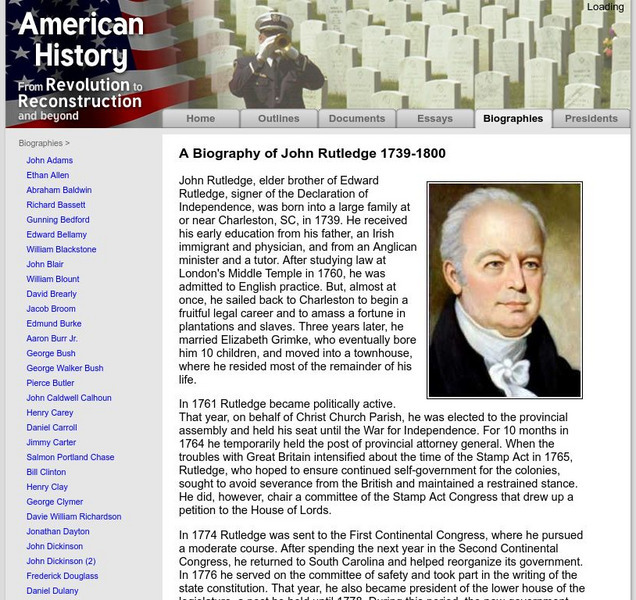
American History: Biographies: John Rutledge 1739 1800
John Rutledge, elder brother of Edward Rutledge, signer of the Declaration of Independence, was born into a large family at or near Charleston, SC, in 1739. He received his early education from his father, an Irish immigrant and...
Independence Hall Association
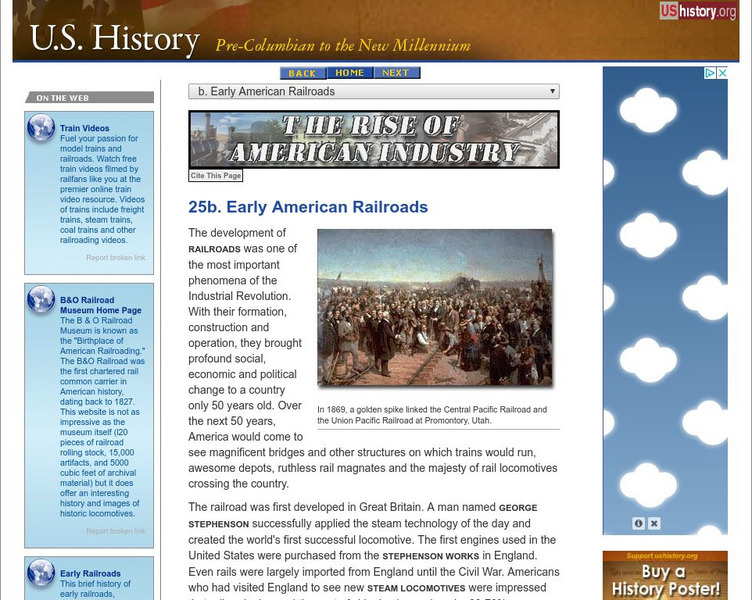
U.s. History: Early American Railroads
Read about the growth of railroads throughout the eastern part of the United States, which greatly reduced transportation costs. See why there was opposition to railroads from many groups. Be sure to look at the stereograph of the...