Hi, what do you want to do?






Curated OER
We Are a Fact Family! Integration Is the Key!
Students practice addition and subtraction. In this fact families unit, students practice finding sums and differences for fact families. This unit includes ten lessons with science and social studies integration.

Curated OER
Lunar Crater Frequency Distributions
In this lunar crater frequency worksheet, students use the power-law function to solve 3 problems related to the number of craters in a given area. They integrate the power-law function to determine their answers.

Curated OER
Using the Balance
Students determine the mass of various objects. In this integrated math and science lesson, students use an arm balance to compare a known object to a combination of washers with a fixed weight. Students record data, construct a bar...

Curated OER
Structures And Mechanisms
Eighth graders explore and demonstrate an understanding of the factors that contribute to the efficient operation of mechanisms and simple machines. They design and make a mechanical toy device that moves a given object a specified...

Curated OER
Up and Down We Go
Students explore physics concepts such as velocity, acceleration and speed to create a model of a safe roller coaster. They design and conduct a lab to demonstrate the properties of an object fired horizontally and at an angle.

Curated OER
Crash Course in Flight
High school physicists demonstrate Bernoulli's Principle by blowing on different items and finding that they do not move in the expected direction! They apply Bernoulli's equation to the flight of an airplane. This well-organized lesson...

Curated OER
Solar Kit Lesson #8 - Positioning Solar Panels II: Explorations with Stationary Panels
This lesson is preparation-intensive, but well worth the investment. You will construct five or six portable testing stations with which lab groups will gather data on the best position for collecting sunlight with a solar panel. This is...

Curated OER
Using Magnetotactic Bacteria to Study Natural Selection
High schoolers observe bacteria that are able to orient themselves using the Earth's magnetic field.They comprehend the difference between anaerobic and aerobic organisms. Students can tell the difference of the shape of magnetic force...

Curated OER
Wind
Students build an anemometer and measure wind speed. In this wind speed lesson, students build an anemometer using the student instruction sheet. Students visit the Alaska windspeed website and look up the wind speed forecast. Students...

Curated OER
Using Magnetotactic Bacteria to Study Natural Selection
Young scholars demonstrate that living organisms may possess incredible adaptations which enable them to survive. They observe bacteria that are able to orient themselves using the Earth's magnetic field and formulate a hypothesis as to...
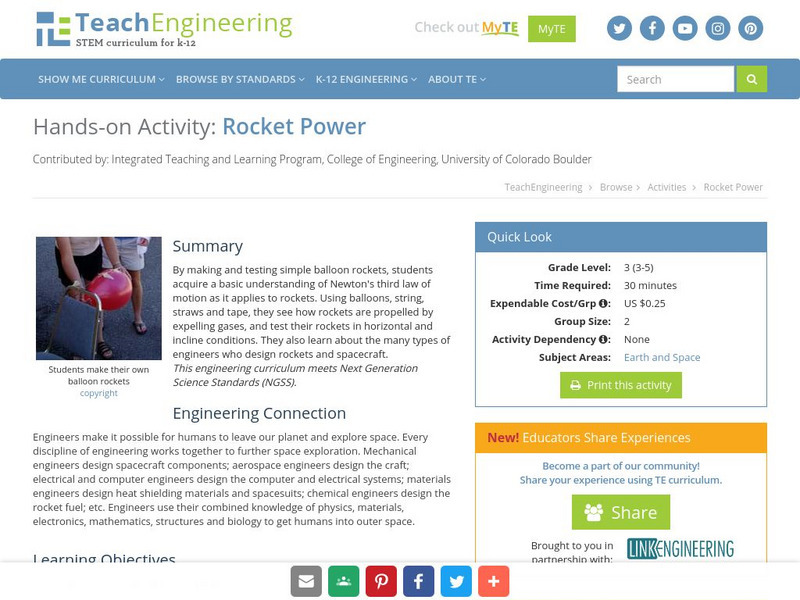
TeachEngineering
Teach Engineering: Rocket Power
By making and testing simple balloon rockets, students acquire a basic understanding of Newton's third law of motion as it applies to rockets. Using balloons, string, straws and tape, they see how rockets are propelled by expelling...
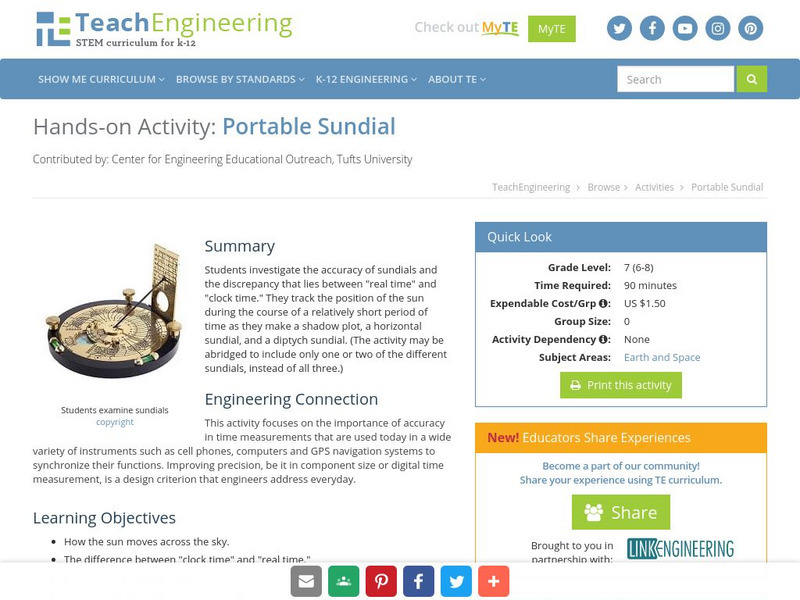
TeachEngineering
Teach Engineering: Portable Sundial
In this activity students will investigate the accuracy of sundials and the discrepancy that lies between "real time" and "clock time". They will track the position of the sun over the course of a relatively short period of time as they...
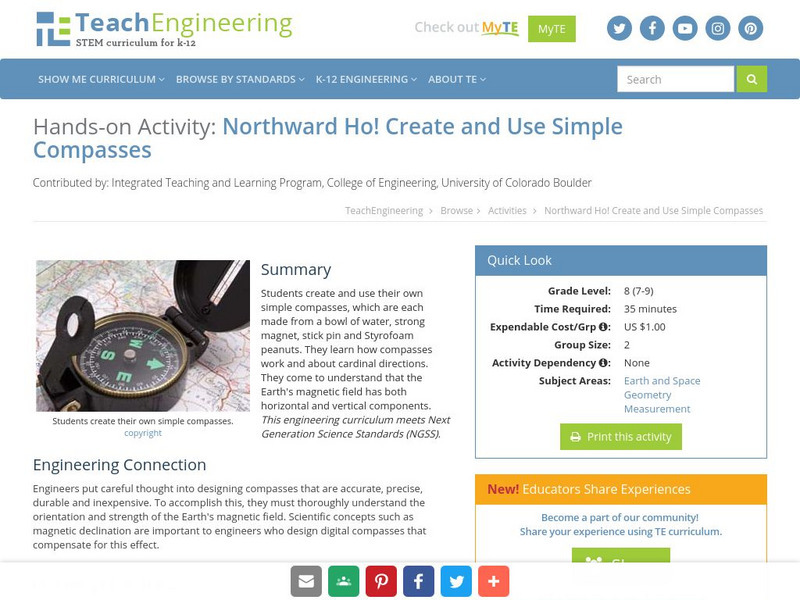
TeachEngineering
Teach Engineering: Northward Ho!
In this activity, students will create their own simple compass, be able to explain how a compass works, understand that the Earth's magnetic field has both horizontal and vertical components, and learn more about cardinal directions.