Hi, what do you want to do?






Cold Spring Harbor Laboratory
3D Brain
Imagine being able to rotate the brain and view interior structures without dissection! This tool allows anatomy masters to do just that. They also learn about the associated functions, disorders, and symptoms of damage to each...

Curated OER
The Human Brain's Capacity for Language
Incorporate this slide show into your lecture about speech, language, psychology, or physiology. Addressing the structure of the brain as well as handedness and aphasia, the presentation could fit the needs of many different lecturers....

University of Minnesota
Dendritic Spines Lab
This is your brain on drugs ... literally! Your neuroscientists-in-training examine the evidence of drug use on the human brain and how neurons change their connectivity when altered by drugs. They then work together to create testing...

University of Minnesota
Mirroring Emotions
Do you ever give your class the "teacher look"? Without saying a word, they become silent and engaged (hopefully). How do they know what you're thinking? Explore the concept of nonverbal communication and how it relates to our...

Curated OER
What Does Your "Homunculus" Look Like?
Students investigate the density of touch receptors in various parts of the body. They discover how the body senses various stimuli, then maps a picture of the "homunculus" of the experimental subject.

Curated OER
The Relationship of the Five Values to the Human Personality
Students are introduced to the five senses and how they are sorted throughout the brain. After reading about each type of mind, they discuss ways in which they can focus on each one on a daily basis. As a class, they discover ways in...

Curated OER
Map Reading in the 21st Century
Students interact with MapPoint tools to view maps of the past and the present in multiple ways. They participate in mini-lessons aimed at locating certain points of interest or famous routes taken in history.

Curated OER
The Human Organism
Students identify their feelings and learn constructive ways of handling conflict. For this feelings and conflict lesson, students read a story about conflict and identify ways to understand emotions and resolve conflict.

Curated OER
U.S. History: Our Constitutional Amendments
Eighth graders conduct Internet research about Constitutional Amendments and present oral reports on their findings. Their reports also include visual representations depicting their chosen amendment's focal point. Students discuss the...

Curated OER
Outdoor Survival
Students are introduced to basic outdoor survival concepts. They identify the seven basic needs for survival. Students describe the symptoms and treatment for frostbite and hypothermia. They compare and contrast the value of different...

Curated OER
Breaking News English: Computers to Match Man by 2009
For this English worksheet, students read "Computers to Match Man by 2009," and then respond to 47 fill in the blank, 7 short answer, 20 matching, and 8 true or false questions about the selection.

Curated OER
Goal Setting and Getting Out of Your Comfort Zone
Goal setting activities can be great for both teachers and students.

Curated OER
Thanksgiving Lesson Plans
Thanksgiving lesson plans can lead to a discussion of nutrition, chemical compositions, and healthy habits.
Science Buddies
Science Buddies: Fast Food: Can Peppermint Improve Reaction Times?
Did you know that some teachers give their students a peppermint candy on state testing days? Is it to give the kids sweet-smelling breath? Or are the teachers hoping for something more on the important testing day? In this human biology...
Science Buddies
Science Buddies: Are You Left or Right Sided?
Our brains are split into two parts, right inside our head. One half is the left brain and the other half is the right brain. Each side of your brain controls different parts of your body and most people are more dominant controlling one...
Smithsonian Institution
National Museum of Natural History: What Does It Mean to Be Human, Human Characteristics
Explore walking upright, tools and food, bodies, brains, social life, language and how humans ultimately changed the world. Excellent charts, pictures and videos accompany easy-to-understand text on the earliest humans.
Science Buddies
Science Buddies: Pinocchio's Arm: A Lie Detector Test
You might be surprised to learn that you have been practicing skills closely tied to lying if you have ever seen someone in pain, or mimicked your favorites sports athlete. In this science fair project, you will discover how your brain...
PBS
Pbs Teachers: Scientific American: Science and the Brain
Describe the "mush-brain" effect, and test blindfolded subjects for their ability to identify items by smell. Explore the effect of biofeedback to help overcome illnesses, and attempt the mind-over-body techniques of visualizing and...
McGraw Hill
Glencoe: Biology: The Nervous System Post Test
A five-question multiple-choice quiz assessing the topic of the central nervous system of the human body.

CK-12 Foundation
Ck 12: Life Science: 11.43 Peripheral Nervous System
Understand the structure and function of the peripheral nervous system in the human body.

Other
Chungara (Arica): Surgical Procedures During Ancient Egyptian Mummification
How did mummification work? Brier and Wade attempt to use primary sources to replicate the mummification process on a human cadaver. Read about how they went about it and whether they were successful.
Exploratorium
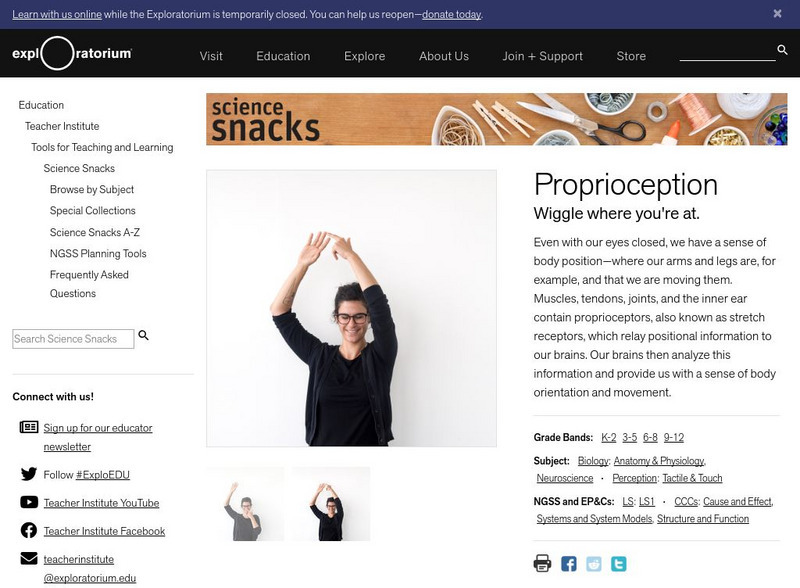
Exploratorium: Science Snacks: Proprioception
The human body has proprioceptors that send signals to the brain so that we are aware of our body's position and movements. Try these simple experiments to learn about proprioception and about other visual and tactile clues that assist...