Hi, what do you want to do?





Scholastic
Scholastic: The Awesomely Evolved Human Brain
This lesson reinforces comprehension of key facts and concepts in the student article "The Awesomely Evolved Human Brain." Students will understand that the brain's reward system has evolved to help ensure the survival of the species....
TeachEngineering
Teach Engineering: Brain Is a Computer
Students learn about the similarities between the human brain and its engineering counterpart, the computer. Since students work with computers routinely, this comparison strengthens their understanding of both how the brain works and...

TED Talks
Ted: Ted Ed: Diagnosing a Zombie: Brain and Behavior
Video explores diagnosing a zombie by relating its symptoms to various human brain and behavior disorders. [3:44] Includes a brief quiz and a list of additional resources to explore.

TED Talks
Ted: Ted Ed: Diagnosing a Zombie: Brain and Body
Video explores diagnosing a zombie by relating its symptoms to various human brain disorders, such as Parkinson's disease. [3:47] Includes a brief quiz and a list of additional resources to explore.

TED Talks
Ted: Ted Ed: What Are Mini Brains?
Shielded by our thick skulls and swaddled in layers of protective tissue, the human brain is extremely difficult to observe in action. Madeline Lancaster shares how to make a brain in a lab.
CK-12 Foundation
Ck 12: Life Science: Organization of the Human Body
[Free Registration/Login may be required to access all resource tools.] Cells, like these nerve cells, do not work in isolation. To send orders from your brain to your legs, for example, signals pass through many nerve cells. These cells...
TeachEngineering
Teach Engineering: Human and Robot Sensors
Students are provided with a rigorous background in human "sensors" (including information on the main five senses, sensor anatomies, and nervous system process) and their engineering equivalents, setting the stage for three associated...
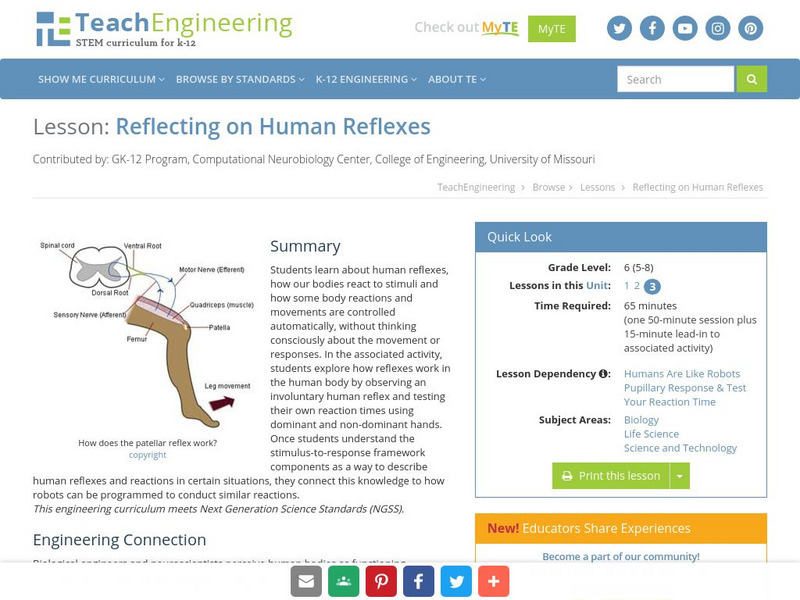
TeachEngineering
Teach Engineering: Reflecting on Human Reflexes
Students learn about human reflexes, how our bodies react to stimuli and how some body reactions and movements are controlled automatically, without thinking consciously about the movement or responses. In the associated activity,...
CK-12 Foundation
Ck 12: Life Science: Human Vision
[Free Registration/Login may be required to access all resource tools.] Sight, or vision, is the ability to see light. It depends on the eyes detecting light and forming images. It also depends on the brain making sense of the images, so...

TED Talks
Ted: Ted Ed: What Is Dyslexia?
Kelli Sandman-Hurley urges us to think again about dyslexic brain function and to celebrate the neurodiversity of the human brain. [4:35]
CK-12 Foundation
Ck 12: Life Science: Central Nervous System
[Free Registration/Login may be required to access all resource tools.] The central nervous system (CNS) is the largest part of the nervous system. It includes the brain and the spinal cord. The bony skull protects the brain. The spinal...
TeachEngineering
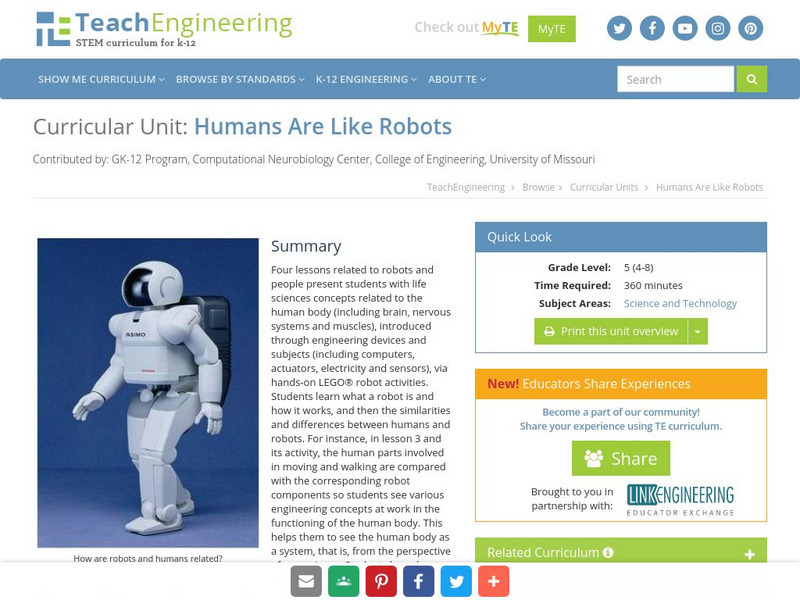
Teach Engineering: Humans Are Like Robots
Four lessons related to robots and people present students with life sciences concepts related to the human body (including brain, nervous systems and muscles), introduced through engineering devices and subjects (including computers,...
National Endowment for the Humanities
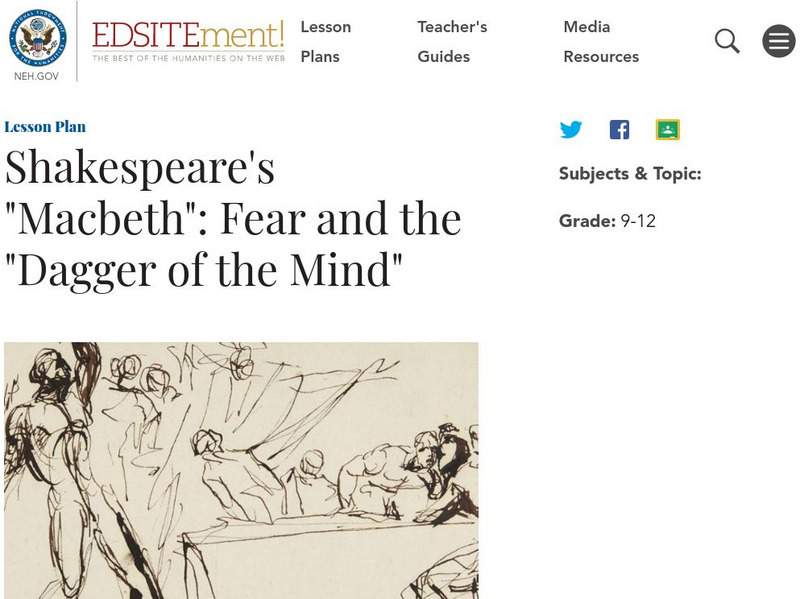
Neh: Edsit Ement: Fear and the "Dagger of the Mind"
This lesson plan accompanies a reading of Shakespeare's Macbeth and lets students explore Macbeth's "response to fear" through studying metaphor, imagery, and dramatic cues and by performing a scene.
TeachEngineering
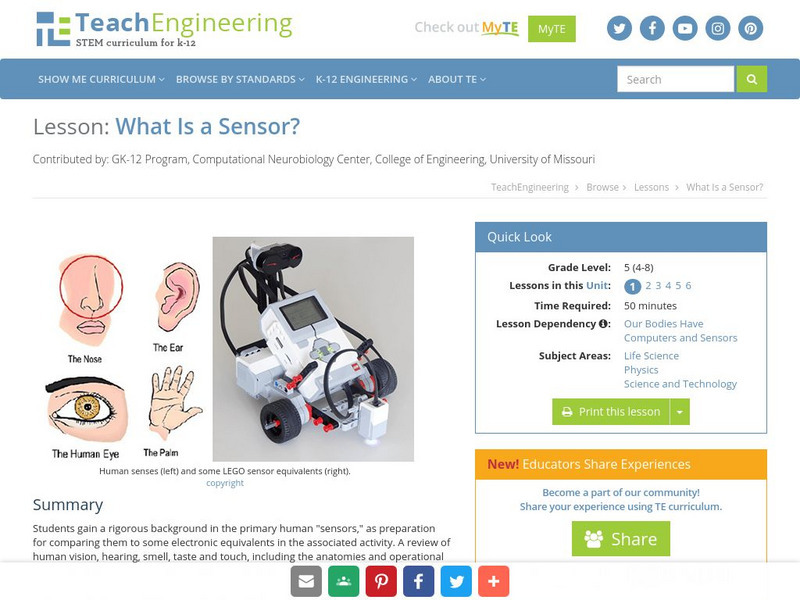
Teach Engineering: What Is a Sensor?
Students gain a rigorous background in the primary human sensors, as preparation for comparing them to some electronic equivalents in the associated activity.
University of Washington
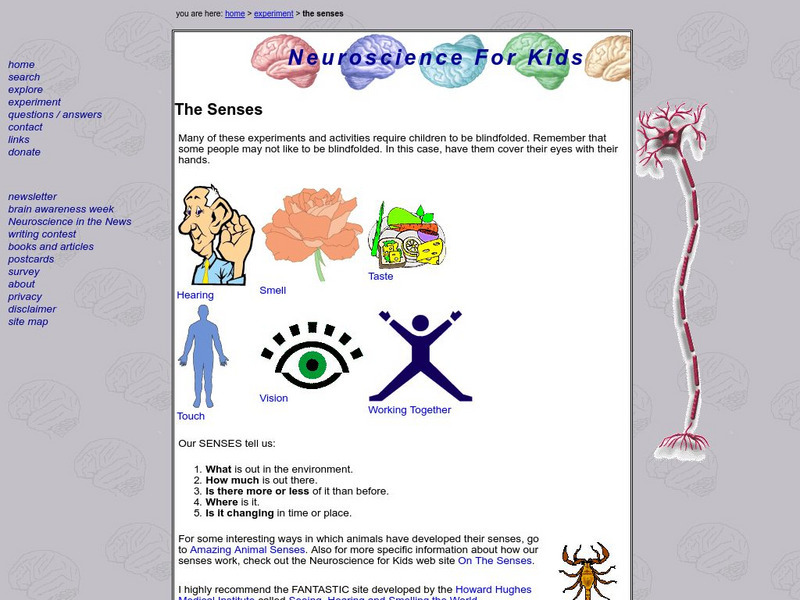
The Senses
This site has a collection of learning activities, games, experiments, and lesson plans on the five senses. Organized by grade level and topic, this site is packed with an assortment of interactive and engaging activities, that would...
Cynthia J. O'Hora
Mrs. O's House: Concussion and Head Injury Action Plan
Concussions and head injuries are the buzz in sports today. Address concussion and head injuries in the classroom and provide students resources to research and report on findings.
TeachEngineering
Teach Engineering: Our Bodies Have Computers and Sensors
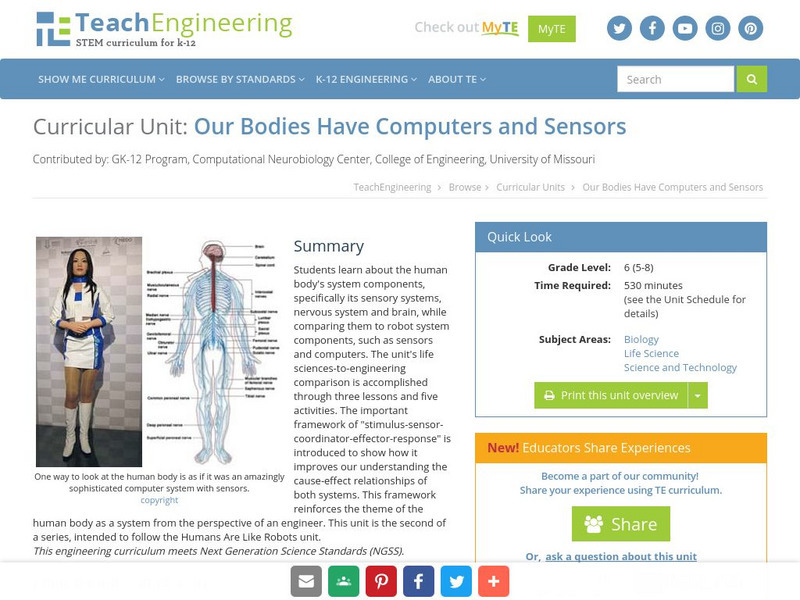
Students learn about the human body's system components, specifically its sensory systems, nervous system and brain, while comparing them to robot system components, such as sensors and computers. The unit's life sciences-to-engineering...