Hi, what do you want to do?






Tumble Science Podcast for Kids
Decoding Dog DNA
Which animal holds the title of “man’s best friend”? Of course, the answer is the dog. Dogs have lived with humans for thousands of years. Scientists’ understanding of how this came to be has changed in recent years. Additionally,...
Wonderscape
From Wild Wolves to Loyal Companions: The Journey of Dog Domestication
Discover the fascinating journey of dog domestication, from ancient wolves to today's beloved pets. This video delves into the genetic twists and self-domestication theory that transformed wolves into dogs, exploring how natural...
TED-Ed
TED-Ed: David Ian Howe: A brief history of dogs
Since their emergence over 200,000 years ago, modern humans have established communities all over the planet. But they didn't do it alone. Whatever corner of the globe you find humans in today, you're likely to find another species as...
Be Smart
Dogs and Humans: A 30,000-Year Friendship (ft. MinuteEarth)
Of all the species that humans have domesticated, dogs are our oldest animal friends. But how did a group of wolves become the furry pup at the end of the bed? New research is finally unlocking the paw-in-hand evolution of dogs and...
PBS
How Dogs (Eventually) Became Our Best Friends
We’re still figuring out the details, but most scientists agree that it took thousands of years of interactions to develop our deep bond with dogs. When did they first become domesticated? Where did this happen? And what did the process...
Wonderscape
First Friends: How Dogs Paved the Path for Domestication
Explore the pivotal role of dogs as the first domesticated animals and their impact on the evolution of human society. This video highlights how the early domestication of dogs enabled humans to transition from nomadic lifestyles to...
Curated Video
Discovering Europe's Earliest Domesticated Dog
The remains of what is considered Europe's earliest pet dog, dating back to between 14,000 and 20,000 years ago, have been discovered in an Italian cave, shedding new light on the domestication process from wolves to dogs. This finding...
Wonderscape
Paws and People: The Multifaceted Roles of Dogs in Human Society
Dive into the diverse roles of dogs throughout human history, from ancient guardians and hunters to modern service animals and social media stars. This video explores how dogs have transitioned from work partners in hunting and herding...
Wonderscape
From Wolves to Wagging Tails: The Domestication of Dogs
Dive into the fascinating journey of how dogs evolved from wild wolves to become cherished members of human families. This video explores the theories of dog domestication, their transformation across cultures, and their significant...
Curated Video
Evidence of Evolution
A video explaining how embryology, anatomy, and genetics can be used as evidence for evolution.
SciShow
Hormones and Puppy Love
This week, science explains the chemical love-connection we share with our dogs, and how some of the most isolated populations of people in the world are different on the inside.
SciShow
Why Do We Have Such Crooked Teeth?
A lot of humans need or want braces to fix their crooked teeth, but why do you never see a dog walking down the street with headgear? Our ancient ancestors and mac and cheese may be to blame!
TED Talks
TED: We can reprogram life. How to do it wisely | Juan enriquez
For four billion years, what lived and died on earth depended on two principles: natural selection and random mutation. Then humans came along and changed everything - hybridizing plants, breeding animals, altering the environment and...
Crash Course
Old & Odd: Archaea, Bacteria & Protists - CrashCourse Biology
Hank veers away from human anatomy to teach us about the (mostly) single-celled organisms that make up two of the three taxonomic domains of life, and one of the four kingdoms: Archaea, Bacteria, and Protists. They are by far the most...
Science ABC
Why Don't We Have Pet Foxes?
Both foxes and dogs belong to the same family Canidae. Then why haven’t foxes become our companions too? To answer this, in 1950, a group of Russian scientists began an experiment to try and create the first ever pet fox species. The...
TED-Ed
TED-Ed: The history of the world according to cats - Eva-Maria Geigl
In ancient times, wildcats were fierce carnivorous hunters. And unlike dogs, who have undergone centuries of selective breeding, modern cats are genetically very similar to ancient cats. How did these solitary, fierce predators become...
Mr. Beat
Scopes Monkey Trial (Story Time with Mr. Beat)
Once upon a time an English naturalist and geologist named Charles Darwin came up with the theory of evolution. Evolution, now widely accepted as a theory, used to be very controversial. It rocked the entire world, as matter of fact. It...
Nature League
Exploring Adaptations | Compilation
Brit looks back on our fifth month on Nature League, when we explored the theme of adaptations.
FuseSchool
How Are Organisms Classified?
In terms of biological classification, organisms are classified, or grouped, with other organisms that they are most closely related to. These small groups are then classified together into larger groups and so on, until we reach the top...
Nature League
Why Are Animals Getting Smaller? - From A to B
In this episode of "From A to B", Adrian asks Brit why animals are basically getting smaller over time.
Nature League
Can We Domesticate Opossums?
This week on Nature League, Brit explores the incredible process of domestication and answers Adrian's question about keeping a house opossum.

MinuteEarth
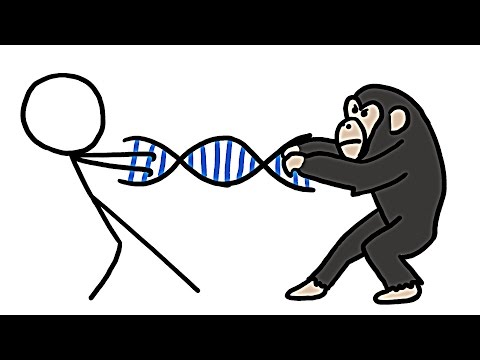
Are We Really 99% Chimp?
Get 10% off of your first order with Squarespace -://squarespace.com/minPatreonh' target='_blank' rel='nofollow'>Squarespace - Please support us on

Big Think
The History of Life on Earth in Three Minutes
Happy New Year, planet Earth! According to the Anno Domini designation, the year is now 2014. But the Earth has been around a lot longer than that - about 4.567 billion years. The first evidence of life dates back to around 3.8 billion...