Hi, what do you want to do?






TED Talks
Ted: Ted Ed: The Pattern Behind Self Deception
Michael Shermer says the human tendency to believe strange things- from alien abductions to dowsing rods- boils down to two of the brain's most basic, hard-wired survival skills. He explains what they are and how they get us into...
![Hofstra Univ: Why Was Bubonic Plague So Devastating to European Society? [Pdf] Unknown Type](https://static.lp.lexp.cloud/images/attachment_defaults/resource/large/FPO-knovation.png "Hofstra Univ: Why Was Bubonic Plague So Devastating to European Society? [Pdf] Unknown Type")
Hofstra University
Hofstra Univ: Why Was Bubonic Plague So Devastating to European Society? [Pdf]
The Bubonic Plague or "Black Death" came out of the eastern Mediterranean along shipping routes, reaching Italy in the spring of 1348. By the time the epidemic was abating in 1351, between 25% and 50% of Europe's population had died. The...
Nature Canada
Nature Canada: Species Spotlight: Whooping Cranes
Although the whooping crane has survived for 3.5 million years, it has become endangered in the last few hundred due to human activities. At its lowest, there were only 15 on the whole planet. The number now stands at several hundred in...
Other
Biology Discussion: Natural Resources: Depletion Reasons, Types and Conservation
Discusses how the the natural resources of the world are being depleted at an alarming rate, and that humans depend on them for their survival. Elaborates on four main causes of resource depletion, and initiatives that could help to...
Society for Science and the Public
Science News for Students: Sea Changes
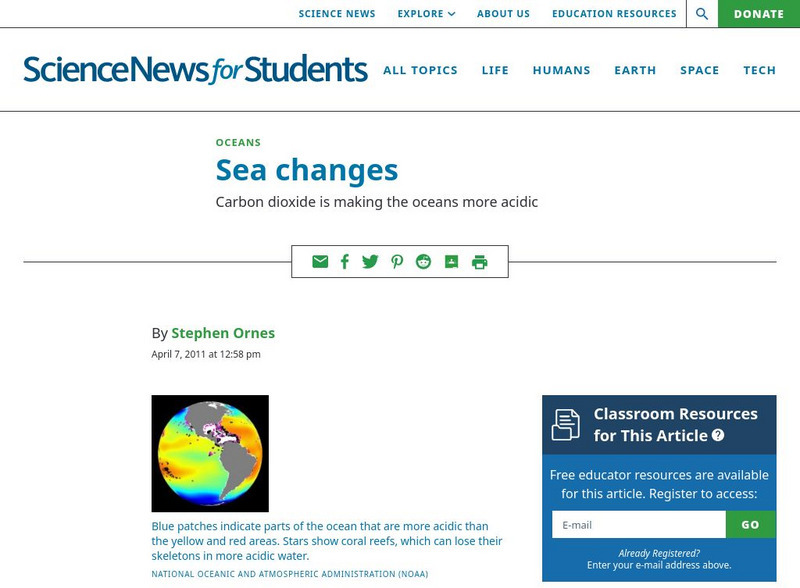
Discusses the serious impact greenhouse gases are having on the pH balance of the oceans. It looks at the sea butterfly, which has more difficulty forming a shell as ocean acidification increases, as well as the damage acidification does...
BBC
Bbc: Resource Depletion: Opportunity or Looming Catastrophe?
The depletion of the world's natural resources threatens the very survival of humans. This article discusses the causes and consequences of our overuse of natural resources, projections for our future, and what types of solutions are...
TeachEngineering
Teach Engineering: Water, Water Everywhere
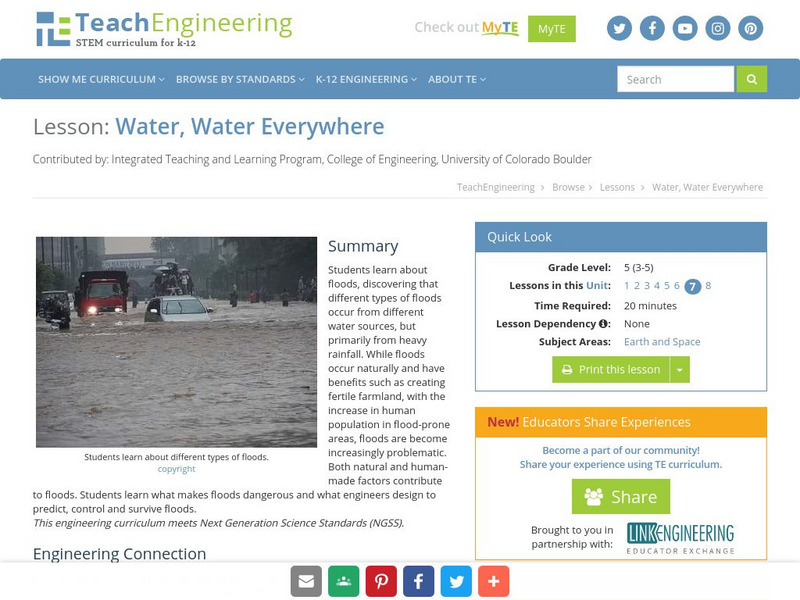
Learners learn about floods, discovering that different types of floods occur from different water sources, but primarily from heavy rainfall. While floods occur naturally and have benefits such as creating fertile farmland, students...
PBS
Nh Pbs: Wildlife Journal Jr: White Tails in Winter
Take a look at how the white-tail survives in winter and how feeding deer in winter can cause serious damage. Learn white-tail deer characteristics and discuss steps scientists are taking to determine human feeding effects.

Khan Academy
Khan Academy: Timekeeping
Why do we need calendars and clocks? To survive in this complex society, you need to track what others are doing and when they're doing it. You also need to know what's happening in the natural world. This article discusses how/why...

Khan Academy
Khan Academy: A Bottle and a Toy: Objects From Daily Life
The wall paintings from Nebamun's tomb-chapel show an idealized vision of daily ancient Egyptian life. Much less is known about the lives of the majority of society. The study of human remains in poor cemeteries is often the only way of...

University of Florida
Florida Museum of Natural History: How to Avoid Shark Attacks
All you ever want to know to avoid being attacked by a shark. Full of lots of good safety tips and information.
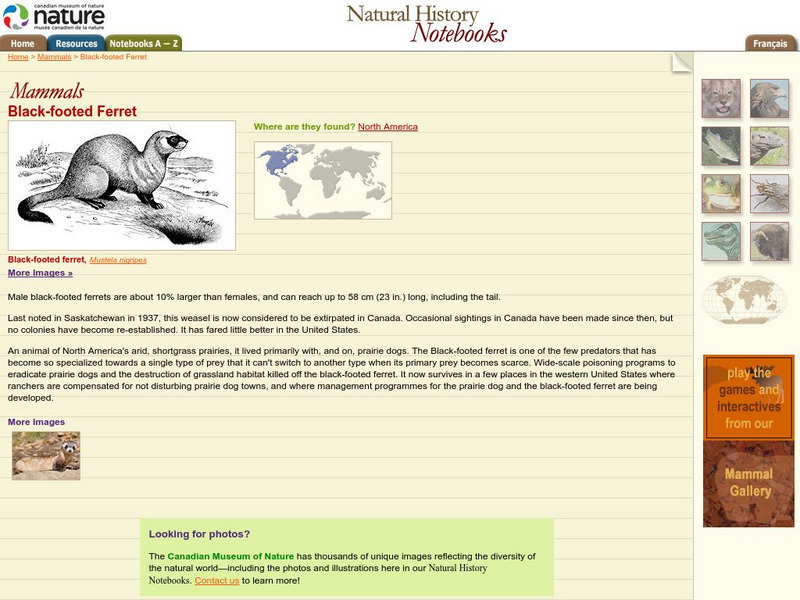
Canadian Museum of Nature
Canadian Museum of Nature: Black Footed Ferret
Most of the black-footed ferret population in North America has been eradicated due to human activities and campaigns to remove prairie dogs from agricultural areas. A few protected colonies have survived in the United States. Some facts...
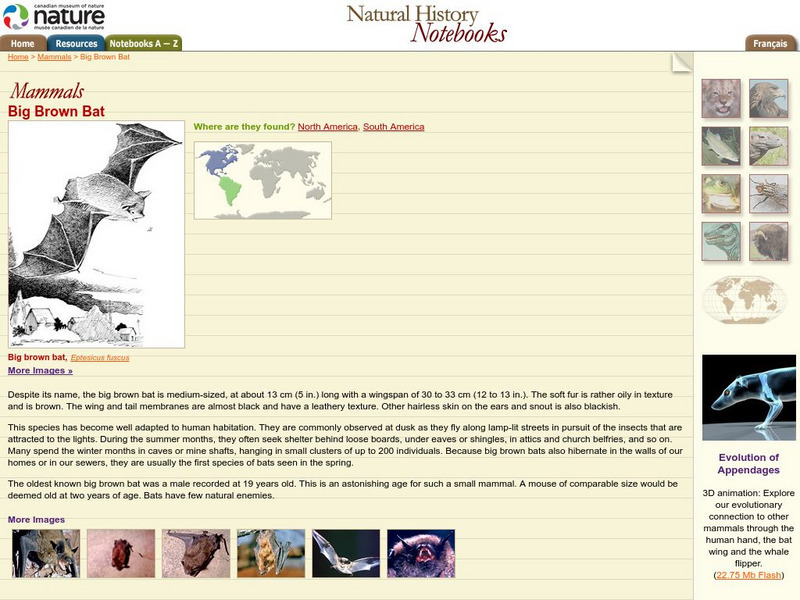
Canadian Museum of Nature
Canadian Museum of Nature: Big Brown Bat
The big brown bat, which is not all that big, has survived well alongside humans. Facts and pictures about these hardy creatures can be found here.
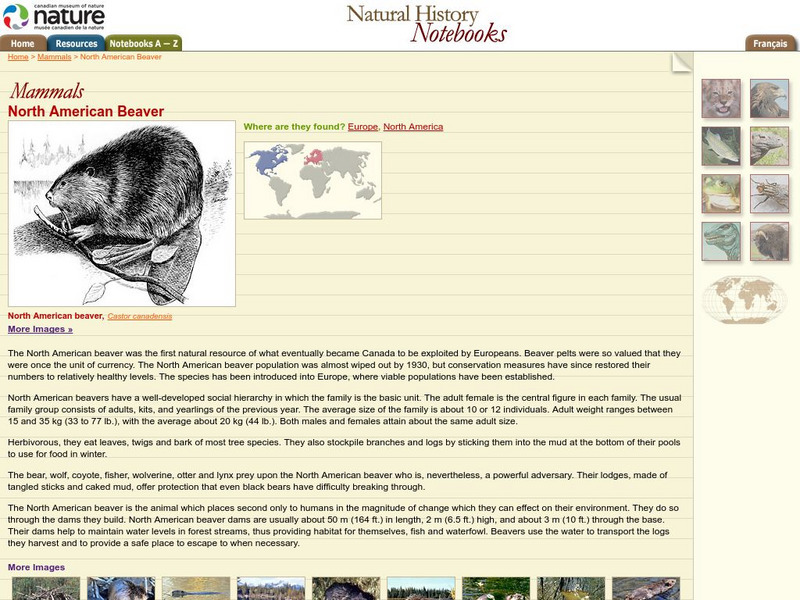
Canadian Museum of Nature
Canadian Museum of Nature: North American Beaver
The North American beaver has survived despite centuries of trapping for their valued pelts. Beavers are marvelous engineers who, the author says, are 'second only to humans in the magnitude of change which they can effect on their...
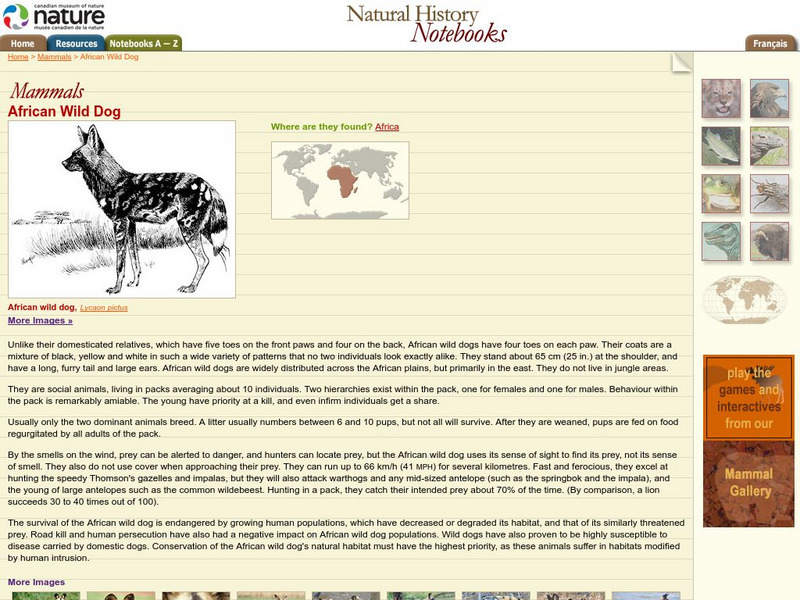
Canadian Museum of Nature
Canadian Museum of Nature: African Wild Dog
The survival of the African wild dog is fragile as it is easily affected by human intrusion on its habitat. Facts and pictures are found on this animal facts page.

EL Education
El Education: Blanca Rosenberg
This memoir-style book was created by a 5th/6th grade student in Shutesbury, Massachusetts, and tells the life story of a Holocaust survivor. Blanca Rosenberg is the biography of Blanca written in first person narrative, as told to the...
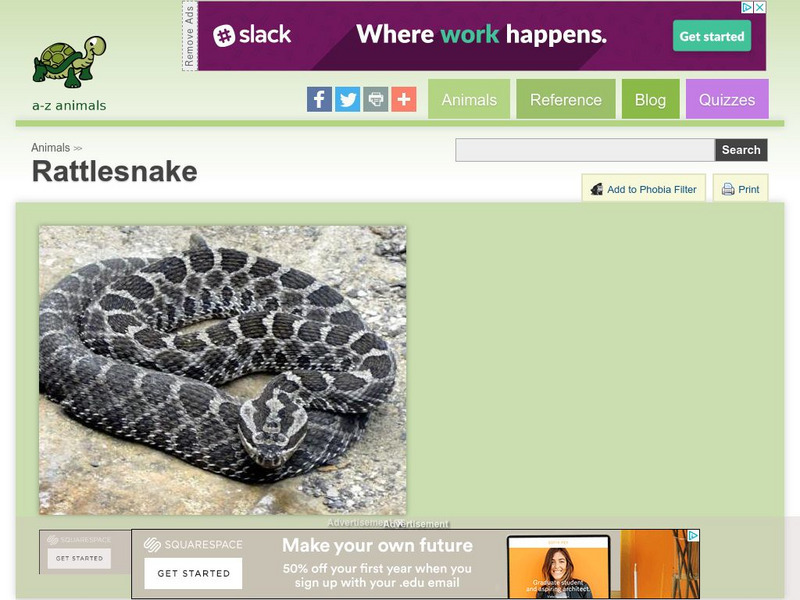
A-Z Animals
A Z Animals: Animal Facts: Rattlesnake
Provides a photograph and a fact card about rattlesnakes. Describes why they are considered poisonous and dangerous, their physical appearance and characteristics, dietary habits, predators, and how humans can survive a bite from one.

Khan Academy
Khan Academy: Hammurabi: The King Who Made the Four Qtrs of the Earth Obedient
Hammurabi's famous legal code survives in partial copies on a stele in the Louvre and on clay tablets. Read a short description of Hammurabi's Code in this article.
Curated OER
Unesco: Lithuania: Curonian Spit
Human habitation of this elongated sand dune peninsula, 98 km long and 0.4-4 km wide, dates back to prehistoric times. Throughout this period it has been threatened by the natural forces of wind and waves. Its survival to the present day...
Other popular searches
- Human Survival Needs
- Human Survival Inquiry
- Human Survival Food
- Human Survival Inqiry
- Human Survival in Wilderness
- Rules of Human Survival