Hi, what do you want to do?





Georgia State University
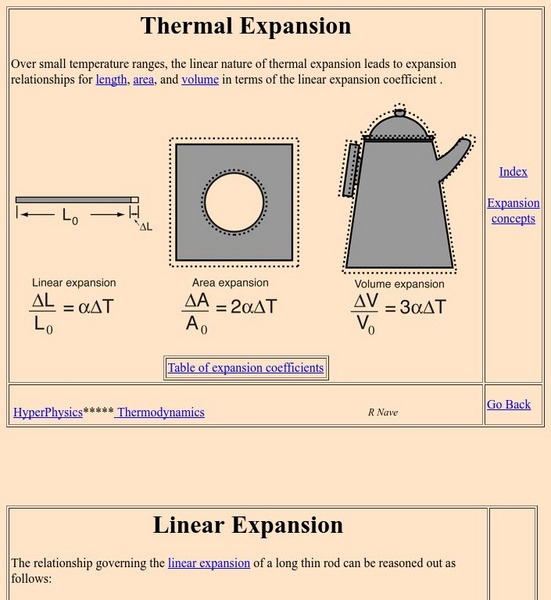
Georgia State University: Hyper Physics: Expansion Concepts
An indexing page from Georgia State University Physics Department which includes links to various other pages with information pertaining to thermal expansion. From expansion coefficients to equations to calculation and practice pages,...
Georgia State University
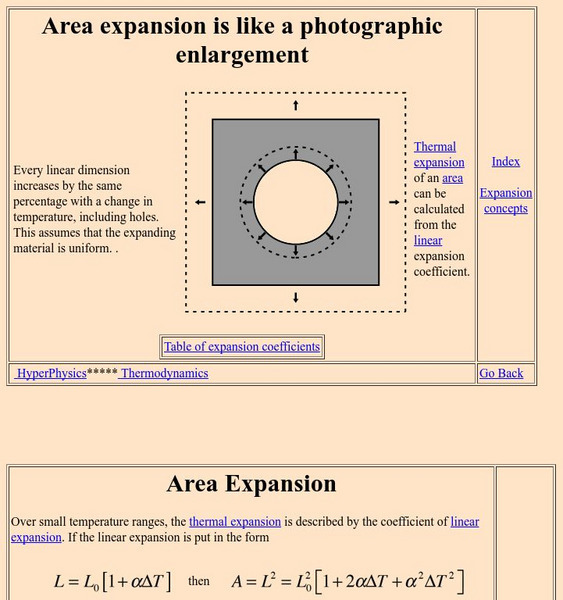
Georgia State University: Hyper Physics: Area Expansion
The concept of area expansion is presented and explained. An equation for calculating the amount of area expansion is provided.

Georgia State University
Georgia State University: Hyper Physics: Bimetallic Strips
The operation of bimetallic strips is explained and illustrated. The principle of thermal expansion is related to their operation. A link to applications of bimetallic strips is provided.
Georgia State University
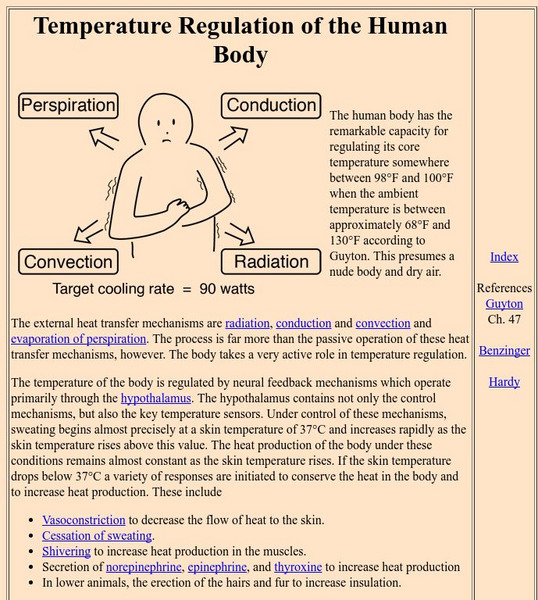
Georgia State University: Hyper Physics: Temperature Regulation of the Human Body
Discusses the methods the human body uses to regulate body temperature. Includes links to the four external heat transfer mechanisms (radiation, conduction, convection, and evaporation of perspiration).
Georgia State University
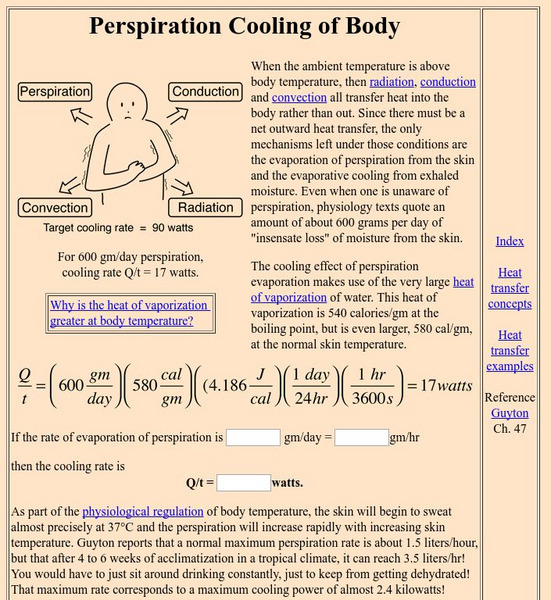
Georgia State University: Hyper Physics: Perspiration Cooling of Body
Discusses perspiration in the context of physics.
Georgia State University
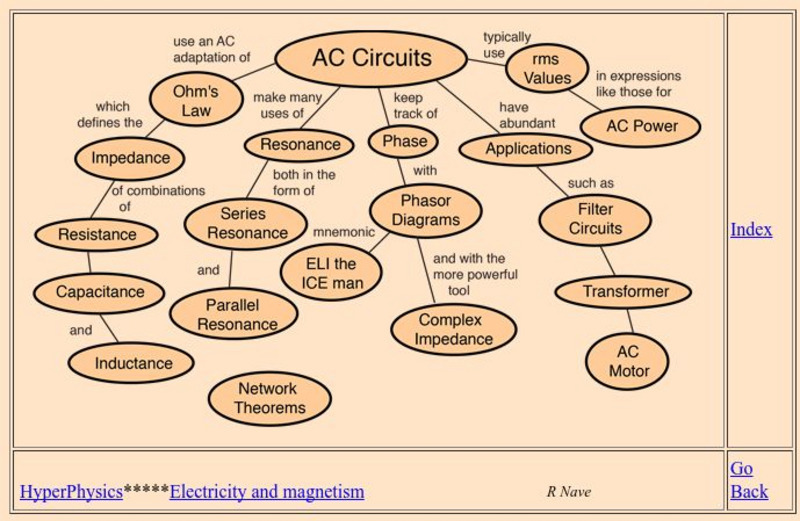
Georgia State University: Hyper Physics: Ac Circuits
A very comprehensive site organized well with many topics dealing with AC circuits.
Georgia State University
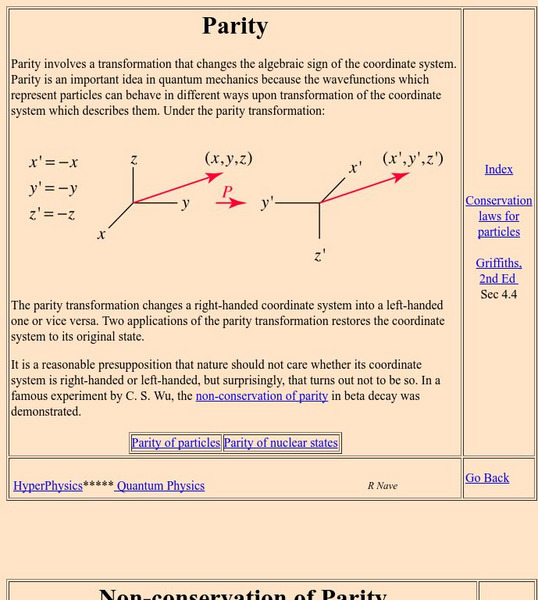
Georgia State University: Hyper Physics: Parity & Nonconservation
A really nice (and short) dual article, on Parity and on Nonconservation of Parity. With diagrams and equations, but does not overwhelm.
Georgia State University
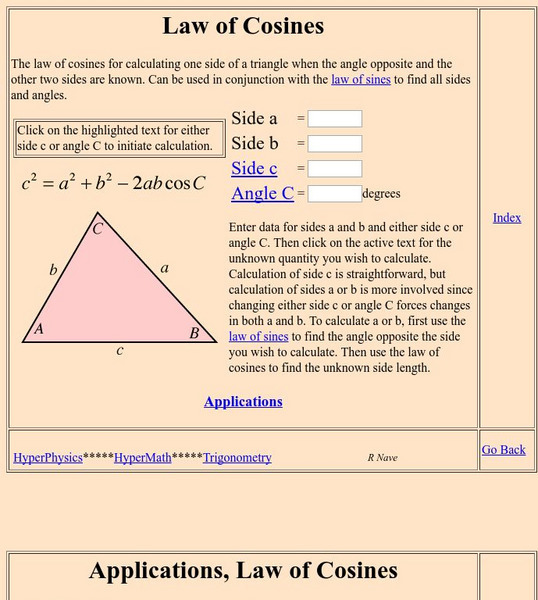
Georgia State University: Hyper Physics: Laws of Sines and Cosines
At the bottom of this page from the Georgia State University, you will two real-world applications of the Laws of Sines and Cosines (in the context of velocity vectors.)

Georgia State University
Georgia State University: Hyper Physics: Hydrogen Energies and Spectrum
This site from Georgia State University gives information on the transitions of electrons between energy levels. The energy levels for electrons in the hydrogen atom are discussed. The Rydberg equation is stated and electron transitions...
Georgia State University
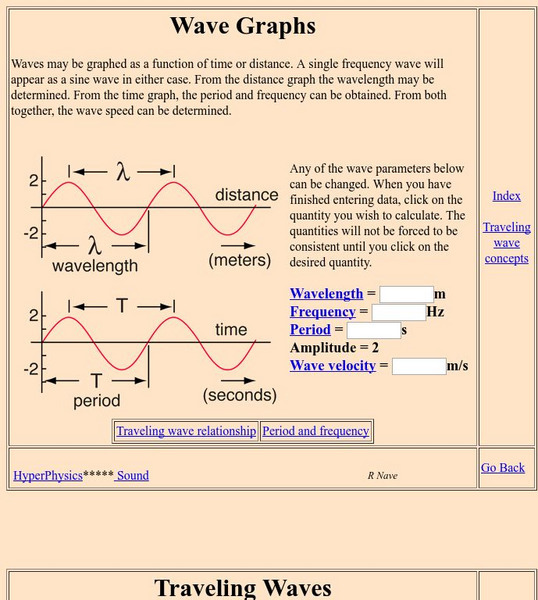
Georgia State University: Hyper Physics: Wave Motion
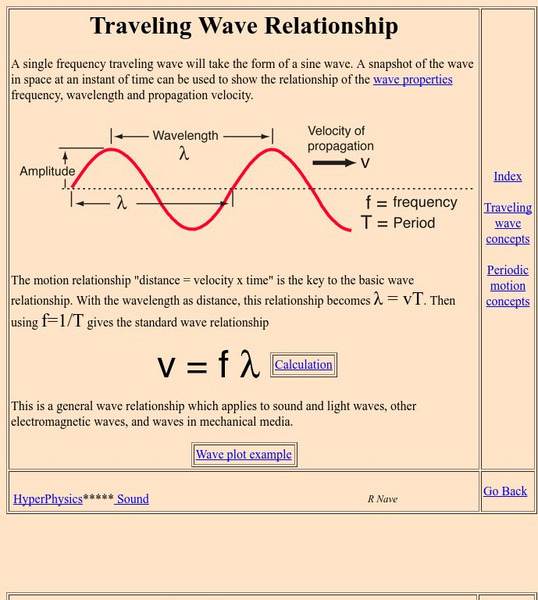
Two wave graphs depicting a sine wave and relating the various characteristics (wavelength, amplitude, frequency, and period) of a wave to each other. The site includes an interactive JavaScript form in which the visitor enters one...
Georgia State University
Georgia State University: Hyper Physics: Traveling Wave Relationship
Online physics text that illustrates and explains the various characteristics of waves such as amplitude, period, frequency, wavelength, and speed. Includes interactive exercises.
Georgia State University
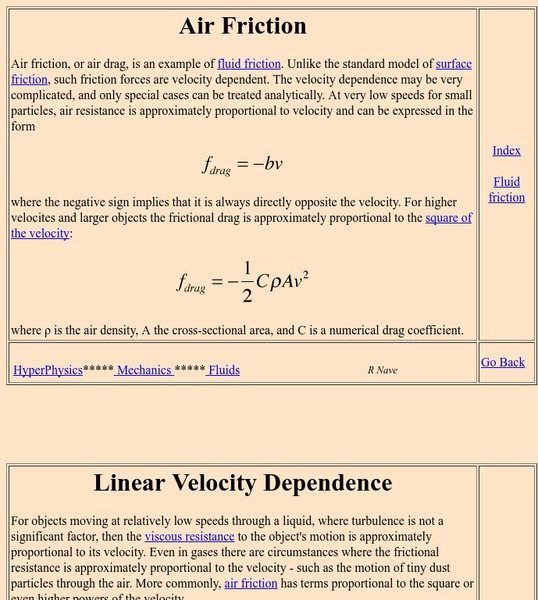
Georgia State University: Hyper Physics: Air Friction
Physics lab definition of air fiction. Part of a hypertext physics course on sound.
Georgia State University
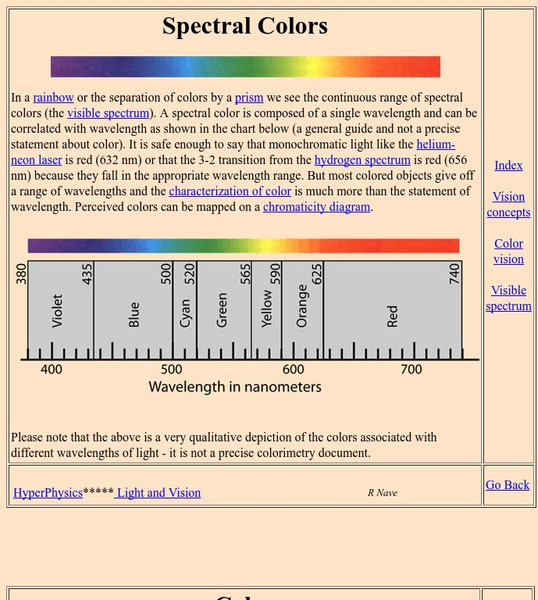
Georgia State University: Hyper Physics: Color
This site from Georgia State University discusses the location of visible light on the electromagnetic spectrum. Includes the wavelength values for various colors of light within the visible light spectrum.
Georgia State University
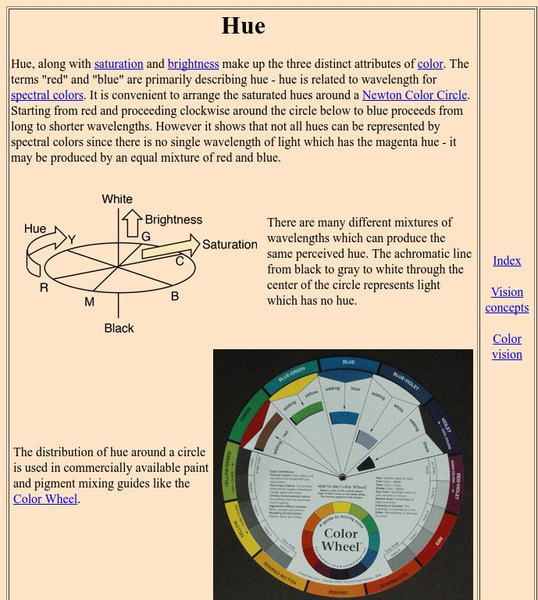
Georgia State University: Hyper Physics: Characterizing Color
This site from Georgia State University discusses the meaning of the terms hue, saturation and brightness. Thorough, meaningful explanations and outstanding graphics.
Georgia State University
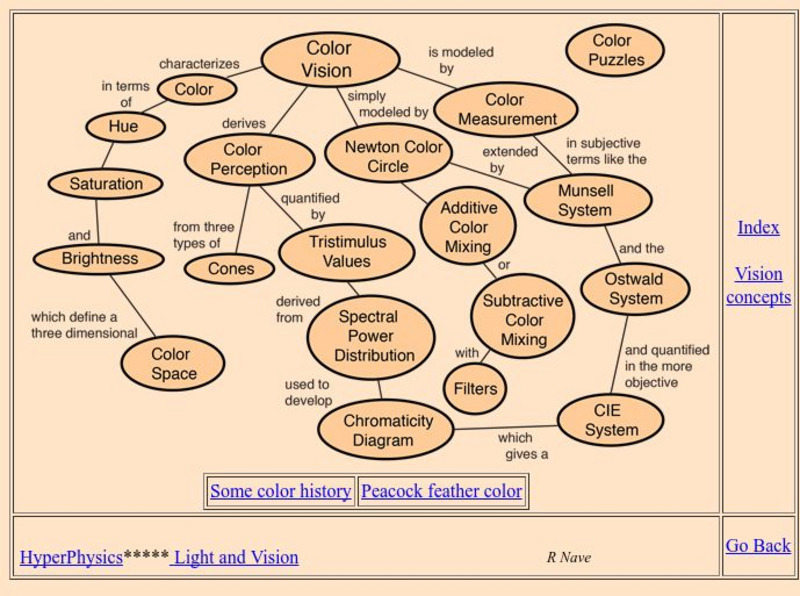
Georgia State University: Hyper Physics: Color Vision Concepts
An indexing page from Georgia State University for a variety of other pages associated with color vision. Pages are filled with meaningful graphics and thorough explanations.
Georgia State University
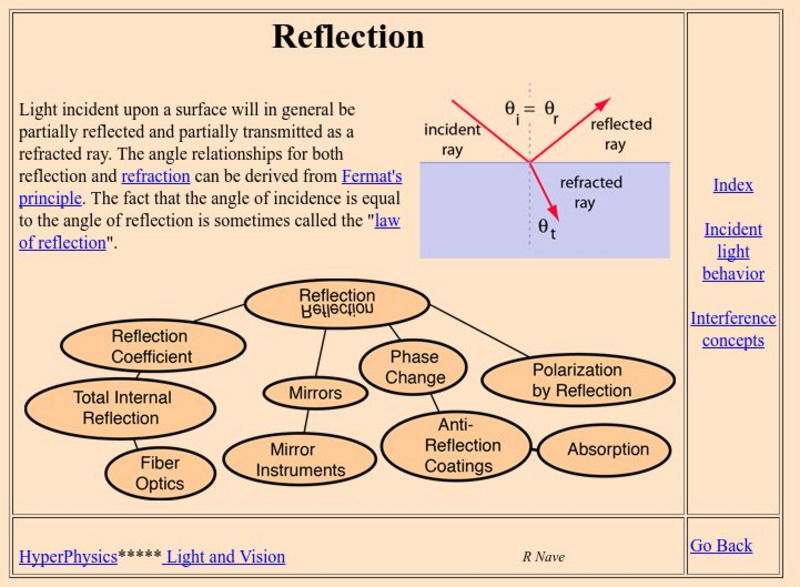
Georgia State University: Hyper Physics: Behavior of Incident Light
This site from Georgia State University is an indexing page for several other pages on the topic of reflection. Topics are treated in an understandable manner and utilize meaningful graphics.

Georgia State University
Georgia State University: Hyper Physics: Mirrors in Imaging
A discussion from Georgia State University of different types of mirrors and the images which they create. Discusses different instruments which use mirrors to produce images.

Georgia State University
Georgia State University: Hyper Physics: Mirror Instruments
This site from Georgia State University discusses the means by which mirrors and lenses are combined to produce an optical instrument which accomplishes a specific purpose. Good illustrations.
Georgia State University
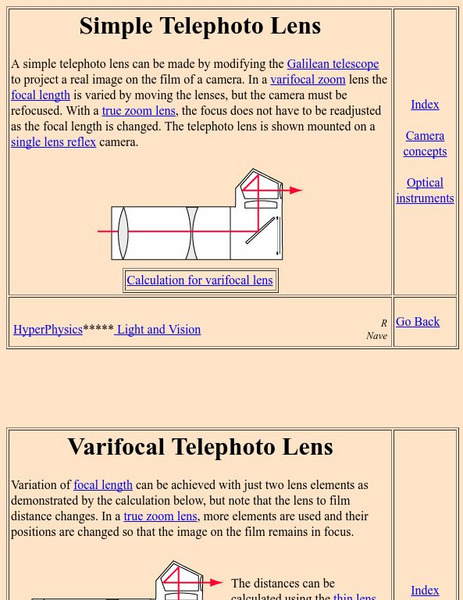
Georgia State University: Hyper Physics: Telephoto Lens
At this site from Georgia State University Physics Department the operation of a telephoto lens is discussed. The refraction of light through the lens is shown and a link to a calculation page is provided.
Georgia State University
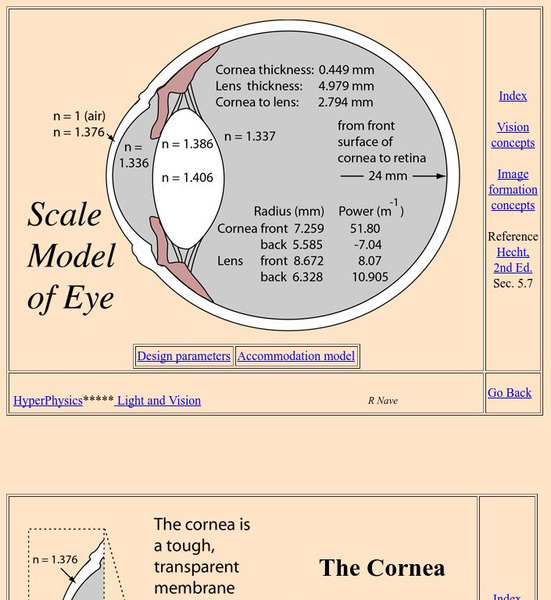
Georgia State University: Hyper Physics: Scale Model of Human Eye
A scale model of the human eye is shown. Information about the parts of the eye and the common defects that result from its malfunctioning.

Georgia State University
Georgia State University: Hyper Physics: Total Internal Reflection
This physics department site provides a definition and explanation of the phenomenon of total internal reflection. Includes a diagram and an equation for calculating the critical angle for light approaching a surface.
Georgia State University
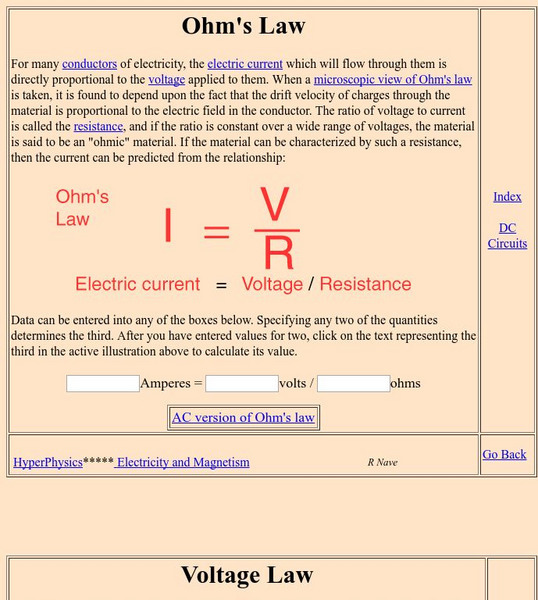
Georgia State University: Hyper Physics: Ohm's Law and Current Law
At this site from Georgia State University Ohm's law is stated in words and using equations. A JavaScript form allows for multiple practice problems with instant feedback and reinforcement. Kirchoff's current law is stated and...
Georgia State University
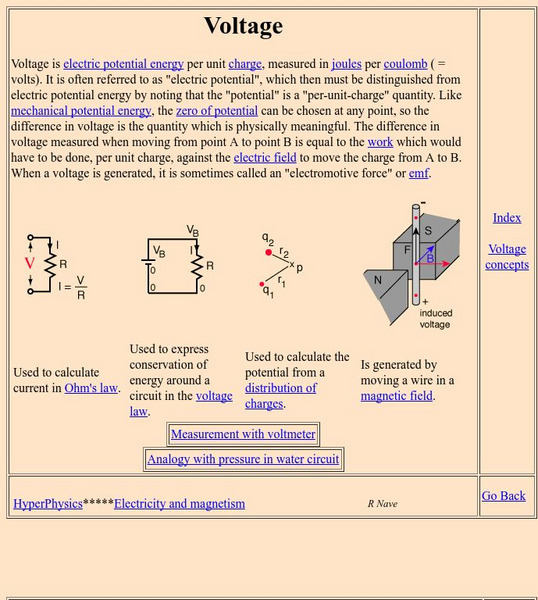
Georgia State University: Hyper Physics: Voltage
Electrical currents and voltage are defined and illustrated.

Georgia State University
Georgia State University: Hyper Physics: Ideal Gas Law With Constraints
Charles' law is derived from the ideal gas law. An equation of the ideal gas law under pressure constraints is given and the derivation is explained.