Hi, what do you want to do?






Curated OER
Science Kids: Science Images: Ice Cubes
This photo shows a glass containing three ice cubes. There is also another ice cube sitting on the bench right next to the glass.
Other
Science House: Ice Cream
Experiment shows students how to use the lowered freezing point of water to chill another mixture (ice cream) to the solid state. Teacher's notes provide background information.
SRI International
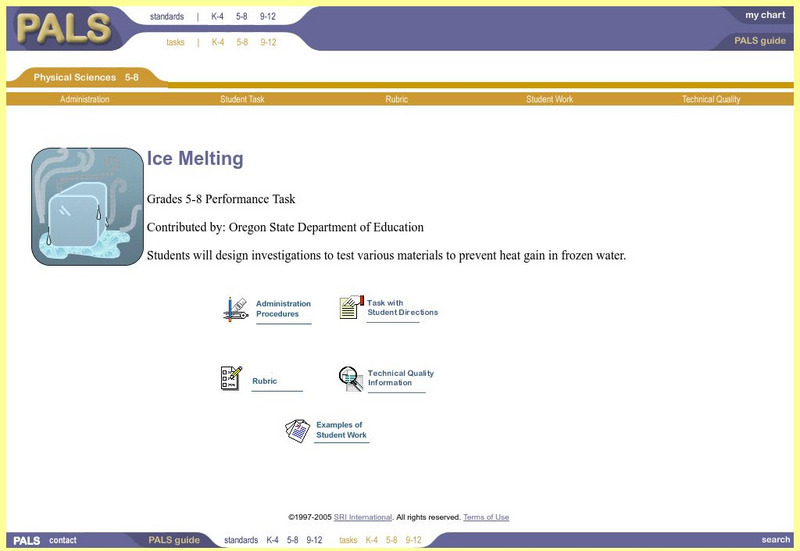
Performance Assessment Links in Science: Ice Melting
A lesson plan for guiding students through a simple research experiment focused on transfer of energy is described for teacher administration and student explanation. Also includes a detailed rubric for evaluating student work.
American Chemical Society
American Chemical Society: Explore Chemistry: Water and Chemistry
Explore water's unique properties in the activities here. Includes ideas for starting a chemistry club, ideas for Earth Day, articles, and videos.
University Corporation for Atmospheric Research
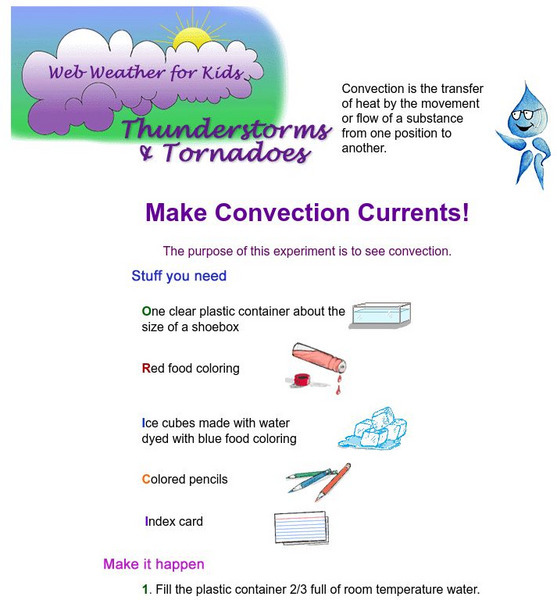
Ucar: Web Weather for Kids: Thunderstorms & Tornadoes Make Convection Currents
Demonstrate convection currents using a clear box, red food coloring, ice cubes, colored pencils and index cards. Get all the directions you need for this simple lab.
Exploratorium
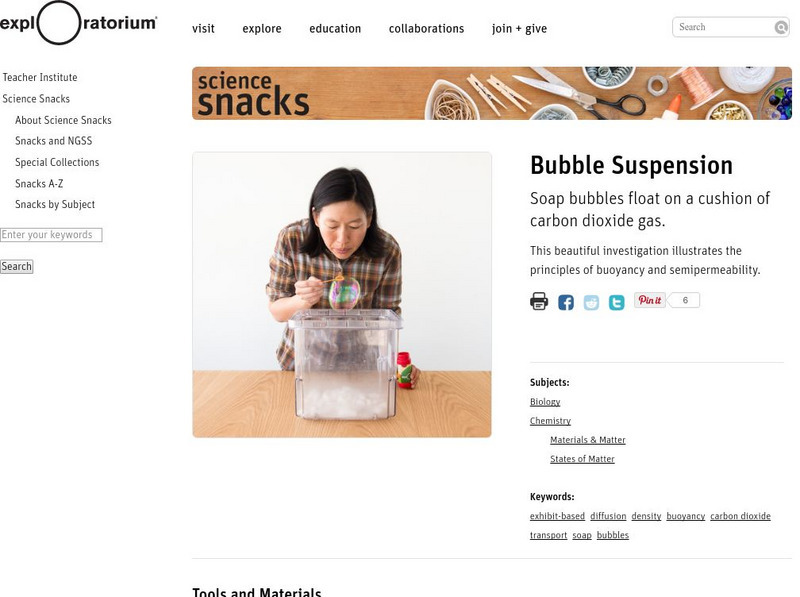
Exploratorium: Science Snacks: Bubble Suspension
Explore the principles of buoyancy and semipermeability in this activity by using bubbles and dry ice.
University of Maryland
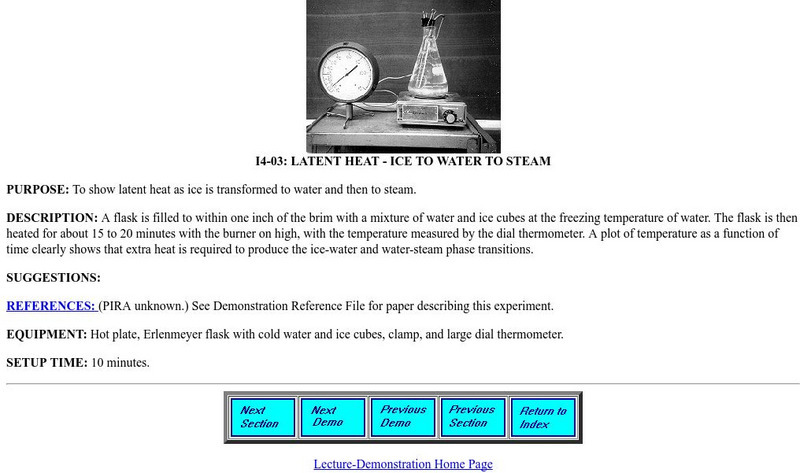
U. Of Maryland: Latent Heat: Ice to Water to Steam
A page from the University of Maryland Physics Lecture Demonstration Facility. Provides directions for a teacher demonstration of latent heat in the melting and vaporization process. Shows apparatus and set-up; provides suggestions....
Other
Njawwa: Kids' Water Zone
Students can learn fun facts about water, perform experiments with it, and play games about it. Includes links and a suggested reading list.
California Institute of Technology
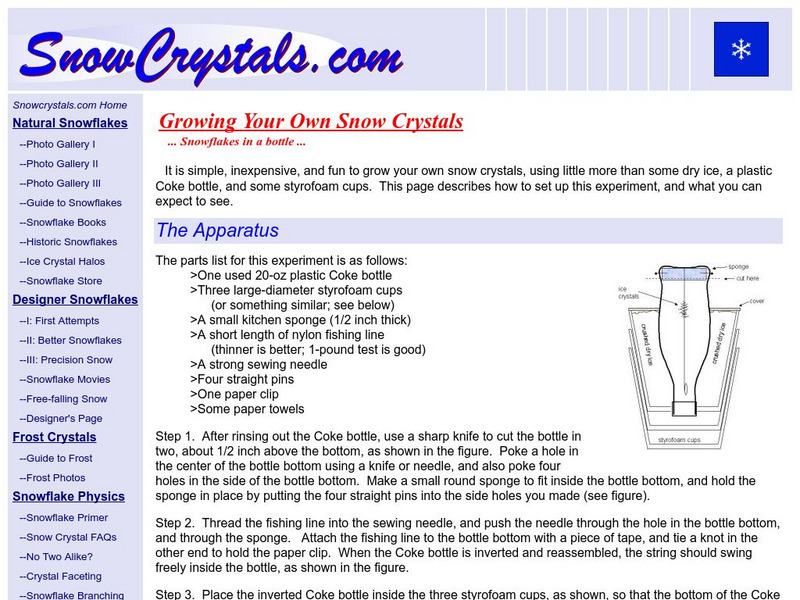
Growing Your Own Snow Crystals
No two snowflakes are the same! Find out if that statement is true by "growing" your own snow flakes and comparing them. You need a coke bottle, dry ice and a Styrofoam cup.
University of Chicago
Center for Astrophysical Research in Antarctica: Don't Be Too Flaky
After reading some facts about the properties of water, students conduct experiments to measure the relative densities of water, ice and snow and submit the results to the website.
Science Buddies
Science Buddies: What's the Fastest Way to Cool a Soda?
When you are craving an ice cold drink of soda, the last thing you want is to be stuck with a bunch of soda cans at room temperature. This fun science experiment sends you on a discovery to find the fastest way to cool soda with...
TeachEngineering
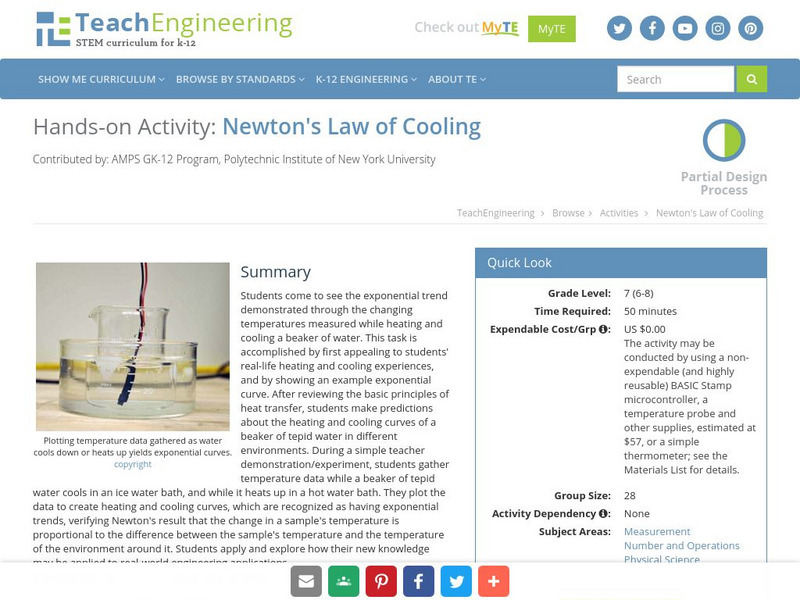
Teach Engineering: Newton's Law of Cooling
Learners come to see the exponential trend demonstrated through the changing temperatures measured while heating and cooling a beaker of water. This task is accomplished by first appealing to students' real-life heating and cooling...
Science Buddies
Science Buddies: Tightening the Turns in Speed Skating
Fast turns around the track can become your laboratory tests in these experiments, whether you skate on ice, wood, or pavement. The goal is to determine which type of turns are best in a race - tight, medium, or wide - and then to figure...
Scholastic
Scholastic Instructor: Wonderful World of Whales
Have your students ever wondered what it is like to be a whale swimming in ice cold water. In this lesson plan they can experience that as well as learn other facts about the lives of whales.
Science Education Resource Center at Carleton College
Serc: Investigation Erosion in Our World
In this lab activity, students will look for evidence of erosion in river or streams. This activity should take place after students have observed erosion in a model.
Science Fun for Everyone
Science Fun: Black Light Blue Beverage
In this science experiment, find out what happens when you pour tonic and ice into a glass and shine a blacklight on it.
Science Education Resource Center at Carleton College
Serc: Mn Step: Sinking Water: Glaciers, Ocean Currents and Weather Patterns
A lesson where students learn how warm water is less dense than cold water, and what this means for global climate change as ice from the polar regions melts. Students will do experiments in buoyancy and water density when hot or cold,...

Alabama Learning Exchange
Alex: Solids, Liquids, and Gases
This lesson focuses on solids, liquids, and gases. It has several review activities and an exciting lab experiment involving ice cream to complete the lesson.

Science Education Resource Center at Carleton College
Serc: Mn Step: What's the Coolest?
This is an investigation into how to insulate something so that it stays frozen. Young scholars will experiment with different materials to try to create the best cooler. They will then follow a procedure to make ice-cream, and learn...
Other popular searches
- Dry Ice Experiments
- Hot Ice Experiment
- Water and Ice Experiments
- Fun Science Experiments Ice
- Melting Ice Experiment
- Dry Ice Experiments C3h7oh
- Density of Ice Experiment
- Salt on Ice Experiment