Hi, what do you want to do?





Texas Instruments
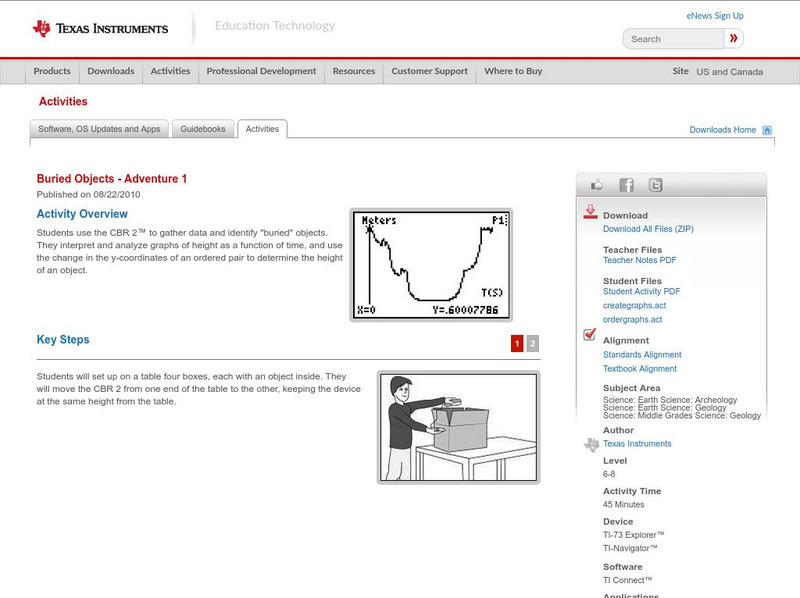
Texas Instruments: Buried Objects Adventure 1
Students use the CBR 2 to gather data and identify "buried" objects. They interpret and analyze graphs of height as a function of time, and use the change in the y-coordinates of an ordered pair to determine the height of an object.
Texas Instruments
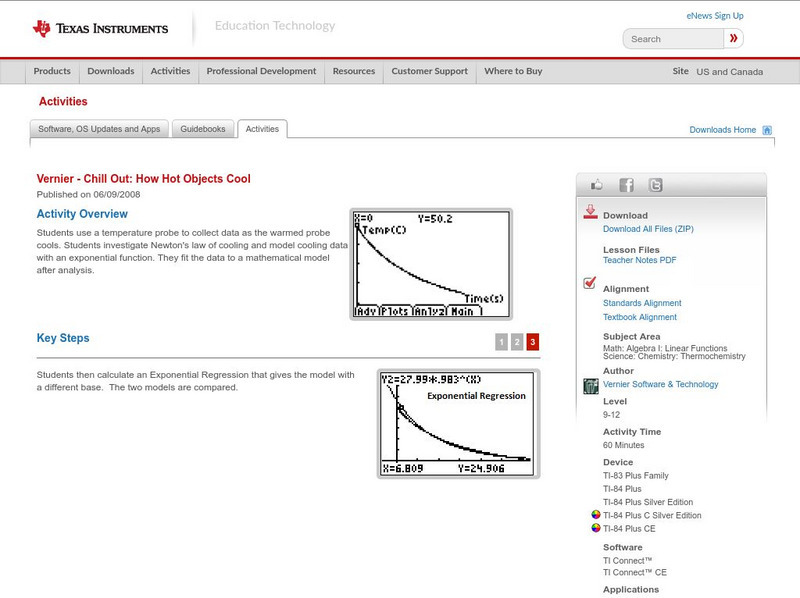
Texas Instruments: Chill Out: How Hot Objects Cool
Students use a temperature probe to collect data as the warmed probe cools. Students investigate Newton's law of cooling and model cooling data with an exponential function. They fit the data to a mathematical model after analysis.
Texas Instruments
Texas Instruments: Chill Out: How Hot Objects Cool
In this activity, students can use a temperature probe to collect data as the warmed probe cool. Students will investigate Newton's law of cooling and model cooling data with an exponential function. They will fit the data to a...
Texas Instruments
Texas Instruments: Looking at Polynomials as Dynamic Mathematical Objects
In this activity, students use the TI InterActive! to construct the expression of a polynomial curve based on its dynamic properties. They explore the behavior of the curve at certain points within its domain. Students also determine the...
Texas Instruments
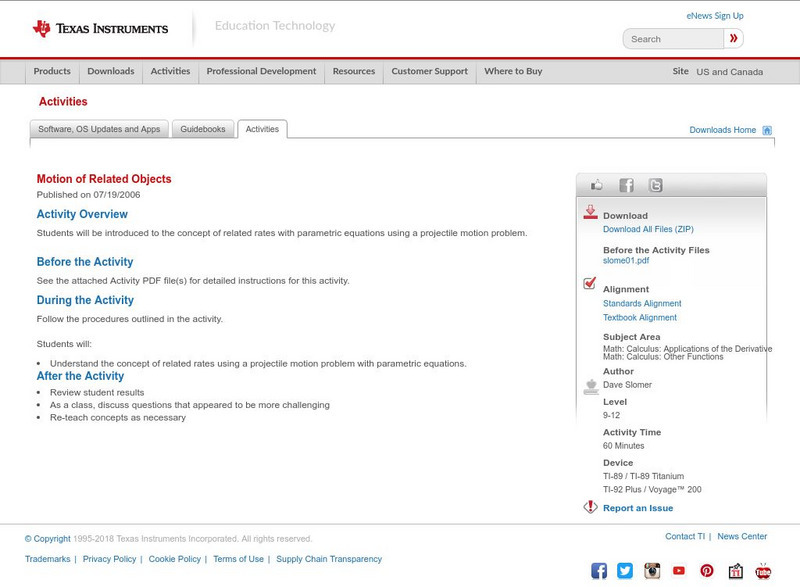
Texas Instruments: Motion of Related Objects
This activity introduces the concept of related rates with parametric equations using a projectile motion problem.
Texas Instruments
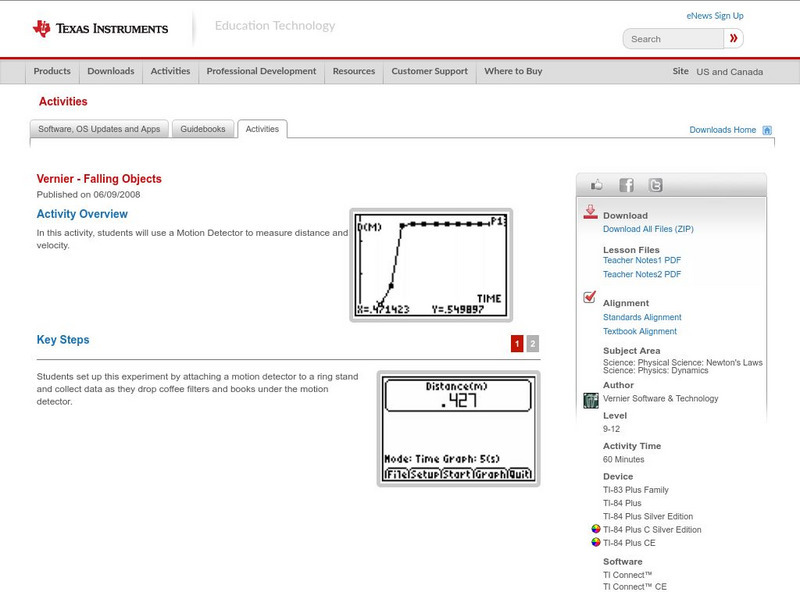
Texas Instruments: Falling Objects
In this activity, Students can use a Motion Detector to measure distance and velocity.
Texas Instruments
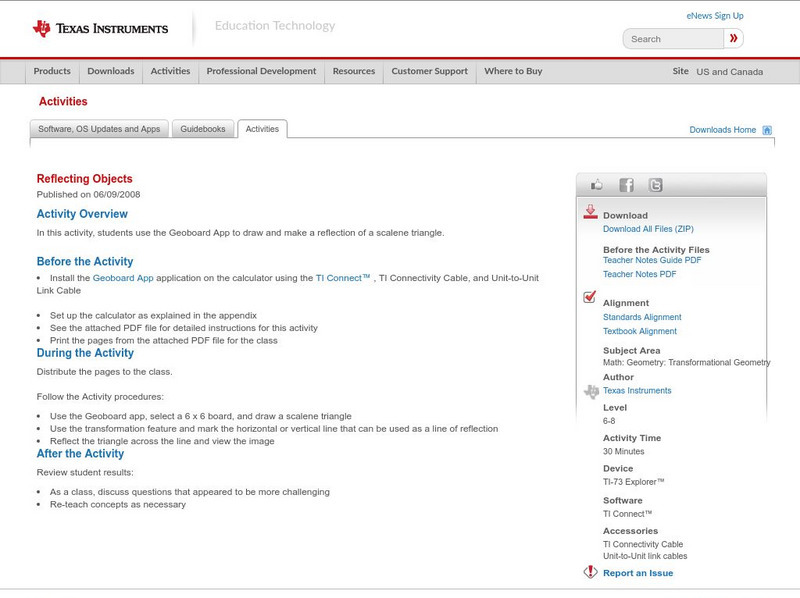
Texas Instruments: Reflecting Objects
In this activity, students use the Geoboard App to draw and make a reflection of a scalene triangle. [Requires Adobe Reader.]
Texas Instruments
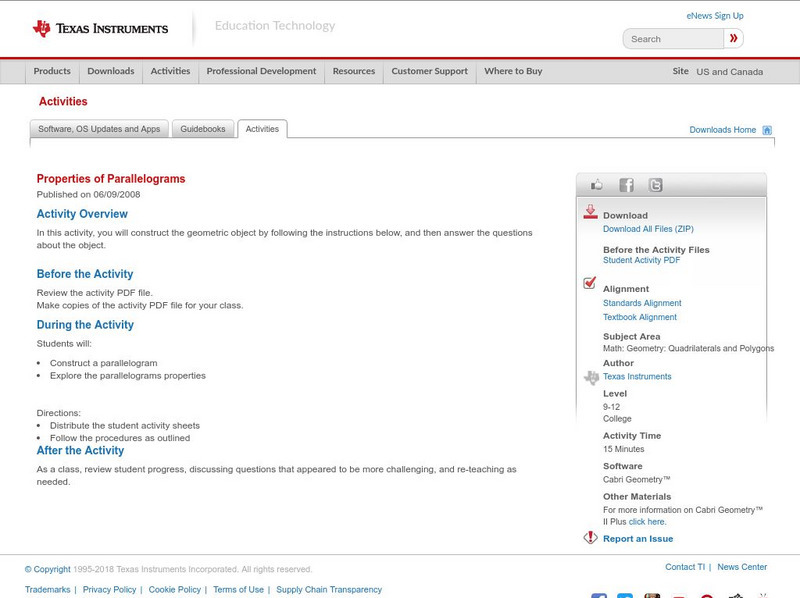
Texas Instruments: Properties of Parallelograms
In this activity, you will construct the geometric object by following the instructions below, and then answer the questions about the object.
Texas Instruments
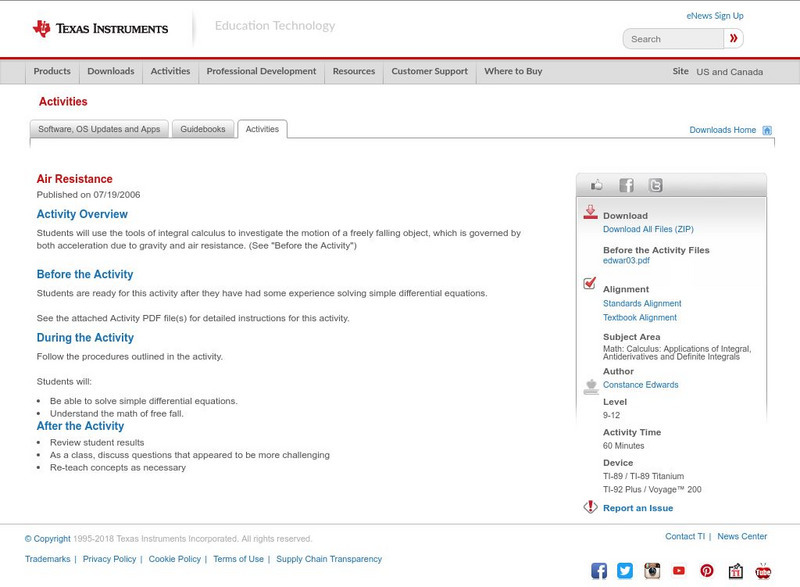
Texas Instruments: Air Resistance
Use the TI-89 to investigate the effect of air resistance on a free-falling object. Examples in the activity use calculator screenprints and keystroke instructions to demonstrate the use of the calculator to solve these problems....

American Association of Physics Teachers
Com Padre Digital Library: Open Source Physics: Free Fall Air Resistance Model
A Java-based simulation where students can observe what happens to a free-falling object, with and without air resistance. Controls allow the user to adjust settings and the results are graphed as the simulation progresses.
School Express
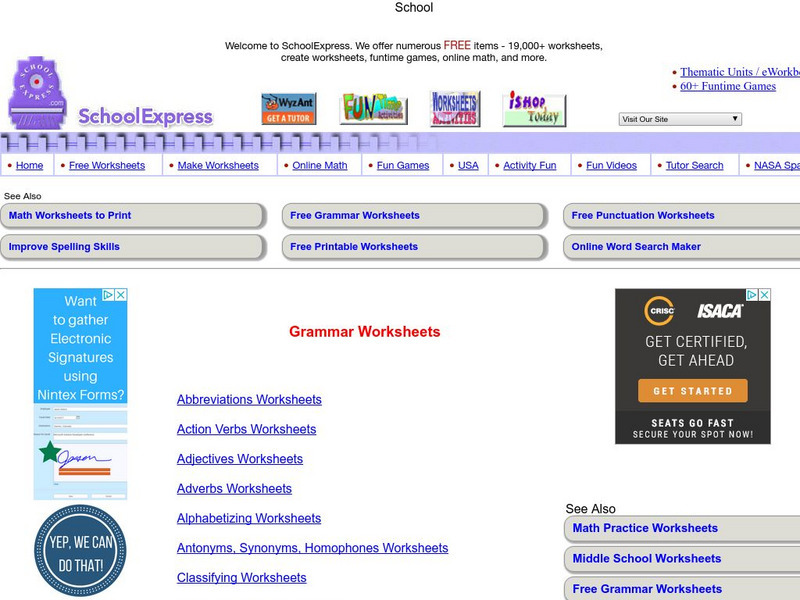
Schoolexpress.com: Grammar Worksheets
This site provides a comprehensive index of printable grammar worksheets. Each topic has an extensive list of worksheets to choose from. Topics include abbreviations, alphabetizing, parts of speech, classifying, punctuation, prefixes,...

National Council of Teachers of Mathematics
Nctm: Illuminations: Cutting Corners
Students will use their knowledge of plane figure attributes to create and view shapes by cutting and rotating shapes to stimulate discussions on names and attributes of various shapes they do not regularly encounter.

Alabama Learning Exchange
Alex: It's in the Bag
This lesson is a unique and fun way to review perimeter, angles, and types of adjectives. Students pick an object from the classroom that will fit in a paper lunch bag. They investigate their object and fill in the attached sheet. You...

American Association of Physics Teachers
Com Padre Digital Library: Open Source Physics: Anisotropic Oscillator Model
In this simulation an object is attached to two strings under tension on opposite sides of it. The object's starting position and the strings' lengths can be altered. The path of the object when it is released is traced on an...

Smithsonian Institution
National Museum of American History: Price of Freedom: Lincoln's Henry Rifle
View the museum object record for a Henry rifle given to Lincoln at the start of the Civil War. Record includes a history of the firearm, making note of its design as the inspiration for the famously successful Winchester rifle that came...
Texas Instruments
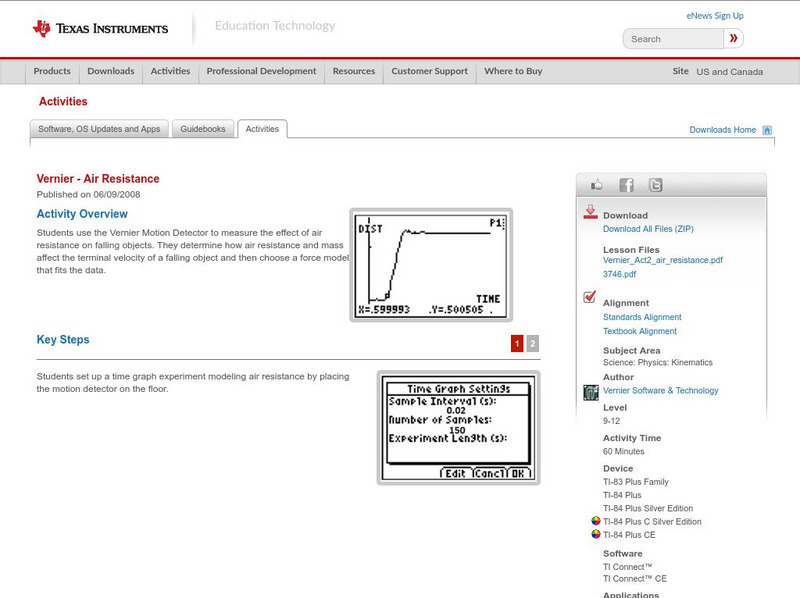
Texas Instruments: Air Resistance
Students use the Motion Detector to measure the effect of air resistance on falling objects. They determine how air resistance and mass affect the terminal velocity of a falling object and then choose a force model that fits the data.
Texas Instruments
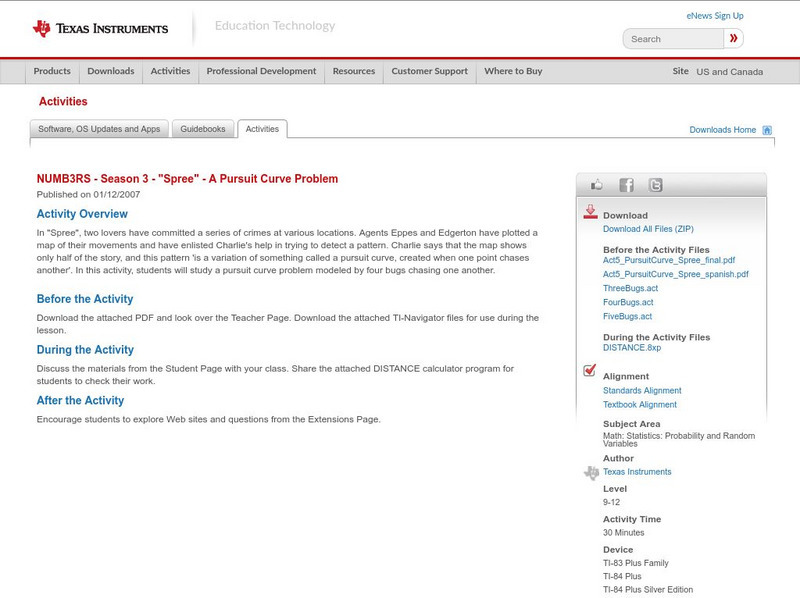
Texas Instruments: Numb3 Rs: A Pursuit Curve Problem
Based off of the hit television show NUMB3RS, this lesson introduces students to pursuit curves, in which objects follow seemingly awkward paths due to other objects chasing it. In this lesson (which is technology intensive), students...
Texas Instruments
Texas Instruments: Numb3 Rs: The Chase
Based off of the hit television show NUMB3RS, this lesson has students develop the concept of pursuit curves, in which one object moves according to the movements of another object. This lesson is framed in the context of an officer...
Texas Instruments
Texas Instruments: Spring Thing: Newton's Second Law
In this activity, students' use a force sensor and a motion detector to collect force and acceleration data for an object moving up and down hanging from a spring. They use the data to test Newton's second law, and to estimate the mass...
Texas Instruments
Texas Instruments: Finding the Shortest Path
Students discover the shortest distance light travels from an object to the human eye, as the light from the object reflects off a single mirror. In the process they learn about reflection in a line, congruent angles, angle bisectors,...
Texas Instruments
Texas Instruments: Numb3 Rs: Clearing All Obstacles
Based off of the hit television show NUMB3RS, this lesson has students modeling a mock food fight using projectile motion. This lesson is very technology-intensive, and a CBR2 is used to measure the velocity of an object so that it's...
Texas Instruments
Texas Instruments: Blackbody Radiation
This program will produce the blackbody radiation curve for one or two objects when the student inputs the temperature(s) in kelvin. The program will also display on the curve the peak frequency and wavelength when one object is selected.
Texas Instruments
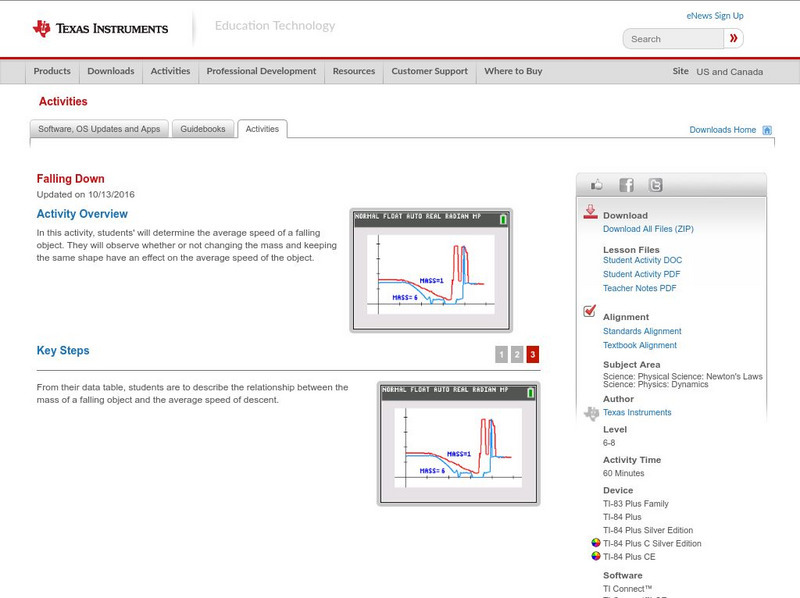
Texas Instruments: Falling Down
In this activity, students will determine the average speed of a falling object. They will observe whether or not changing the mass and keeping the same shape have an effect on the average speed of the object.
Texas Instruments
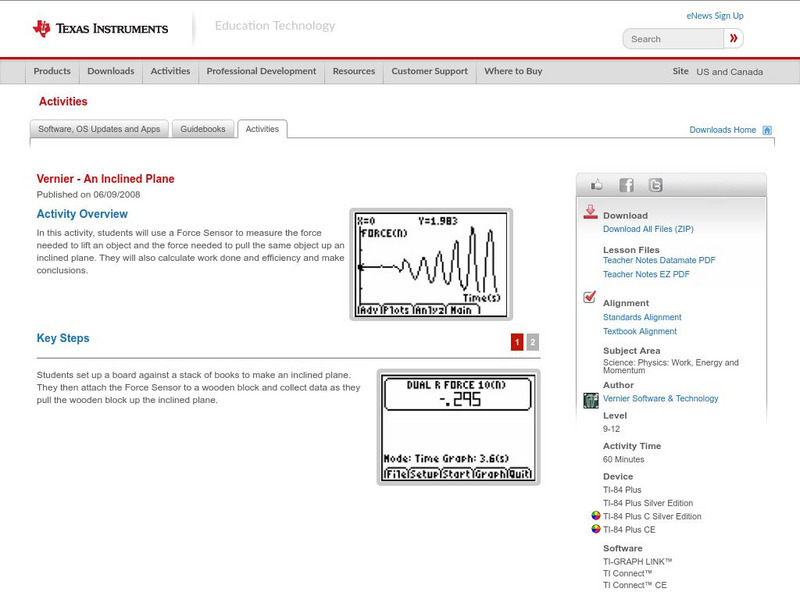
Texas Instruments: An Inclined Plane
In this activity, Students can use a Force Sensor to measure the force needed to lift an object and the force needed to pull the same object up an inclined plane. They will also calculate work done and efficiency and make conclusions.