Hi, what do you want to do?





American Chemical Society
Inquiry in Action: Changing the Density of an Object: Changing Shape
Throughout the activities in this investigation, students may have wondered how a boat made out of steel, which is more dense than water, can float. This activity addresses that question. Students will see that changing the shape of an...
American Chemical Society
Inquiry in Action: Changing the Density of an Object: Adding Material
In this activity, students see that a can of regular cola sinks while a can of diet cola floats. As a demonstration, bubble wrap is taped to the can of regular cola to make it float. This high-volume but light-weight material increases...
American Chemical Society
Inquiry in Action: Compare the Density of an Object to the Density of Water
In this activity, students use tea light candle holders and a student-made balance to compare the weight of equal volumes of wax, water, and clay. Students will discover that since the wax weighs less than an equal volume of water, it is...
Texas Instruments
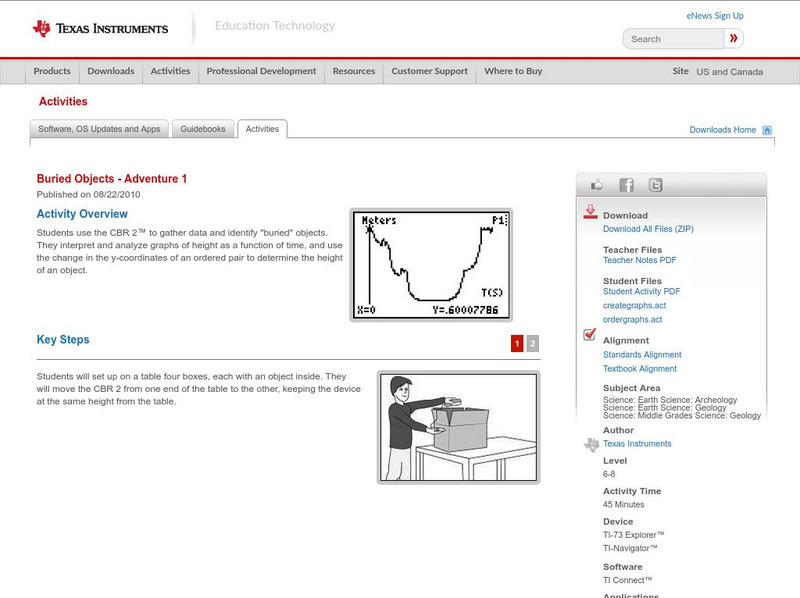
Texas Instruments: Buried Objects Adventure 1
Students use the CBR 2 to gather data and identify "buried" objects. They interpret and analyze graphs of height as a function of time, and use the change in the y-coordinates of an ordered pair to determine the height of an object.
Texas Instruments
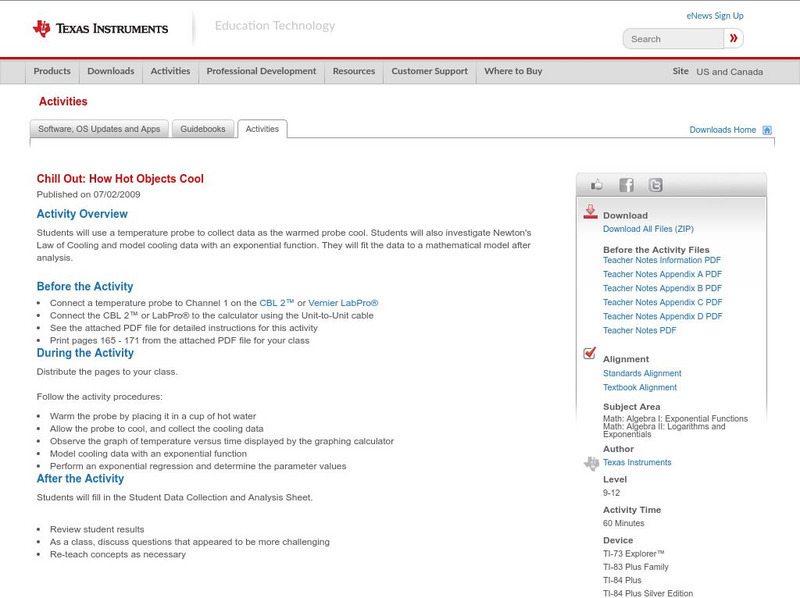
Texas Instruments: Chill Out: How Hot Objects Cool
In this activity, students can use a temperature probe to collect data as the warmed probe cool. Students will investigate Newton's law of cooling and model cooling data with an exponential function. They will fit the data to a...
Texas Instruments
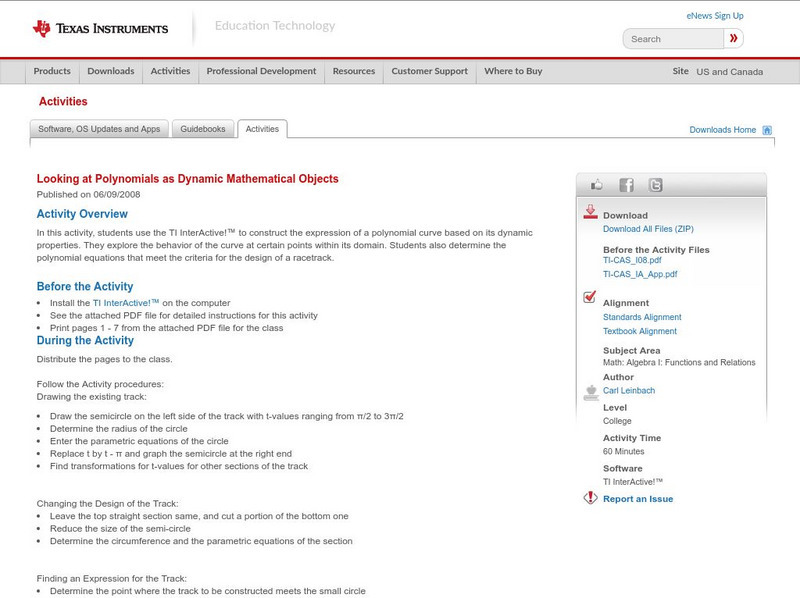
Texas Instruments: Looking at Polynomials as Dynamic Mathematical Objects
In this activity, students use the TI InterActive! to construct the expression of a polynomial curve based on its dynamic properties. They explore the behavior of the curve at certain points within its domain. Students also determine the...
Texas Instruments
Texas Instruments: Motion of Related Objects
This activity introduces the concept of related rates with parametric equations using a projectile motion problem.
Texas Instruments
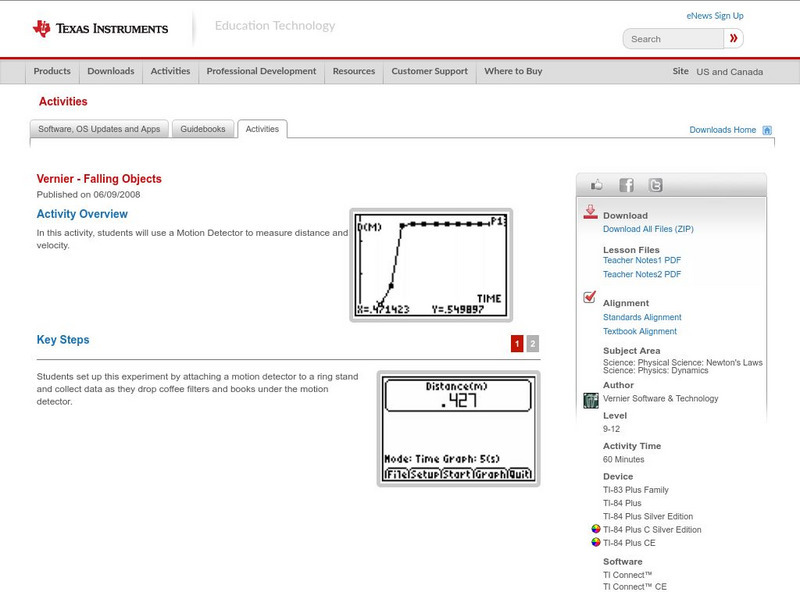
Texas Instruments: Falling Objects
In this activity, Students can use a Motion Detector to measure distance and velocity.
Texas Instruments
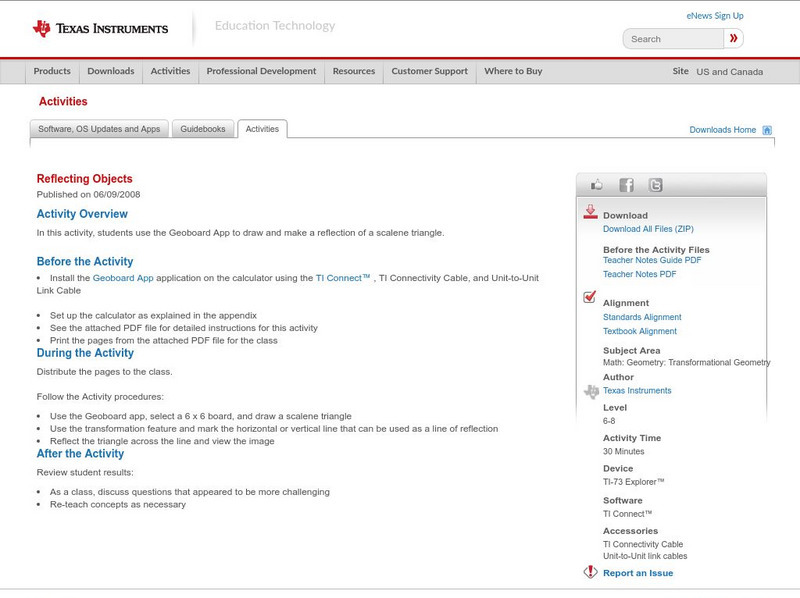
Texas Instruments: Reflecting Objects
In this activity, students use the Geoboard App to draw and make a reflection of a scalene triangle. [Requires Adobe Reader.]
Texas Instruments
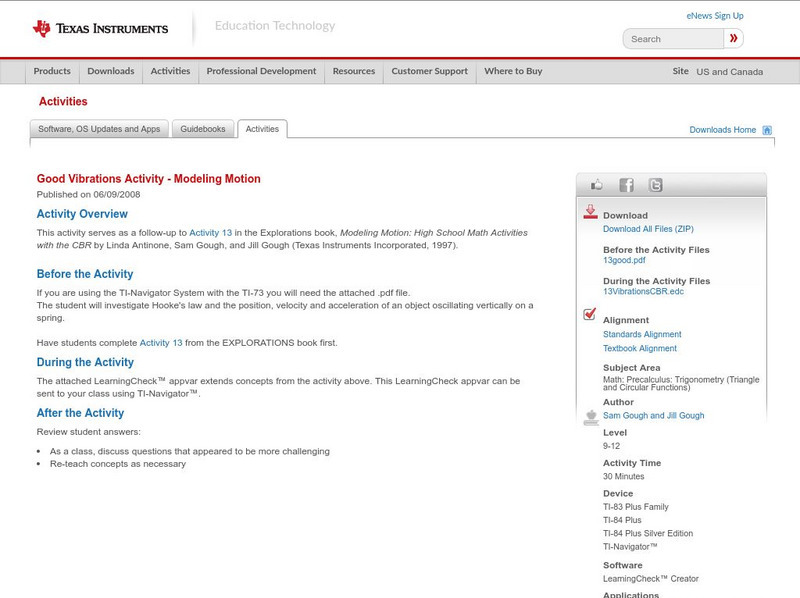
Texas Instruments: Good Vibrations Activity Modeling Motion
The student will investigate Hooke's law and the position, velocity and acceleration of an object oscillating vertically on a spring.

Scholastic
Scholastic: Hands on Is Minds On
As students put projects together, create crafts, or use familiar materials in new ways, they're constructing meaning. Students love to touch and manipulate materials and this can activate kids' brains. This article gives tips for...
Texas Instruments
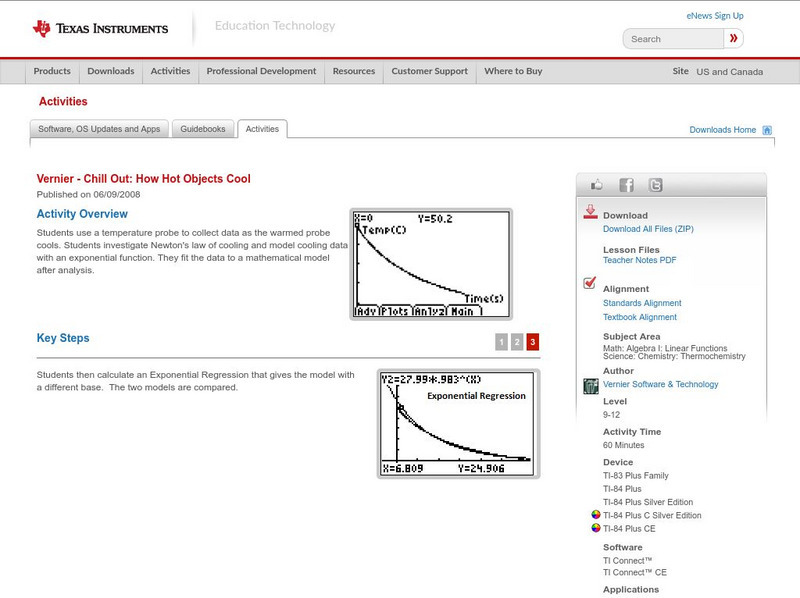
Texas Instruments: Chill Out: How Hot Objects Cool
Students use a temperature probe to collect data as the warmed probe cools. Students investigate Newton's law of cooling and model cooling data with an exponential function. They fit the data to a mathematical model after analysis.
Texas Instruments
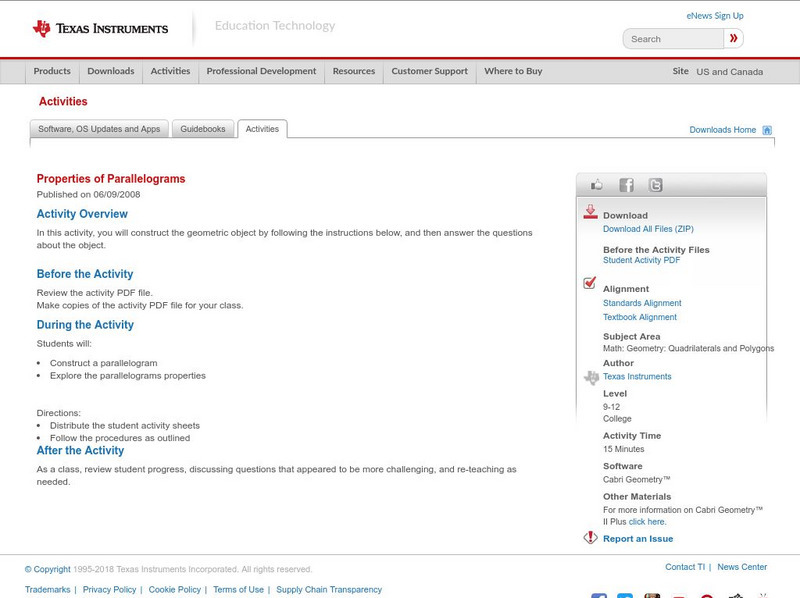
Texas Instruments: Properties of Parallelograms
In this activity, you will construct the geometric object by following the instructions below, and then answer the questions about the object.

Alabama Learning Exchange
Alex: What's the Matter: A Sinker or Floater?
Students will explore matter that sinks or floats when submerged in water and that matter is categorized as either a sinker or a floater. Students will work actively in small, cooperative learning groups as well as gather in a whole...
Texas Instruments
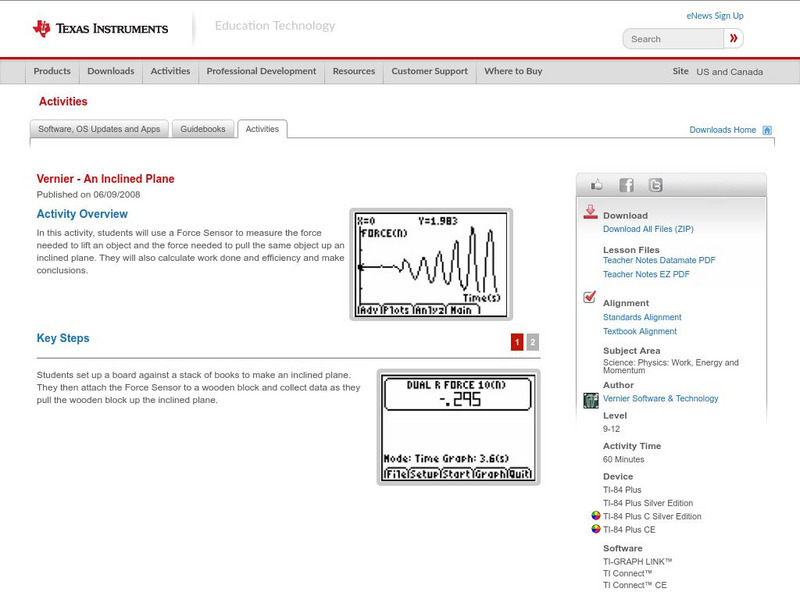
Texas Instruments: An Inclined Plane
In this activity, Students can use a Force Sensor to measure the force needed to lift an object and the force needed to pull the same object up an inclined plane. They will also calculate work done and efficiency and make conclusions.

Alabama Learning Exchange
Alex: 1, 2, 3 Throw!
Lesson plan designed to help young students further develop the skill of throwing an object. The lesson focuses on throwing at targets as well as throwing while moving.
Texas Instruments
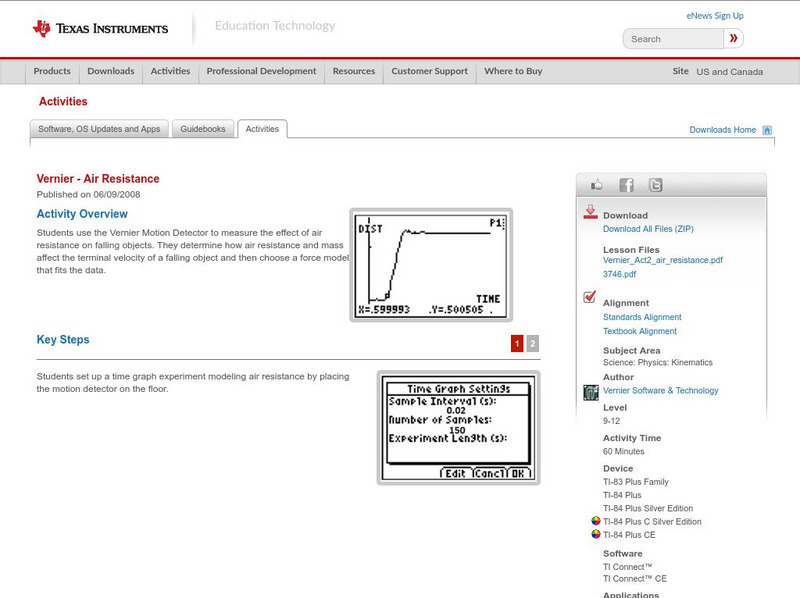
Texas Instruments: Air Resistance
Students use the Motion Detector to measure the effect of air resistance on falling objects. They determine how air resistance and mass affect the terminal velocity of a falling object and then choose a force model that fits the data.
Texas Instruments
Texas Instruments: Blackbody Radiation
This program will produce the blackbody radiation curve for one or two objects when the student inputs the temperature(s) in kelvin. The program will also display on the curve the peak frequency and wavelength when one object is selected.

Alabama Learning Exchange
Alex: Soaring With Literary Elements and Devices
In this lesson, students will observe literary elements and devices in a variety of chapter books. Students will be paired with a partner and allowed to choose one book to identify literary elements. Using digital cameras and a computer,...
Texas Instruments
Texas Instruments: Centripetal Acceleration
In this activity, students observe the centripetal acceleration of an object in uniform circular motion. Relate the changes in velocity and radius to the centripetal acceleration.

PE Central
Pe Central: Throw Hard!
Practice throwing overhand while properly positioning your body and going through "the full range of the throwing motion." This website links to PE Central Overhand Throwing Cues (which provides simple steps on overhand throwing), and...

Alabama Learning Exchange
Alex: Spotting Sounds All Around
This is both a hands-on and technology based lesson where students can apply their knowledge of letter/sound relationships while incorporating the use of classroom technology. This Language Arts activity will allow for the students to...
Texas Instruments
Texas Instruments: Circular Motion
In UCM, the net force called Fc is equal to mv2/r and is directed toward the center. This is demonstrated by an object that is suspended by a string and is moving in a circular path which makes a conical pendulum. In this experiment, you...
Texas Instruments
Texas Instruments: Air Resistance
Use the TI-89 to investigate the effect of air resistance on a free-falling object. Examples in the activity use calculator screenprints and keystroke instructions to demonstrate the use of the calculator to solve these problems....