Hi, what do you want to do?






Curated OER
Whale Adaptations
Students explore whales and how they have adapted to survive in the ocean. For this whale adaptations lesson students complete several activities that allow them to investigate animal adaptations.

Curated OER
"Did You Eat That!"
First graders investigate why plants are an important part of our everyday lives, providing us with food, clothing, shelter, etc. In this lesson students participate in a series of hands-on, online, and multimedia activities to examine...

Curated OER
Fungi
Young scholars study fungi and its parts. For this exploring fungi lesson students fill out a worksheet that includes a diagram of fungi and questions.

Curated OER
Bugsicles (A Frozen Insect Larva You can Find!)
Learners explore how animals survive in the winder. After attending a gall-collecting field trip, students place them in a freezer. Once frozen, the learners open the gall flay larva and observe it as the larva revives. Students...

Curated OER
Mythical Animals
Learners create imaginary animals by assembling pictures of body parts from pictures of real animals. This is one of three linked tasks. The others are "Who's Parts Do I Have?" and "Animals Piece by Piece."

Curated OER
Amazing Aussie Animals
Fourth graders are introduced to Australian animals through a PowerPoint presentation. They choose an animal of interest and conduct in-depth research using several websites. They design a presentation with their findings.

Curated OER
DNA Extraction From a Variety of Tissue Samples
Students, working in cooperative groups, extract very impure samples of DNA from a number of tissue samples. They determine how the samples can be preserved and how they are similar.

Curated OER
Biome Exchange: Send the Stuff Not The Kids
Students exchange information with students from various geographic biomes. They explore the unique ecologically significant features of the biomes and share with other students.

Curated OER
The Giant Cell
After actively participating in a unit on cells, the students act out and become the organelles. They will act out and explain the functions of what each of the organelles do for the cell.

Curated OER
Feedback and Flowcharts
Sixth graders explain what a negative feedback system is and they distinguish it from a positive feedback system. They describe examples of how negative feedback is used in both nature and technology. , Students define homeostasis, and...
Science Education Resource Center at Carleton College
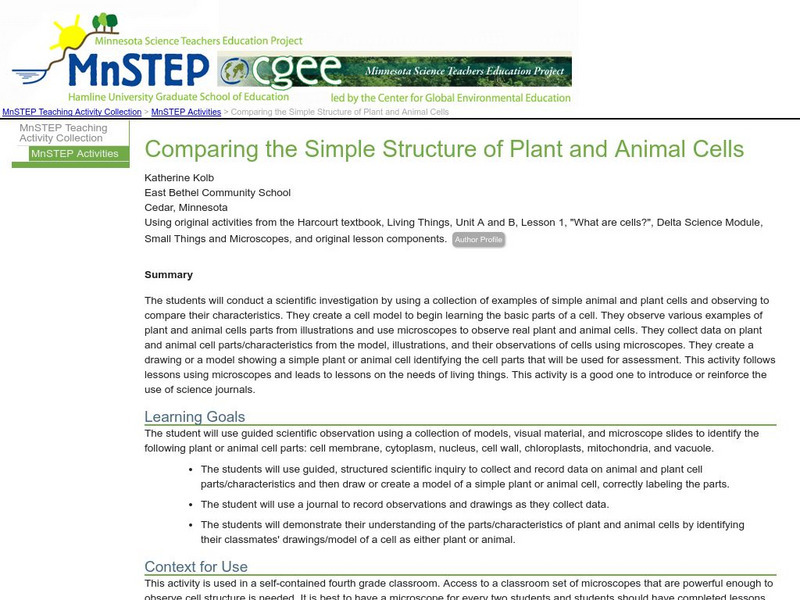
Serc: Comparing the Simple Structure of Plant and Animal Cells
Students use guided scientific observation using a collection of models, visual material, and microscope slides to identify cell organelles. Then they demonstrate their understanding of the parts/characteristics of cells by identifying...
Alabama Learning Exchange
Alex: Inside the Cell
In this lesson, students learn the different kinds of cells including plant and animal cells. They also learn how to identify and name the organelles of eukaryotic cells.
Science and Mathematics Initiative for Learning Enhancement (SMILE)
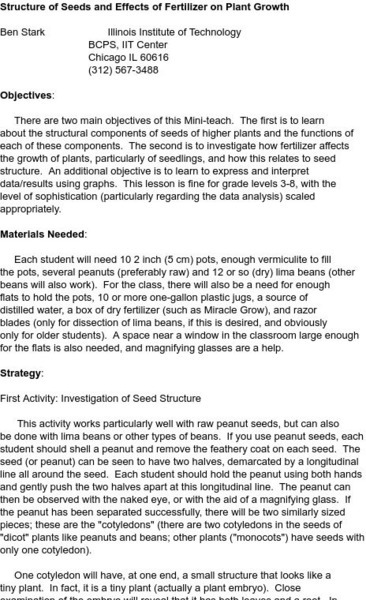
Smile: Structure of Seeds and Effects of Fertilizer on Plants
In this lesson plan, students identify parts of seeds and the effect of fertilizer on their germination and development.