Hi, what do you want to do?






Physics Classroom
The Physics Classroom: Refraction/ray Model of Light: The Angle of Refraction
Focusing on the question, "By how much does light refract when it crosses a boundary?" this physics tutorial will allow students the opportunity to explore these concepts of refraction.
Physics Classroom
The Physics Classroom: Reflection and Ray Model of Light: The Law of Reflection
Through an illustrated tutorial and some interactive practice problems, students learn about the law of reflection of light.
Other
Propagation of Light Using Geometry
A discussion of Christian Huygens' contribution to wave optics, and particularly to our understanding of the reflection and refraction of light. Excellent diagrams and a geometric proof on why the law of reflection is mathematically...
Physics Classroom
The Physics Classroom: Refraction and Ray Model of Light: Boundary Behavior
In this illustrated physics tutorial, students investigate the connection between light reflection and light refraction.
University of Minnesota
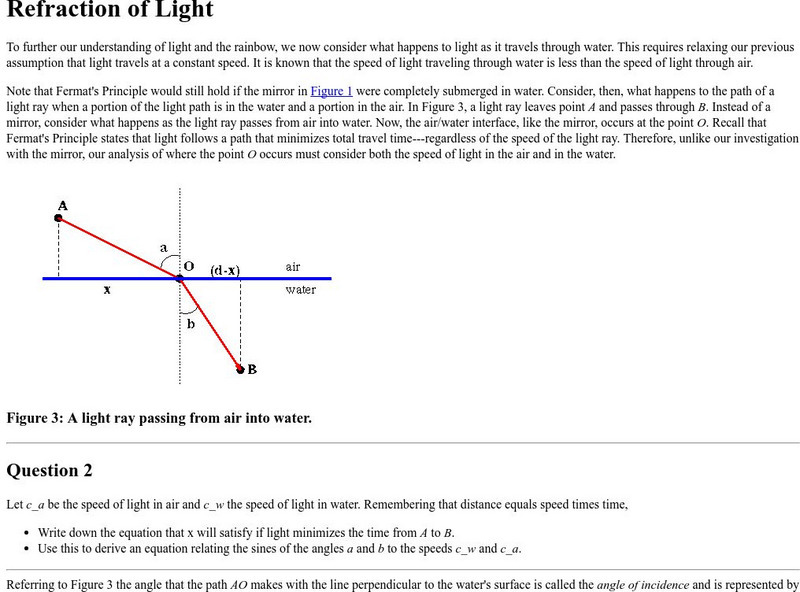
University of Minnesota: Refraction of Light
This page is a continuation of a tutorial about light reflection and refraction. It contains a diagram and suggestions on how to derive Snell's Law, which governs the refraction of light in a medium. For background to this derivation,...
Physics Classroom
The Physics Classroom: Refraction and the Ray Model of Light: Snell's Law
In this interactive physics tutorial, students will learn about a mathematical equation relating these two angles and the indices of refraction of the two materials on each side of the boundary.
Physics Classroom
The Physics Classroom: Refraction/ray Model of Light: Determination of N Values
Through illustrated examples and interactive practice problems, students explore the details of Snell's Law.
Physics Classroom
The Physics Classroom: Refraction and the Ray Model of Light: Converging Lenses
An illustrated tutorial which takes students step-by-step through the process of drawing ray diagrams.
Physics Classroom
The Physics Classroom: Ray Diagrams for Concave Mirrors Case B
Ray diagrams are useful tools for determining the location of an image as produced by a concave mirror. Of all the rays which emanate from the top of the object arrow and are incident to the mirror, there are two rays whose behavior at...
Physics Classroom
The Physics Classroom: Ray Diagrams for Concave Mirrors Case D
Ray diagrams are useful tools for determining the location of an image as produced by a concave mirror. Of all the rays which emanate from the top of the object arrow and are incident to the mirror, there are two rays whose behavior at...
Walter Fendt
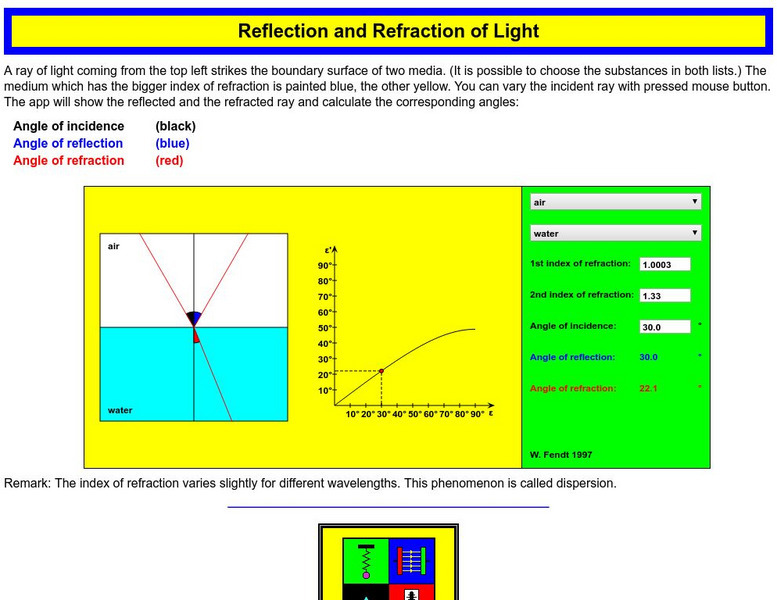
Walter Fendt: Reflection and Refraction of Light
Defines the refraction of light and provides an applet for investigating it.

CK-12 Foundation
Ck 12: Index of Refraction
[Free Registration/Login may be required to access all resource tools.] In this module, discover and solve problems involving the index of refraction, and investigate problems involving Snell's Law.
Other
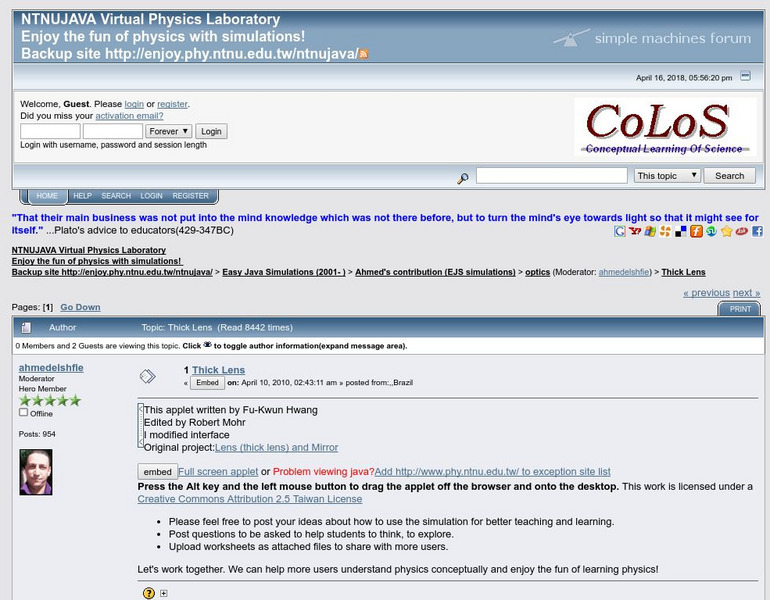
Ntnu Virtual Physics Lab: Thick Lens Java Applet
An interactive Java applet which allows the user to investigate the path of light through a lens shape object. The shape of the object, the index of refraction of the material, and the location of the incident rays can be altered.
Physics Classroom
The Physics Classroom: Reflection/ray Model of Light: Reflection Rules Concave
Students learn two rules of reflection as it has to do with concave mirrors. These two rules will greatly simplify the task of determining the image locations for objects placed in front of concave mirrors.

CK-12 Foundation
Ck 12: Plix: Wave Interactions: Law of Reflection
[Free Registration/Login Required] Move the light source to see what happens to the reflected ray as you change the angle of the incident ray.
Curated OER
Ntnu Virtual Physics Lab: Thick Lens Java Applet
An interactive Java applet which allows the user to investigate the path of light through a lens shape object. The shape of the object, the index of refraction of the material, and the location of the incident rays can be altered.