Hi, what do you want to do?






Curated OER
Designing Machines
Students explore simple and compound machines. In groups of four students, they design a compound machine using K'NEX that has a stated purpose and consists of at least two simple machines.

Curated OER
Big Wheels Keep on Turning
Eleventh graders work in groups and investigate how force determines the speed and distance then they view the video, "Math Vantage #7: What's Your Angle?." They are given a real life problem to solve using speed, ramps, angle, incline...

Curated OER
Levers
Students brainstorm if they think that any lever would use the same amount of paperclips. They break into small groups and use a data sheet as well as a lever, Lego person, fulcrum, and some paperclips and prove what they think by taking...

Curated OER
Simple Machines
Third graders examine and identify the six types of simple machines. Using a model of each simple machine, they demonstrate the state the function of them to the class. They discover examples of simple machines at school and home and...

Curated OER
Challenger's Lost Lessons - The Lost Simple Machines Lesson
Students investigate the characteristics of simple machines. In this simple machine lesson, students investigate work as a product of applying constant force. They answer questions about what happens on Earth and what may have happened...

Curated OER
Simple Machines III - Pulleys
Fourth graders are introduced to a spring scale to show that the forces on both sides of the pulley are the same. They break into groups to lift objects with fixed pulleys and with multiple looped pulleys and then measure the force...

Curated OER
Who's the Frog Jumping Champion?
Students use a simple machine (a lever) to launch a plastic frog. students determine who is able to make their frog "jump" the farthest and graph the results.

Curated OER
Newton's Laws
Middle schoolers give examples of each of Newton's three laws as they occur in everyday experiences. They visually represent and differentiate the difference between a direct proportion and an inverse proportion. Students explain how...

Curated OER
Moving Along
Students are introduced to the concept of motion. In groups, they practice calculating the rate, time, and distance of various objects on a variety of surfaces. To end the lesson, they apply the same principles to those objects moving...

Curated OER
Simple Machine Test
Students complete several worksheets about machines. In this machine instructional activity students complete several handouts that describe the different machines and how pulleys work.

Curated OER
Building the Pyramids: No Light Task
Eighth graders perform experiments with simple machines and write up the results. They research the construction of the step pyramid and the three pyramids at Giza. Students research how the ancient Egyptians used simple machines in...

Curated OER
3-2-1 Blast Off!
Fifth graders work cooperatively in groups to assemble and launch a rocket.

Curated OER
Finding Simple Machines in Farm Machinery
Students identify simple machines and how they must work together to form a piece of equipment used in agriculture. They create a diagram of a piece of farm equipment and write about two of the simple machines they drew.

Curated OER
An Eclipsing Binary System with a Precessing Accretion Disk
Students work together to complete an experiment over binary sources. They determine values for the orbital period of certain objects and interpret intensity changes. They also calculate a value for the period of precession of an...
![Erosion in Different Soils [Erosion Races] Lesson Plan](http://lessonplanet.com/content/resources/thumbnails/140405/large/cgrmlwnvbnzlcnqymdezmdmyos01nde3lxfmmzy0dc5qcgc.jpg?1414240121 "Erosion in Different Soils [Erosion Races] Lesson Plan")
Curated OER
Erosion in Different Soils [Erosion Races]
Fourth graders review how erosion can happen by wind, water, and gravity which they studied in previous lesson. They attempt to discover if all soils erode at the same rate. In small groups, 4th graders experiment with three different...

Curated OER
Third Grade Science Multiple Choice Practice
For this 3rd grade science worksheet, 3rd graders complete a total of 25 multiple choice questions related to grade 3 concepts. An answer key is given.

Curated OER
Properties of Matter (Biomaterial Through Nanotechnology)
Students investigate friction between different surfaces. In this physics lesson plan, students research biomaterials that can reduce friction. They calculate efficiency using a mathematical formula.

Curated OER
Exploring Simple Machines
Students investigate simple machines. In this simple machines lesson, students study how simple machines work. Students determine the function of various simple machines.

Curated OER
The Gravity Of It All-Newton's Laws
Pupils experiment with the concept of Newton's second law of motion. After building a ramp, they determine whether a large marble or a small marble will move farther, based on Newton's law. Students record their data on the provided....

Curated OER
What Can You Make of It?
Students investigate the various uses of a paper cup. In this scientific inquiry lesson plan, students investigate various ways to use a paper cup by identifying its characteristics. Students sketch their discovery.

Physics Classroom
The Physics Classroom: Vectors: Inclined Planes
Through examples and interactive practice problems, this physics tutorial helps students understand how forces behave on an object on an inclined plane.
TeachEngineering
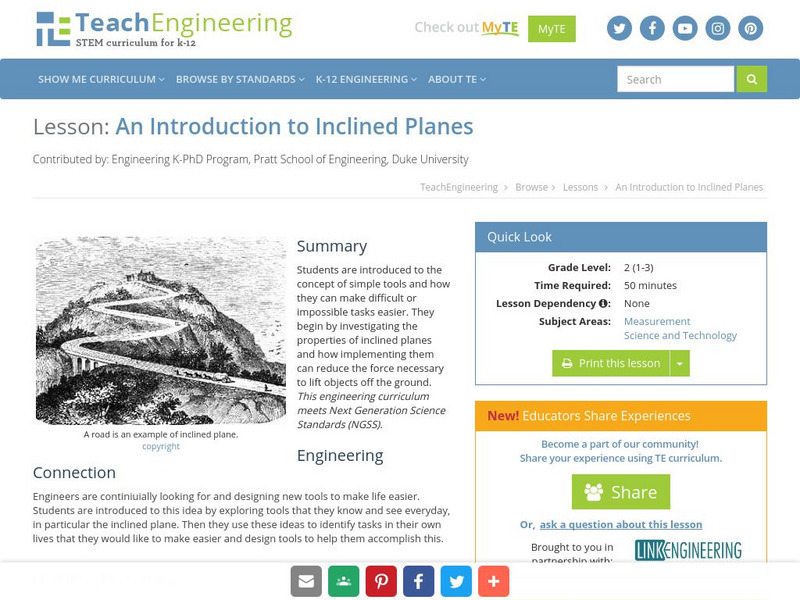
Teach Engineering: An Introduction to Inclined Planes
Students are introduced to the concept of simple tools and how they can make difficult or impossible tasks easier. They begin by investigating the properties of inclined planes and how implementing them can reduce the force necessary to...
Science Education Resource Center at Carleton College
Serc: Investigating the Inclined Plane Through Inquiry
In this activity, students will use different materials to find the most effective way to use an inclined plane (in other words, moving an object with as little force as possible). This is a guided inquiry. Although the students will be...
CK-12 Foundation
Ck 12: Episd: Inclined Planes
[Free Registration/Login may be required to access all resource tools.] Students will identify how work and force are figured out on inclined planes as well as how to apply Newton's Second Law of Motion to them.