Hi, what do you want to do?






Curated OER
ESOL Telephone Communication
Students discuss the importance of leaving an appropriate message on an answering machine or voice mail system. They write a message for a friend and in pairs take turns reading their message while their partner writes it down.

English Club
English Club: Learn English: Grammar: Verbs: Infinitive or Ing Quiz
Choose the correct infinitive or "ing" verb form to complete each of the ten sentences in this Quiz. Answers can be checked upon completion.

Other
Oxford Dictionaries: Verb Tenses: Adding Ed and Ing
Spelling rules and word lists for adding -ed and -ing endings to verbs.
PBS
Pbs Learning Media: Using the Present Progressive Tense
Present progressives describe an action in progress, or something that started in the past and is still happening. It is formed with the helping "to be" verb in the present tense and the present participle of the verb. [0:42]

Other
Woodward English: Spelling Rules: Ing
Rules, exceptions, and examples of how to add -ing to verbs, dependent on the ending of the original word.
English Club
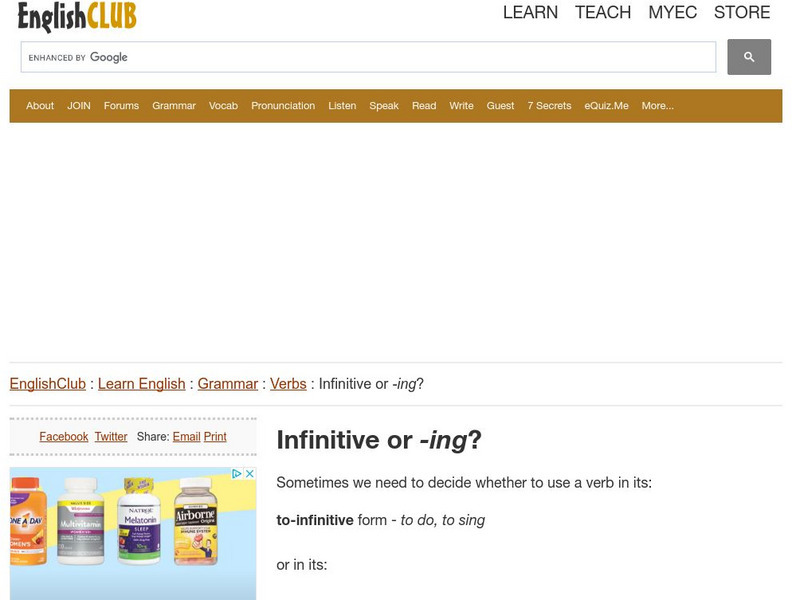
English Club: Learn English: Grammar: Verbs: Infinitive or Ing?
An explanation and examples of when to use verbs in their infinitive form and when to use them with the "ing" suffix.
English Club
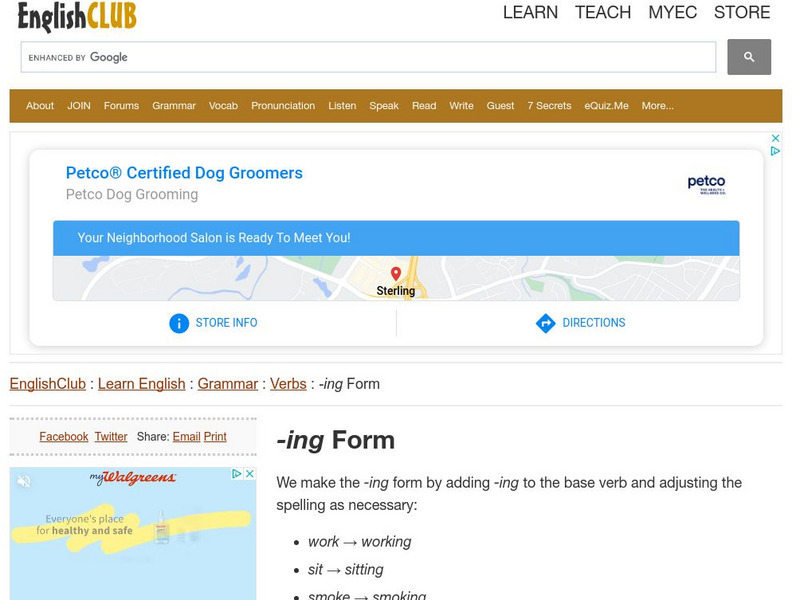
English Club: Learn English: Grammar: Verbs: Gerunds
An explanation and examples of gerunds and the difference between a gerund and a verb ending in "ing." Links to additional information and a quiz on gerunds is provided.
Other
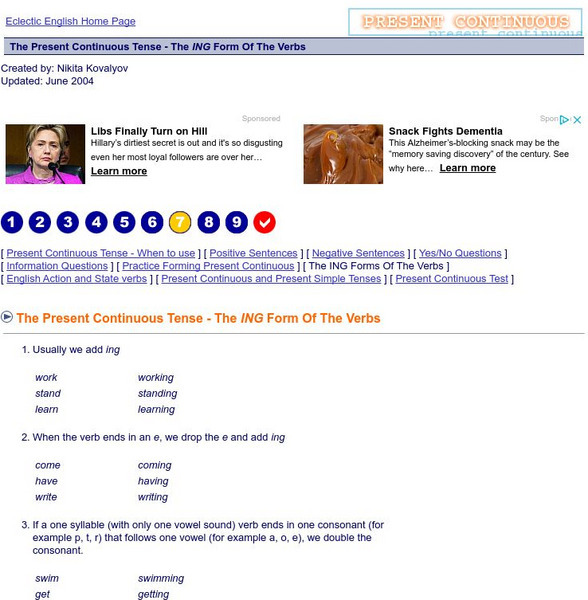
Eclectic English: The Present Continuous Tense the Ing Form of Verbs
Learn how to correctly add the -ing ending to various types of words, and then practice by adding -ing to twenty-two verbs.

Quia
Quia: Inflectional Endings (S, Ed, and Ing)
Decide which inflectional ending matches the verb in each sentence.
Towson University
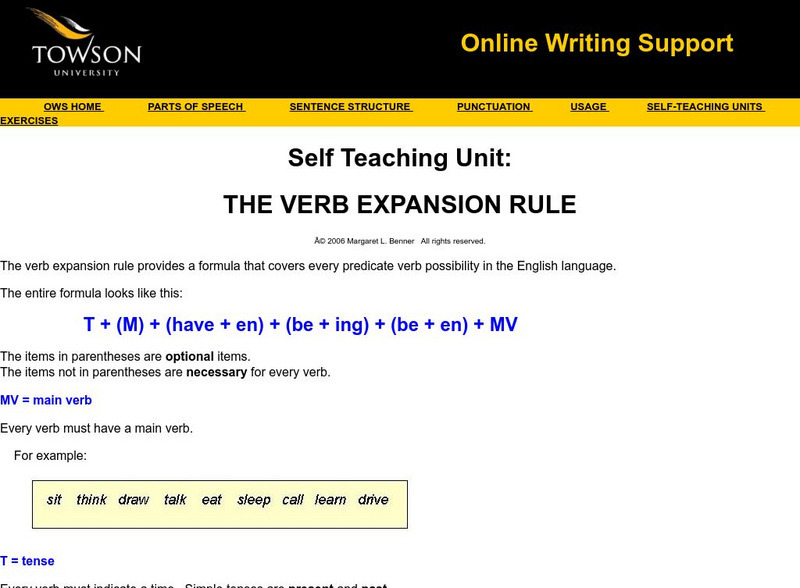
Towson University: Ows: Self Teaching Unit: The Verb Expansion Rule
This lesson focuses on the verb expansion rule which provides a formula that covers every predicate verb possibility in the English language. The formula is T + (M) + (have + en) + (be + ing) + (be + en) + MV. The lesson explains all of...

Khan Academy
Khan Academy: Progressive Verb Aspect
When something is ongoing, we say that it's in the 'progressive' or 'continuous' aspect. Test your knowledge of this grammatical aspect!

Khan Academy
Khan Academy: Progressive Perfect Verb Aspect
If an action has been ongoing for some time, or was once ongoing and has since completed, we say it's in the progressive perfect aspect! Test your knowledge of this grammatical aspect.
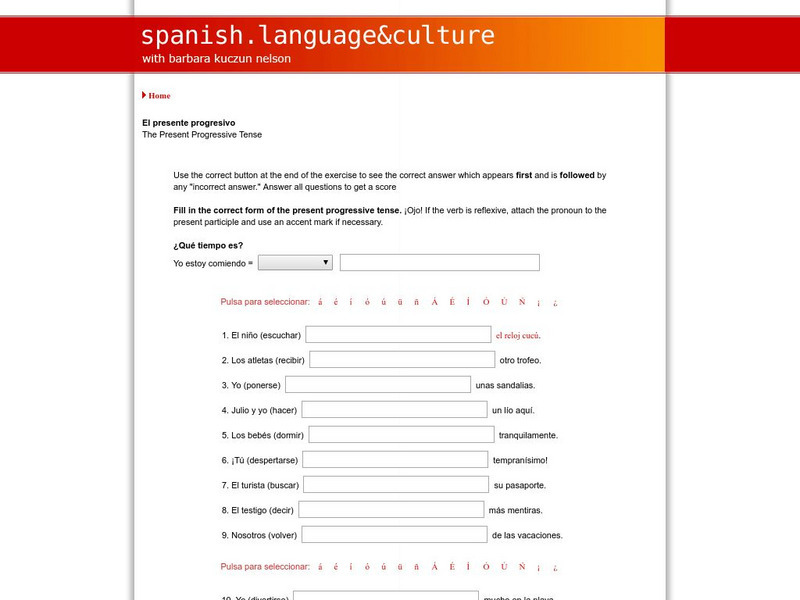
Colby College
Spanish Language & Culture: The Present Progressive Tense
Comprehensive online practice from Colby College is available for the present progressive tense. Regular, irregular, and stem-changing participles are included in this exercise. Utilize this self-grading online worksheet to help improve...

ClassFlow
Class Flow: Add Ed and Ing Endings to Verb
[Free Registration/Login Required] This flipchart introduces rules for correct spelling of verbs ending in -ed and -ing. There is a wonderful interactive activity and Activote assessment.
Education Place
Houghton Mifflin: Eduplace: Wacky Web Tales: The Weather Station
This fill-in-the-blank Wacky Web Tale includes a story about a weather station. It is fun and serves an interactive grammar review. Wacky Web Tales are fun and interactive grammar reviews. Students fill in blanks for different parts of...
Dave's ESL Cafe
Dave's Esl Cafe: Verb Forms and Verb Tenses #6: Spelling Ing Forms
Spelling rules and examples for adding the "ing" suffix to the ends of words.
Sophia Learning
Sophia: Past Perfect Continuous
This lesson introduces the past perfect continuous tense and how it is used. This tutorial lesson shares a short slideshow and provides review questions over the lesson's content.

ClassFlow
Class Flow: Adding Ing to Verbs
[Free Registration/Login Required] This flipchart discusses how the spelling of verbs changes when ing is added.

ClassFlow
Class Flow: Verb Endings
[Free Registration/Login Required] Students will learn to spell regular verb endings s, ed, ing (link to grammar work on tenses).
Other
Learning Alive: Papel De Mujeres De Hoy en Matrimonio
Practice conjugating verbs in this article on the role of women in modern marriage. Fill in the blank with the correct form of the verb in the designated tense: present, present subjunctive, future, preterite, imperfect, or a gerund....
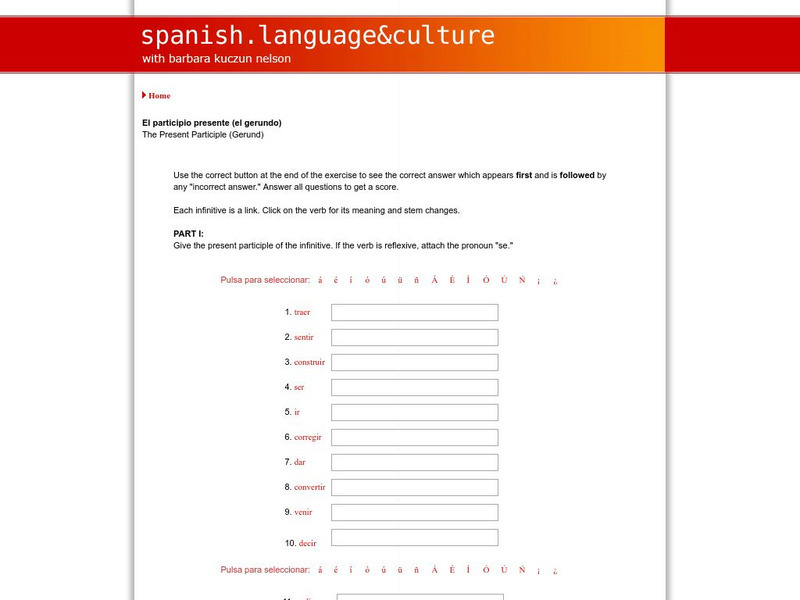
Colby College
Spanish Language & Culture: The Present Participle
Use this site to practice strengthening your knowledge of present participles. Utilize this efficient online worksheet to insert the present participles of the given infinitive. Afterwards, translate the English infinitive into the...
Other
Jump Start: Suffix Search [Pdf]
Learners practice making words with -ed, -ing, and -er suffixes. [PDF]
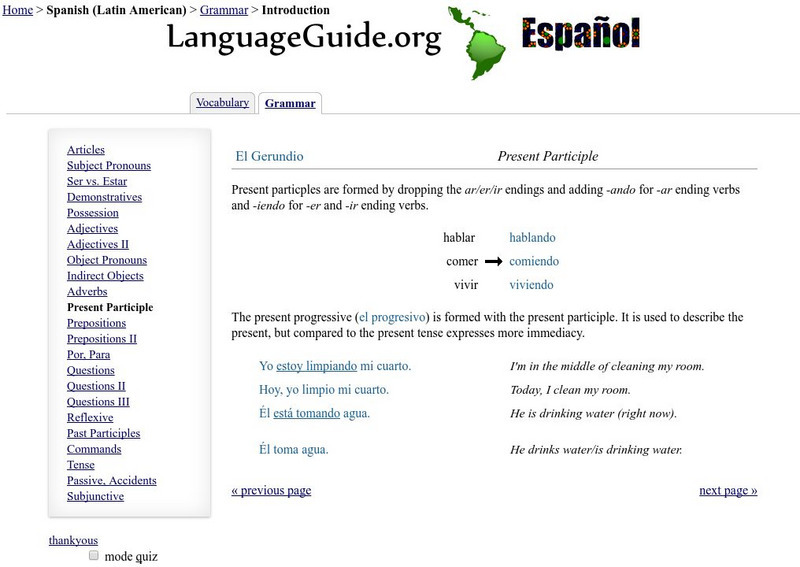
Language Guide
Language Guide: El Gerundio
A very brief explanation of how to form the present participle for ar/er/ir verbs and later form the present progressive tense with the participle.
PBS
Pbs Learning Media: What Verbals Are
Verbals are verbs disguised as nouns, adjectives, and adverbs. Verbals come in three forms: gerunds, infinitives, and participles. Gerunds are verbs that end in "-ing" and function as nouns. Participles end in "-ing," "-ed," "-d," "-t,"...
Other popular searches
- Adding Ing to Verbs
- Verbs With Ing Endings
- Verbs That End With "Ing"
- Verbs That End With Ing
- Action Verbs With Ing
- Action Verbs With "Ing"
- Comma With Ing Verbs
- Add Ing to Verbs
- Ing Verbs in Sentences
- Verbs Using Ing
- Action Verbs With "Ing
- Adding "Ing" to Verbs