Hi, what do you want to do?





Smithsonian Institution
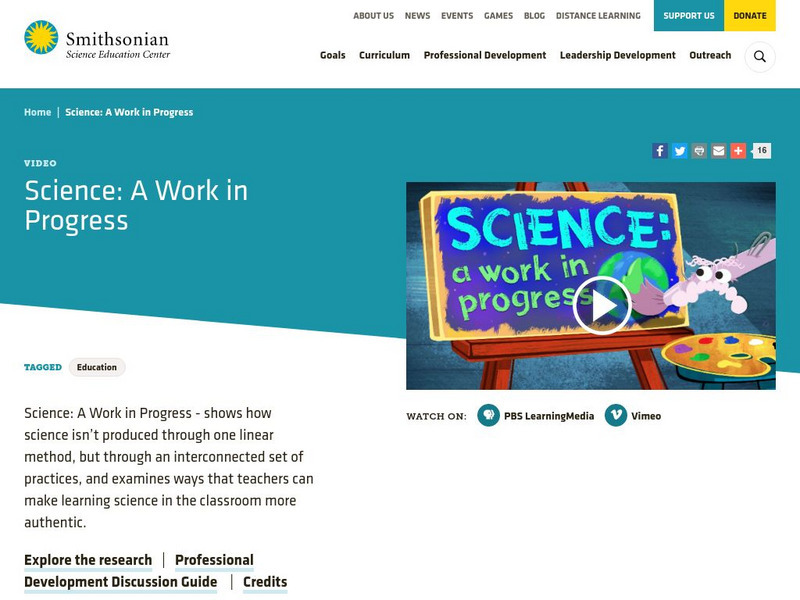
Smithsonian Science Education Center: Science: A Work in Progress
The scientific method is more than just a series of steps to be followed like a recipe. It is a fluid, ever-changing process. This video discusses student's perception of the scientific method and how to make learning science in the...
Discovery Education
Discovery Education: Science Fair Central: Choose a Project Type Investigation
Discover how to approach a scientific question, and learn eight steps students will perform in doing so. Offers suggestions on how to ask a testable question as well as several examples.
E-learning for Kids
E Learning for Kids: Science: Vikings: How Do Plants Grow?
Olaf the viking is learning about the life cycle of plants. Help him tend to his garden as he learns.
E-learning for Kids
E Learning for Kids: Science: Atlantic Ocean: Day and Night
This module explores day and night. Learn about what we see during the day and night and why we see what we see.
Science Buddies
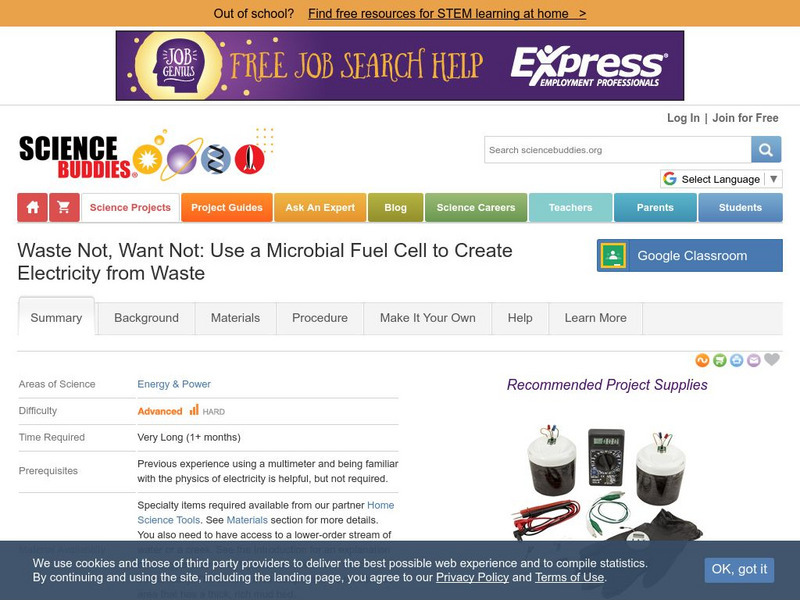
Science Buddies: Waste Not, Want Not: Use the Microbial Fuel Cell to Create Elec
Gross. What is that in the toilet? But maybe it's not just gross. Did you know there are bacteria that digest organic waste and create electrons? What if there was a way to collect those electrons to power a circuit? In this science fair...
Science Buddies
Science Buddies: Memory Mnemonics
Though lists can be full of interesting facts, they can be hard to remember, especially for tests. In this human behavior science fair project, you will learn about a memory technique called mnemonics (pronounced nuh-MAH-nicks). See if...
NASA
Nasa: Mars and Earth: Science Learning Activities for Afterschool
This set of activities teaches students about the big picture of science using Mars as an example: how to collect data, use evidence, and look at models.

Sophia Learning
Sophia: Space Science: Bill Nye: Weightless Clothespin
Created to teach students of the 21st century, SOPHIA is bringing the world of science straight to your fingertips. Become the commander of your own learning experiences as you take part in this interactive experiment.

National Science Foundation
National Science Foundation: Language and Linguistics
The language we use everyday reveals a great deal about who we are and where we come from. However, did you know that language is linked to psychology, biology, and other sciences? Explore the "science" of language: how the brain...
![Genome Sciences Education Outreach: State Your Traits [Pdf] Lesson Plan](https://static.lp.lexp.cloud/images/attachment_defaults/resource/large/FPO-knovation.png "Genome Sciences Education Outreach: State Your Traits [Pdf] Lesson Plan")
University of Washington
Genome Sciences Education Outreach: State Your Traits [Pdf]
Multi-activity lesson in which students engage in learning about the inheritance of genetic traits.

Sophia Learning
Sophia: Health Sciences: Functions of Bone
Created to teach students of the 21st century, SOPHIA is bringing the 7 functions of the bone straight to your fingertips. Become the commander of your own learning experiences as you take part in this interactive lesson.
Science Bob Pflugfelder
Science Bob: Science Fairs
Find out what the difference is between a science demonstration and a science experiment. Then explore Science Bob's page to learn about ideas for science fairs, the Scientific Method, science fair resources, and even some helpful advice.
Sophia Learning
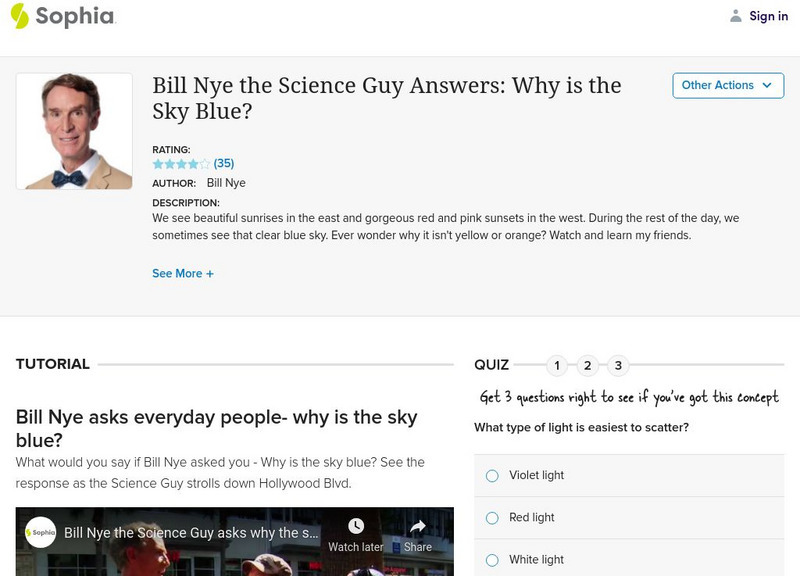
Sophia: Bill Nye the Science Guy Answers: Why Is the Sky Blue?
Take a look at this video [0:51] from Bill Nye the Science Guy to learn why the sky is blue.
E-learning for Kids
E Learning for Kids: Science: Antarctica: How Are Sounds Useful to Us?
Paul is a researcher on Antarctica. The topic of his research is sounds. Identify which objects make sounds, and learn to recognize different sounds.
E-learning for Kids
E Learning for Kids: Science: Bermuda Triangle: What Happens When an Object Gains or Loses Heat?
Learn about states of matter on a flight tour over the Atlantic Ocean.
E-learning for Kids
E Learning for Kids: Science: Easter Island: What Makes Up Our Circulatory System?
Help Atua learn how our blood works, and what our circulatory system has to do with this.
E-learning for Kids
E Learning for Kids: Science: Iceland: Plants: What Parts Do Plants Have?
Explore Benny's garden, and he will show how plants and trees are built. Join him to to learn about basic plant parts.
E-learning for Kids
E Learning for Kids: Science: Italy: How Are Magnets Made?
Paolo works in a Pizzeria. He is trying to make his own magnets. Join him and help him learn.
E-learning for Kids
E Learning for Kids: Science: Hawaii: What Happens in the Life Cycle of a Flowering Plant?
Sophie and Max are growing plants in their greenhouse. Join them, and learn about the life cycle of a plant.
CK-12 Foundation
Ck 12: Earth Science: Seismic Waves
[Free Registration/Login may be required to access all resource tools.] The seismic waves that emanate from earthquakes include body waves and surface waves. Learn how scientists use seismic waves to learn about the Earth's interior.
American Geosciences Institute
American Geosciences Institute: Earth Science Week: What's Under My Feet? Learning to Use a Geologic Map
Students use geologic maps to learn about rocks and minerals.
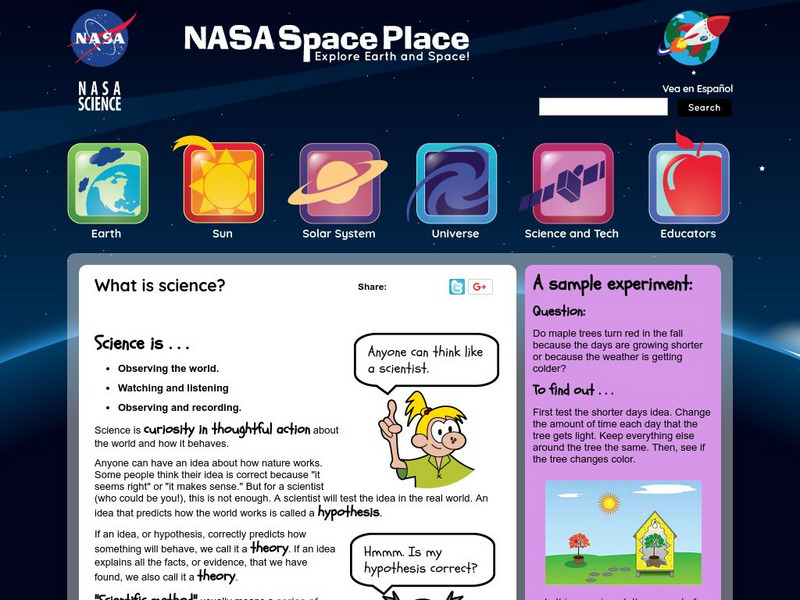
NASA
Nasa: Space Place: What Is Science?
Students learn abut scientific investigation and the difference between hypotheses and theories.
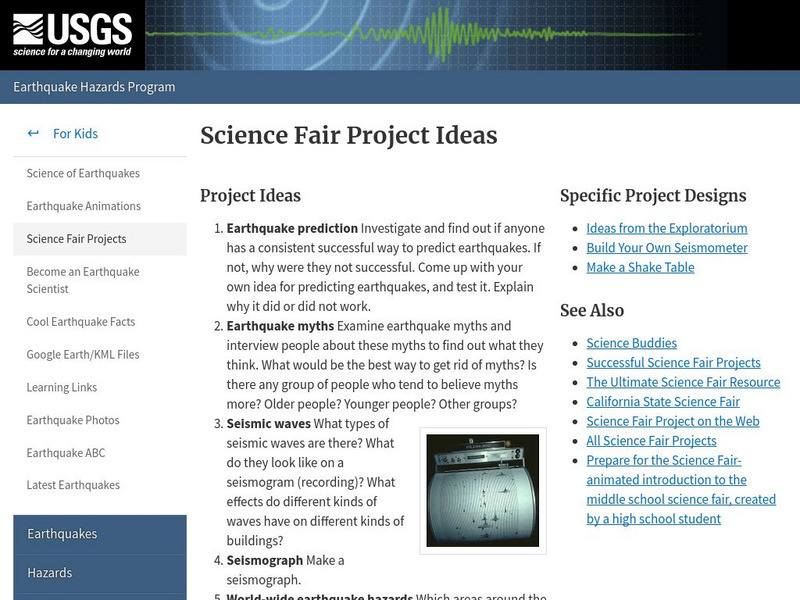
US Geological Survey
U.s. Geological Survey: Earthquake Science Fair Project Ideas
Twenty earthquake-related science fair project ideas. Each idea has a short description of a possible investigation.
CK-12 Foundation
Ck 12: Life Science: 12.18 Food Chain
Learn how energy is passed along through living things in a food chain and web.
Other popular searches
- Project Based Learning Science
- Science Cooperative Learning
- Science Learning Contracts
- Science Learning Centers
- Science Learning Cycle
- Science Problem Based Learning
- Mastery Learning Science
- Inquiry Based Learning Science
- Independent Learning Science
- Learning Cycle Science Earth
- Science Learning Games
- Inductive Learning Science