Hi, what do you want to do?






Achieve
Ivy Smith Grows Up
Babies grow at an incredible rate! Demonstrate how to model growth using a linear function. Learners build the function from two data points, and then use the function to make predictions.

Shodor Education Foundation
Data Flyer
Fit functions to data by using an interactive app. Individuals plot a scatter plot and then fit lines of best fit and regression curves to the data. The use of an app gives learners the opportunity to try out different functions to see...

Shodor Education Foundation
Conic Flyer
Graphing conics made easy. Individuals use an interactive to graph conic sections. The app can handle circles, vertical and horizontal parabolas, ellipses, and vertical and horizontal hyperbolas.

Shodor Education Foundation
Multi-Function Data Flyer
Explore different types of functions using an interactive lesson. Learners enter functions and view the accompanying graphs. They can choose to show key features or adjust the scale of the graph.

EngageNY
Analyzing Data Collected on Two Variables
Assign an interactive poster activity to assess your class's knowledge and skill concerning data analysis. The teacher reference provides solid questions to ask individuals or groups as they complete their posters.

Curated OER
Graphs and Data
Pupils investigate poverty using graphs. In this algebra lesson, students collect data on the effects of poverty and use different rules to analyze the data. They graph and use the trapezoid rule to interpret the data.

Curated OER
Exploring Functions with Calculus and Dynamic Software
Calculus can be project-based and inquiry-centered by using dynamic software.

Curated OER
Lesson 6-7: Scatter Plots and Equations of Lines
For this scatter plot worksheet, students examine tables and write a linear equation that matches the table. Students graph linear equations. They read scatter plots, determine the trend line, and write a linear equation to...

Curated OER
Math TODAY Challenge - New Color of Money
Students read about the changes in the "new money" and then create a graph to represent various combinations of currency produced.

Curated OER
Volumes in 3-D
In this geometry learning exercise, 11th graders calculate the volume of there dimensional shapes using the formula for cylinders. They are given the height and the base and asked to calculate the volume. There are 4 problems.

Curated OER
Finding the Vertex of a Quadratic Function
Young scholars solve quadratic equations and identify the vertex. In this algebra lesson, students factor quadratic equations and identify the different properties of a parabola. They graph the functions using the vertex and intercepts.

Curated OER
Resources - A Reading Guide
In this resources worksheet, students compare and contrast physical and chemical properties and changes. Students review the periodic table, pattern of atomic numbers and chemical reactivity. This worksheet has 56 short answer questions.
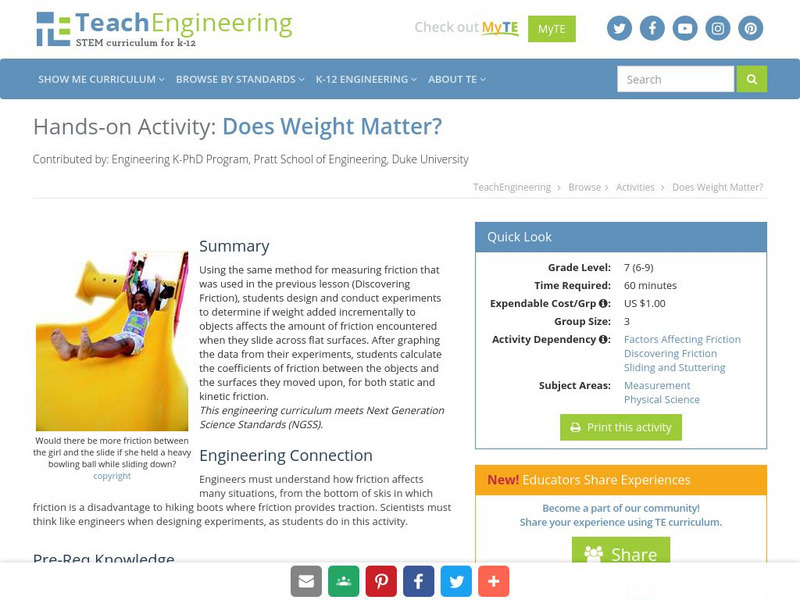
TeachEngineering
Teach Engineering: Does Weight Matter?
Using the same method for measuring friction that was used in the previous lesson (Discovering Friction), students design and conduct an experiment to determine if weight added incrementally to an object affects the amount of friction...
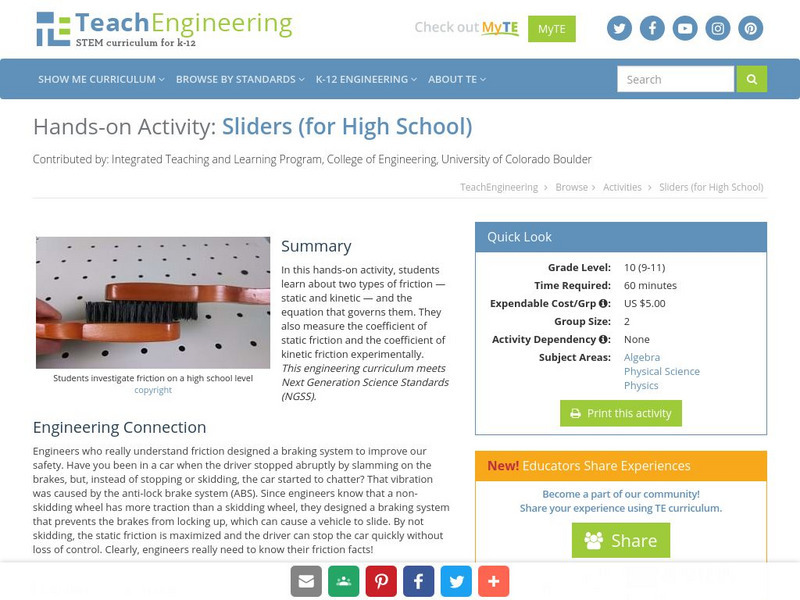
TeachEngineering
Teach Engineering: Sliders (For High School)
In this hands-on activity, students learn about two types of friction - static and kinetic - and the equation that governs them. They also measure the coefficient of static friction and the coefficient of kinetic friction experimentally.
Texas Instruments
Texas Instruments: An Introduction to Derive
In this activity, students use the Derive software to algebraically solve expressions, find factors, study binomial coefficients, and investigate derivatives and integrals.
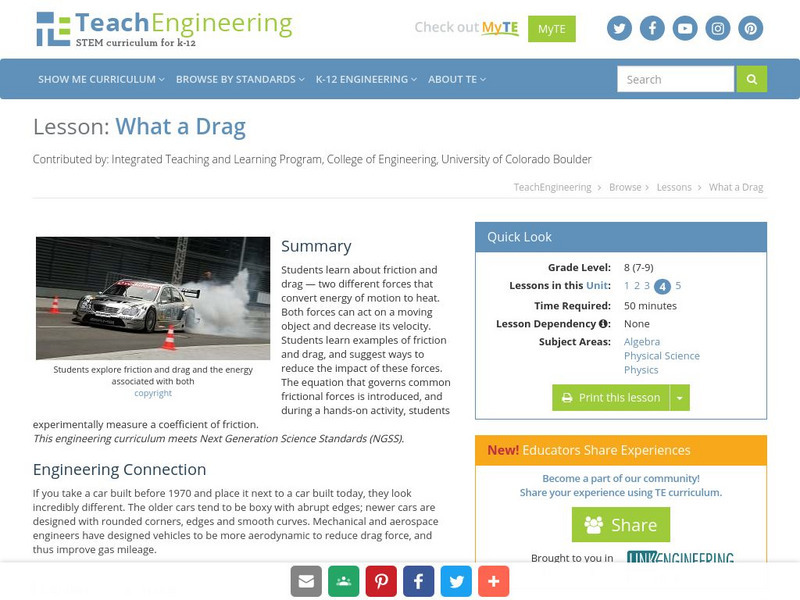
TeachEngineering
Teach Engineering: What a Drag
Students learn about friction and drag - two different forces that convert energy of motion to heat. Both forces can act on a moving object and decrease its velocity. Students learn examples of friction and drag, and suggest ways to...
TeachEngineering
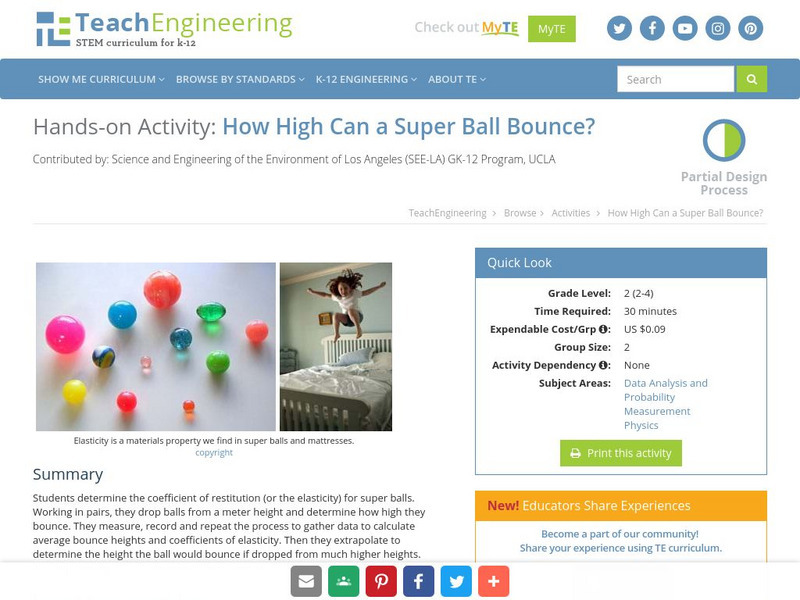
Teach Engineering: How High Can a Super Ball Bounce?
Students determine the coefficient of restitution (or the elasticity) for super balls. Working in pairs, they drop balls from a meter height and determine how high they bounce. They measure, record and repeat the process to gather data...
TeachEngineering
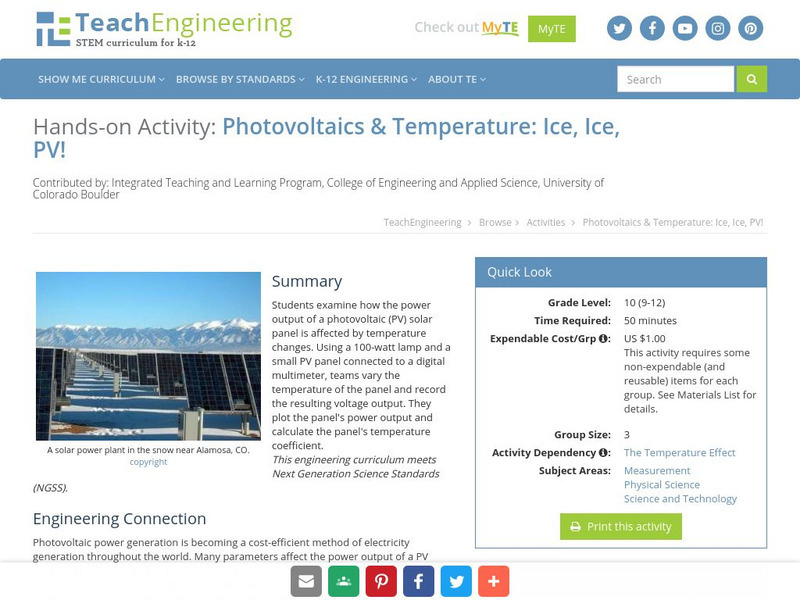
Teach Engineering: Ice, Ice, Pv!
Students examine how the power output of a photovoltaic (PV) solar panel is affected by temperature changes. Using a 100-watt lamp and a small PV panel connected to a digital multimeter, teams vary the temperature of the panel and record...
TeachEngineering
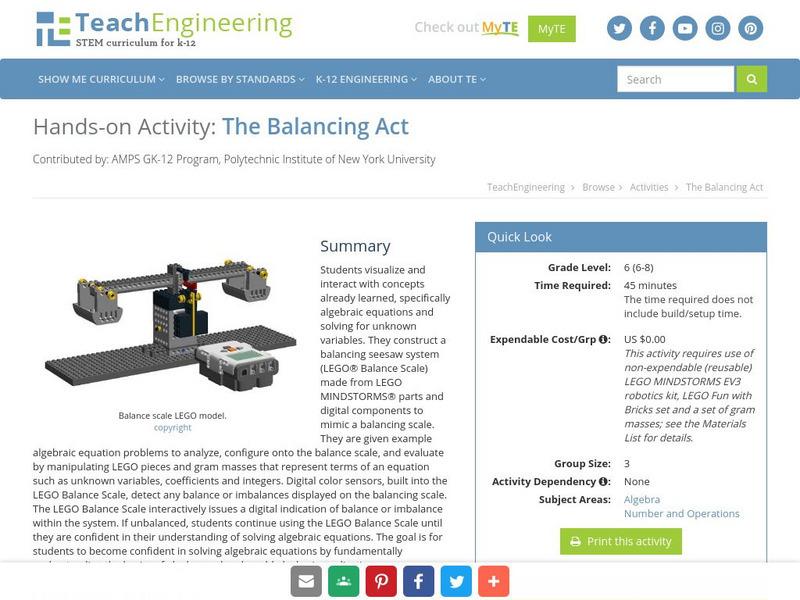
Teach Engineering: The Balancing Act
Students are given the opportunity to visualize and interact with concepts they have already learned, specifically algebraic equations and solving for unknown variables. Students construct a balancing seesaw system (LEGO Balance Scale)...
TeachEngineering
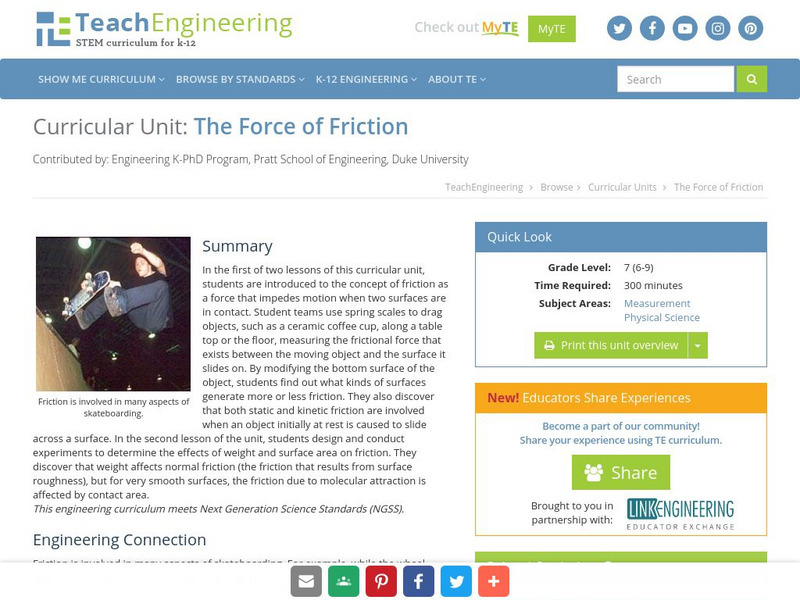
Teach Engineering: The Force of Friction
In the first of two lessons of this curricular unit, students are introduced to the concept of friction as a force that impedes motion when two surfaces are in contact. Student teams use spring scales to drag objects, such as a ceramic...
TeachEngineering
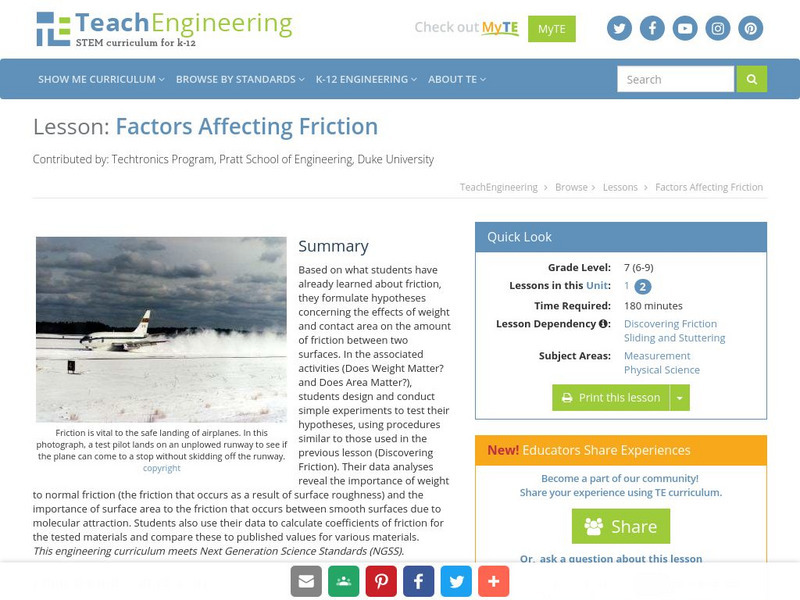
Teach Engineering: Factors Affecting Friction
In this lesson, students use previous knowledge about friction to formulate hypotheses concerning the effects of weight and contact area on the amount of friction between two surfaces. In the Associated Activities (Does Weight Matter?...
TeachEngineering
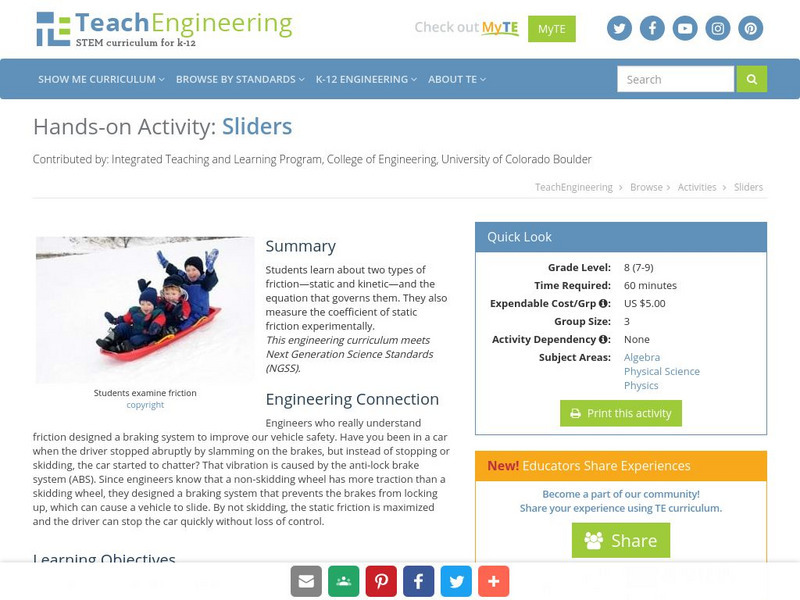
Teach Engineering: Sliders
In this hands-on activity, students learn about two types of friction - static and kinetic - and the equation that governs them. They also measure the coefficient of static friction experimentally.

TeachEngineering
Teach Engineering: Ramp and Review (For High School)
In this hands-on activity - rolling a ball down an incline and having it collide into a cup - the concepts of mechanical energy, work and power, momentum, and friction are all demonstrated. During the activity, students take measurements...
TeachEngineering
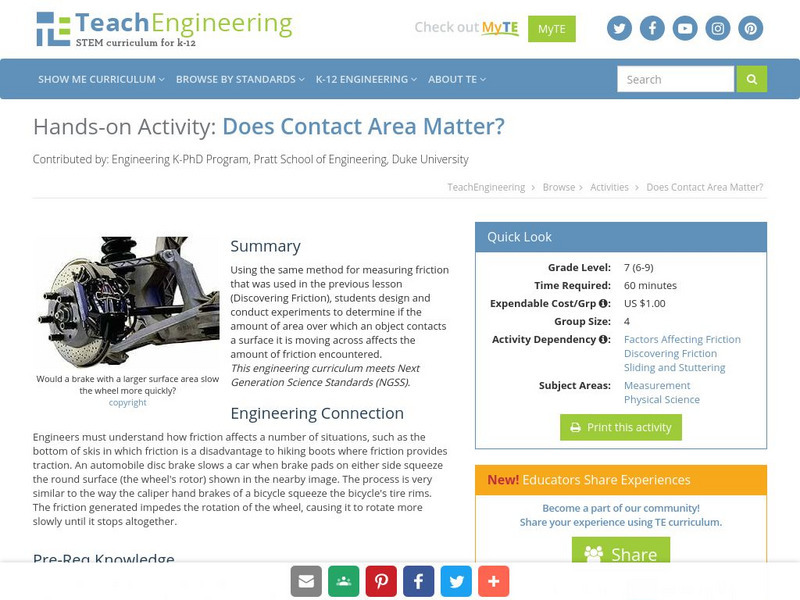
Teach Engineering: Does Contact Area Matter?
Using the same method for measuring friction that was used in the previous lesson (Discovering Friction), students design and conduct an experiment to determine if the amount of area over which an object contacts a surface it is moving...