Hi, what do you want to do?





TeachEngineering
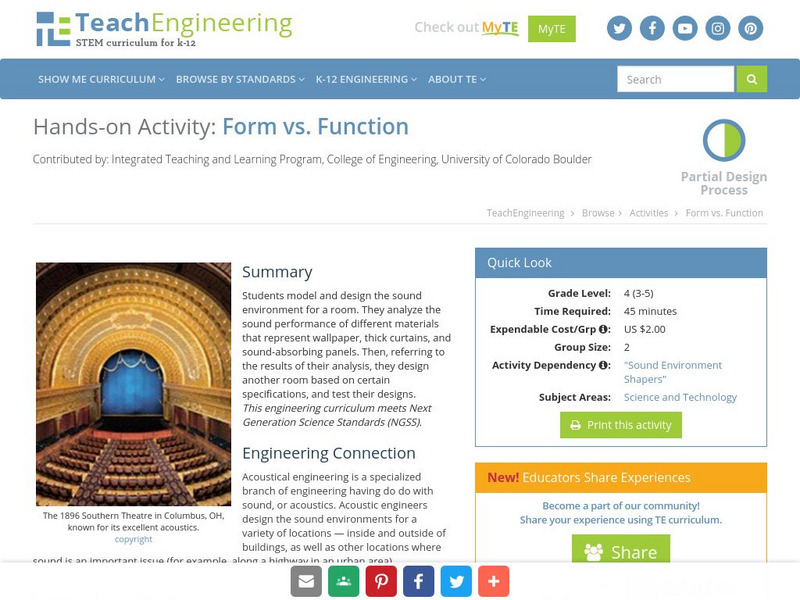
Teach Engineering: Form vs. Function
Students model and design the sound environment for a room. They analyze the sound performance of different materials that represent wallpaper, thick curtains, and sound-absorbing panels. Then, referring to the results of their analysis,...
TeachEngineering
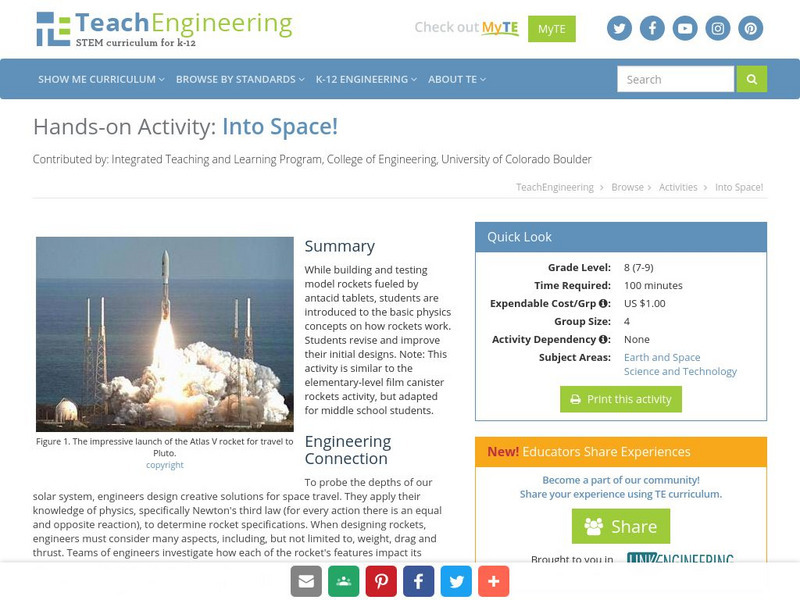
Teach Engineering: Into Space!
While building and testing model rockets fueled by antacid tablets, students are introduced to the basic physics concepts on how rockets work. Students revise and improve their initial designs. Note: This activity is similar to the...
TeachEngineering
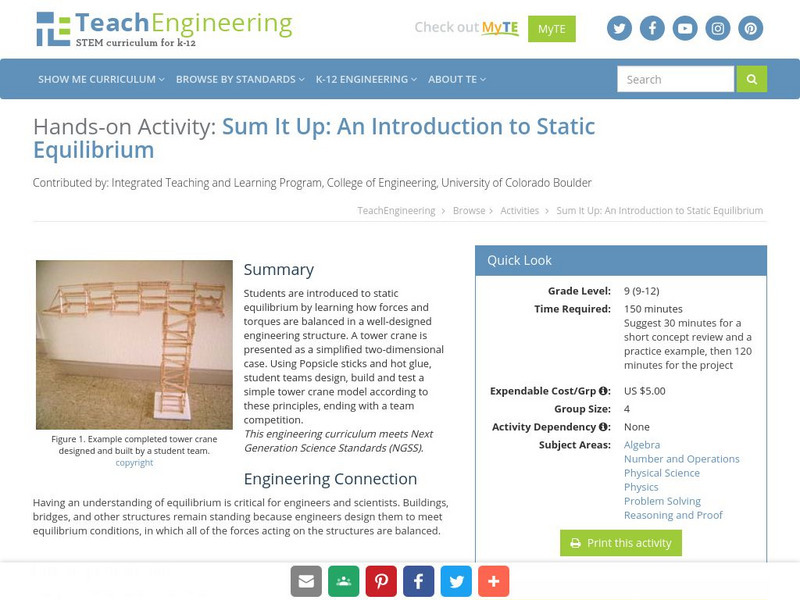
Teach Engineering: Sum It Up: An Introduction to Static Equilibrium
Students are introduced to static equilibrium by learning how forces and torques are balanced in a well-designed engineering structure. A tower crane is presented as a simplified two-dimensional case. Using Popsicle sticks and hot glue,...
TeachEngineering
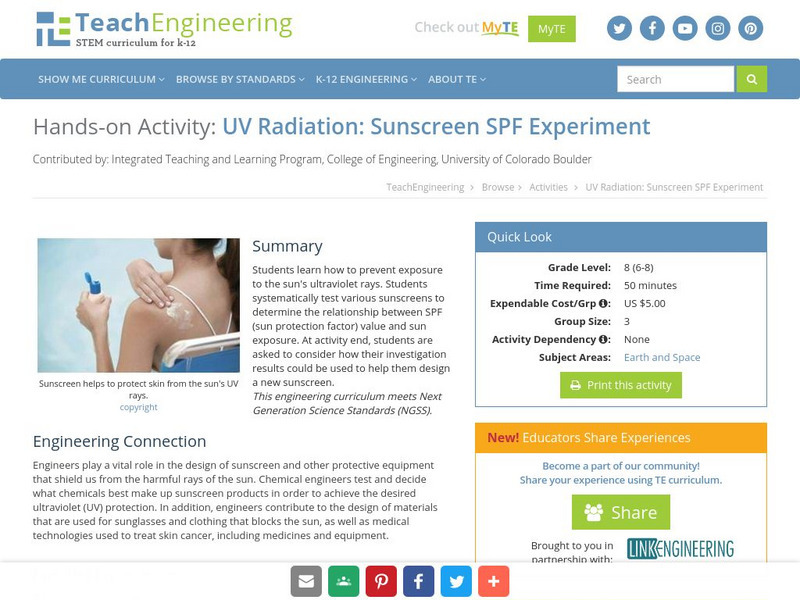
Teach Engineering: It Burns!
In this activity, students learn how to prevent exposure to the Sun's harmful ultraviolet rays. Students will systematically test various sunscreens to determine the relationship between spf (sun protection factor) value and sun...
TeachEngineering
Teach Engineering: Designing a Robotic Surgical Device
Student teams create laparoscopic surgical robots designed to reduce the invasiveness of diagnosing endometriosis and investigate how the disease forms and spreads. Using a synthetic abdominal cavity simulator, students test and iterate...
TeachEngineering
Teach Engineering: Viking Ship Design Challenge
In this design challenge, students learn about the Vikings from an engineering point-of-view. While investigating the history and anatomy of Viking ships, they learn how engineering solutions are shaped by the surrounding environment and...
TeachEngineering
Teach Engineering: Save a Life, Clean Some Water!
Student teams practice water quality analysis through turbidity measurement and coliform bacteria counts. They use information about water treatment processes to design prototype small-scale water treatment systems and test the influent...
TeachEngineering
Teach Engineering: The Puck Stops Here
After learning about transfer of energy, specifically the loss of kinetic energy to friction, students get a chance to test friction. In groups they are given a wooden block, different fabrics, and weights and asked to design the "best"...
TeachEngineering
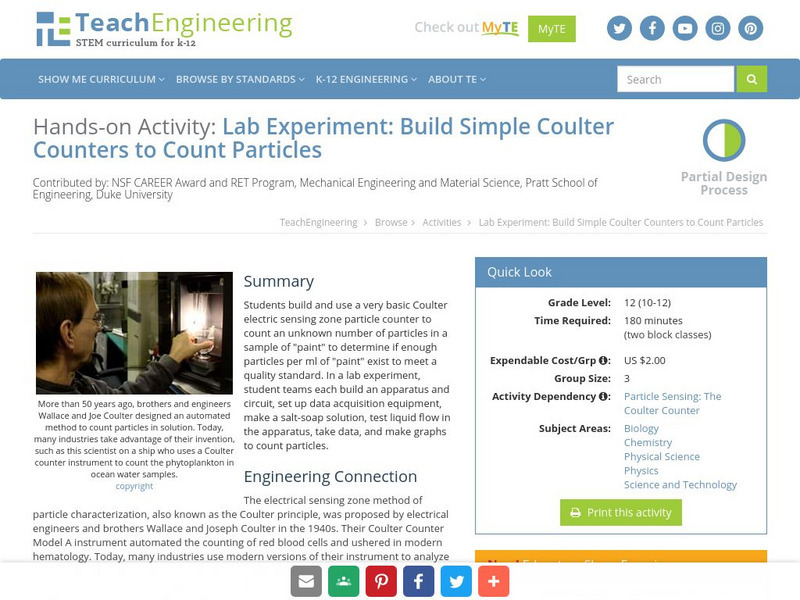
Teach Engineering: Simple Coulter Counter
Students build and use a very basic Coulter electric sensing zone particle counter to count an unknown number of particles in a sample of "paint" to determine if enough particles per ml of paint exist to meet a quality standard. In a lab...
TeachEngineering
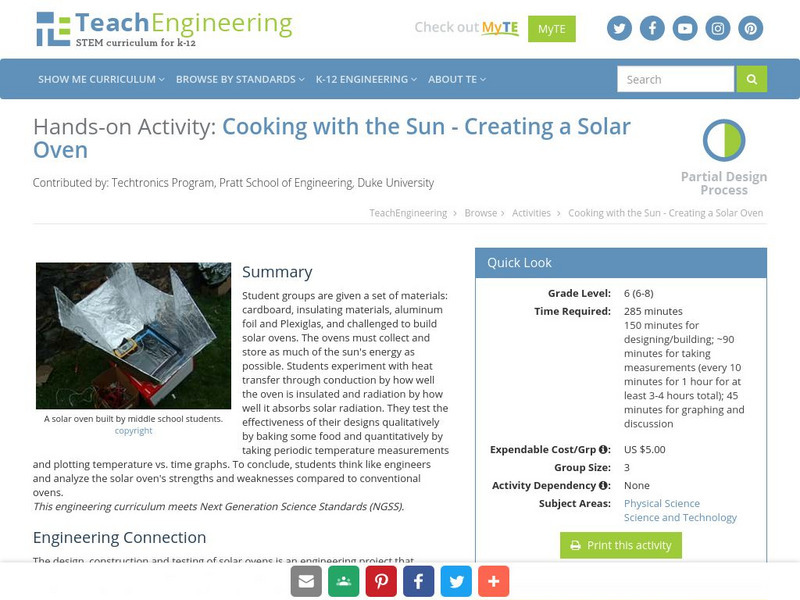
Teach Engineering: Cooking With the Sun Creating a Solar Oven
For this activity, students will be given a set of materials: cardboard, a set of insulating materials (i.e. foam, newspaper, etc.), aluminum foil, and Plexiglas. Students will then become engineers in building a solar oven from the...
TeachEngineering
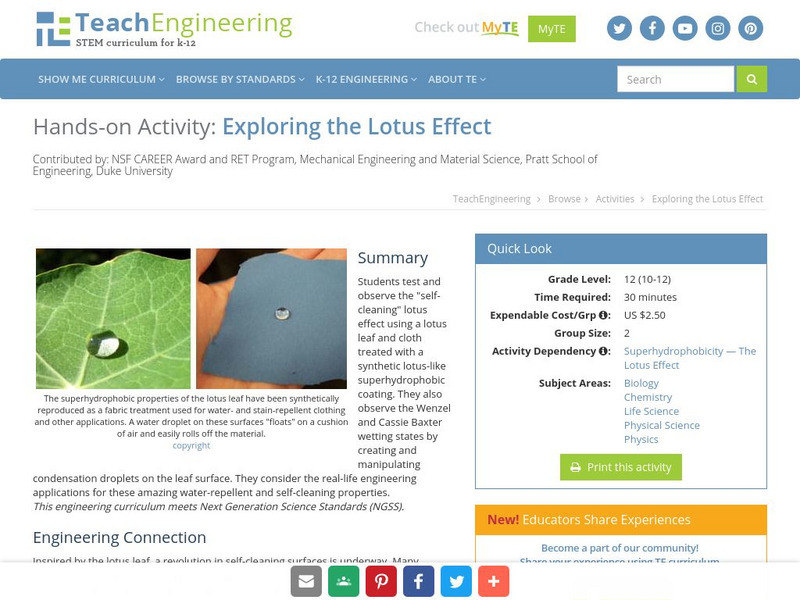
Teach Engineering: Exploring the Lotus Effect
Students test and observe the "self-cleaning" lotus effect using a lotus leaf and cloth treated with a synthetic lotus-like superhydrophobic coating. They also observe the Wenzel and Cassie Baxter wetting states by creating and...

TeachEngineering
Teach Engineering: A Tasty Experiment
Students conduct an experiment to determine whether or not the sense of smell is important to being able to recognize foods by taste. They do this by attempting to identify several different foods that have similar textures. For some of...
TeachEngineering
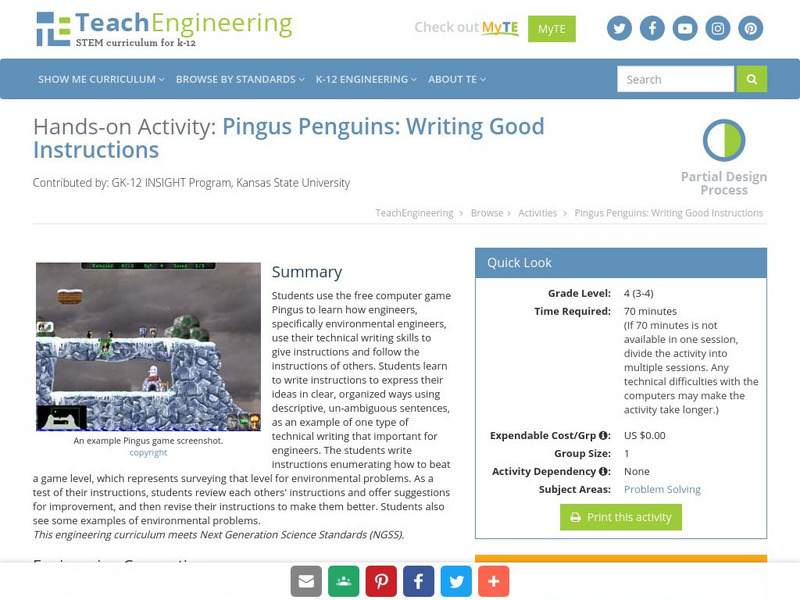
Teach Engineering: Pingus Penguins: Writing Good Instructions
Students use the free computer game Pingus to learn how engineers, specifically environmental engineers, use their technical writing skills to give instructions and follow the instructions of others. Students learn to write instructions...
TeachEngineering
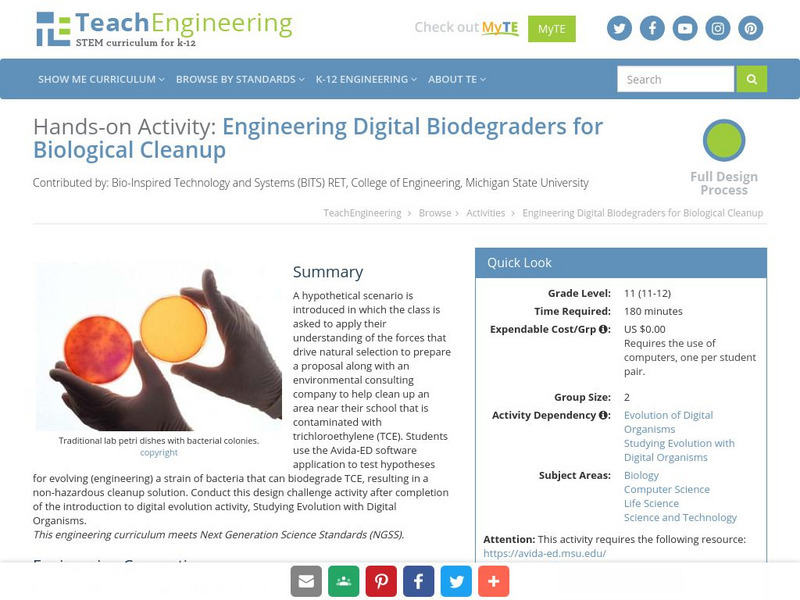
Teach Engineering: Evolving Tce Biodegraders
A hypothetical scenario is introduced in which the class is asked to apply their understanding of the forces that drive natural selection to prepare a proposal along with an environmental consulting company to help clean up an area near...
TeachEngineering
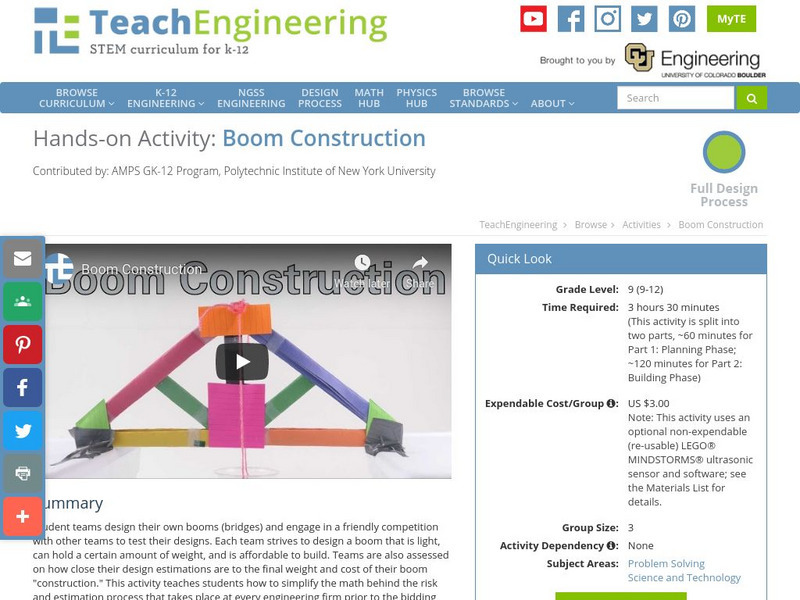
Teach Engineering: Boom Construction
Student teams design their own booms (bridges) and engage in a friendly competition with other teams to test their designs. Each team strives to design a boom that is light, can hold a certain amount of weight, and is affordable to...
TeachEngineering
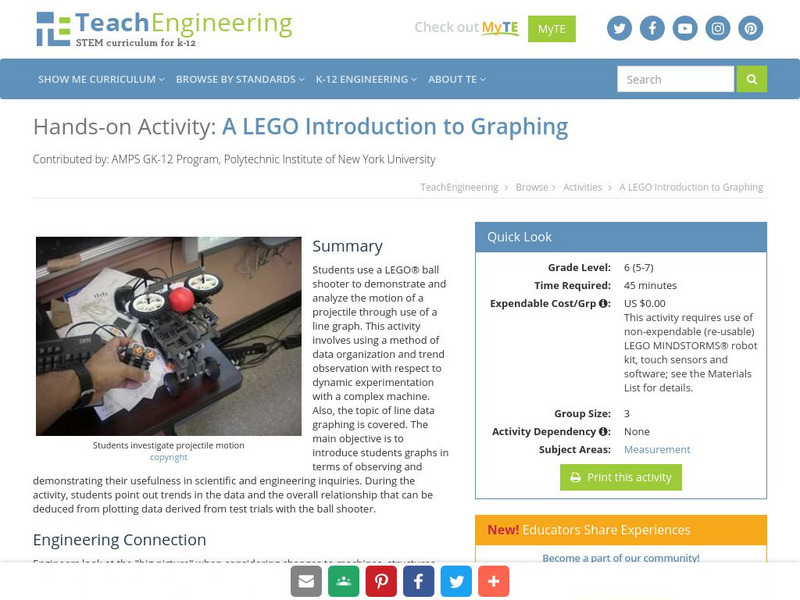
Teach Engineering: A Lego Introduction to Graphing
Students use a LEGO ball shooter to demonstrate and analyze the motion of a projectile through use of a line graph. This activity involves using a method of data organization and trend observation with respect to dynamic experimentation...
TeachEngineering
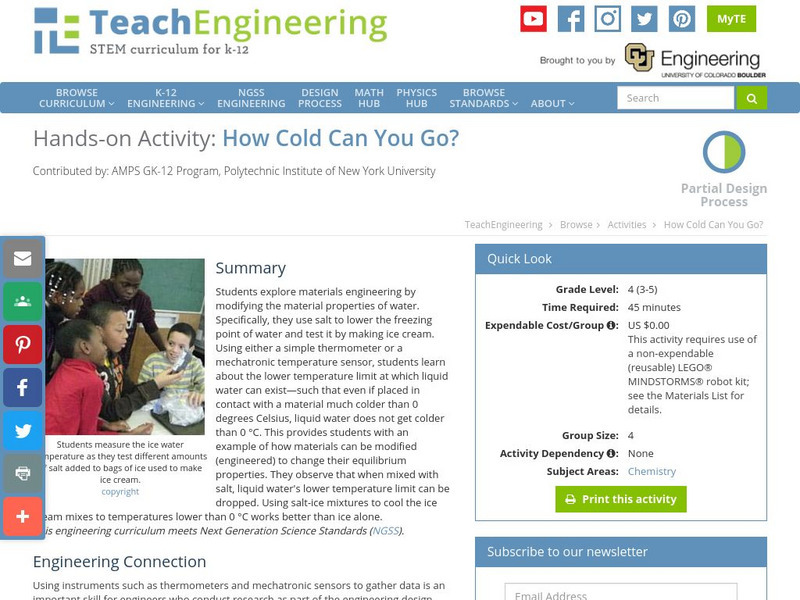
Teach Engineering: How Cold Can You Go?
Students explore materials engineering by modifying the material properties of water. Specifically, they use salt to lower the freezing point of water and test it by making ice cream. Using either a simple thermometer or a mechatronic...
TeachEngineering
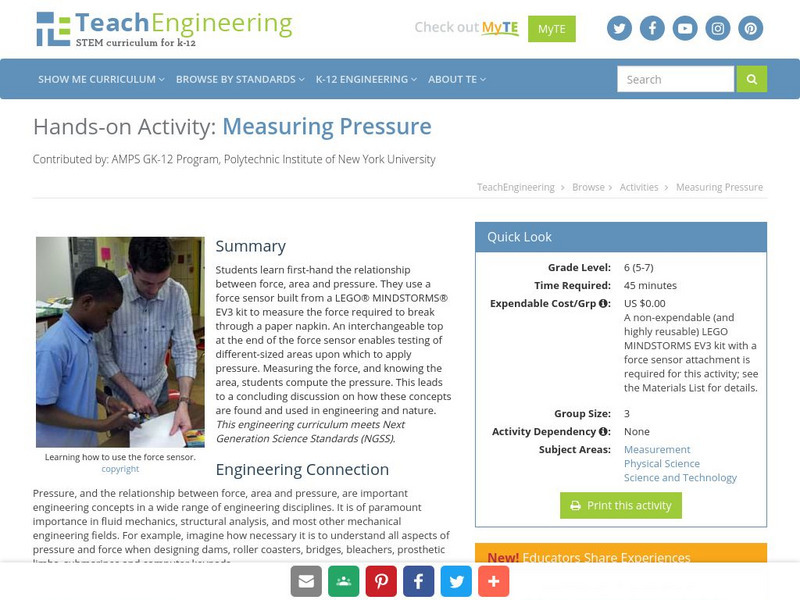
Teach Engineering: Measuring Pressure
Students learn first-hand the relationship between force, area and pressure. They use a force sensor built from a LEGO MINDSTORMS NXT kit to measure the force required to break through a paper napkin. An interchangeable top at the end of...
TeachEngineering
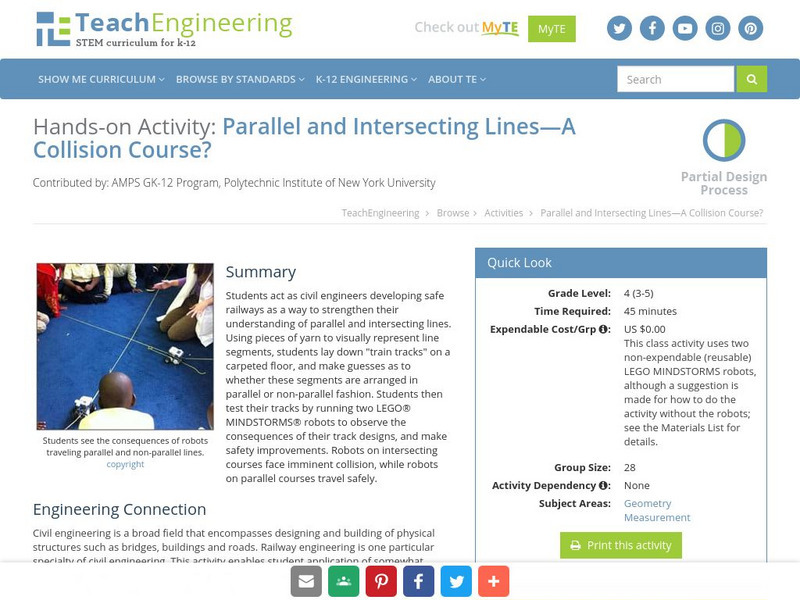
Teach Engineering: Parallel and Intersecting Lines: A Collision Course?
Students act as civil engineers developing safe railways as a way to strengthen their understanding of parallel and intersecting lines. Using pieces of yarn to visually represent line segments, students lay down "train tracks" on a...
TeachEngineering
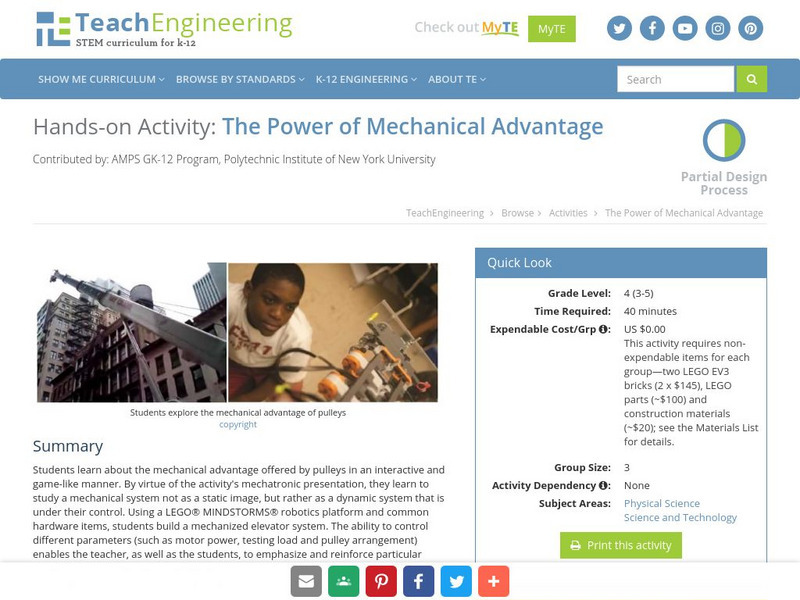
Teach Engineering: The Power of Mechanical Advantage
Students learn about the mechanical advantage offered by pulleys in an interactive and game-like manner. By virtue of the activity's mechatronic presentation, they learn to study a mechanical system not as a static image, but rather as a...
TeachEngineering
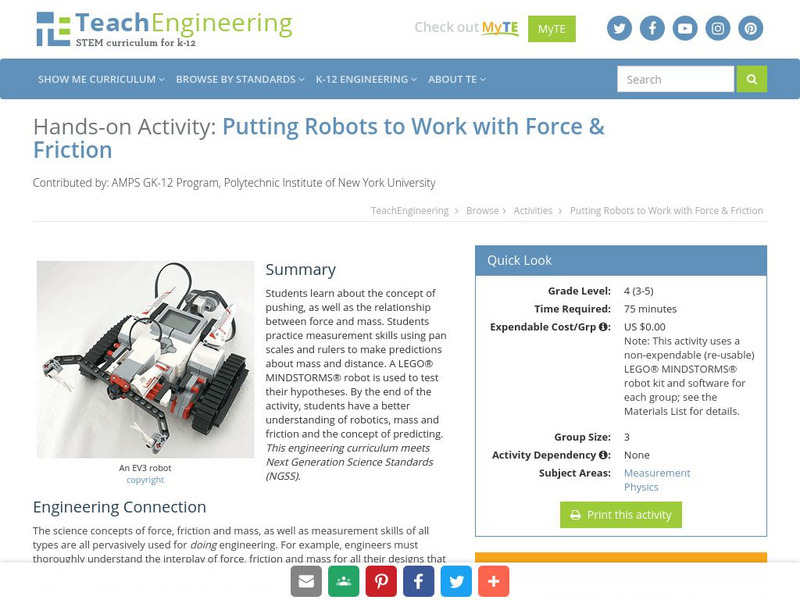
Teach Engineering: Putting Robots to Work With Force & Friction
Students learn about the concept of pushing, as well as the relationship between force and mass. Students practice measurement skills using pan scales and rulers to make predictions about mass and distance. A LEGO MINDSTORMS NXT robot is...
TeachEngineering
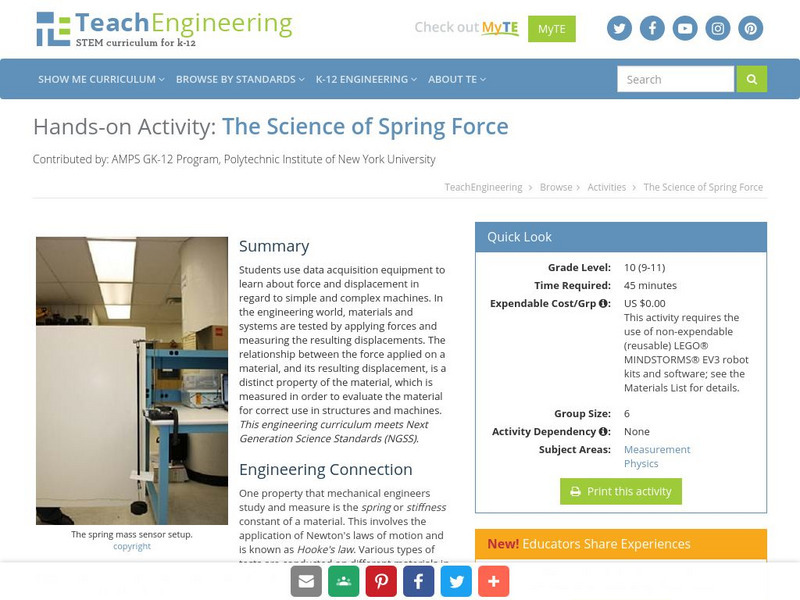
Teach Engineering: The Science of Spring Force
Students use data acquisition equipment to learn about force and displacement in regard to simple and complex machines. In the engineering world, materials and systems are tested by applying forces and measuring the resulting...
TeachEngineering
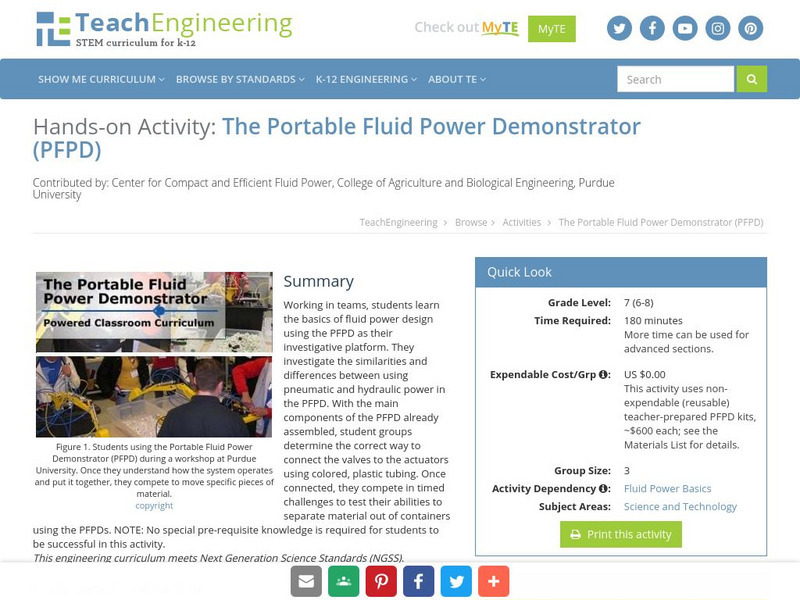
Teach Engineering: The Portable Fluid Power Demonstrator (Pfpd)
Working as teams, students learn the basics of fluid power design using the PFPD as their investigative platform. Students will investigate the similarities and differences between using pneumatic and hydraulic power in the PFPD. While...
TeachEngineering
Teach Engineering: Sound From Left or Right?
Why do humans have two ears? How do the properties of sound help with directional hearing? Students learn about directional hearing and how our brains determine the direction of sounds by the difference in time between arrival of sound...