Hi, what do you want to do?






Other
Specialist Schools and Academies Trust: Learn Ar: Pe: Arms & Muscles
A learning resource that incorporates augmented reality (AR), using a camera, where students explore the anatomy of the human arm. The home page for this site has a PDF resource that explains how AR works and provides printable marker...
Other
Catie (Canadian Aids Treatment Information Exchange)
CATIE is a Canadian organization that provides support and information to people affected by HIV and AIDS, and those seeking information on AIDS prevention. The site offers many resources, for example, information for HIV-infected...
Georgia Department of Education
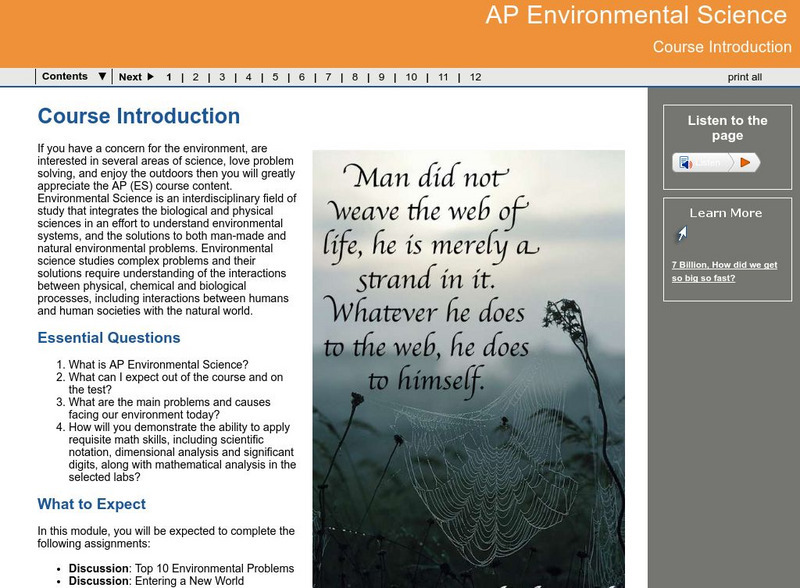
Ga Virtual Learning: Ap Environmental Science: Course Introduction
An introduction to Environmental Science, an interdisciplinary field of study that integrates the biological and physical sciences in an effort to understand environmental systems, and the solutions to both man-made and natural...
TeachEngineering
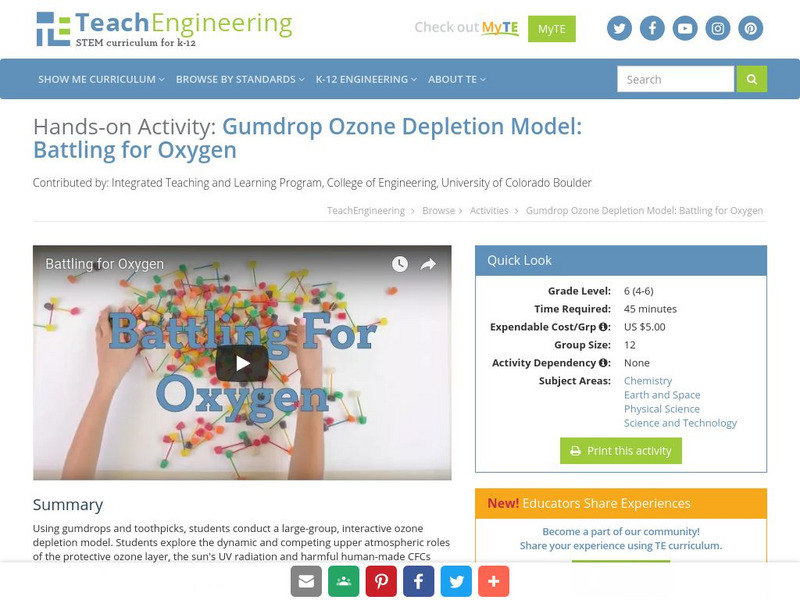
Teach Engineering: Battling for Oxygen
Using gumdrops and toothpicks, students conduct a large-group, interactive ozone depletion model. Students explore the dynamic and competing upper atmospheric roles of the protective ozone layer, the sun's UV radiation and harmful...
TeachEngineering
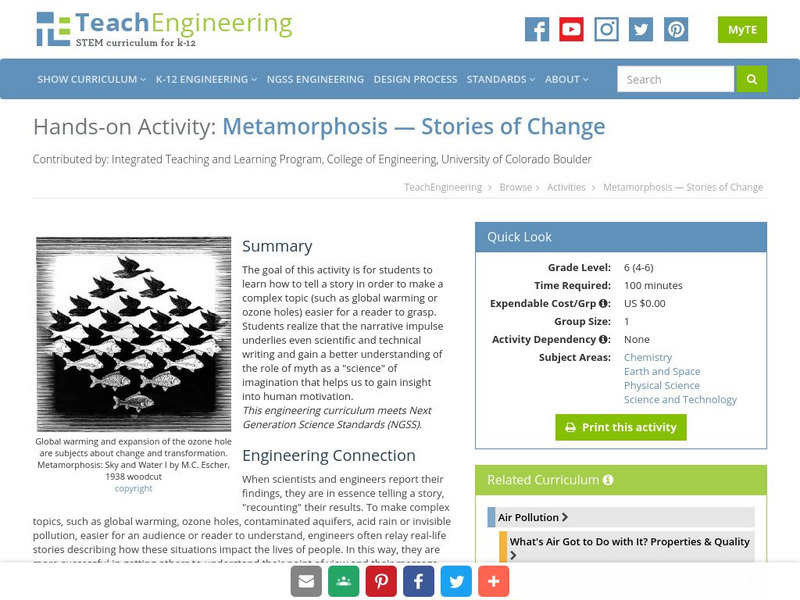
Teach Engineering: Metamorphosis Stories of Change
The goal of this activity is for students to learn how to tell a story in order to make a complex topic (such as global warming or ozone holes) easier for a reader to grasp. Students realize that the narrative impulse underlies even...
TeachEngineering
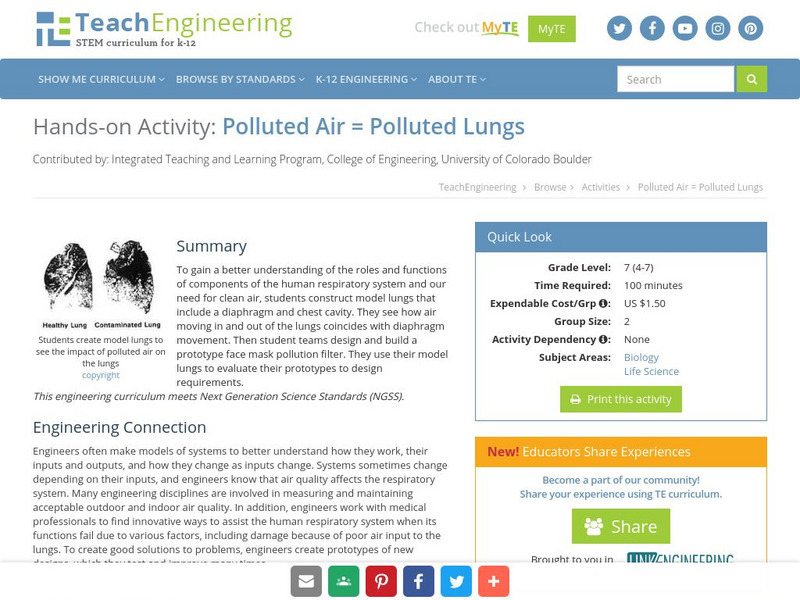
Teach Engineering: Polluted Air = Polluted Lungs
To gain a better understanding of the roles and functions of components of the human respiratory system and our need for clean air, students construct model lungs that include a diaphragm and chest cavity. They see how air moving in and...
TeachEngineering
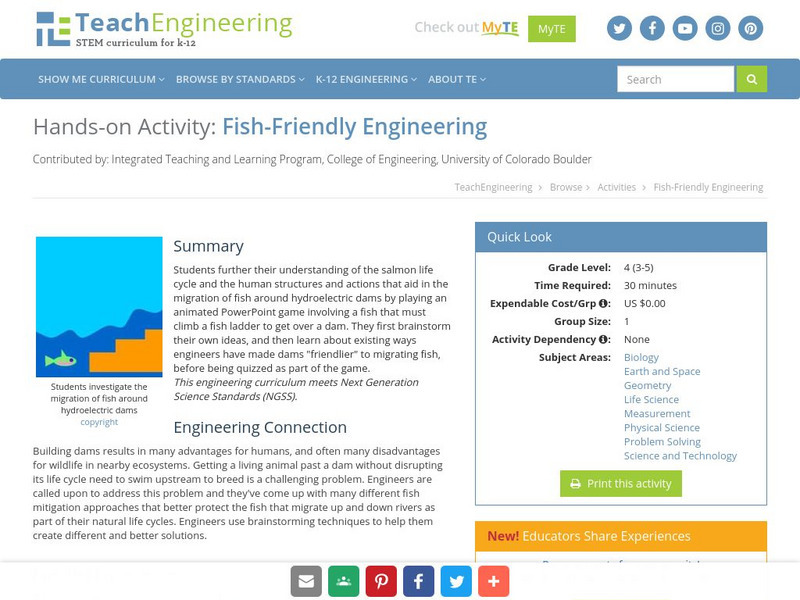
Teach Engineering: Fish Friendly Engineering
Students further their understanding of the salmon life cycle and the human structures and actions that aid in the migration of fish around hydroelectric dams by playing an animated PowerPoint game involving a fish that must climb a fish...
TeachEngineering
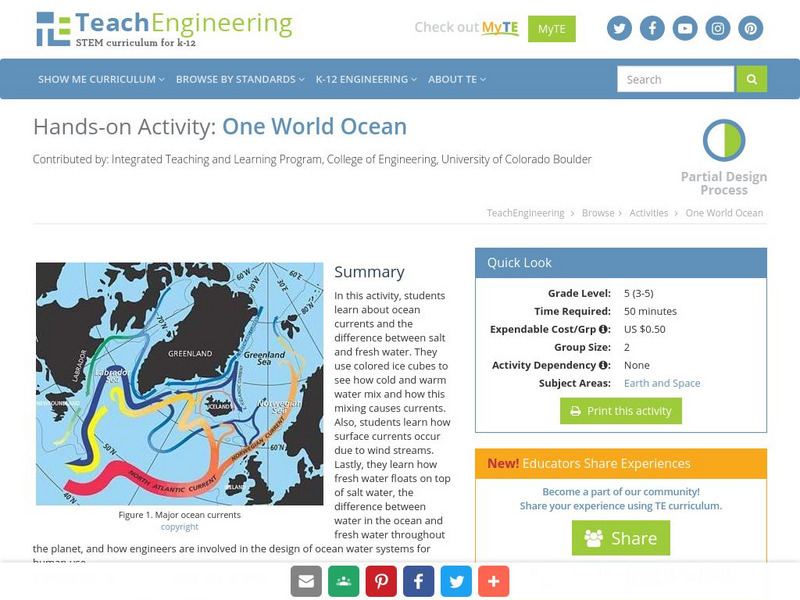
Teach Engineering: One World Ocean
In this activity, students learn about ocean currents and the difference between salt and fresh water. They use colored ice cubes to see how cold and warm water mix and how this mixing causes currents. Also, students learn how surface...
TeachEngineering
Teach Engineering: Can You Catch the Water?
Students construct a three-dimensional model of a water catchment basin using everyday objects to create hills, mountains, valleys and water sources. They experiment to see where rain travels and collects, and survey water pathways to...
TeachEngineering
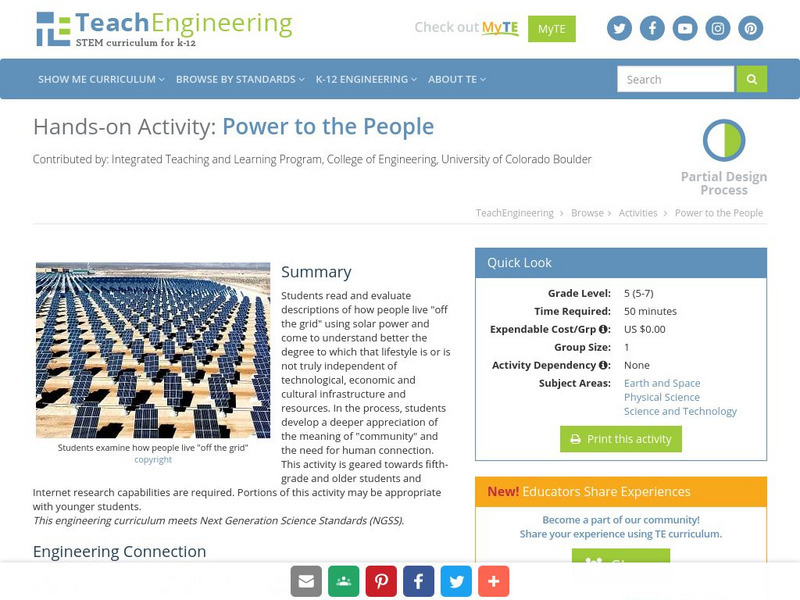
Teach Engineering: Power to the People
Students read and evaluate descriptions of how people live "off the grid" using solar power and come to understand better the degree to which that lifestyle is or is not truly independent of technological, economic and cultural...
TeachEngineering
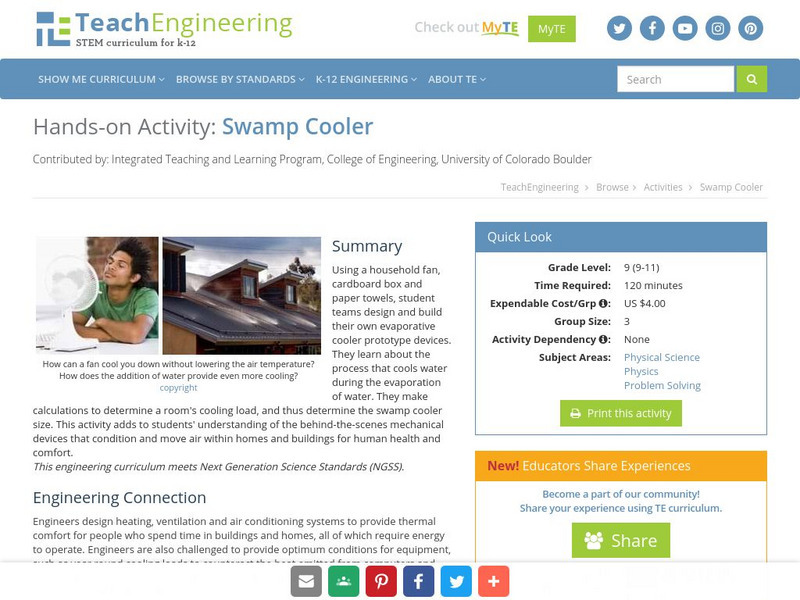
Teach Engineering: Swamp Cooler
Using a household fan, cardboard box and paper towels, student teams design and build an evaporative cooler (swamp cooler). They learn about the process that cools water during the evaporation of water. They make calculations to...
TeachEngineering
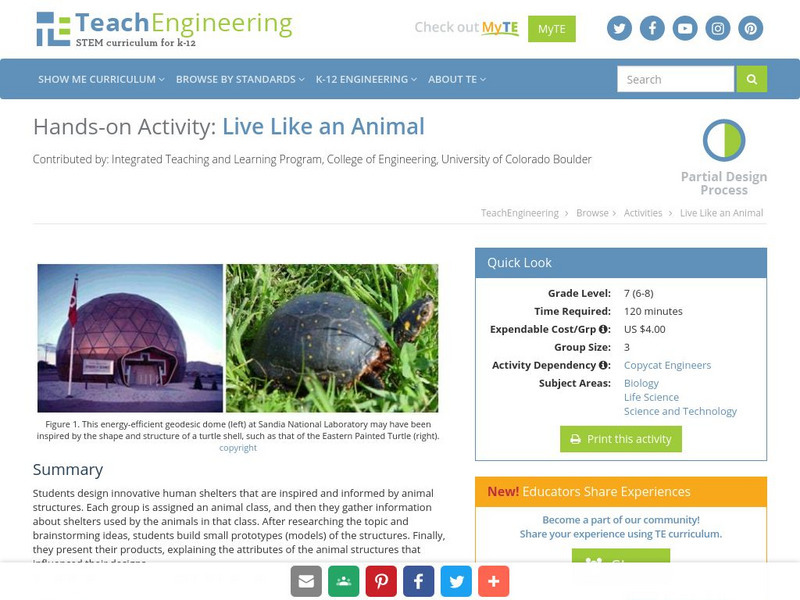
Teach Engineering: Live Like an Animal
In this activity, students design an innovative human shelter that is inspired and informed by an animal structure. Each group is assigned an animal class, and they gather information about shelters used by the animals in that class....
TeachEngineering
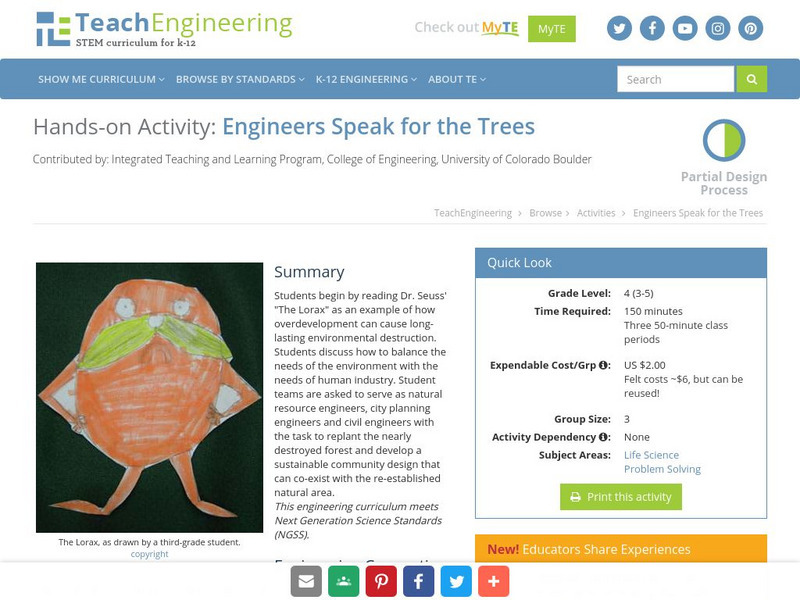
Teach Engineering: Engineers Speak for the Trees
Students begin by reading Dr. Seuss' "The Lorax" as an example of how overdevelopment can cause long-lasting environmental destruction. Students discuss how to balance the needs of the environment with the needs of human industry....
TeachEngineering
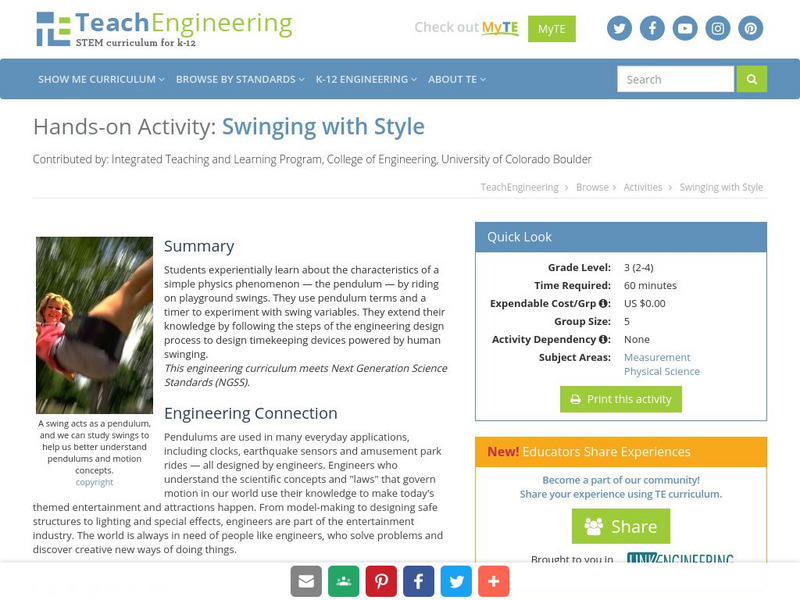
Teach Engineering: Swinging With Style
Students experientially learn about the characteristics of a simple physics phenomenon - the pendulum - by riding on playground swings. They use pendulum terms and a timer to experiment with swing variables. They extend their knowledge...
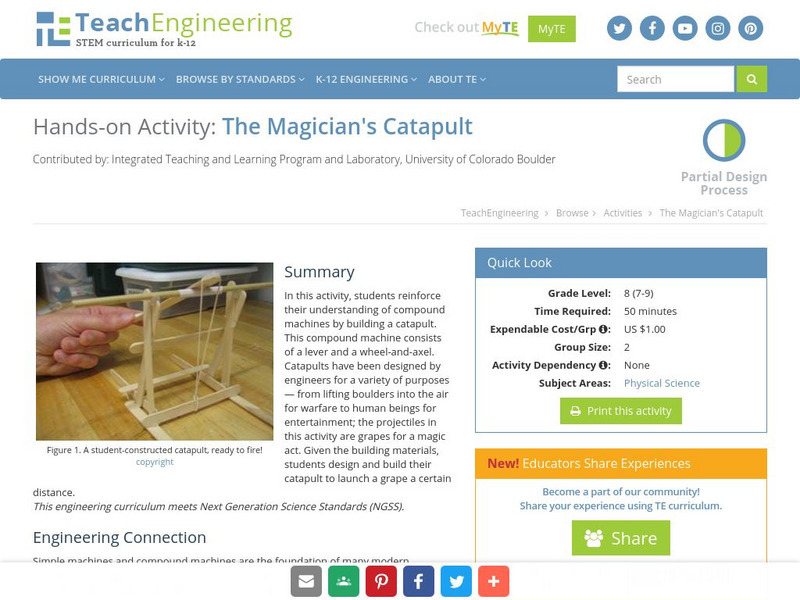
TeachEngineering
Teach Engineering: The Magician's Catapult
In this activity, students reinforce their understanding of compound machines by building a catapult. This compound machine consists of a lever and a wheel-and-axel. Catapults have been designed by engineers for a variety of purposes -...
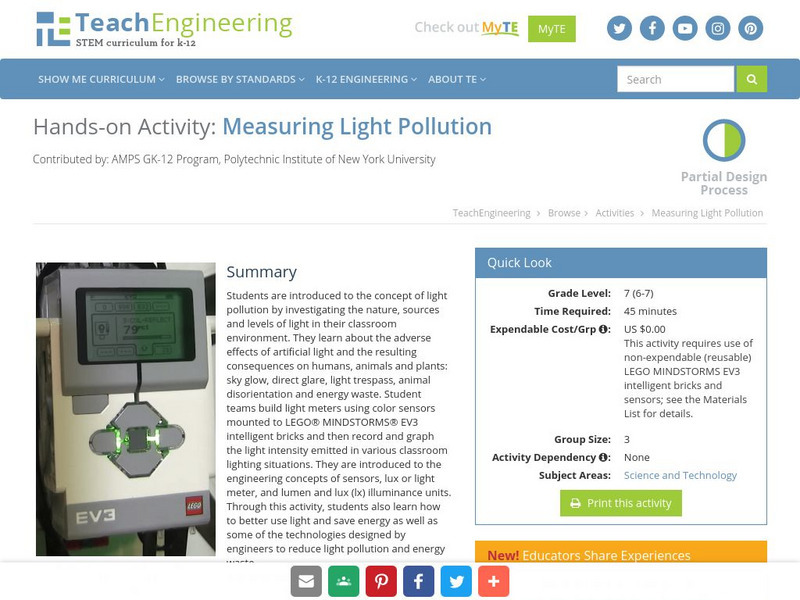
TeachEngineering
Teach Engineering: Measuring Light Pollution
Students are introduced to the concept of light pollution by investigating the nature, sources and levels of light in their classroom environment. They learn about the adverse effects of artificial light and the resulting consequences on...
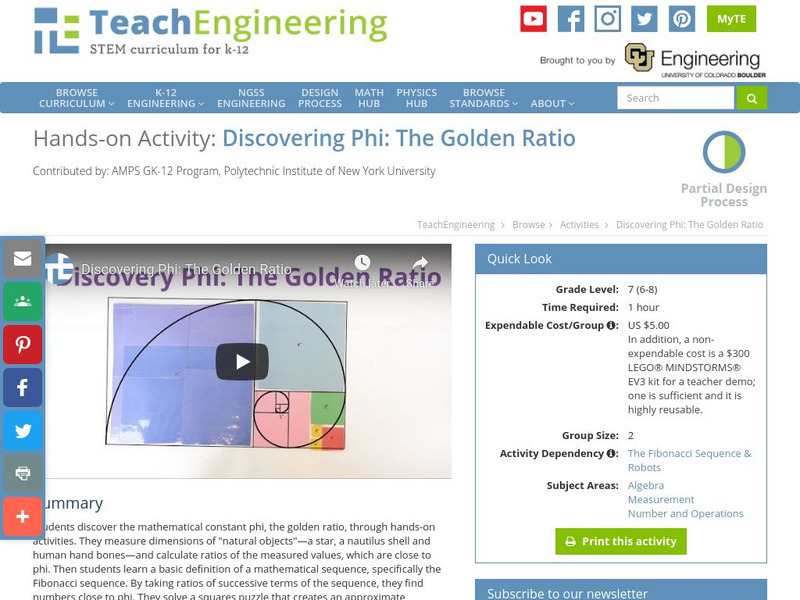
TeachEngineering
Teach Engineering: Discovering Phi: The Golden Ratio
Students discover the mathematical constant phi, the golden ratio, through hands-on activities. They measure dimensions of "natural objects"--a star, a nautilus shell and human hand bones--and calculate ratios of the measured values,...
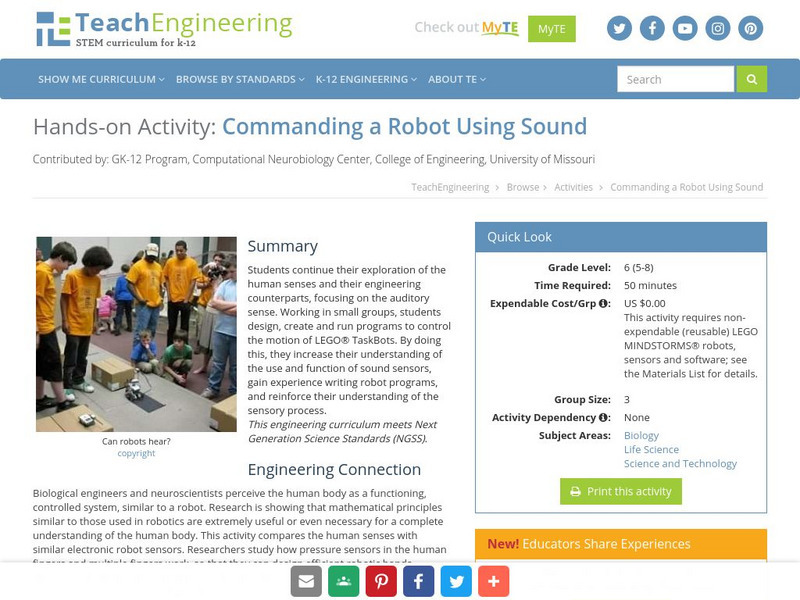
TeachEngineering
Teach Engineering: Commanding a Robot Using Sound
Students continue their exploration of the human senses and their engineering counterparts, focusing on the auditory sense. Working in small groups, students design, create and run programs to control the motion of LEGO TaskBots. By...
TeachEngineering
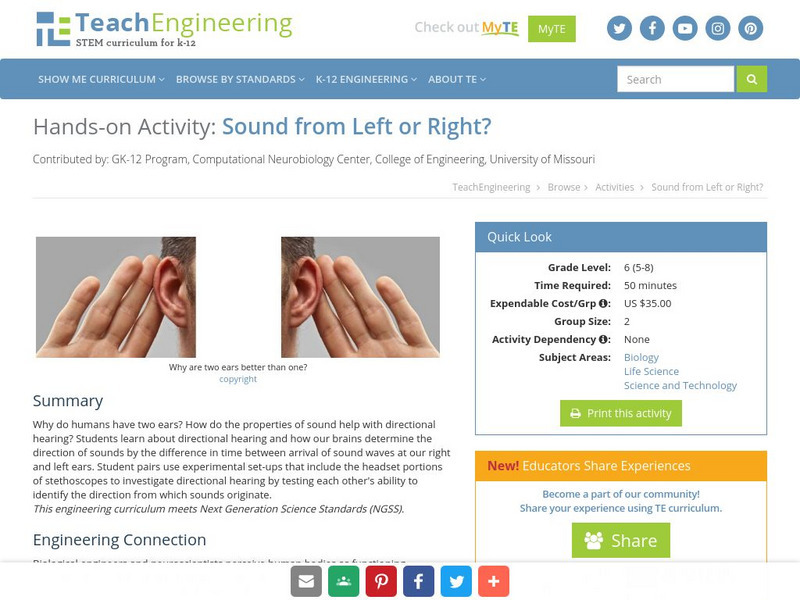
Teach Engineering: Sound From Left or Right?
Why do humans have two ears? How do the properties of sound help with directional hearing? Students learn about directional hearing and how our brains determine the direction of sounds by the difference in time between arrival of sound...
TeachEngineering
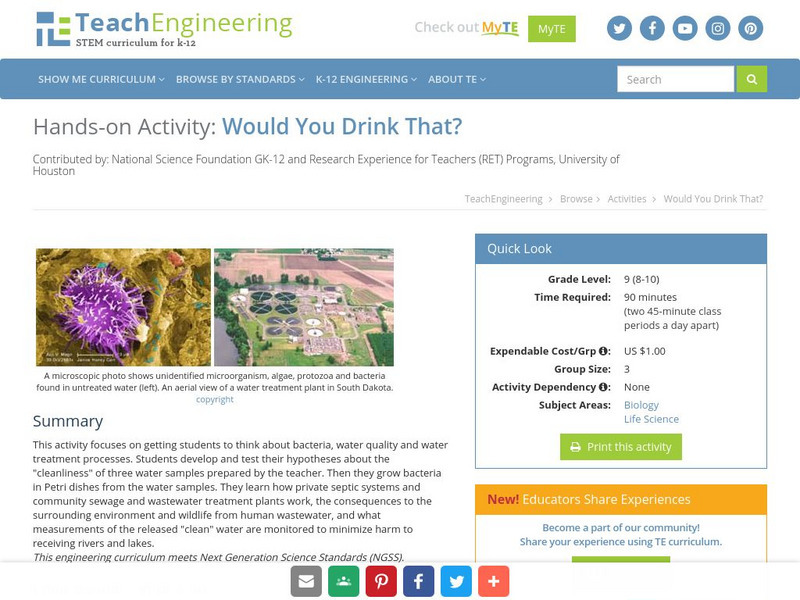
Teach Engineering: Would You Drink That?
This activity focuses on getting students to think about bacteria, water quality and water treatment processes. Students develop and test their hypotheses about the "cleanliness" of three water samples prepared by the teacher. Then they...
TeachEngineering
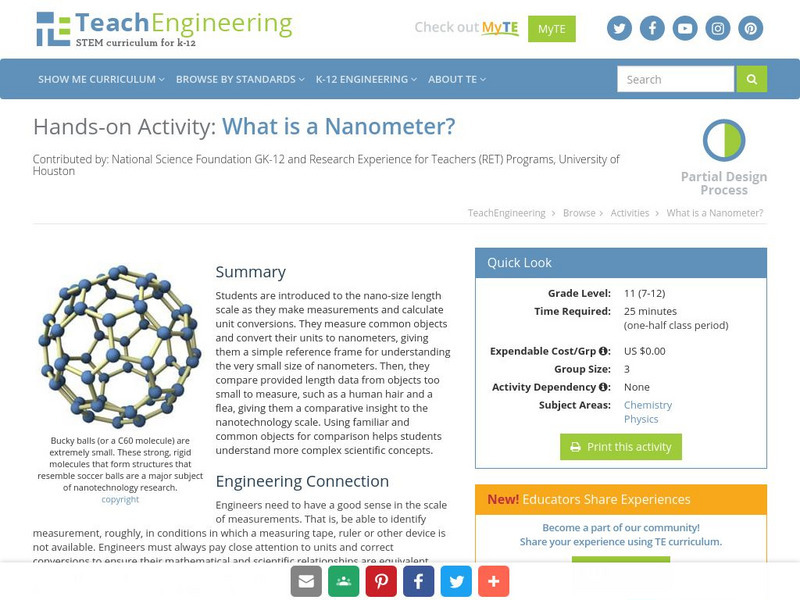
Teach Engineering: What Is a Nanometer?
Students are introduced to the nano-size length scale as they make measurements and calculate unit conversions. They measure common objects and convert their units to nanometers, giving them a simple reference frame for understanding the...
TeachEngineering
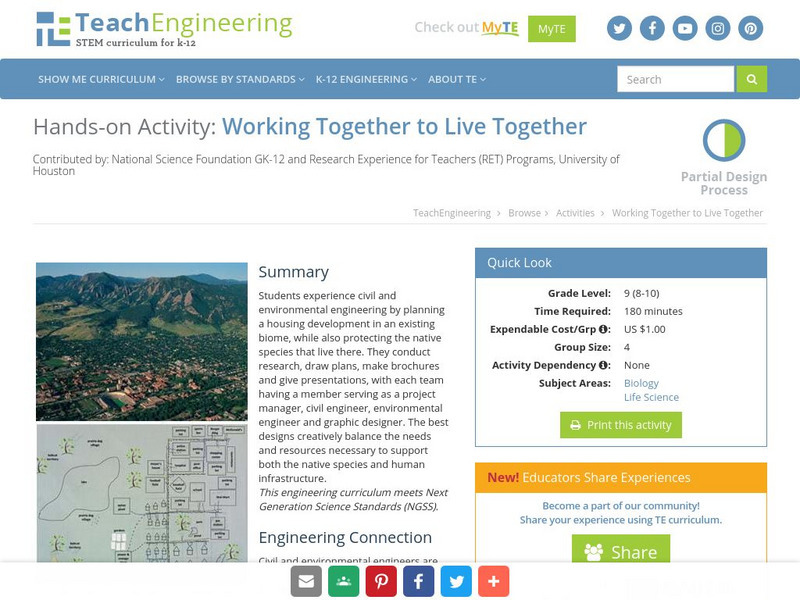
Teach Engineering: Working Together to Live Together
Students experience civil and environmental engineering by planning a housing development in an existing biome, while also protecting the native species that live there. They conduct research, draw plans, make brochures and give...
TeachEngineering
Teach Engineering: Things That Matter to Flocculants
Prior to reaching households, water is exposed to a variety of treatments designed to render it fit for human consumption and use. One of the first treatment steps is the removal of suspended solids using chemical additives called...
TeachEngineering
Teach Engineering: Putting It All Together: Peripheral Vision
In this culminating activity of the unit, students bring together everything they've learned in order to write the code to solve the Grand Challenge. The code solution takes two images captured by robots and combines them to create an...