Hi, what do you want to do?





TeachEngineering
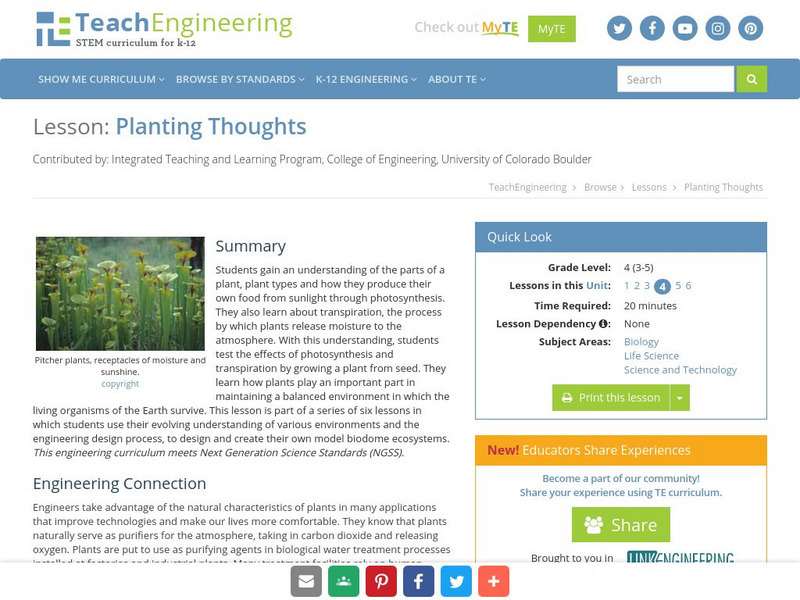
Teach Engineering: Planting Thoughts
Students gain an understanding of the parts of a plant, plant types and how they produce their own food from sunlight through photosynthesis. They also learn about transpiration, the process by which plants release moisture to the...
TeachEngineering
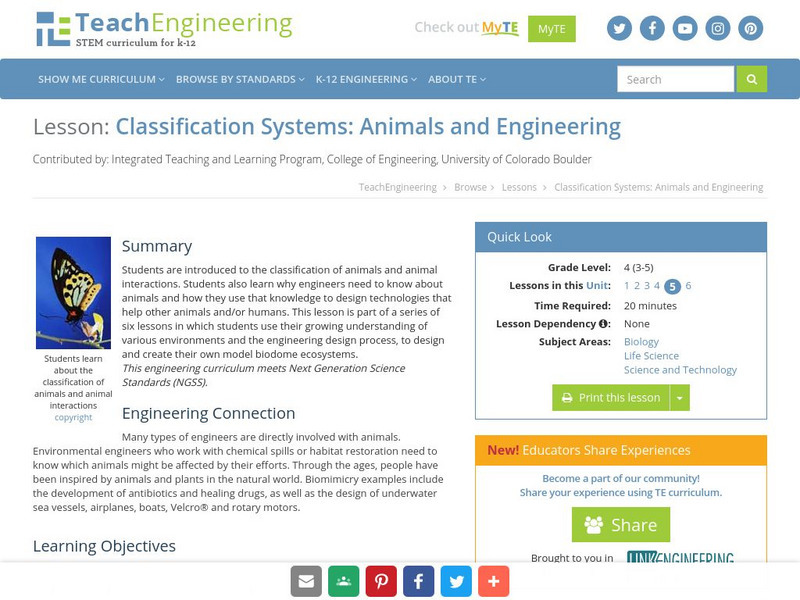
Teach Engineering: Animals and Engineering
Students are introduced to the classification of animals and animal interactions. Students also learn why engineers need to know about animals and how they use that knowledge to design technologies that help other animals and/or humans....
TeachEngineering
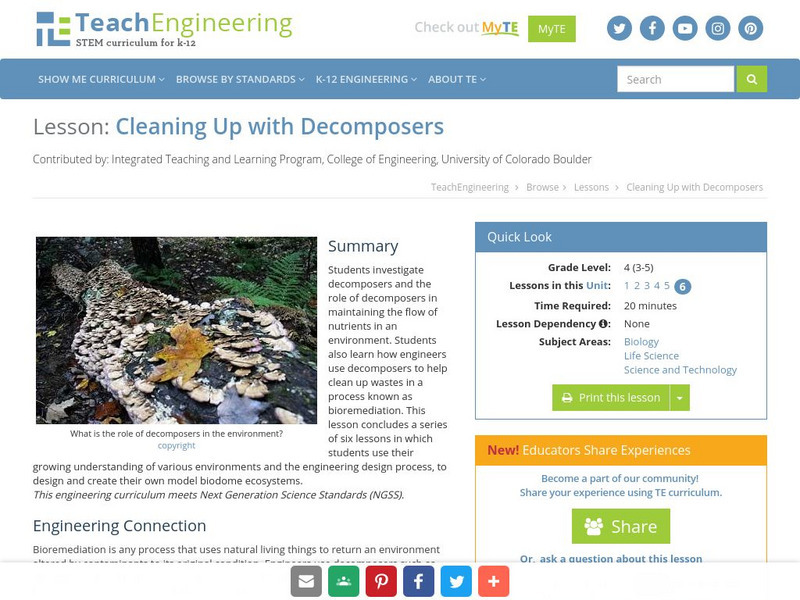
Teach Engineering: Cleaning Up With Decomposers
Students investigate decomposers and the role of decomposers in maintaining the flow of nutrients in an environment. Students also learn how engineers use decomposers to help clean up wastes in a process known as bioremediation. This...
TeachEngineering
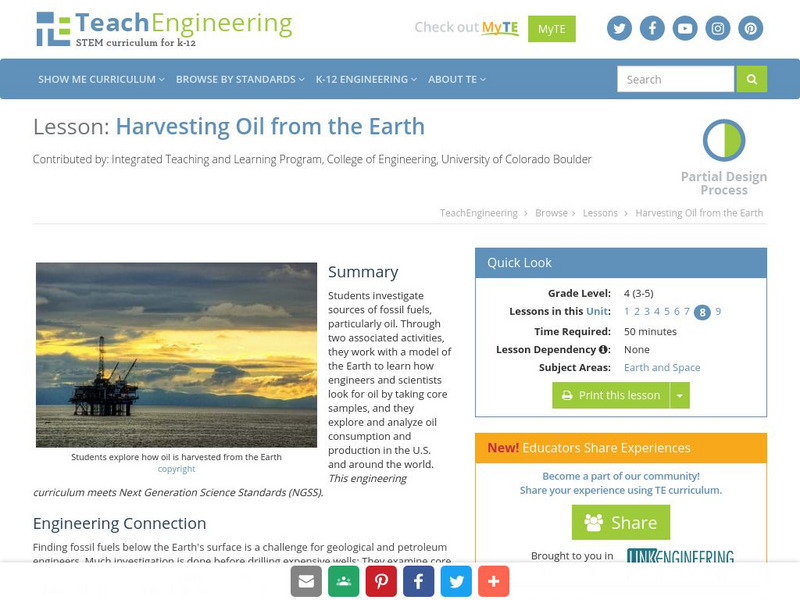
Teach Engineering: Harvesting Oil From the Earth
In this lesson, students investigate sources of fossil fuels, particularly oil. Students will learn how engineers and scientists look for oil by taking core samples from a model of the Earth. Also, students will explore and analyze oil...
TeachEngineering
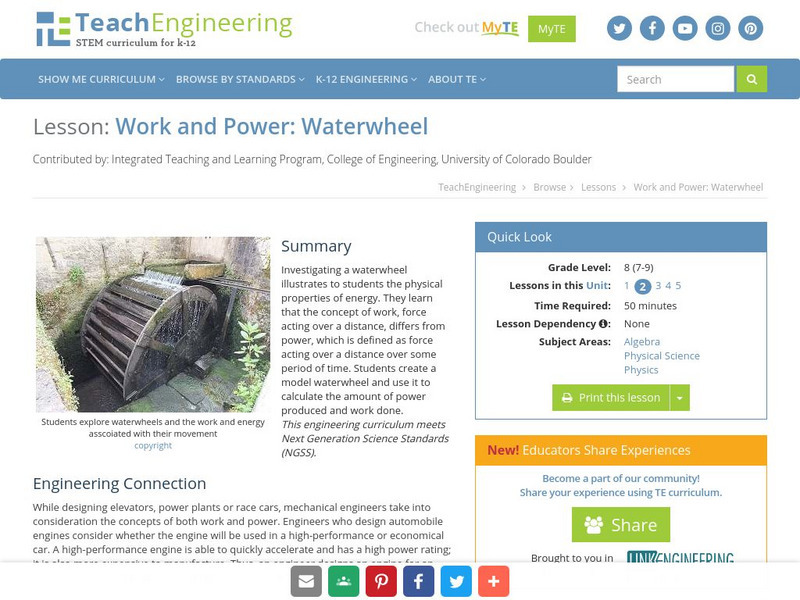
Teach Engineering: Work and Power: Waterwheel
Investigating a waterwheel illustrates to students the physical properties of energy. They learn that the concept of work, force acting over a distance, differs from power, which is defined as force acting over a distance over some...
TeachEngineering
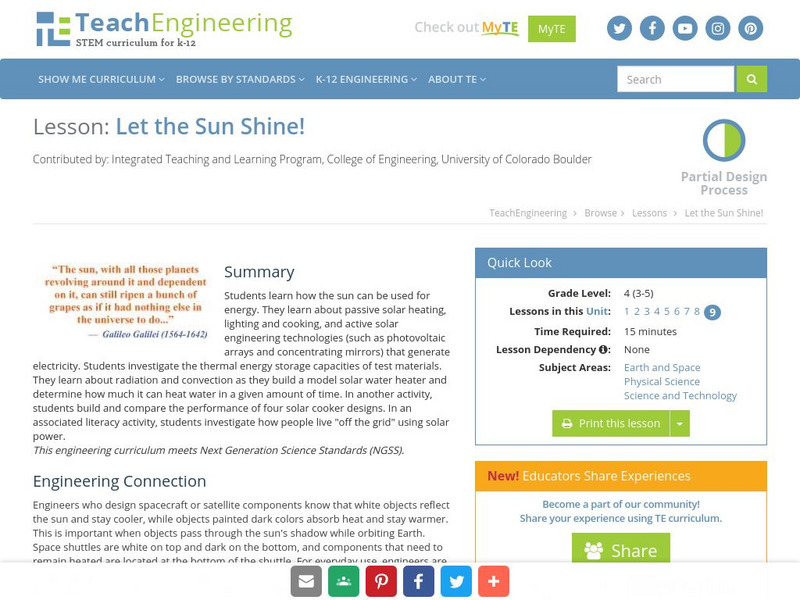
Teach Engineering: Let the Sun Shine!
Young scholars learn how the sun can be used for energy. They learn about passive solar heating, lighting and cooking, and active solar engineering technologies (such as photovoltaic arrays and concentrating mirrors) that generate...
TeachEngineering
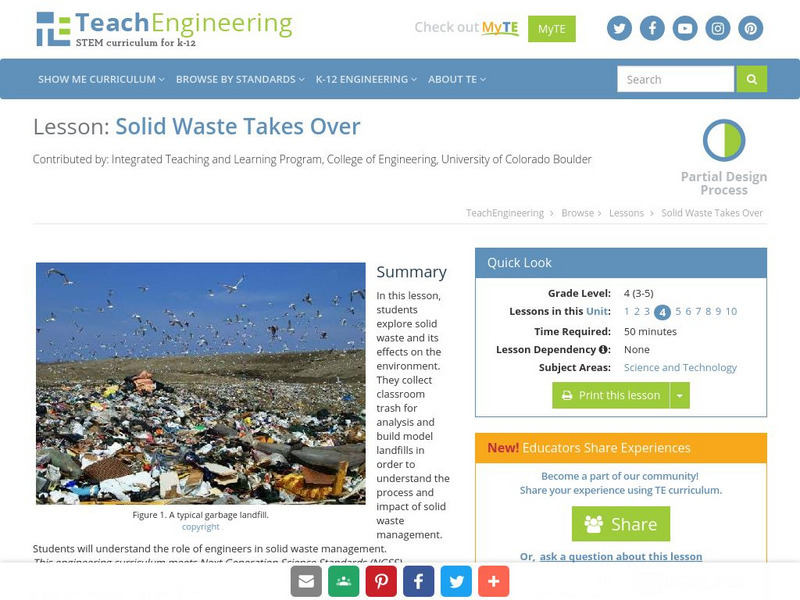
Teach Engineering: Solid Waste Takes Over
In this lesson, students explore solid waste and its effects on the environment. They will collect classroom trash for analysis and build model landfills in order to understand the process and impact of solid waste management. Students...
TeachEngineering
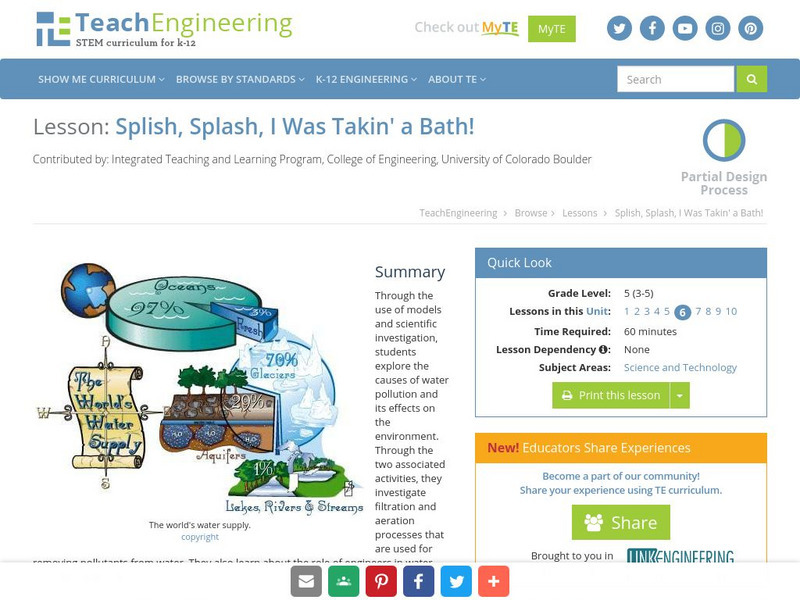
Teach Engineering: Splish, Splash, I Was Takin' a Bath!
In this lesson, students will explore the causes of water pollution and its effects on the environment through the use of models and scientific investigation. In the accompanying activities, they will investigate filtration and aeration...
TeachEngineering
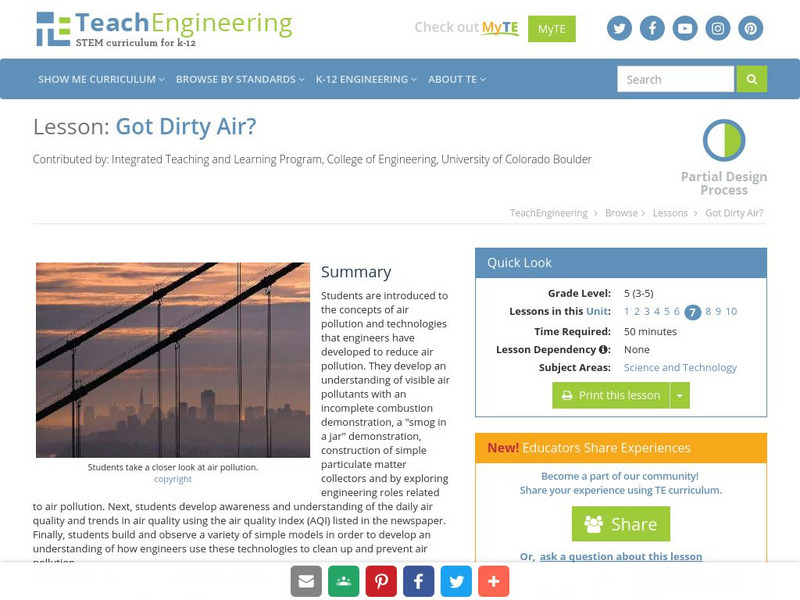
Teach Engineering: Got Dirty Air?
This lesson introduces students to the concepts of air pollution and technologies that have been developed by engineers to reduce air pollution. Students develop an understanding of visible air pollutants with an incomplete combustion...

TeachEngineering
Teach Engineering: What Makes Airplanes Fly?
Students begin to explore the idea of a force. To further their understanding of drag, gravity and weight, they conduct activities that model the behavior of parachutes and helicopters. An associated literacy activity engages the class...
TeachEngineering
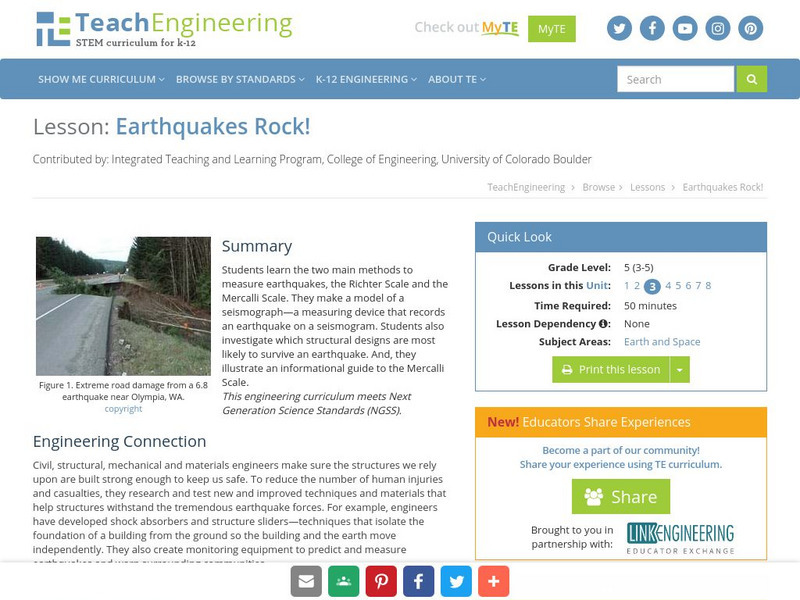
Teach Engineering: Earthquakes Rock!
Students learn the two main methods to measure earthquakes, the Richter Scale and the Mercalli Scale. They make a model of a seismograph - a measuring device that records an earthquake on a seismogram. Students also investigate which...
TeachEngineering
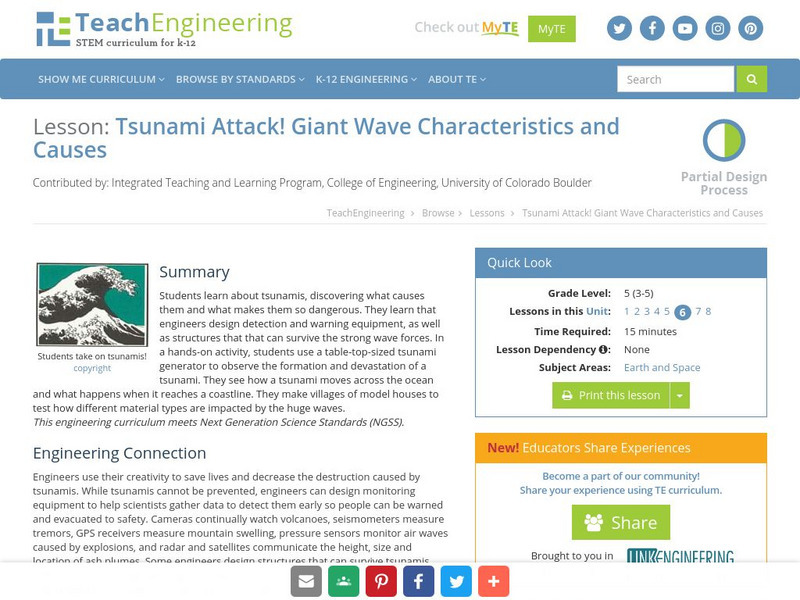
Teach Engineering: Tsunami Attack!
Students learn about tsunamis, discovering what causes them and what makes them so dangerous. They learn that engineers design detection and warning equipment, as well as structures that that can survive the strong wave forces. In a...
TeachEngineering
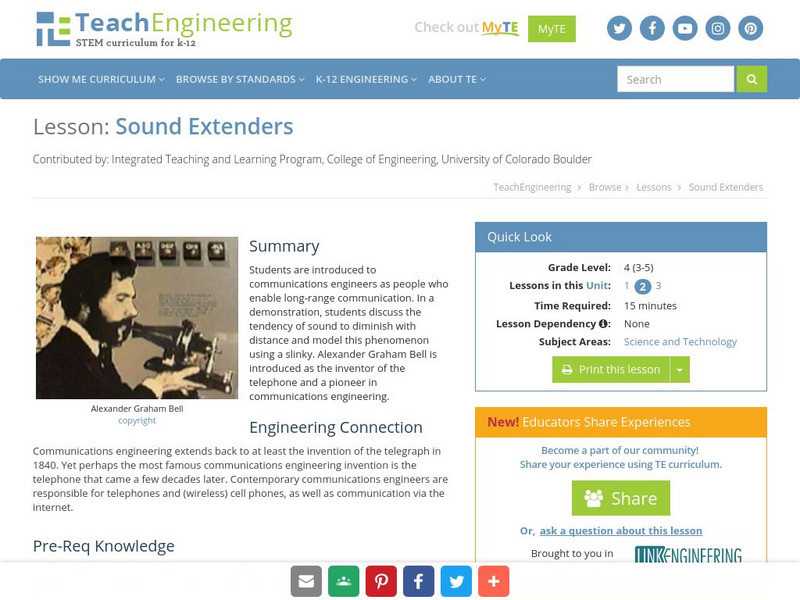
Teach Engineering: Sound Extenders
In this lesson, students are introduced to communications engineers as people who enable long-range communication. In the lesson demonstration, students discuss the tendency of sound to diminish with distance and model this phenomenon...
Scholastic
Scholastic: Math Journals Boost Real Learning
Discover how writing in a journal can boost your students reading skills when you read this article. This article sites ways to integrate writing with teaching math skills.
TeachEngineering
Teach Engineering: Go With the Energy Flow
Students learn about energy and nutrient flow in various biosphere climates and environments. They learn about herbivores, carnivores, omnivores, food chains and food webs, seeing the interdependence between producers, consumers and...

TeachEngineering
Teach Engineering: Forces and Graphing
This activity can be used to explore forces acting on an object, to practice graphing experimental data, and/or to introduce the algebra concepts of slope and intercept of a line. A wooden 2x4 beam is set on top of two scales. Students...