Hi, what do you want to do?






Physics Classroom
The Physics Classroom: Light Waves and Color: Wavelike Behaviors of Light
In this series of interactive physics tutorials, students will focus on the wavelike nature of light.
Physics Classroom
The Physics Classroom: Refraction and Ray Model of Light: Direction of Bending
In this interactive physics tutorial about refraction, students investigate the topic of the direction of bending of a light wave.
Georgia Department of Education
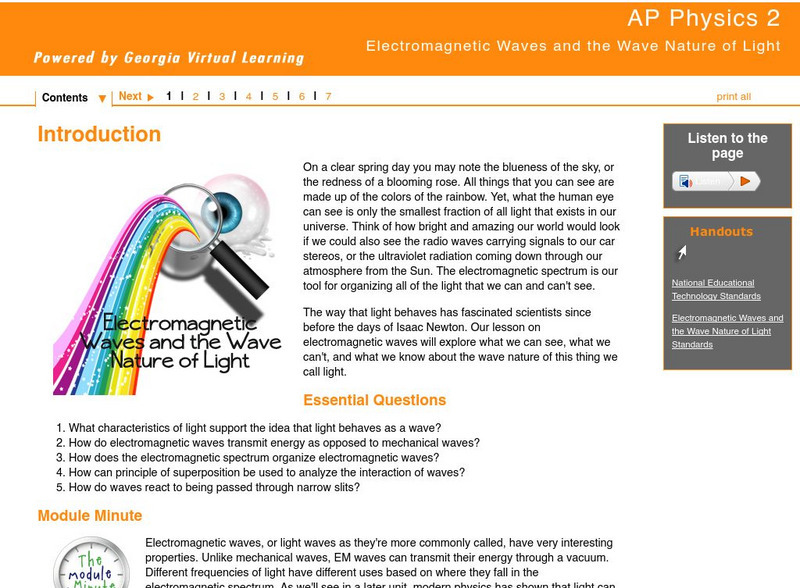
Ga Virtual Learning: Electromagnetic Waves and the Wave Nature of Light
In this interactive lesson about electromagnetic waves students will explore what they can see, what they can't, and what they know about the wave nature of this thing called "light."
Space Telescope Science Institute
Amazing Space: Star Light Star Bright
A few short, interactive activities on light waves can be found on this site. Numerous others links and teacher resources are posted here as well. A good background on light is offered for teachers.
University of Colorado
University of Colorado: Physics 2000: Cat Scans: Projecting Shadows
This page and the three pages which follow discuss how X-ray technology can be used to produce an image of the human body. Discussion is understandable and highly intriguing. Several interactive animations allow the visitor to explore...
PBS
Pbs Learning Media: What Is a Wave?
This interactive activity adapted from the University of Utah's ASPIRE Lab provides an overview of the characteristics and properties of various types of waves, including light waves, sound waves, and water waves.
University of Colorado
University of Colorado: Ph Et Interactive Simulations: Wave Interference
Make waves with a dripping faucet, audio speaker, or laser. Add a second source or a pair of slits to create an interference pattern.
Georgia State University
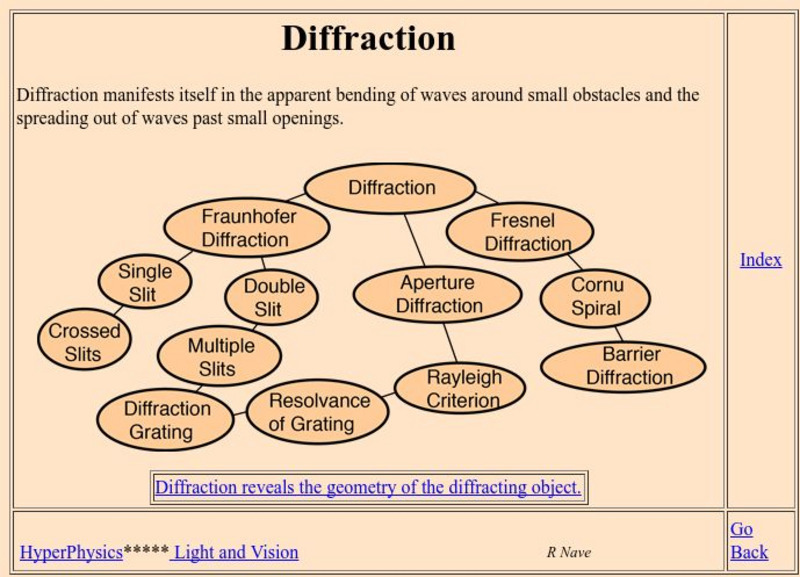
Georgia State University: Hyper Physics: Diffraction
This physics department site provides links about the diffraction of light. Each page includes thorough explanations and meaningful graphics. Some pages include interactive problem-solving practice sections.
University of Colorado
University of Colorado: Ph Et Interactive Simulations: Wave Interference
Conduct virtual experiments with water, sound, and light waves to determine the sine wave and patterns created in each.
PBS
Pbs Learning Media: Mechanical Waves
Learn about mechanical waves, which transfers energy from one place to another through liquids, gases and solids, with this interactive lesson.
Georgia Department of Education
Ga Virtual Learning: Electromagnetic Waves
Through informational text, interactive activities, practice problems, and virtual simulations, students explore the properties of electromagnetic waves.
TeachEngineering
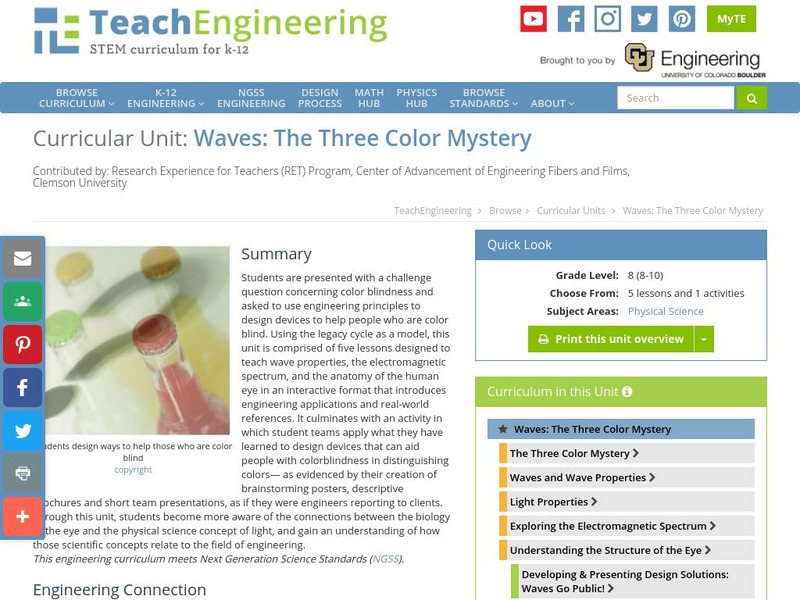
Teach Engineering: Waves: The Three Color Mystery
Students are presented with a challenge question concerning color blindness and asked to use engineering principles to design devices to help people who are color blind. Using the legacy cycle as a model, this unit is comprised of five...
CK-12 Foundation
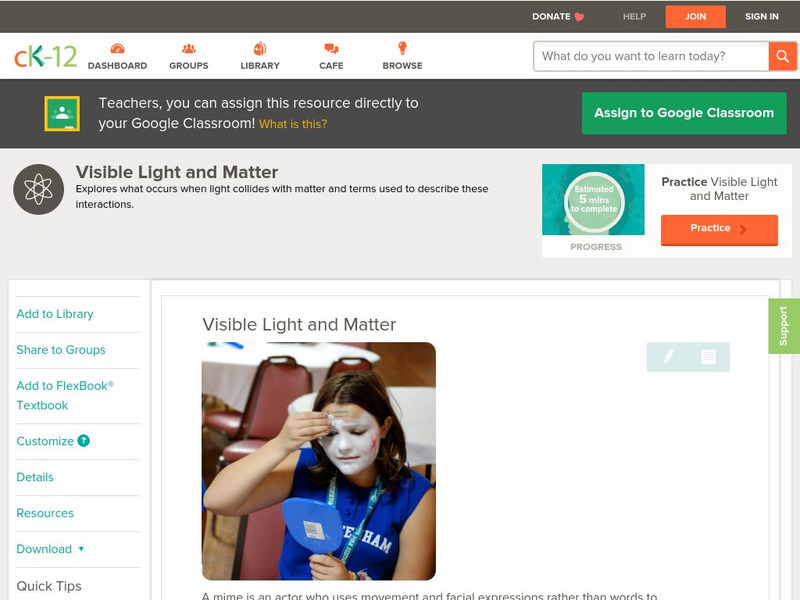
Ck 12: Physical Science: Visible Light and Matter
[Free Registration/Login may be required to access all resource tools.] How visible light interacts with matter and classifying matter in terms of light.
PBS
Pbs Learning Media: Bringing the Universe to America's Classrooms: Waves: Light Collection
Observe the appearance of objects under different conditions to find that objects are only visible when illuminated by light, explore how light interacts with different materials, and develop a code that uses light to communicate across...
Georgia State University
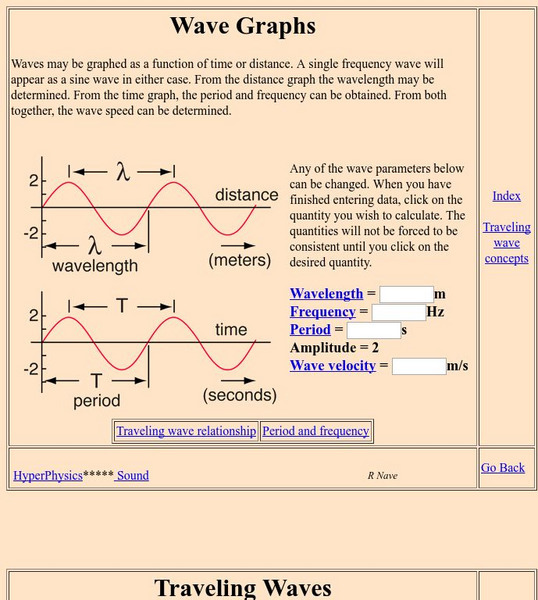
Georgia State University: Hyper Physics: Wave Motion
Two wave graphs depicting a sine wave and relating the various characteristics (wavelength, amplitude, frequency, and period) of a wave to each other. The site includes an interactive JavaScript form in which the visitor enters one...

CK-12 Foundation
Ck 12: Plix: Law of Reflection: Angle of Incidence
[Free Registration/Login Required] In the scenario shown here, the laser cannot shine through the black barrier but can hit all three targets by reflecting off of the floor. Use the red dot to change the angle of the laser generator and...
Other
Open School Bc: Sound and Light
The Sound and Light interactive investigates these two forms of energy. Students will enjoy exploring how sound and light are created, travel, and can be controlled.
Discovery Education
Discovery Education: Science of Everyday Life: Light and Shadow [Pdf]
For this lesson plan, students experience how light interacts with the environment by investigating relationships between shadows and light. Students will experiment with light by observing how light travels through materials and distances.
American Museum of Natural History
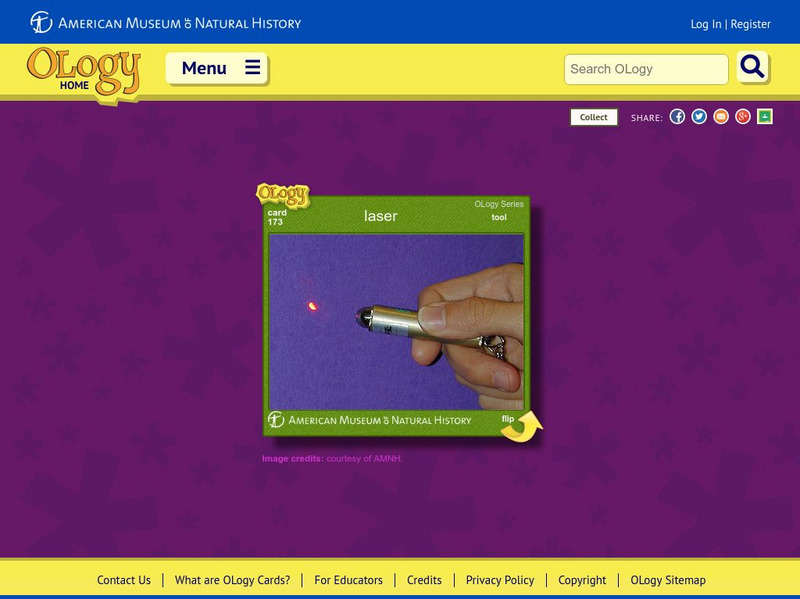
American Museum of Natural History: Laser O Logy Card
Flip over this interactive OLogy card to find fast facts, questions and answers, and similar bite-size pieces of information about the properties and uses of lasers.
CK-12 Foundation
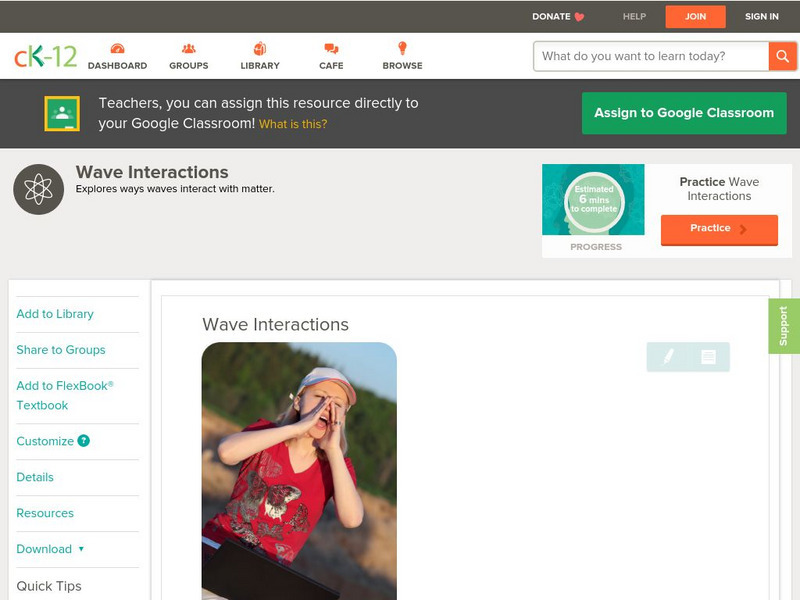
Ck 12: Physical Science: Wave Interactions
[Free Registration/Login may be required to access all resource tools.] Ways that waves can interact with matter and examples.
CK-12 Foundation
Ck 12: Physics Simulation: Least Time
[Free Registration/Login Required] Explore how Snell's Law arises out of the principle of least time; understand how light rays change direction at interfaces between materials using this interactive simulation. A PDF worksheet and a...
Science is Fun
Science Is Fun: Floating Soap Bubbles
In this experiment you learn how to generate carbon dioxide inside a container, and float soap bubbles above the gas. Once the bubbles are suspended, it is possible to observe them closely, which is normally very difficult to do....
California Institute of Technology
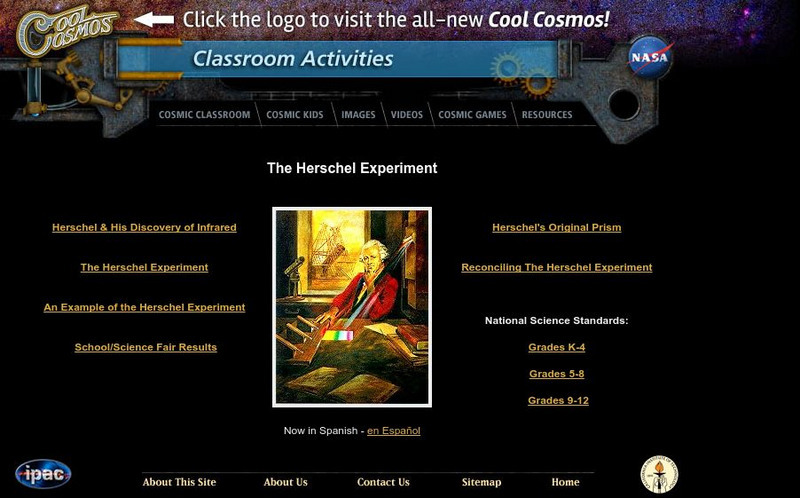
Cool Cosmos: The Herschel Experiment
This website provides a background on the discoverer of infared light--Sir Frederick William Herschel. A version of the experiment Herschel conducted in the 1800s is provided as well.
E-learning for Kids
E Learning for Kids: Science: Winery: Why Can We See Through Some Objects but Not Others?
Learn about the properties of materials in their interactions with light, including whether they are opaque, transparent, or translucent, and which of these produce shadows.