
Curated OER
What Is Hot?
Students explore why: Schools are hotbeds of popular young opinion about what to wear, which music to listen to, and what TV shows to watch. In this activity, students extend their fascination with "what's hot" to the books they read by...

Curated OER
Sentences And Sequencing
Learners practice writing complete sentences and sequencing three or more events. They listen to at least one version of the story read aloud and work cooperatively to put the story events in proper sequence. They access a...

Curated OER
Memory Book - A Cooperative Learning Experience
Students document sections of their life through pictures, stories, and video to create an English "memory book". They use photographs, video and edited video which includes their history, includes calculated growth, and genetic...

Curated OER
The Journey of a Bill
Fifth graders discover how a bill becomes a law in America. After watching a video, they put the steps of a bill becoming a law into the correct order. They create their own bill that they believe needs to be passed out of construction...

Curated OER
Physical Pendulum Lab
Students calculate the moment of inertia of a disc. In this physics lesson, students differentiate the two methods used in finding the inertia. They construct their own pendulum for the lab.
Department of Defense
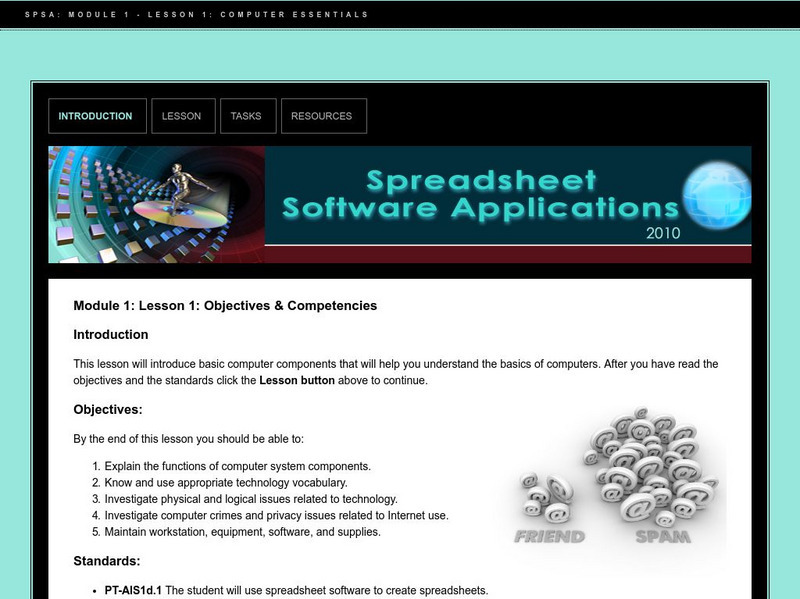
Do Dea: Spreadsheet Software Applications: M1: L1: Computer Essentials
In Module 1 Lesson 1 of this course, students are introduced to the basic functions of computer system components, to some technical vocabulary, and they will learn about computer security, privacy, and crimes. They will also learn how...
TeachEngineering
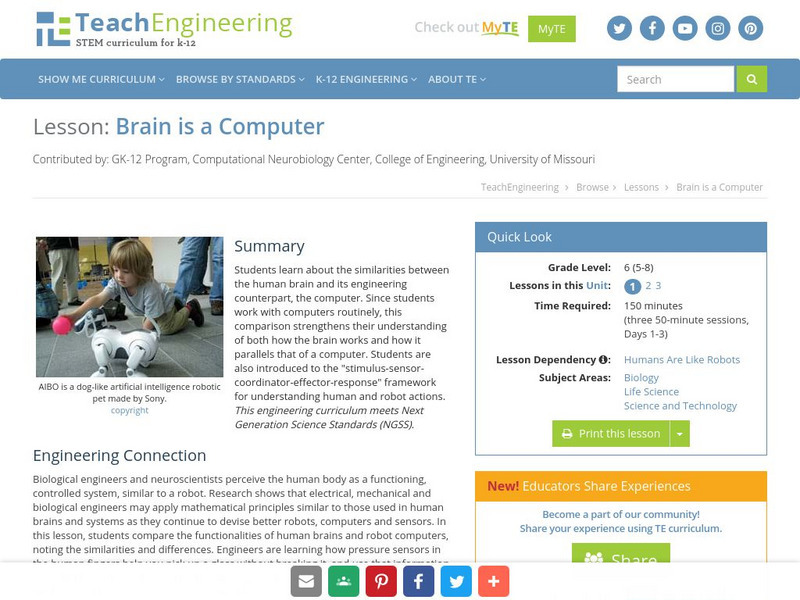
Teach Engineering: Brain Is a Computer
Students learn about the similarities between the human brain and its engineering counterpart, the computer. Since students work with computers routinely, this comparison strengthens their understanding of both how the brain works and...
TeachEngineering
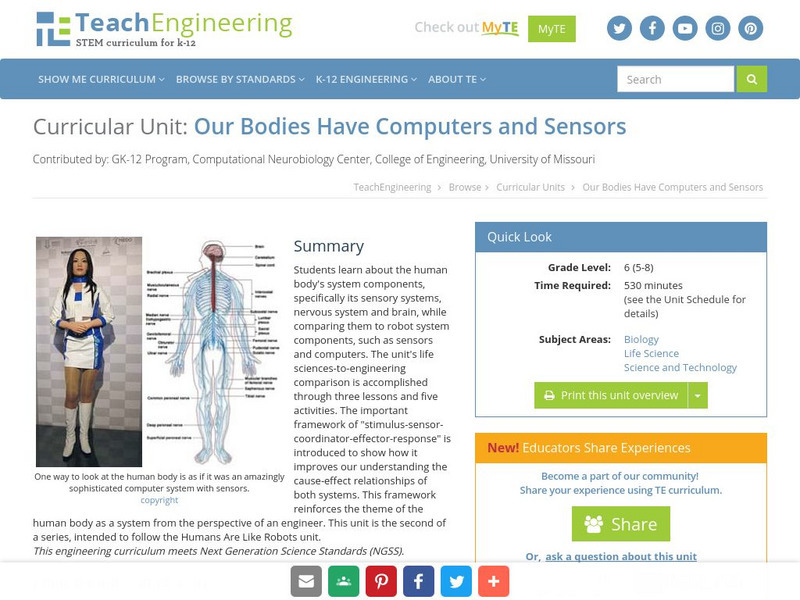
Teach Engineering: Our Bodies Have Computers and Sensors
Students learn about the human body's system components, specifically its sensory systems, nervous system and brain, while comparing them to robot system components, such as sensors and computers. The unit's life sciences-to-engineering...
Other
Computer Art Using Ms Paint
A site by Diana Hunter, an educator in Indiana. This site uses common software in PCs to introduce the use of computers in making art. There are lessons on design, Tessellations, Butterflies, Piet Mondrian, Landscapes with Spraypaint,...
Department of Defense
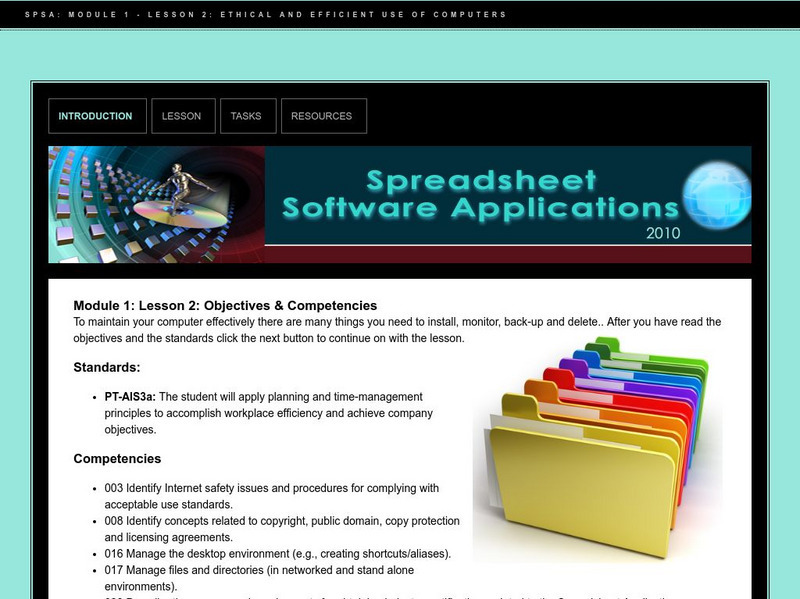
Do Dea: Spreadsheet Software: M1: L2: Ethical and Efficient Use of Computers
In Module 1 Lesson 2 of this course, students are introduced to issues related to copyright, public domain, and licensing agreements. They will also learn about industry certification for this course on spreadsheet applications.
TeachEngineering
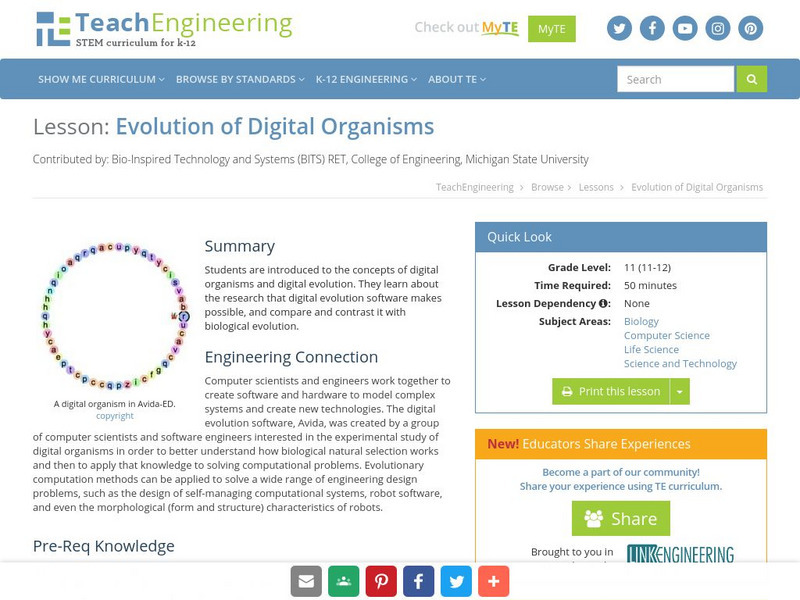
Teach Engineering: Evolution of Digital Organisms
Students are introduced to the concepts of digital organisms and digital evolution. They learn about the research that digital evolution software makes possible, and compare and contrast it with biological evolution.
TeachEngineering
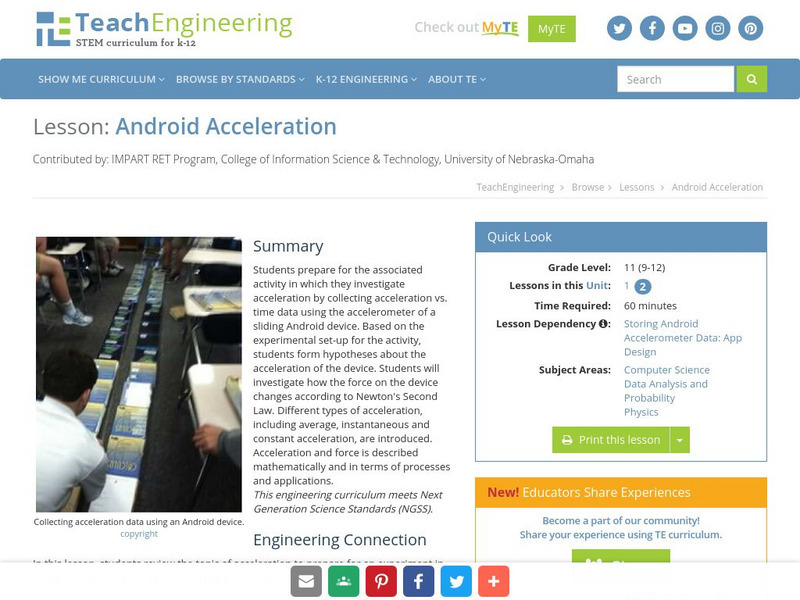
Teach Engineering: Android Acceleration
Learners prepare for the associated activity in which they investigate acceleration by collecting acceleration vs. time data using the accelerometer of a sliding Android device. Based on the experimental set-up for the activity, students...
TeachEngineering
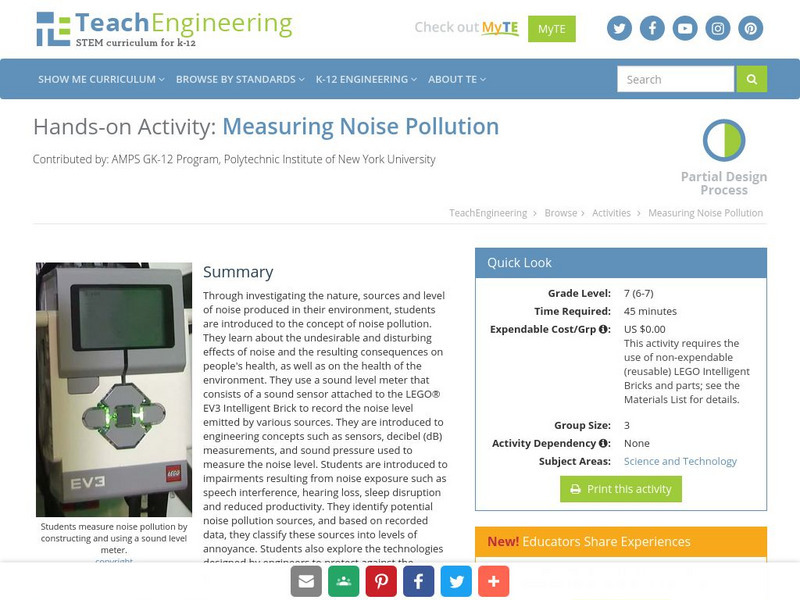
Teach Engineering: Measuring Noise Pollution
Through investigating the nature, sources and level of noise produced in their environment, students are introduced to the concept of noise pollution. They learn about the undesirable and disturbing effects of noise and the resulting...
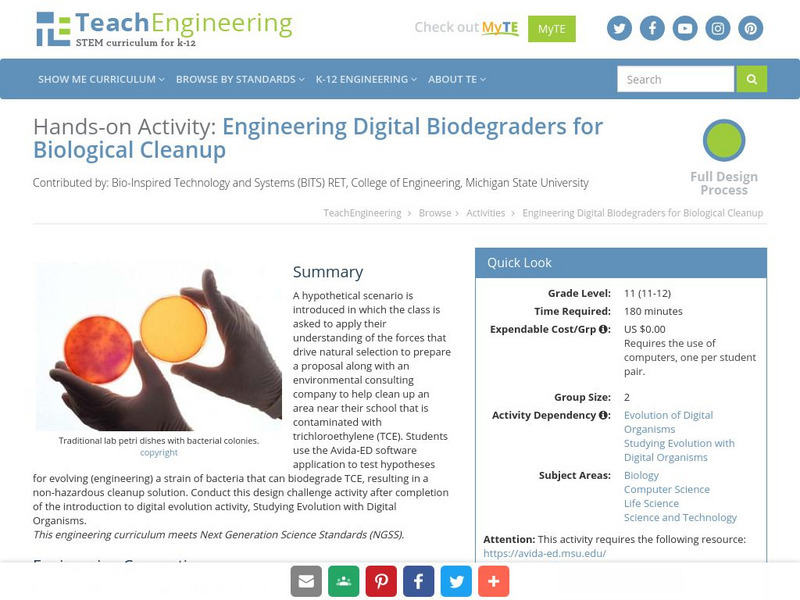
TeachEngineering
Teach Engineering: Evolving Tce Biodegraders
A hypothetical scenario is introduced in which the class is asked to apply their understanding of the forces that drive natural selection to prepare a proposal along with an environmental consulting company to help clean up an area near...
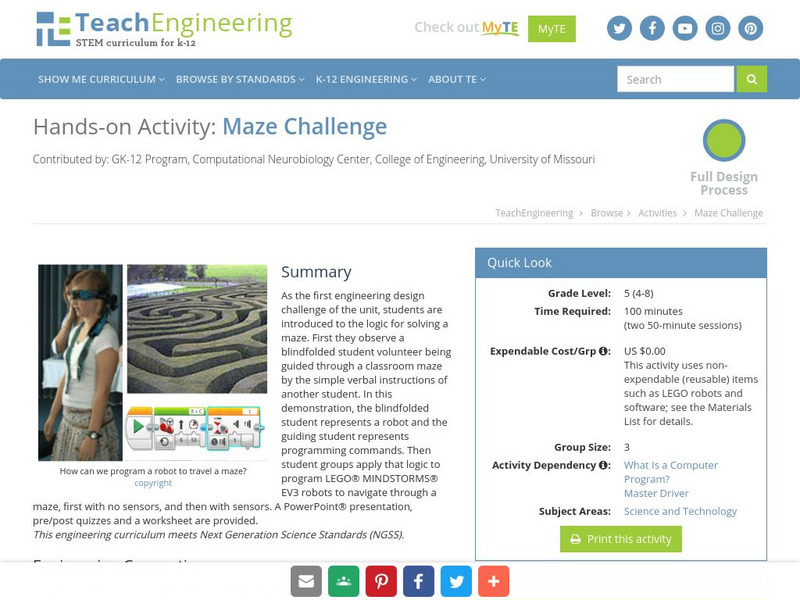
TeachEngineering
Teach Engineering: Maze Challenge
As the first engineering design challenge of the unit, students are introduced to the logic for solving a maze. student groups apply that logic to program LEGO MINDSTORMS NXT robots to navigate through a maze, first with no sensors, and...
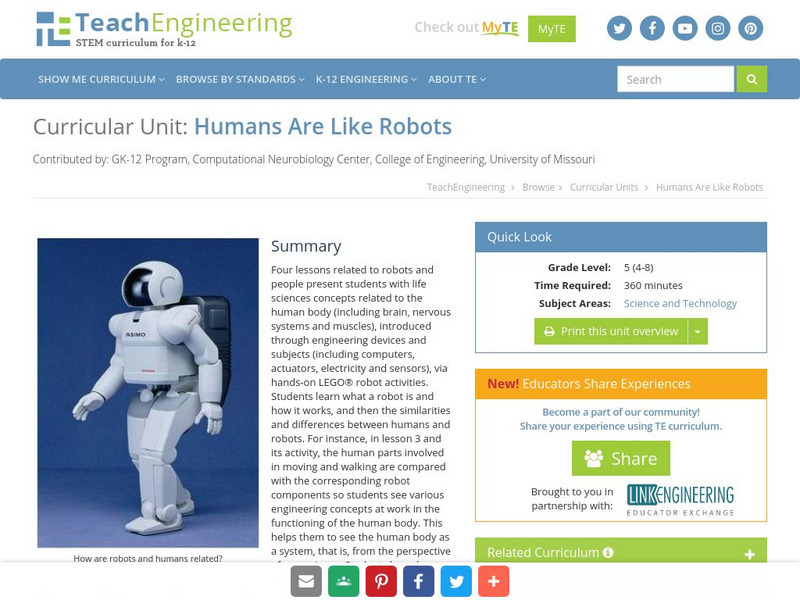
TeachEngineering
Teach Engineering: Humans Are Like Robots
Four lessons related to robots and people present students with life sciences concepts related to the human body (including brain, nervous systems and muscles), introduced through engineering devices and subjects (including computers,...
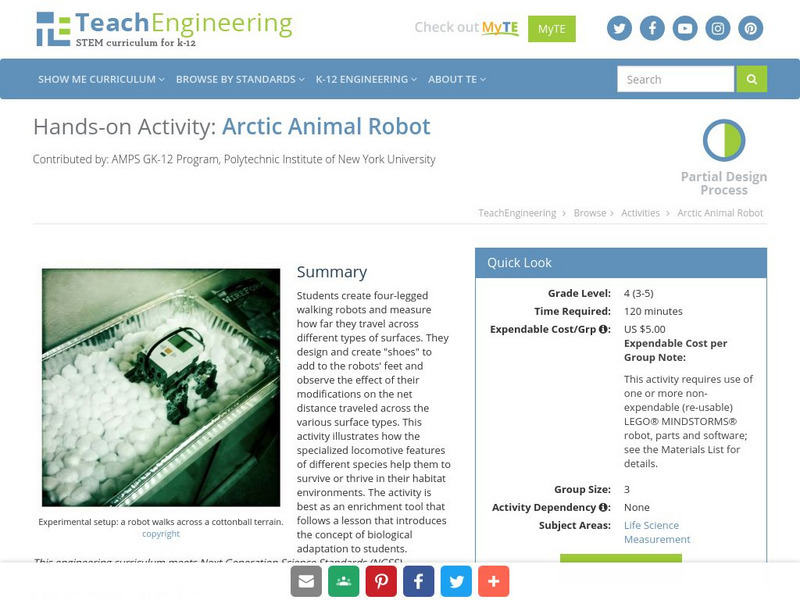
TeachEngineering
Teach Engineering: Arctic Animal Robot
Students create four-legged walking robots and measure how far they travel across different types of surfaces. They design and create "shoes" to add to the robots' feet and observe the effect of their modifications on the net distance...
TeachEngineering
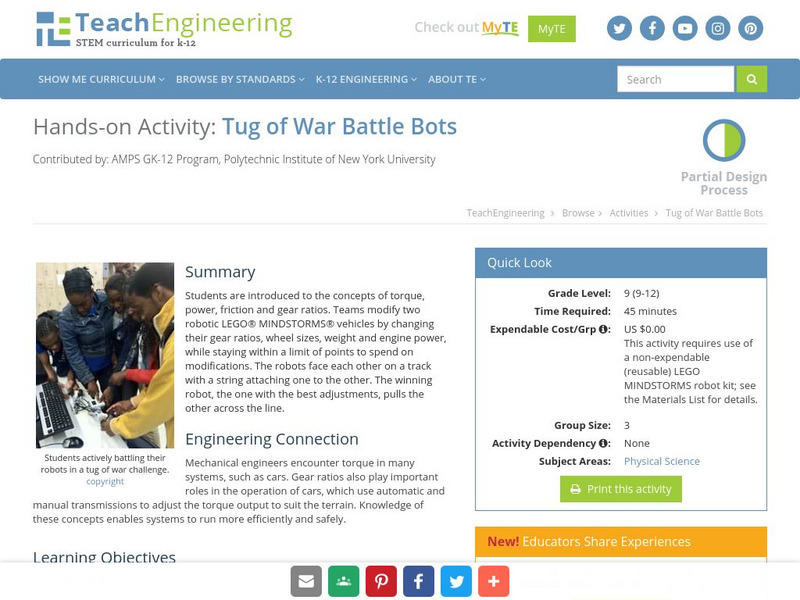
Teach Engineering: Tug of War Battle Bots
Students are introduced to the concepts of torque, power, friction and gear ratios. Teams modify two robotic LEGO vehicles by changing their gear ratios, wheel sizes, weight and engine power, while staying within a limit of points to...
TeachEngineering
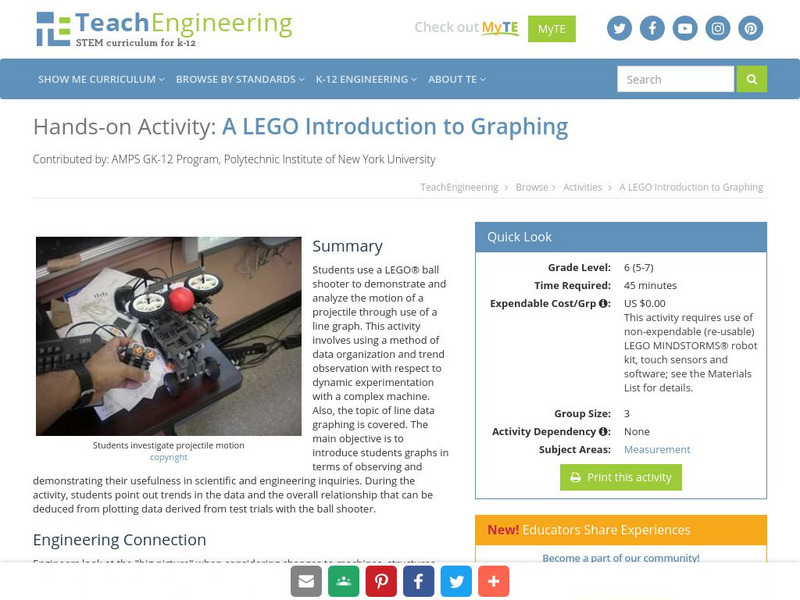
Teach Engineering: A Lego Introduction to Graphing
Students use a LEGO ball shooter to demonstrate and analyze the motion of a projectile through use of a line graph. This activity involves using a method of data organization and trend observation with respect to dynamic experimentation...
TeachEngineering
Teach Engineering: Peripheral Vision Lab
Students explore their peripheral vision by reading large letters on index cards. Then they repeat the experiment while looking through camera lenses, first a lens with a smaller focal length and then a lens with a larger focal length....
TeachEngineering
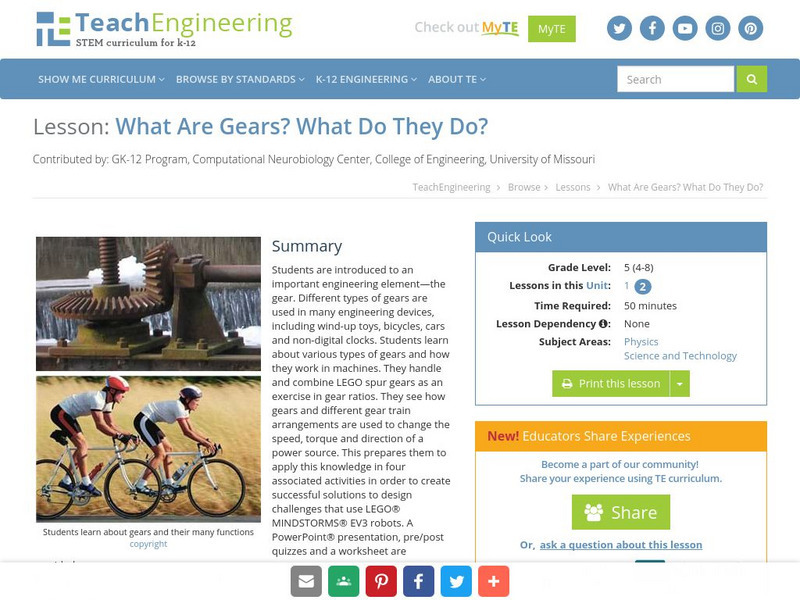
Teach Engineering: What Are Gears? What Do They Do?
Students are introduced to an important engineering element- the gear. This prepares them to apply this knowledge in four associated activities in order to create successful solutions to design challenges that use LEGO MINDSTORMS NXT...
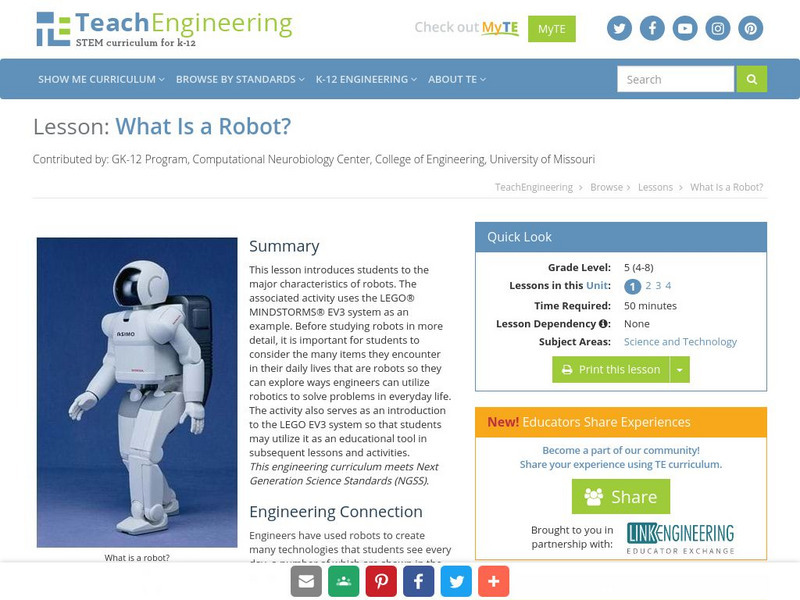
TeachEngineering
Teach Engineering: What Is a Robot?
This lesson introduces young scholars to the major characteristics of robots. The associated activity uses the LEGO MINDSTORMS NXT system as an example. Before studying robots in more detail, it is important for students to consider the...
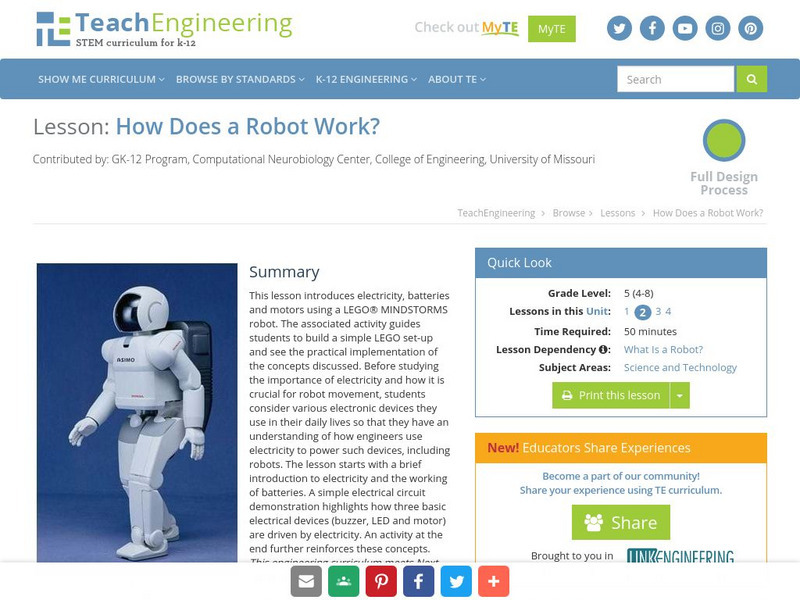
TeachEngineering
Teach Engineering: How Does a Robot Work?
This lesson plan introduces electricity, batteries and motors using a LEGO MINDSTORMS NXT robot. The associated activity guides students to build a simple LEGO NXT set-up and see the practical implementation of the concepts discussed....
TeachEngineering
Teach Engineering: How Do You Store All This Data?
During this lesson, students start to see the data structure they will use to store their images, towards finding a solution to this unit's Grand Challenge. Students are introduced to two-dimensional arrays and vector classes. Then they...