Hi, what do you want to do?






Curated OER
Aqueous Solutions
In this aqueous solutions worksheet, learners will explore the characteristics of solutions, including the ability of different compounds to dissolve in the solutions. This worksheet has 10 true or false statements and 8 short answer...

Curated OER
Displacement Reactions and Acid/Base Reactions
In this chemical reactions worksheet, students review the solubility rules for common salts. Students determine the molecular equation, ionic equation, and net ionic equation for specific reactions. Students calculate moles and volume...

Curated OER
The Nature Of Dissolving Processes
Students examine the rule of "like dissolves like." They define and describe solutions and solubility models on molecular liquids, ionic solids, and molecular solids.

Curated OER
High School Chemistry Questions
In this chemistry worksheet, students determine the number of water molecules is a given volume of water. Students determine the empirical formula for given compounds from the percentage mass of elements. This worksheet has 20 problems...

Curated OER
Liquids and Solids
Young scholars describe the properties of solids and liquids, and explain how a semiconductor works. In this atom lesson students demonstrate the bonding properties of carbon and silicon.

Kenan Fellows
What Element Would You Be?
Primo Levi wrote a collection of short stories comparing his life from Italy to Auschwitz to elements in the periodic table. Pupils read an excerpt from his book and research the characteristics of various elements. Then, they make a...

Curated OER
Learning Outcomes
In this science worksheet, students explore the learning outcomes for a unit on chemical reactions. Students define 60 vocabulary words and answer a list of questions for each topic.

Curated OER
Science Hits Activity
Students listen to a song that teaches the elements of the periodic table and write their own song to be used as an aid in remembering scientific information.

Mr. E. Science
Acids, Bases and Solutions
If you are not part of the solution, then you are part of the precipitate. The presentation covers solutions, suspensions, solubility, dissociation, and acid/base reactions. This is the 19th lesson in a series of 26.

Curated OER
Water - the (Nearly) Universal Solvent
In this water worksheet, students explore the reasons why water is considered a universal solvent. Students compare different ways to change the dissolving rate of a solute. This worksheet has 11 fill in the blank and 8 matching questions.

Curated OER
Additional Aqueous Solution Review Problems
In this solutions worksheet, students balance chemical equations, classify reactions by the type of reaction it represents, and review the solubility rules. Students practice working out double displacement, neutralization, and dilution...

Curated OER
Animated Chemical Bonding
Learners demonstrate their understanding of a chemical process. In this exploratory lesson students create a clay animation that shows how a specific type of chemical bond.

Curated OER
Water - the (Nearly) Universal Solvent
In this solvent worksheet, students explore why water is considered a universal solvent. Students explore what can change dissolving rates. This worksheet has 8 matching, 3 short answer, 11 fill in the blank, and 4 problems to solve.

Curated OER
Formulas and Mole Conversions
In this formulas and mole conversion instructional activity, learners answer 22 graphic organizer, multiple choice, and short answer questions pertaining to formulas and mole conversion.
Frostburg State University
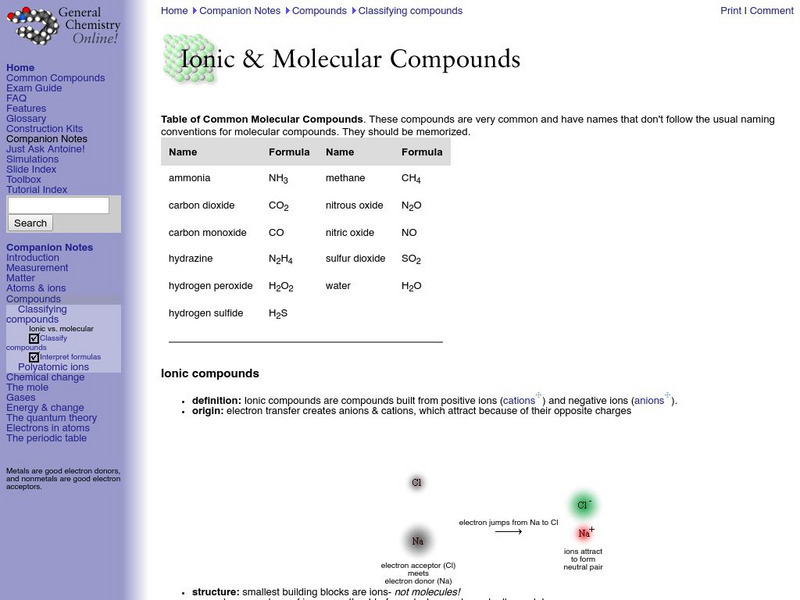
General Chemistry Online: Ionic and Molecular Compounds
Provides a good outline of the concepts involved in ionic and covalent bonding, with links to definition of terms. Features a list of common molecular compounds and a chart that compares ionic and molecular compounds.
CK-12 Foundation
Ck 12: Chemistry: Naming Binary Molecular Compounds
[Free Registration/Login may be required to access all resource tools.] Covers molecular compound, binary molecular compound, molecules, and naming of binary molecular compounds.
Frostburg State University
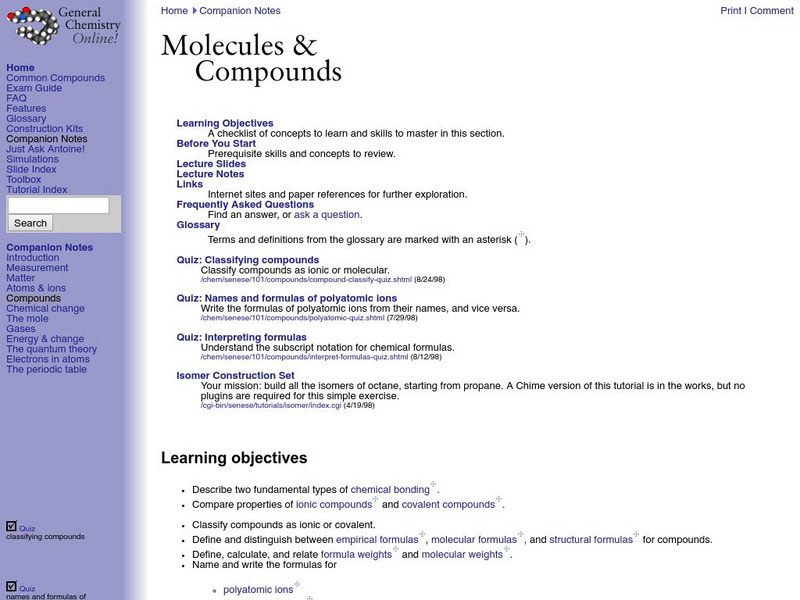
General Chemistry Online: Molecules and Compounds
A complete lesson on compounds, from introductory material in the beginning to a practice exam at the end. This lesson covers bonding, ionic compounds, molecular compounds, naming compounds, structural formulas, polyatomic ions, and much...

Science Struck
Science Struck: Ionic Compounds vs. Molecular Compounds
Explains what ionic and molecular or covalent compounds are, their properties, and the differences between them.
CK-12 Foundation
Ck 12: Physical Science: Molecular Compounds
[Free Registration/Login may be required to access all resource tools.] Definition of covalent compound, how they are named and how they differ from ionic compounds.
CK-12 Foundation
Ck 12: Molecular Compounds
[Free Registration/Login may be required to access all resource tools.] In the following online tutorial students will name ionic compounds containing main group or transition metals, covalent compounds, acids, and bases, using...
Science Education Resource Center at Carleton College
Serc: Using Properties to Identify Ionic and Molecular Compounds
A guided inquiry in which students test different physical properties, such as melting point or conductivity, to help them determine whether the compounds are ionic or molecular.
Science Struck
Science Struck: Molecular Compounds
Explains what a molecular compound is, how they are named, their properties, and the difference between ionic and molecular compounds. Includes a list of molecular compounds.
Chiral Publishing
Chiral Publishing: An Introduction to Chemistry: Types of Compounds
Discover different types of compounds such as binary covalent, binary ionic, binary acids, and oxyacids. Explore links that give information about writing names and formulas for different compounds.
CK-12 Foundation
Ck 12: Net Ionic Equations
[Free Registration/Login may be required to access all resource tools.] Students write net ionic equations for double-replacement reactions that produce precipitates, gases, or molecular compounds, write net ionic equations for...