Hi, what do you want to do?






iCivics
Why Government?
Why do people create governments? Where did we get our ideas about government? This is a fantastic introductory lesson for your American government class that begins by reviewing the philosophies of Thomas Hobbes and John Locke in...

Curated OER
Why Do Governments Exist? Locke, Hobbes, Montesquieu, and Rousseau
Here is a great secondary source reading that includes the primary ideas and philosophies of the famed Enlightenment philosophers: Thomas Hobbes, John Locke, Charles Montesquieu, and Jean-Jacques Rousseau. In additional to discussing...

Curated OER
Four Enlightenment Thinkers
Students examine lives, philosophies, and political beliefs of four Enlightenment Thinkers: Baron de Montesquieu, Jean-Jacques Rousseau, Thomas Hobbes, and John Locke. Students then work with partner to write short speech from...

Curated OER
19c European Liberalism
If you'd like to prompt some great discussions in your history class, this presentation will surely get your class talking. Addressing 19th century liberalism in Europe (including influences from England, France, America, and Ireland),...

Curated OER
Locke v. Hobbes
In this Hobbes and Locke study guide worksheet, students respond to 18 short answer questions. The questions correlate to assigned readings in a textbook.

Curated OER
Unit 12: Enlightenment and French Revolution
In this Enlightenment lesson, students respond to 34 short answer questions about John Locke, Thomas Hobbes, Baron de Montesquieu, Jean Jacques Rousseau, Voltaire, Denis Diderot, and Mary Wollstonecraft.

Curated OER
Quotes by Hobbes, Locke, Montesquieu, Rousseau, and Voltaire
In Enlightenment quotations study guide worksheet, students read quotations and identify the speakers as Hobbes, Locke, Montesquieu, Rousseau, Peter the Great, Copernicus, Louis XIV, Galileo, Harvey, Kepler , Frederick the Great, or...

Curated OER
People of the Enlightenment -1600s & 1700s
In this people of the Enlightenment study guide worksheet, students read the notes provided regarding Locke, Hobbes, Rousseau, Montesquieu, and Voltaire.

Curated OER
How Does Government Secure Natural Rights?
Students explain why a government with a constitution is not necessarily a constitutional government, and identify alternative models of government that the Founders had to choose from.

Curated OER
Why do we need a Government
Middle schoolers explore some of the ideas of major importance to the Founders, why we need a government, and how the Founders believed governments should be created and what they should do. They think of a right that all people should...

Curated OER
Revolution! Freedom for All?
Twelfth graders examine the causes of freedom by revolutionary patriots. In this Civics and Economics lesson, 12th graders analyze primary sources. Students work cooperatively to write a freedom declaration for their group.

Curated OER
The Declaration of Independence
For this social studies worksheet, students locate 54 words relating to the Declaration of Independence in a word search. Students may self correct by selecting the link at the bottom of the page.

Curated OER
The Declaration of Independence
Students reflect on the Declaration of Independence. For this U.S. History lesson, students read the Declaration of Independence then complete an activity and worksheet on the topic.

Curated OER
The Enlightenment
In this online interactive world history worksheet, students answer 20 fill in the blank questions regarding the Enlightenment. Students may submit their answers to be scored.

Curated OER
Separation of Powers
Eighth graders explore and explain the responsibilities and limits of our national system of government. After reading various selections documenting the viewpoints of the federalists and anti-federalists and the separation of power,...

Curated OER
American Revolution and Constitution Take Home Assessment
In this early American history activity, students create posters that feature the branches of government as established by the U.S. Constitution. Students also research founding ideals of the nation and use Venn diagrams to compare and...

Curated OER
American Revolution and Constitution Take-Home Assessment
In this early American history activity, students draw diagrams of that feature the responsibilities of each of the 3 branches of the federal government and then create their own original visuals that highlight the formation of American...

Curated OER
The Fall of the Roman Empire and the Armenian Tragedy of 1915
Students examine the fall of the Roman Empire and the Armenian tragedy. In this world history lesson, students read handouts about both world history events and create presentations that feature the events.

iCivics
I Civics: John Locke Mini Lesson
Introduce students to the ideas and writings of John Locke that influenced the likes of Thomas Jefferson and other Founding Fathers.
University of Groningen
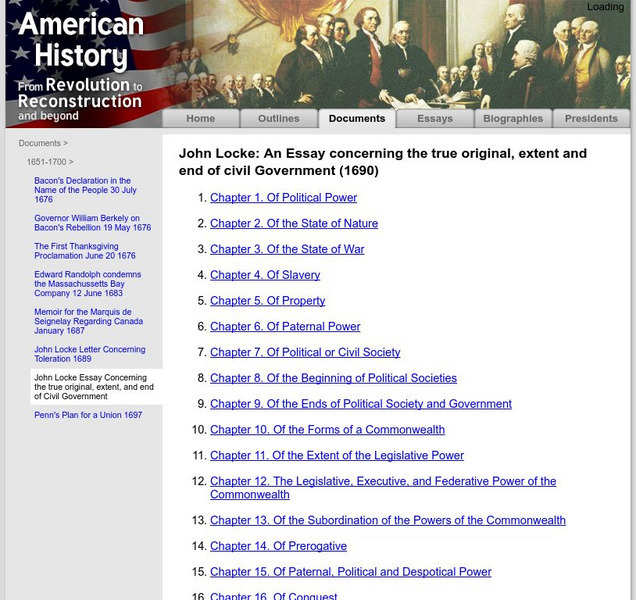
American History: Documents: John Locke on Government
This site from the University of Groningen provides the complete John Locke's "Second Treatise on Government." It discusses everything from slavery and property to civil government and its functions.
Boston University
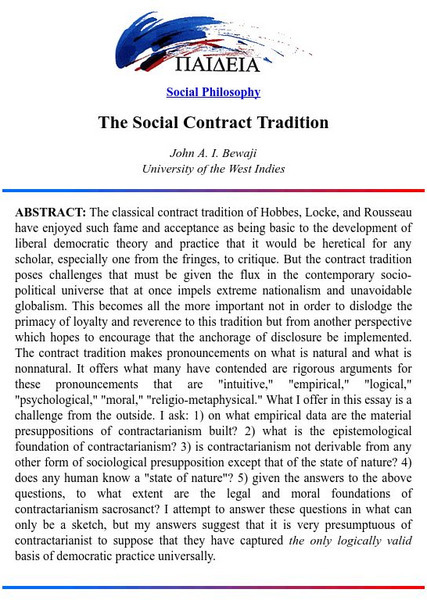
Boston University: The Social Contract Tradition
This site presents an abstract of the social contract tradition. It also contains a very detailed overview of the ideas of Hobbes, Locke, and Rousseau.
Columbia University
Columbia University: John Locke: Of the Conduct of the Understanding
A complete biography of the philosopher John Locke. It discusses his contribution to philosophy and his social contract.
CPALMS
Florida State University Cpalms: Florida Students: Enlightenment Ideas and the Founding Fathers
A tutorial that looks at the ideas from the Enlightenment that influenced the Founding Fathers, particularly those of John Locke and Montesquieu. A PDF file of the tutorial is available.
Internet History Sourcebooks Project
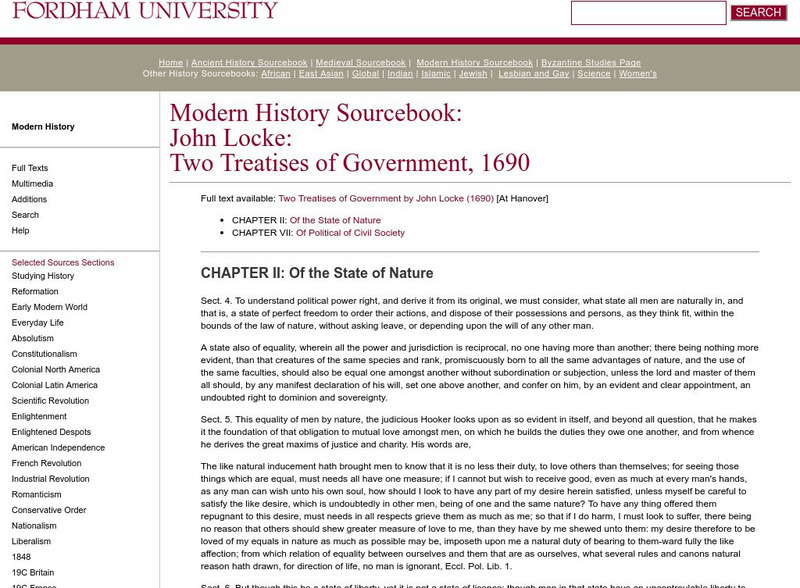
Fordham University: Modern History Sourcebook: Two Treatisies on Government
This site provides selections from John Locke's "Two Treatisies on Government." It contains evaluations on the sections 'Of the State of Nature' and 'Of Political of Civil Society.'