Hi, what do you want to do?





TeachEngineering
Teach Engineering: Energy Forms and States Demonstrations
Demonstrations explain the concepts of energy forms (sound, chemical, radiant [light], electrical, atomic [nuclear], mechanical, thermal [heat]) and states (potential, kinetic).

Georgia Department of Education
Ga Virtual Learning: Physical Science: Work and Energy
Find out about simple machines, calculate the mechanical advantage and efficiency of machines, differentiate potential and kinetic energy, and learn ways to use energy more efficiently.
Utah State Office of Education
Utah State Office of Education: Force, Energy, & Motion
A unit on energy, force, and motion presented with interactive and classroom activities. Students gain an understanding of weight, mass, potential and kinetic energy, sound, and heat with this engaging resource.
Sophia Learning
Sophia: Transfer of Energy: Lesson 2
This lesson explains the difference between the types of energy, including Potential Energy and Kinetic Energy. It is 2 of 2 in the series titled "Transfer of Energy."

E-learning for Kids
E Learning for Kids: Science: Antilles: What Are the Different Forms of Energy?
Students will learn about the different types and sources of energy, including heat and light, electrical, potential, and kinetic energy.
TeachEngineering
Teach Engineering: Collisions and Momentum: Bouncing Balls
As a continuation of the theme of potential and kinetic energy, this activity introduces the concepts of momentum, elastic and inelastic collisions. Many sports and games, such as baseball and ping-pong, illustrate the ideas of momentum...
Energy for Sustainable Development
Esd Bulgaria: Kids & Energy: Seven Energy Principles
Outlines the seven main principles of energy.
City University of New York
Energy: Characteristics of Life
An explanation of types of energy, how living things use energy and how they can convert energy forms. This is a good, basic, start to studying this characteristic of life.
TeachEngineering
Teach Engineering: What Is Energy?
With an introduction to the ideas of energy, students discuss specific types of energy and the practical sources of energy. Hands-on activities help them identify types of energy in their surroundings and enhance their understanding of...

Science Education Resource Center at Carleton College
Serc: Com Padre: Introduction to Work and Energy: The Hopper Popper Surprise
This activity will provide students with a qualitative understanding of the Work-Energy Theorem, especially on how the energy transferred depends on the distance over which the force is applied.

University of Colorado
University of Colorado: Ph Et Interactive Simulations: Masses and Springs
Use this interactive, animated lab to explore conservation of mechanical energy.
Science Education Resource Center at Carleton College
Serc: Using Your Marbles: Making Energy Work for You
This activity is based on the common experiment of running a marble down a ramp to do work on a cup. Students will be able to see the relationship between mass and energy of the marble and the ramp height.
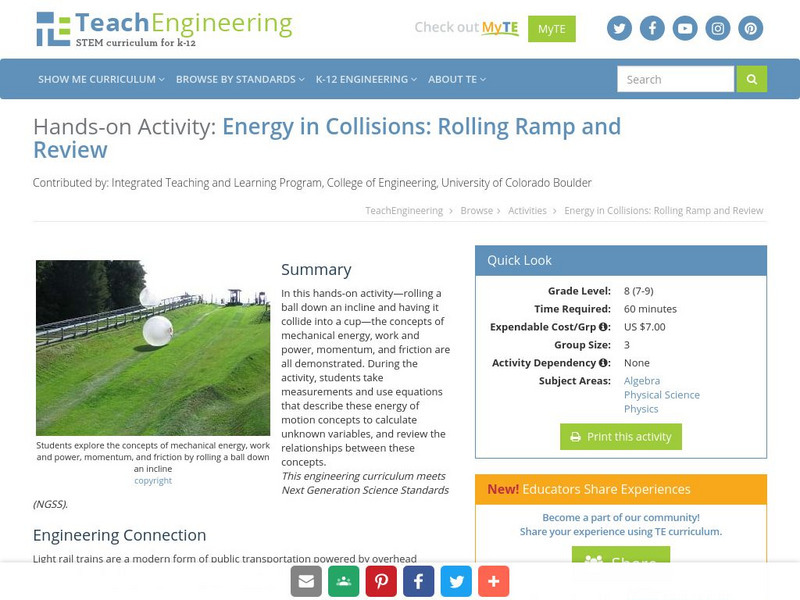
TeachEngineering
Teach Engineering: Ramp and Review
In this hands-on activity - rolling a ball down an incline and having it collide into a cup - the concepts of mechanical energy, work and power, momentum, and friction are all demonstrated. During the activity, students take measurements...

TeachEngineering
Teach Engineering: Ramp and Review (For High School)
In this hands-on activity - rolling a ball down an incline and having it collide into a cup - the concepts of mechanical energy, work and power, momentum, and friction are all demonstrated. During the activity, students take measurements...
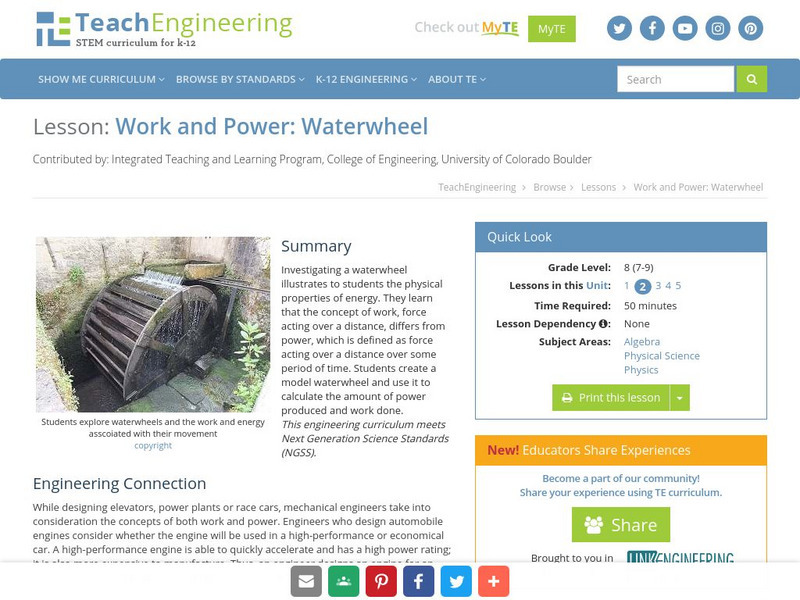
TeachEngineering
Teach Engineering: Work and Power: Waterwheel
Investigating a waterwheel illustrates to students the physical properties of energy. They learn that the concept of work, force acting over a distance, differs from power, which is defined as force acting over a distance over some...

Ducksters
Ducksters: Physics for Kids: Kinetic Energy
Kids learn about kinetic energy in the science of physics. The energy of motion can be calculated using mass and velocity. The standard unit is the joule. How it is different from potential energy.
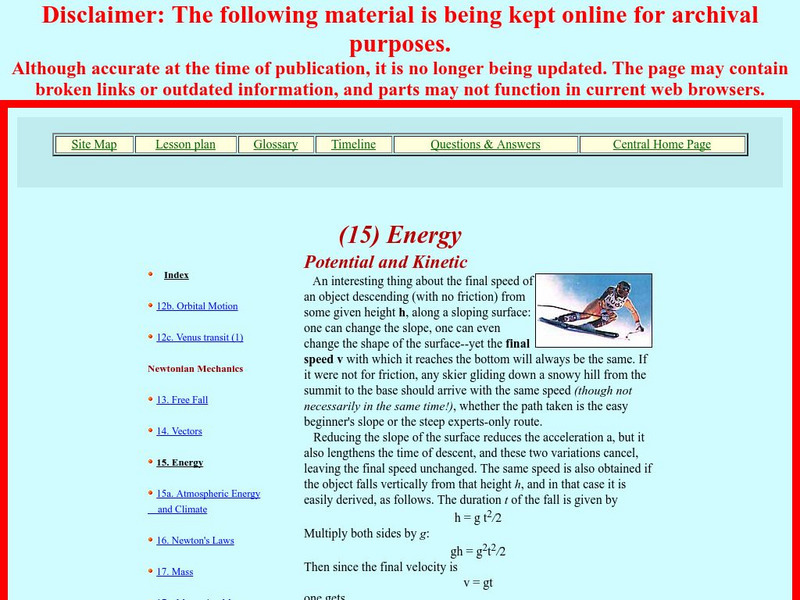
NASA
Nasa: From Stargazers to Starships: Energy
Demonstrates how principles of kinetic energy, potential energy and energy conservation can be used to determine the speed of a descending object if given its initial height. Further discussion of other topics such as heat and...
Science Education Resource Center at Carleton College
Serc: Mn Step: Slow the Ball
For this experiment, students will design a track for a rolling ball to try to have the longest roll time possible. They will, in the process, apply their understanding of kinetic and potential energy, and acceleration and deceleration.

Science Buddies
Science Buddies: Put Your Water to Work: Using Hydropower to Lift a Load
Water creates a lot of energy, just look at the Grand Canyon. In this science fair project, you will demonstrate the power of water by converting the kinetic energy in moving water to mechanical energy, which will lift a small weight.

Concord Consortium
Concord Consortium: What Is Happening When a Spark Occurs?
Students define potential and kinetic energy, explore energy transfer and energy conservation, and connect energy to atomic structure. The following activities guide students to a conclusion: Activity 1. Can my finger start a fire?...
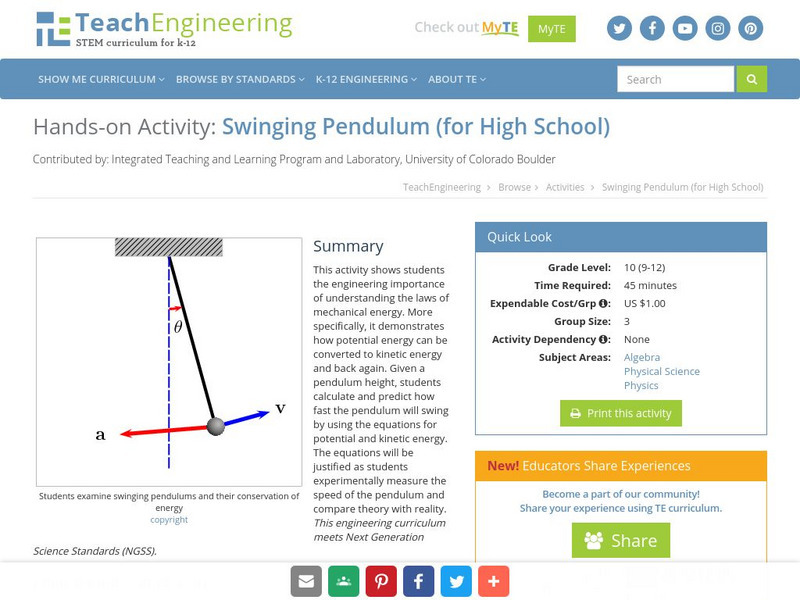
TeachEngineering
Teach Engineering: Swinging Pendulum
This activity shows students the engineering importance of understanding the laws of mechanical energy. More specifically, it demonstrates how potential energy can be converted to kinetic energy and back again. Given a pendulum height,...
Science Education Resource Center at Carleton College
Serc: Exploring Energy Conservation With Rulers and Cars
In this lab, students will investigate the law of conservation of energy. The lab is designed as something of an open, hands-on assessment where students demonstrate how to maximize the conversion of potential energy into kinetic energy.

TED Talks
Ted: Ted Ed: All of the Energy in the Universe Is
The energy in the universe never increases or decreases- but it does move around a lot. Energy can be potential or kinetic. George Zaidan and Charles Morton get excited about energy. [3:52]
Energy4Me
Energy4me: What Is Energy
Learn the difference between potential and kinetic energy, and how this plays a role in the sources we use for our energy needs.