Hi, what do you want to do?





CK-12 Foundation
Ck 12: The International System of Units
[Free Registration/Login may be required to access all resource tools.] In this online tutorial students will begin to identify the seven base units of the International System of Units. They will understand the commonly used metric...

Khan Academy
Khan Academy: Photoelectron Spectroscopy
An explanation of how photoelectron spectroscopy can be used to detect electron structures in atoms or molecules.

American Chemical Society
Middle School Chemistry: Heat, Temperature, and Conduction
Learners observe, describe, and draw a model on the molecular level, showing how energy is transferred from one substance to another through conduction.

Science Museum of Minnesota
Science Museum of Minnesota: Thinking Fountain: Friction
The Thinking Fountain provides this simple experiment for understanding friction and it relationship to energy.
Concord Consortium
Concord Consortium: Molecular Workbench Showcase: Heat and Temperature
A tutorial that explores the concepts of heat and temperature, the transfer of energy between substances, the relationship of temperature and the movement of atom, and thermal radiation. The tutorial includes animations, interactive...
OpenSciEd
Open Sci Ed: Net Logo: Conduction in Solids Reduced
This simulation shows conduction of thermal energy within and between solids, based on the kinetic energy of particles, and collisions between neighboring particles.
TeachEngineering
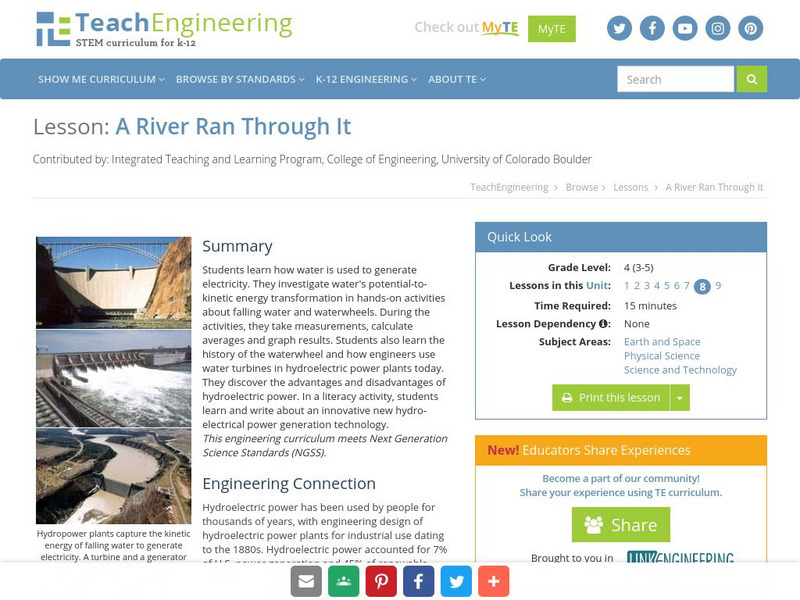
Teach Engineering: A River Ran Through It
Students learn how water is used to generate electricity. They investigate water's potential-to-kinetic energy transformation in hands-on activities about falling water and waterwheels. During the activities, they take measurements,...

Museum of Science
Museum of Science and Industry, Chicago: Activities: Build a Roller Coaster
Build the roller coaster, then keep making adjustments to see how it affects the potential and kinetic energy of the marble along its tracks.
TeachEngineering
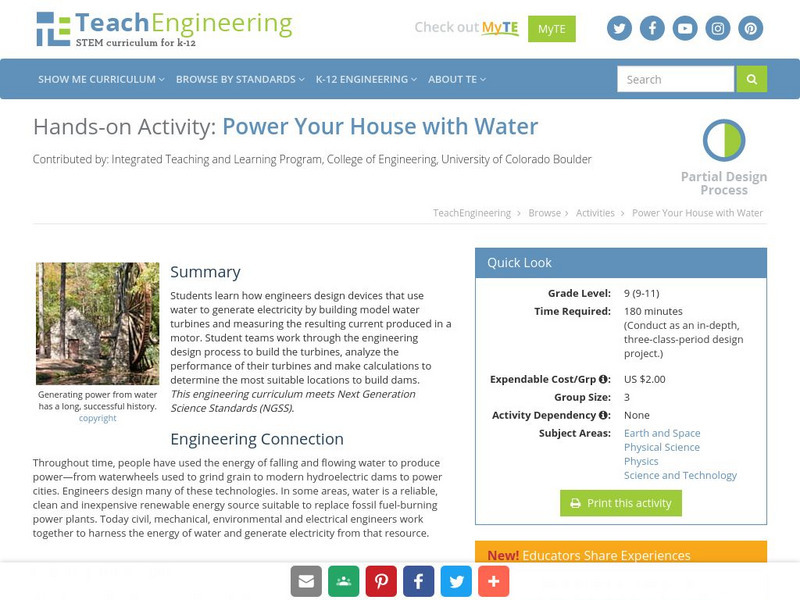
Teach Engineering: Power Your House With Water
Students learn how engineers design devices that use water to generate electricity by building model water turbines and measuring the resulting current produced in a motor. Students work through the engineering design process to build...

TeachEngineering
Teach Engineering: Latex and Hybrids: What's the Connection?
An engineering challenge where students create small-scale models from which their testing results could be generalized to large-scale latex tubing for a hydraulic accumulator. They brainstorm ideas about how latex can be used in a...

DOGO Media
Dogo News: Hi Tech Fabric Charges Devices on the Run
Read about an innovative technology in fabric that allows users to generate enough electricity through movement to charge devices such as cell phones. Includes video.
Georgia Department of Education
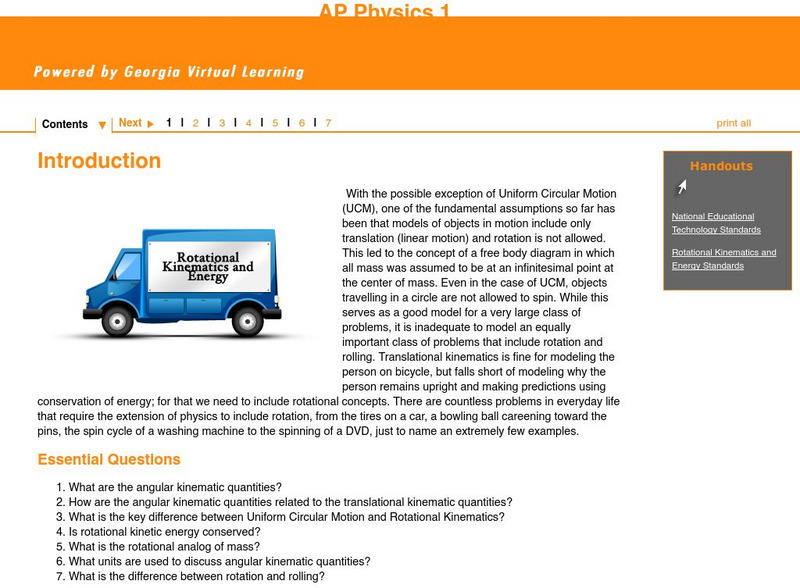
Ga Virtual Learning: Ap Physics 1: Rotational Kinematics and Energy
This module is the introduction to model rotational motion. All of the concepts are conveniently recast into forms that have the same mathematical forms as their translational counterparts.
Discovery Education
Discovery Education: Build Your Own Perpetual Motion Machine [Pdf]
A lesson for students to explore the conversion of energy from electrical energy to kinetic energy by constructing a homopolar motor. Also by constructing the motor, students can investigate magnetism, electricity, and RPM.
Museum of Science
The Atoms Family
Let this classic family of monsters guide you as you learn about energy. Interactive exercises, experiments, and demonstrations help to build knowledge and raise questions.
TeachEngineering
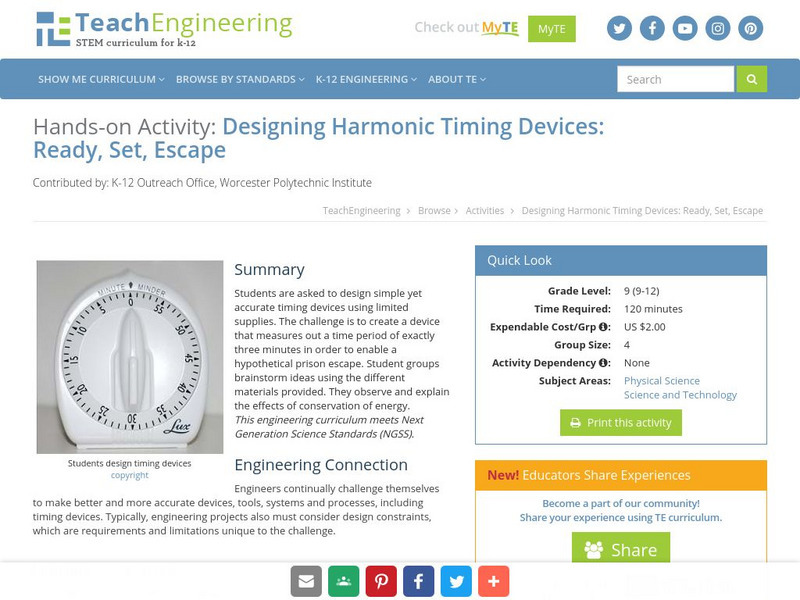
Teach Engineering: Ready, Set, Escape
During this project, students will be asked to design a device that will measure out a time period of exactly 3 minutes. They will be asked to brainstorm ideas using the different materials provided. Students will observe and explain the...
University Corporation for Atmospheric Research
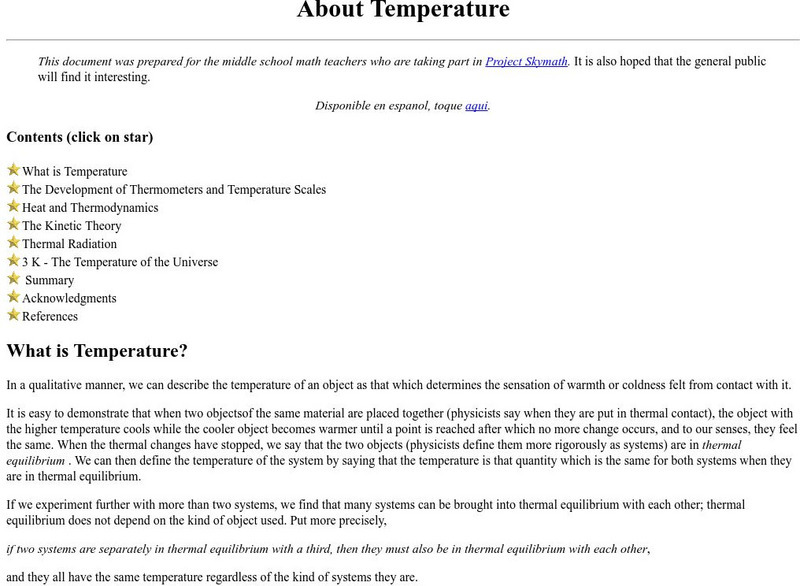
Ucar: About Temperature
This site from the University Corporation of Atmospheric Research provides a lengthy page covering numerous topics including the difference between heat and temperature, the use of different temperature scales, thermal expansion, how a...
Physics Classroom
The Physics Classroom: Work, Energy, and Power: Internal vs. External Forces
Through illustrated examples and interactive examples, students learn about the two categories of forces are referred to as internal forces and external forces.
TeachEngineering
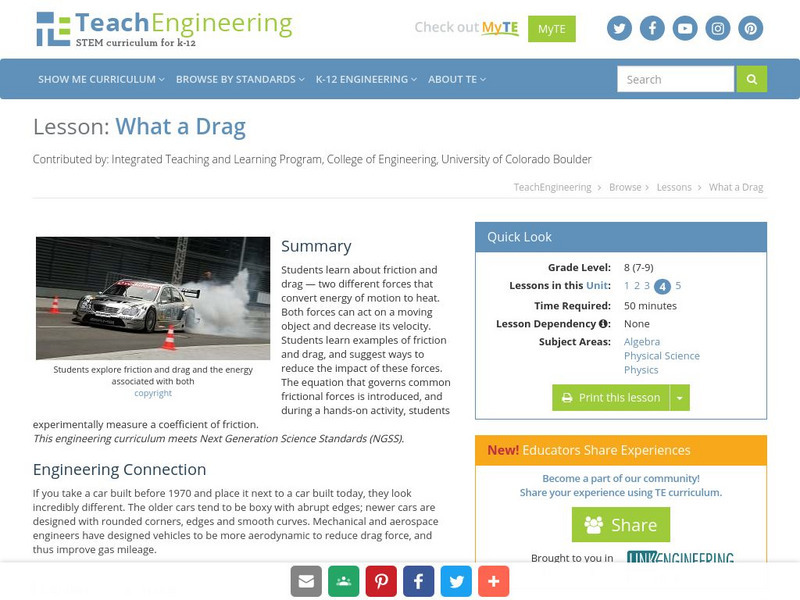
Teach Engineering: What a Drag
Students learn about friction and drag - two different forces that convert energy of motion to heat. Both forces can act on a moving object and decrease its velocity. Students learn examples of friction and drag, and suggest ways to...
Physics Aviary
Physics Aviary: Practice Problems: Jumping Joe
Students must predict the distance traveled by a person on a BMX bike. The person will start with potential energy due to gravity and then convert it into KE. They will then hit a ramp and become a projectile. You have to predict how far...
Physics Classroom
The Physics Classroom: Pendulum Motion
This tutorial investigates pendulum motion and how a variety of quantities change over the course of time. Such quantities will include forces, position, velocity and energy - both kinetic and potential energy. Take the interactive...
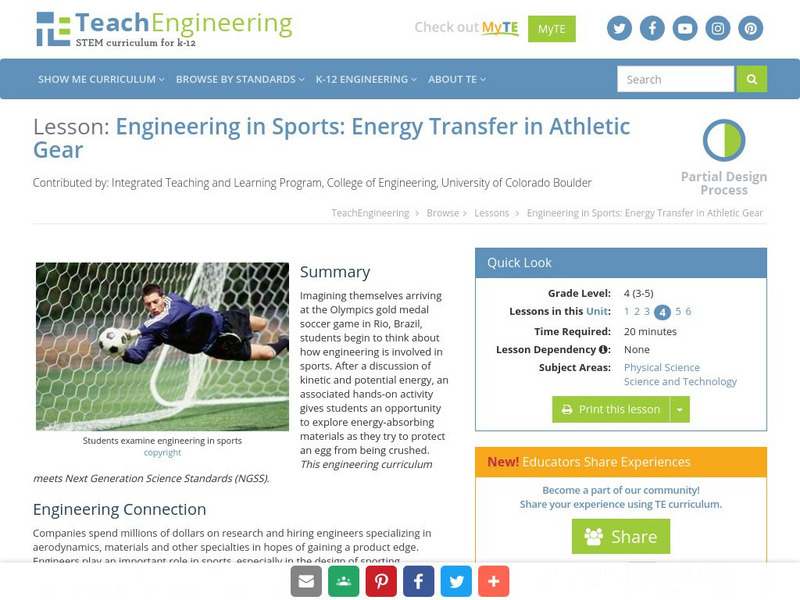
TeachEngineering
Teach Engineering: Engineering in Sports
Imagining themselves arriving at the Olympic gold medal soccer game in Beijing, young scholars begin to think about how engineering is involved in sports. After a discussion of kinetic and potential energy, an associated hands-on...
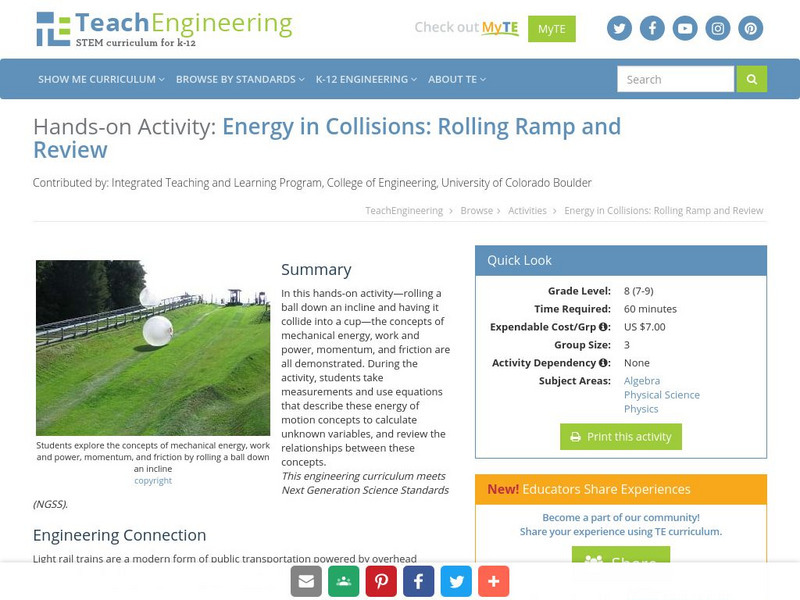
TeachEngineering
Teach Engineering: Ramp and Review
In this hands-on activity - rolling a ball down an incline and having it collide into a cup - the concepts of mechanical energy, work and power, momentum, and friction are all demonstrated. During the activity, students take measurements...
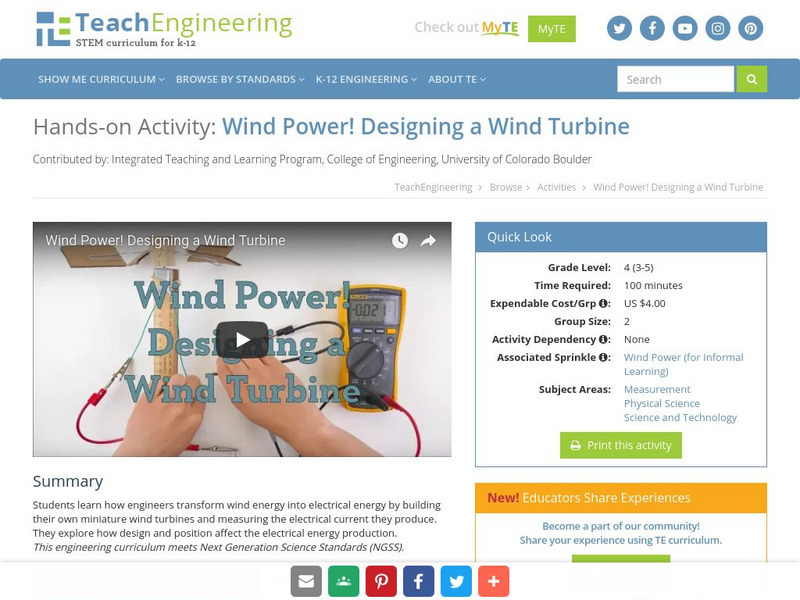
TeachEngineering
Teach Engineering: Wind Power!
Students learn how engineers transform wind energy into electrical energy by building their own miniature wind turbines and measuring the electrical current it produces. They explore how design and position affect the electrical energy...
Physics Aviary
Physics Aviary: Practice Problems: Billy on Hill (Level 1)
Students must predict the distance traveled by a person on a sled. The person will start with potential energy due to gravity and it will turn into KE without loss. They will then lose their energy on a level surface at the bottom of a...
Other popular searches
- Potential and Kinetic Energy
- Potential Kinetic Energy
- Potential & Kinetic Energy
- Kinetic Energy Questions
- Thermal and Kinetic Energy
- Kinetic Energy Lesson Plans
- Kinetic Energy of Particles
- Kinetic Energy Problems
- Science Kinetic Energy
- Potentail and Kinetic Energy
- Kinetic Energy Experiment
- Pot Entail and Kinetic Energy