Hi, what do you want to do?






Curated OER
It's For the Birds
Fifth graders examine how anatomical adaptations make it possible for a bird to survive in various habitats. They discuss and list birds and their unique characteristics, and create an imaginary bird, illustrating the environmental...

Curated OER
Riparian Review
High schoolers engage in the process of researching a riparian ecosystem. They conduct a field trip in order to obtain different types of data and work on measurement skills to analyze data to form a conclusion about the biotic factors...

Curated OER
Creating Communities
Young scholars design a community with minimal environmental impact. They rate each other's community's presentation using the "Planning and Zoning Commission Rating Scale".

Curated OER
Creating a National Park
Students explore how national parks are created, operate and benefit society by creating a new national park for their state.

Curated OER
If You Mess With A Wetland, At Least Try to Make Amends!
Eighth graders examine the role of wetlands in an ecosystem. In groups, they use the internet to research how humans have disturbed and ruined the effectiveness of wetlands throughout the country. They pretend they are in charge of...

Curated OER
Turning Parks into Islands
Students discuss the effects of isolating areas in a park to make "islands" for nature. In this nature lesson plan, students role play park rangers who are developing a new section of the park. Students work in groups to plan a park,...

Curated OER
Past Time: Vocabulary Practice
In this past time worksheet, students select the word or phrase from 3 choices that means the same as the word in bold in 12 sentences. All pertain to events in the past.

Curated OER
Vocabulary Practice With Past Time
In this word meanings worksheet, learners practice their vocabulary skills while using the past tense. Students complete twelve multiple choice questions where they choose the correct meaning of the bold word in each sentence.

Curated OER
Exploring Life in the Coral Reef
Learners study life forms in coral reefs. In this ocean life lesson, students study life in coral reefs as they create a coral reef sculpture.

Curated OER
Coqui Frog Camouflage
Students investigate the concept of the coqui frog of Puerto Rico. They conduct research using a variety of resources. Students explain in oral or written form some of the characteristics to that identify the frog. The lesson includes...

Curated OER
Trout Life-Cycle Booklet
Pupils write books about trout, completing one page per life stage.

Curated OER
Creating an Experimental Design
Students research the damage to the environment by certain plant species. They create an experimental design which they test how these species take over certain habitats. They share their information with the class.
PBS
Nova: Earth in Peril
A series of nine maps with accompanying explanations. They show how population growth has affected the environment around the world in terms of water availability, climate change, land and forest use, and more. There are both interactive...
University of Guelph
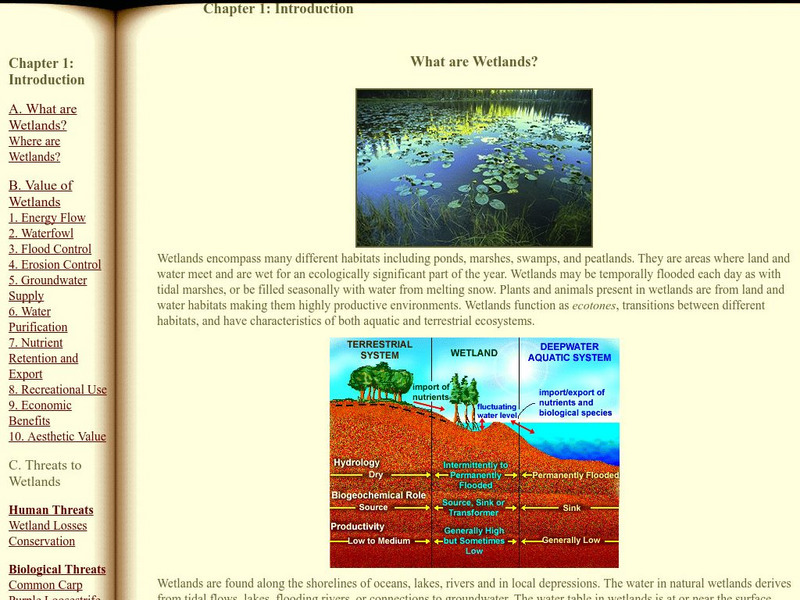
What Are Wetlands?
Wetlands are an important part of our ecosystem. They are often called the kidneys of the land. Learn about wetlands, where they are located, their value, and what threatens them.

ClassFlow
Class Flow: Habitats
[Free Registration/Login Required] A 2nd grade unit on animal environments and habitats. Include web links for information on different land and water habitats, as well as a lesson on food chains.
US Environmental Protection Agency
Epa: Surf Your Watershed
This resource provides information on watersheds, maps, activities, and links to local watershed information.

Alabama Learning Exchange
Alex: Wildlife Math
This integrated lesson is the result of collaboration between Chip Blanton, a wildlife management teacher, and Greg Pendergrass, a math teacher (Ft. Payne High School). Learning to manage wildlife requires an understanding of planting...

CK-12 Foundation
Ck 12: Life Science: Amphibians
[Free Registration/Login may be required to access all resource tools.] Amphibians are a group of vertebrates that have adapted to live in both water and on land. Amphibian larvae are born and live in water, and they breathe using gills....

ClassFlow
Class Flow: Changes in Habitats
[Free Registration/Login Required] A 2nd grade unit on how people and weather can change habitats. Topics include too much and too litter rain (flooding and drought), lightning and fire, and land, water, and air pollution. This flipchart...