Hi, what do you want to do?






Science Education Resource Center at Carleton College
Serc: Experiencing Newton's 3rd Law With Match Stick Rockets
Students build and launch match-stick rockets in order to experience Newton's Third Law of motion.
Science and Mathematics Initiative for Learning Enhancement (SMILE)
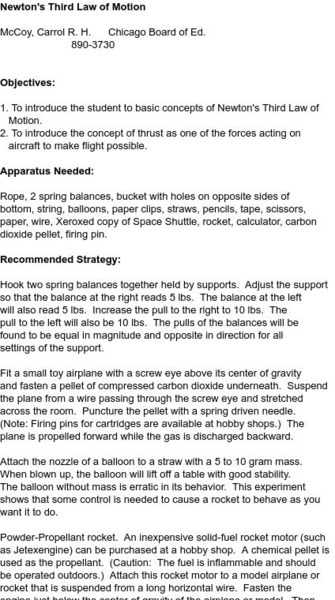
Smile: Third Law of Motion
This Illinois Institute of Technology site is a lesson plan and lab that utilizes a toy rocket to investigate Newton's third law. Includes directions and practical applications.
Science Education Resource Center at Carleton College
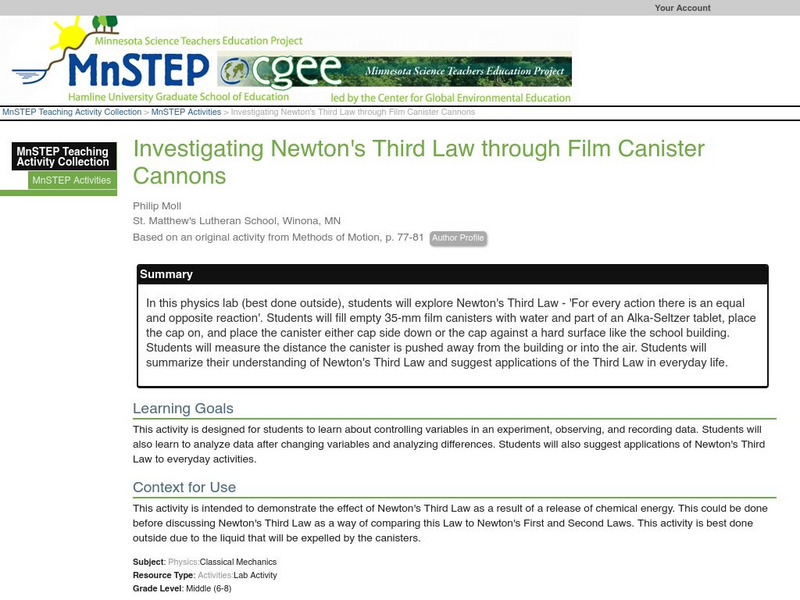
Serc: Investigating Newton's Third Law Through Film Canister Cannons
In this physics lab (best done outside), students will explore Newton's Third Law - 'For every action there is an equal and opposite reaction'. Students will fill empty 35-mm film canisters with water and part of an Alka-Seltzer tablet,...

Physics Classroom
The Physics Classroom: Newton's Laws
A four-lesson e-textbook covering topics in Newton's Laws. Tutorials include informational text,animations, interactive activities, and quick, interactive comprehension checks throughout the lessons.

NASA
Nasa: The Space Place: Build a Bubble Powered Rocket
This site from the National Aeronautics and Space Administration provides fun information on bubble powered rockets. "Build your own rocket using paper and fizzing tablets! Watch it lift off. How high does your rocket go?"
TeachEngineering
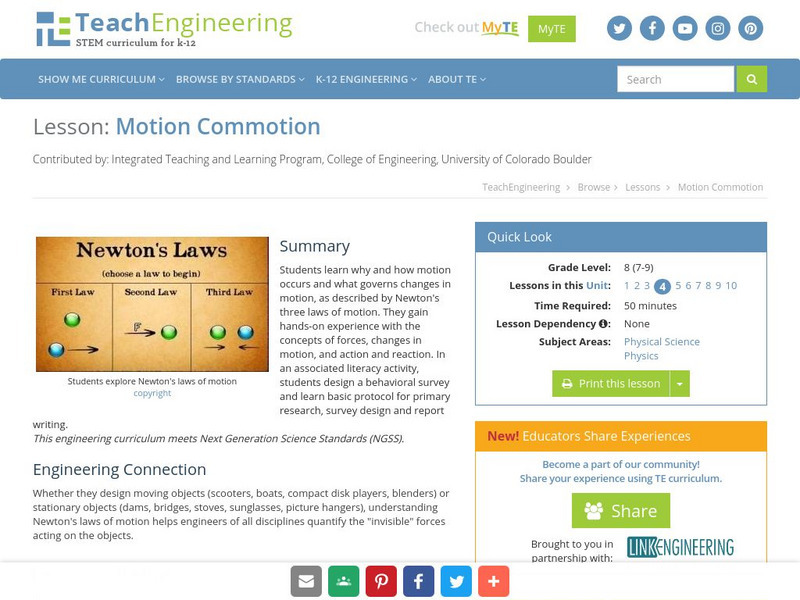
Teach Engineering: Motion Commotion
Students learn why and how motion occurs and what governs changes in motion, as described by Newton's three laws of motion. They gain hands-on experience with the concepts of forces, changes in motion, and action and reaction. In an...
Sophia Learning
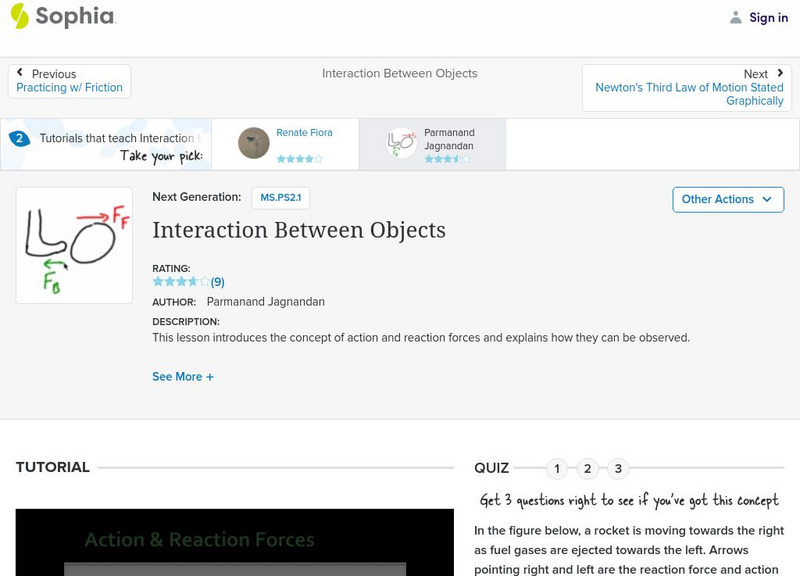
Sophia: Interaction Between Objects: Lesson 1
This lesson introduces the concept of action and reaction forces and explains how they can be observed. It is 1 of 2 in the series titled "Interaction Between Objects."
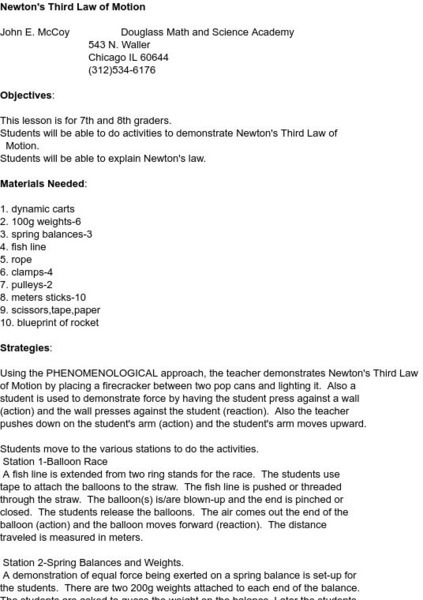
Science and Mathematics Initiative for Learning Enhancement (SMILE)
Smile: Third Law of Motion
This Illinois Institute of Technology site provides a teacher lesson plan for an activity in which students use spring balances and carts to investigate the action-reaction relationship for any given force. Includes directions, materials...
Physics Classroom
The Physics Classroom: Momentum and Its Conservation
Two complete tutorials on momentum and its conservation. Tutorials include informational text, interactive activities, animations, and quick, interactive comprehension checks throughout the lessons.

CK-12 Foundation
Ck 12: Plix Series: Satellites, Shuttles, and Space Stations
[Free Registration/Login Required] Simulate the launch of a rocket to see how rocket propulsion works. After the activity, answer a challenge question to check for understanding.
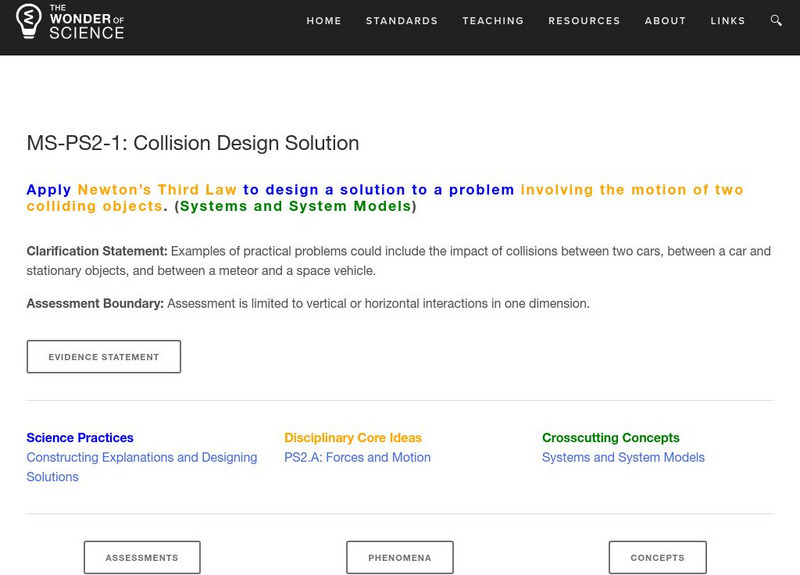
The Wonder of Science
The Wonder of Science: Ms Ps2 1: Collision Design Solution
Help your students explore how the motion of objects changes during a collision. This website includes work samples, phenomena, assessment templates, and videos that focus on collision design solution.
TeachEngineering
Teach Engineering: Mechanics Mania
Through ten lessons and numerous activities, students explore the natural universal rules engineers and physicists use to understand how things move and stay still. Together, these rules are called "mechanics." The study of mechanics is...
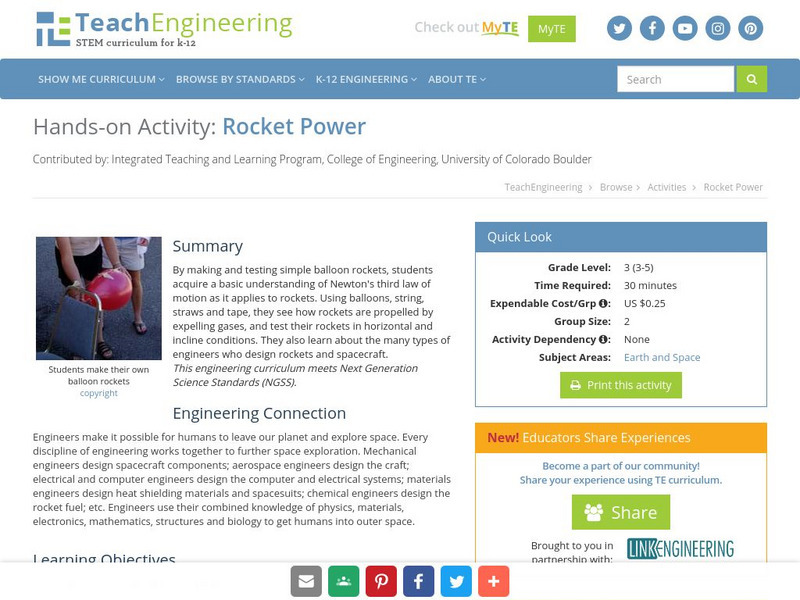
TeachEngineering
Teach Engineering: Rocket Power
By making and testing simple balloon rockets, students acquire a basic understanding of Newton's third law of motion as it applies to rockets. Using balloons, string, straws and tape, they see how rockets are propelled by expelling...
Quia
Quia: Newton's Laws Quiz
A short quiz on Newton's famous laws of motion. Has ten multiple-choice questions.
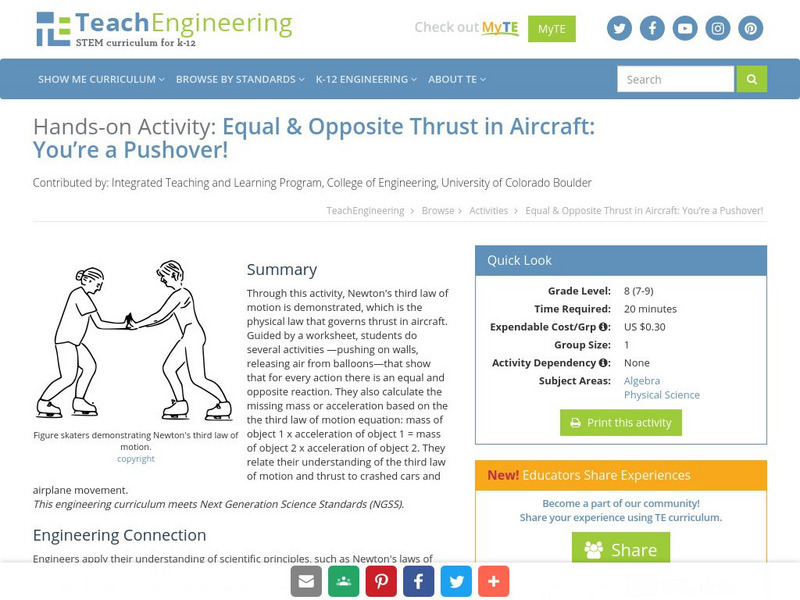
TeachEngineering
Teach Engineering: You're a Pushover!
The purpose of this activity is to demonstrate Newton's 3rd Law of Motion, which is the physical law that governs thrust in aircraft. The students will do several activities that show that for every action there is an equal and opposite...
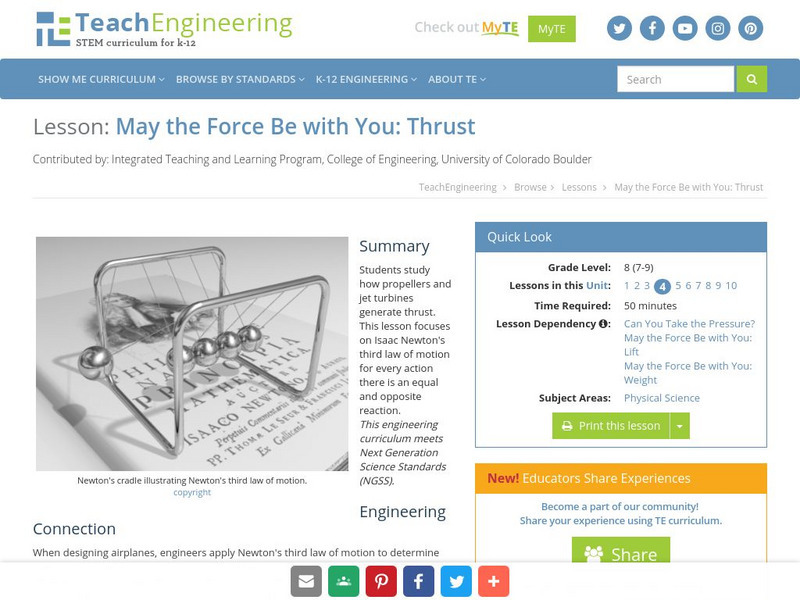
TeachEngineering
Teach Engineering: May the Force Be With You: Thrust
In this lesson, students will study how propellers and jet turbines generate thrust. This lesson focuses on Isaac Newton's 3rd Law of Motion, which states that for every action there is an equal and opposite reaction.

TED Talks
Ted: Ted Ed: What if Everyone Jumped at the Same Time?
If every action has an equal and opposite reaction, what kind of physical action would it take for the earth to notice us? Check out Vsauce's video on what would happen if everyone on Earth got together and jumped. [7:13]
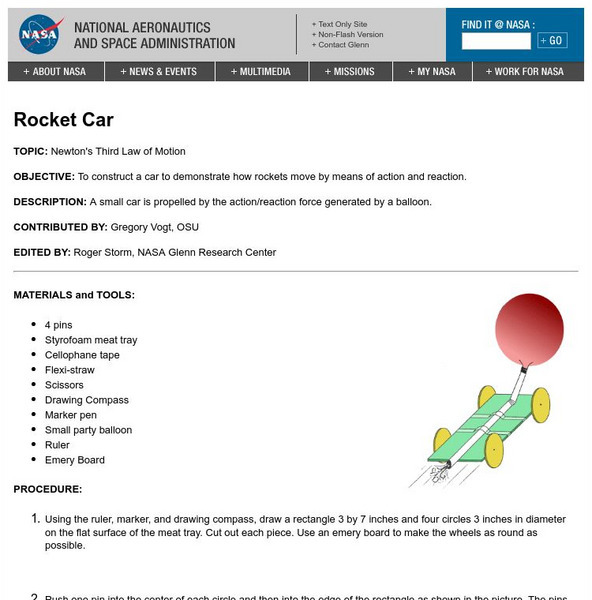
NASA
Nasa Glenn Research Center: Rocket Car (Class Activity)
Students discover Newton's Third Law of Motion by constructing a rocket car.
Davidson College
Davidson College: Chemical Equilibria
Explains what chemical equilibrium is and the role of the Law of Mass Action. A Java simulation shows the concentration-time curves of a chemical reaction.
TeachEngineering
Teach Engineering: Pop Rockets
Students design and build a paper rocket around a film canister, which is used as the engine. An antacid tablet and water are put into the canister, react to form carbon dioxide gas, and act as the pop rocket's propellant. With the lid...
Cosmo Learning
Cosmo Learning: Newton's Laws
Do you need to review any of Newton's three laws? This website contains a video collection on Newton's Law from a physics course at East Los Angeles College. In twelve lectures, each law is explained with examples. Also discussed is...
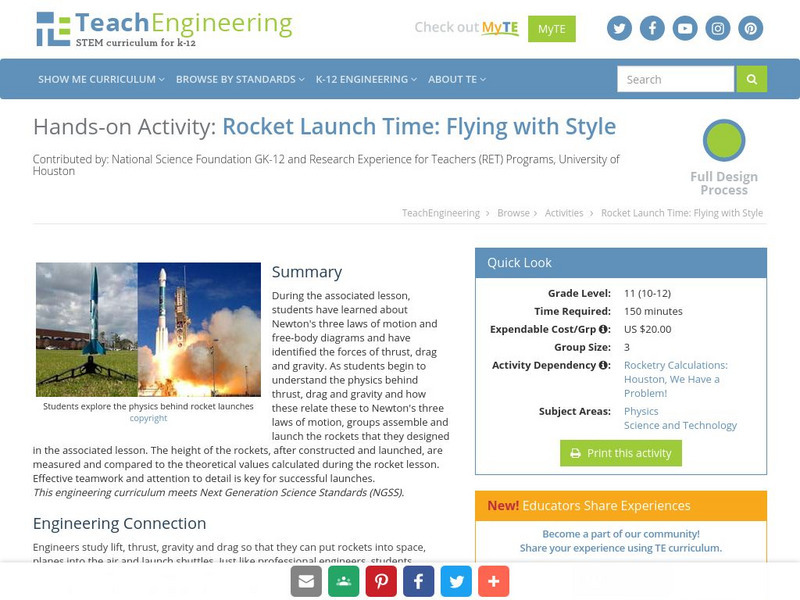
TeachEngineering
Teach Engineering: Flying With Style
As students begin to understand the physics behind thrust, drag, and gravity and how these relate these to Newton's three laws of motion, groups assemble and launch the rockets that they designed in the associated lesson.

NASA
Nasa: Beginner's Guide to Aerodynamics
Includes exhaustive information and a wealth of activities pertaining to aerodynamics and the physics of flight.
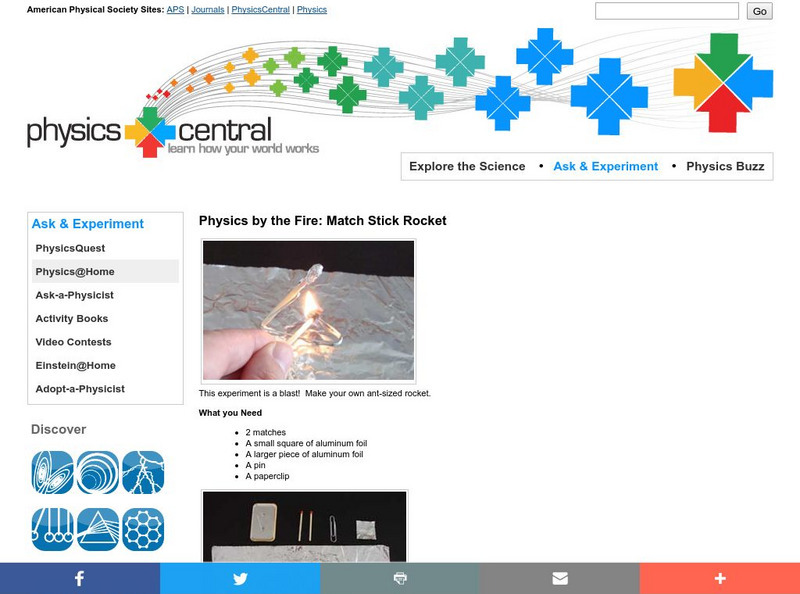
Physics Central
Physics Central: Physics by the Fire: Match Stick Rocket
Match stick rockets makes a great demonstrations to show students Newton's third law. By covering a match with tin foil, students can see the reaction thrust as the molecules escaping the matchstick are propelled into the air. Lesson...