Hi, what do you want to do?





Khan Academy
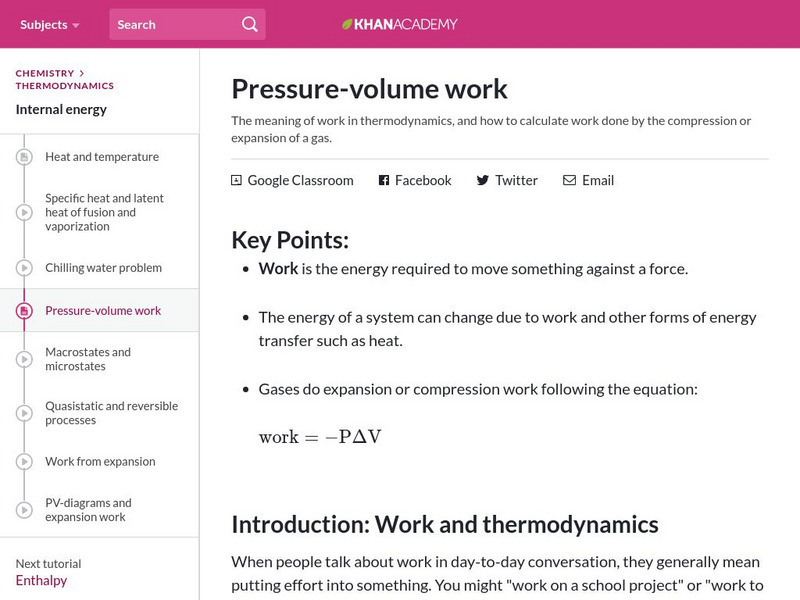
Khan Academy: Pressure Volume Work
Work, in regards to thermodynamics, is defined and calculated using the expansion and contraction of gasses.
Chemistry Collective
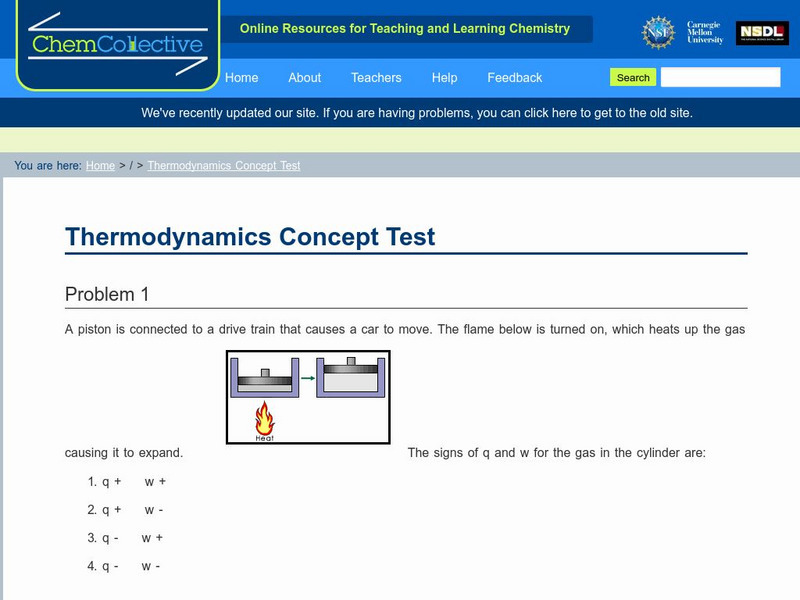
Chem Collective: Thermodynamics Concept Test
Concept tests that can be used as part of in-class activities to help students reason about energy and work.

Famous Scientists
Famous Scientists: William Thomson
Learn about William Thompson's important work in the mathematical analysis of electricity and formulation of the first and second laws of thermodynamics, and did much to unify the emerging discipline of physics in its modern form.
Georgia Department of Education
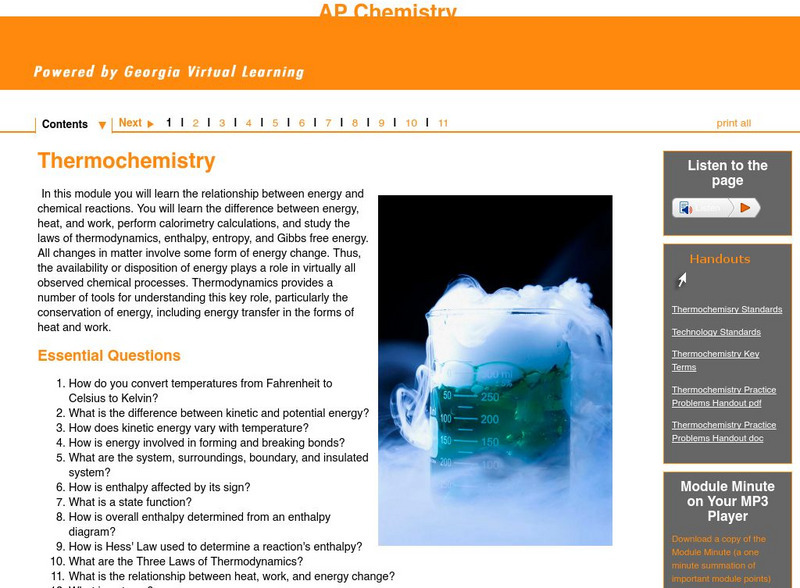
Ga Virtual Learning: Ap Chemistry: Thermochemistry
In this module students learn the relationship between energy and chemical reactions, and understand the difference between energy, heat, and work. They perform calorimetry calculations, and study the laws of thermodynamics, enthalpy,...
Other
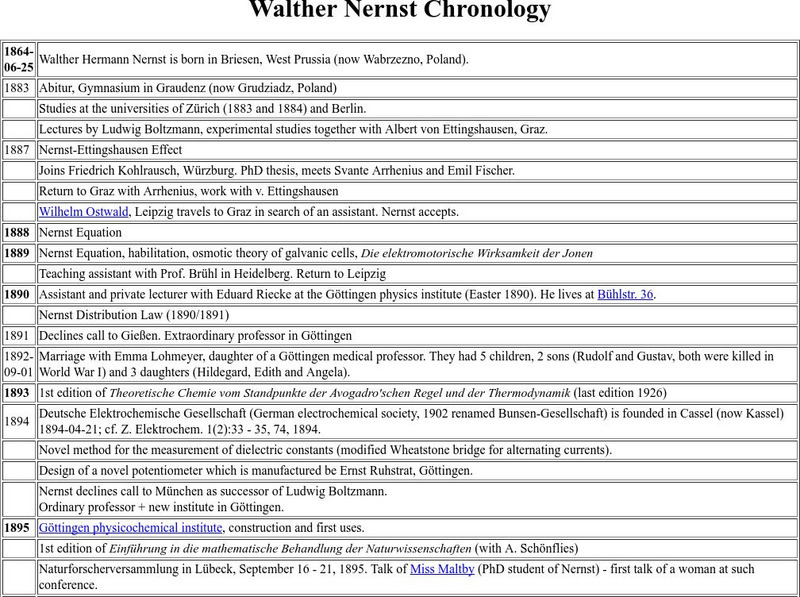
Walther Nernst Chronology
Walther Nernst (1846-1941) discovered the Third Law of Thermodynamics and won a Nobel Price in 1921 for his work in thermochemistry.
Physics4kids
Physics 4 Kids: Thermodynamics Quiz
Take this ten question multiple choice quiz over thermodynamics.
University Corporation for Atmospheric Research
Ucar: About Temperature
This site from the University Corporation of Atmospheric Research provides a lengthy page covering numerous topics including the difference between heat and temperature, the use of different temperature scales, thermal expansion, how a...
Simon Fraser University
Chem1 Virtual Textbook: Chemical Energetics
A thorough introduction to chemical thermodynamics and the first law at the university level.

Georgia State University
Georgia State University: Hyper Physics: Heat Engine Cycle
The heat engine cycle is defined and discussed. So pressure-volume diagrams are introduced and their use in depicting the cycles of a heat engine is demonstrated. Informative graphics are accompanied by reason-filled explanations.
Georgia State University
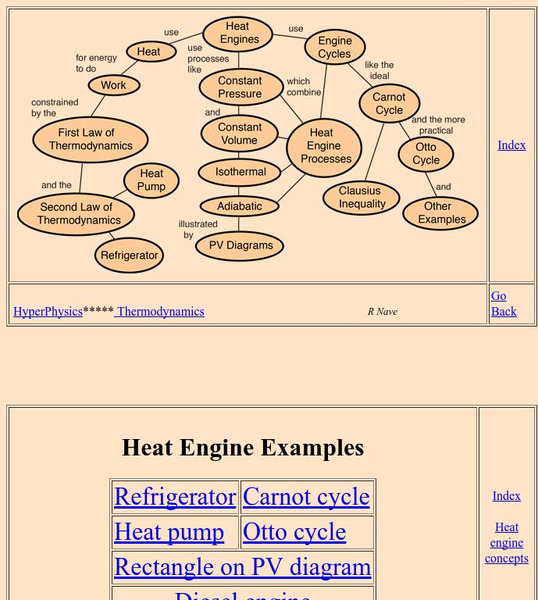
Georgia State University: Hyper Physics: Heat Engine Concepts
An indexing page for the HyperPhysics site. The page contains a concept map of links to a variety of other pages which discuss concepts related to heat engines. All pages contain informative graphics and excellent explanations.
Georgia State University
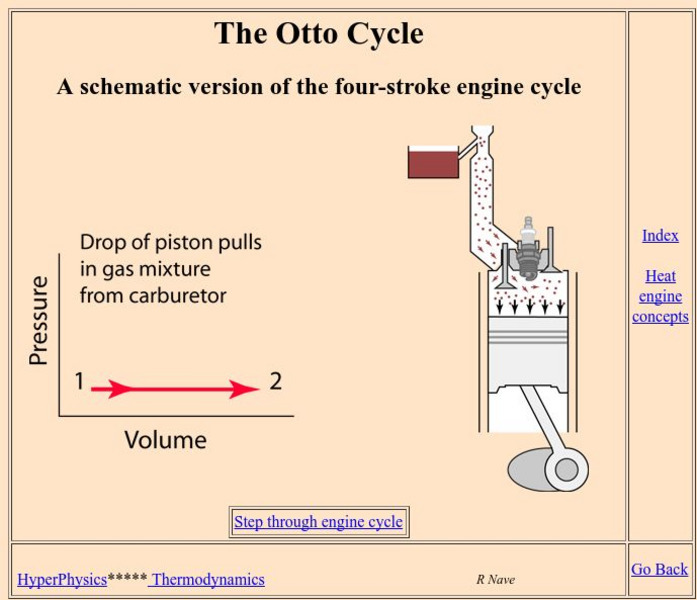
Georgia State University: Hyper Physics: Heat Engine Concepts: The Otto Cycle
Schematic diagrams illustrating the operation of a four-stroke engine cycle. Interactive buttons allow you to step through the various steps of each engine cycle. Each graphic is accompanied by an excellent explanation.

Georgia State University
Georgia State University: Hyper Physics: Heat Engine Concepts: Carnot Cycle
The Carnot cycle is described, illustrated and explained. The Carnot efficiency equation is given and interactive JavaScript form allows the visitor to investigate the effect of the reservoir temperature and the sink temperature upon the...

Georgia State University
Georgia State University: Hyper Physics: Entropy
This informative site is from Georgia State University. The tendency of nature to move towards a more disordered state in an isolated system, a concept known as entropy, is discussed. This concept is well-depicted in meaningful diagrams.

Georgia State University
Georgia State University: Hyper Physics: Heat Pump
Heat flow from a hot region to a cold region is described and explained. Applications of this phenomenon (specifically heat pumps and refrigerators) are discussed. Excellent graphics.
Simon Fraser University
Chem1 Virtual Textbook: Hess' Law and Thermochemical Calculations
With an overview of topics related to chemical energetics, this site provides a foundation to a study of thermodynamics and its relation Hess's law and enthalpies of combustion.
Cosmo Learning
Cosmo Learning: Fundamentals of Physics
A collection of video lectures from a fundamentals of physics course taught at Yale University. The course is an introduction to physics and discusses Newtonian mechanics, special relativity, gravity, thermodynamics, and waves. Course...
Physics4kids
Physics4 kids.com: Thermodynamics & Heat: Enthalpy
Concise information about enthalpy, the measure of the total energy of a thermodynamic system.
Center of Science and Industry
Cosi Columbus: Strange Soap
Investigate the behavior of a soapy bubble solution, and find out why bubbles move, and ultimately pop.
Other
Dr. Rod Beavon: The Solubility of Ionic Compounds
A detailed discussion of solubility as a function of Enthalpy and Entropy. Goes way beyond the standard solubility discussion.
Other
Nye Thermodynamics: Basic Gas Turbine Theory
Outstanding information (and a lot of it) on gas turbine (jet) engines. Describes the history behind their development and the theory behind their operation. Well written and includes very informative graphics.

TeachEngineering
Teach Engineering: The Physics of Fluid Mechanics
Five lessons about the study of fluid mechanics. The unit concludes with students applying what they have learned to determine the stability of individual above-ground storage tanks given specific storm conditions so they can analyze...
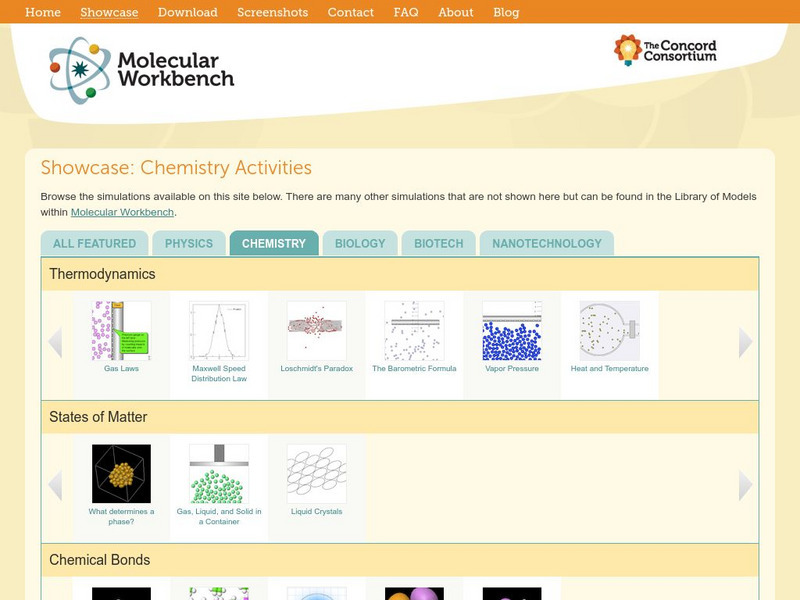
Concord Consortium
Concord Consortium: Molecular Workbench Showcase: Chemistry, Thermodynamics
Explore some virtual experiments on gases and vapor pressure, the Maxwell speed distribution, the barometric formula, and heat and temperature.

National High Magnetic Field Laboratory
Magnet Academy: James Joule
James Prescott Joule experimented with engines, electricity and heat throughout his life. Joule's findings resulted in his development of the mechanical theory of heat and Joule's law, which quantitatively describes the rate at which...

Georgia Department of Education
Ga Virtual Learning: Chemistry: Thermochemistry
Through informational text, interactive practice problems, online labs, and virtual simulations, students are introduced to the concepts of thermochemistry.
Other popular searches
- Second Law of Thermodynamics
- First Law of Thermodynamics
- 1st Law of Thermodynamics
- 2nd Law of Thermodynamics