Hi, what do you want to do?





Curated OER
Healthy Happy heart Booklet
Students complete activity pages in a book to demonstrate their understanding of a healthy heart.

Curated OER
Haunted House Challenge Fitness Stations
Learners rotate through ten physical fitness stations. They perform various stretching and strengthening activities for three minutes at a time.

Curated OER
Characteristics of Living Things
Students examine the characteristics of living things. They list the differences between living and non-living things, explore areas around the school, and create a Venn diagram for items found in the school areas.

Curated OER
Drugs In The Olympics
Students brainstorm and discuss the issues raised by Olympic drug cheating from history as well as today. They bring in examples of individuals who have been accused of drug cheating and examine their situations. In addition, they chart...

Curated OER
Making Mummies
Students examine how mummies are made. In this ancient mummification lesson, students discover types of mummies and discuss the environments naturallly preserve bodies. Students research noteable mummy discoveries and present...

Curated OER
Make Sense of Nature
Students participate in this program that heightens their awareness and curiosity of nature as well as their sense of adventure and exploring new surroundings. They identify and choose an object from nature after exploring it with other...

Curated OER
You Won't Believe Your Eyes!
Students gain a basic understanding of the sense of sight. They watch a video on sight, then engage in some vocabulary games, and perform some simple experiments which focus on the basics of sight.

Curated OER
It's All About Me!
Students study the five major body system in this unit. They examine how to keep themselves healthy.

PBS
Pbs Learning Media: Meet My Muscles Lower Body Lesson Plan
This lesson depicts students following along with their teacher to learn about lower body muscles. Students learn about muscles such as the gluteal and hamstring and how to give them a good stretch and exercise.
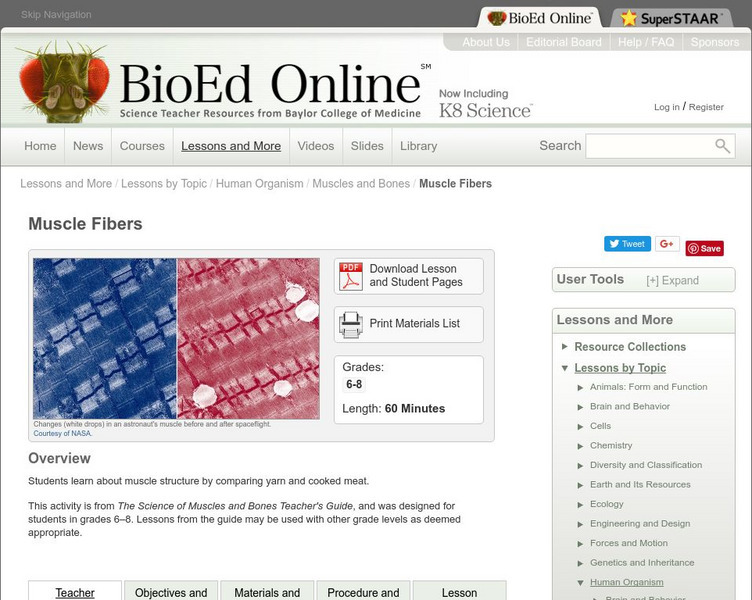
BioEd Online
Bio Ed Online: Muscle Fibers
Muscles are made of fibers within fibers and the structure of muscles makes them strong. In this activity young scholars learn about muscle structure by comparing yarn and cooked meat.

North Central Regional Educational Laboratory
Ncrel: Human Body Systems Resource
What do you know about the different human body systems? This site features information on each of the different systems. Students and teachers will benefit from this comprehensive resource.
PBS
Pbs Learning Media: Meet My Muscles Upper Body Lesson Plan
Following along with their teacher, students learn about the various upper body muscles we have such as the bicep and pectoral muscles and learn how to give them a good stretch and exercise.
Other
Specialist Schools and Academies Trust: Learn Ar: Pe: Arms & Muscles
A learning resource that incorporates augmented reality (AR), using a camera, where students explore the anatomy of the human arm. The home page for this site has a PDF resource that explains how AR works and provides printable marker...

BioEd Online
Bio Ed Online: Arm Model
In the following activity students are required to construct a model arm and learn how muscles and bones work together to achieve efficient movement.
OpenStax
Open Stax: Forces and Torques in Muscles and Joints
From a chapter on Statics and Torque in a Physics textbook. This section of the chapter provides an in-depth discussion of forces and torque in the human body. We learn about muscular force, the importance of posture in preventing back...
PBS
Pbs Learning Media: Map of the Human Heart
See how the human heart moves blood through the body in this animated feature from the NOVA: "Cut to the Heart" Web site.

Untamed Science
Untamed Science: Human Biology: Musculatory System
Learn about the three types of muscle tissue, how a muscle contracts, and how muscles are adapted for exercise. [3:40]
CK-12 Foundation
Ck 12: Life Science: Organization of the Human Body
[Free Registration/Login may be required to access all resource tools.] Cells, like these nerve cells, do not work in isolation. To send orders from your brain to your legs, for example, signals pass through many nerve cells. These cells...
Other
Biology Guide: Human Life Span
Students learn about the human life-span. Some topics investigated in the tutorial are reproduction, nervous system, skeletal muscle, and homeostasis.
TeachEngineering
Teach Engineering: Engineering and the Human Body
The Engineering and the Human Body unit covers the broad spectrum of topics that make up our very amazing human body. Students are introduced to the space environment and learn the major differences between the environment on Earth and...
TeachEngineering
Teach Engineering: Humans Are Like Robots
Four lessons related to robots and people present students with life sciences concepts related to the human body (including brain, nervous systems and muscles), introduced through engineering devices and subjects (including computers,...
TeachEngineering
Teach Engineering: Measuring Our Muscles
Student teams build model hand dynamometers used to measure grip strengths of people recovering from sports injuries. They use their models to measure how much force their classmates muscles are capable of producing, and analyze the data...
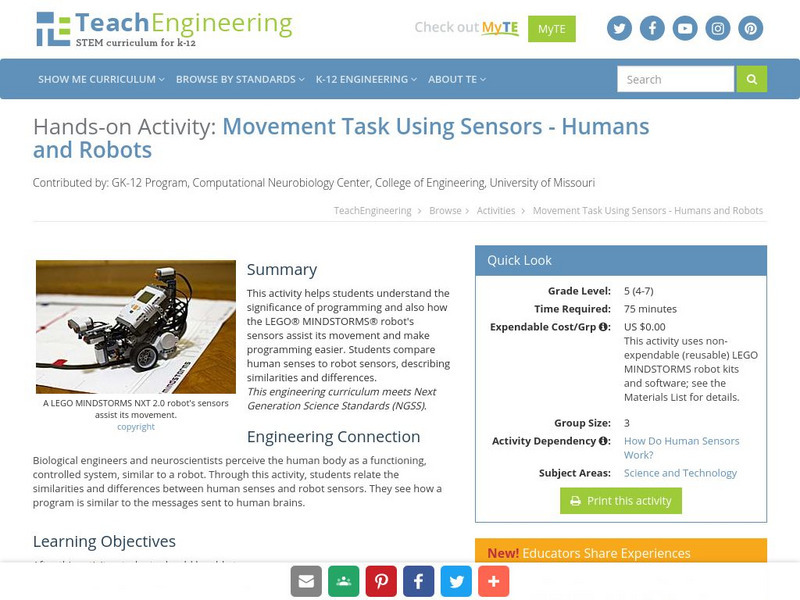
TeachEngineering
Teach Engineering: Movement Task Using Sensors Humans and Robots
This activity helps students understand the significance of programming and also how the LEGO MINDSTORMS NXT robot's sensors assist its movement and make programming easier. Students compare human senses to robot sensors, describing...

Other
Artnatomy/artnatomia: Anatomical Facial Expression Learning Tool
A magnificent Flash interactive tool useful for teaching and learning about the anatomical foundation of facial expression. Expandable animated images overlay each other to show both the structure of the skull and the muscles employed...