Hi, what do you want to do?






Curated OER
Talking Bulls and Bears
Students compare and contrast bull and bear markets. In this stock market lesson, students visit the noted Web sites to study supply and demand, the stock exchange, and financial scandals.

Curated OER
An Academic, Economic, Cultural, and Political Lesson Plan
Students reflect on how many board games they've played have African Americans, their culture or history incorporated within. They identify four street games and three card games that appeal to African Americans. They play the...

Curated OER
U.S. History: The Great Depression
Seventh graders examine the Great Depression and federal relief programs such as the Civilian Conservation Corps. Focusing on Texas, they assess the effects on poor farmers and discuss what they would do for a living had they lived in...

Curated OER
Needs and Wants
Students demonstrate responsible consumer choices. In this social studies instructional activity, students read The Lorax and discuss wants and needs. Students discuss how to save natural resources by making informed consumer choices.

Curated OER
For Sale!
Learners review same type (denomination) coin sets, and build same type coin sets equaling fifty cents.

Curated OER
Matching Numbers to Words
Students explore a math concept. For this math lesson, students practice matching a number with its corresponding word. Students can work independently or with teacher help.


Curated OER
Let's Make A Deal
Students conduct a Swap Day to determine how bartering to exchange goods works. They trade something that they do not want for an item that they prefer.

Curated OER
Lesson #73 Absolute Maximum and Minimum
Students listen to a lecture about absolute maximum and absolute minimum. In this maximum and minimum lesson students use steps to find points and practice with an example.
E-learning for Kids
E Learning for Kids: Math: Halloween: Shopping
On this interactive website students practice various math skills using a real life scenario doing Halloween shopping. Those skills include solving money problems with addition and subtraction and understanding the value of money and coins.
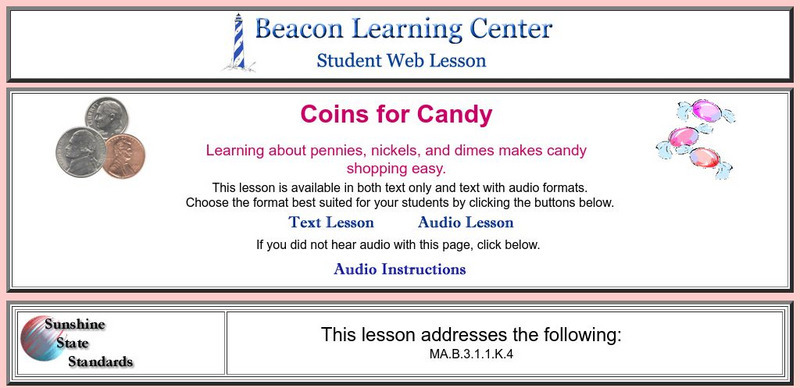
Beacon Learning Center
Beacon Learning Center: Coins for Candy
An interactive lesson helps students identify, compare, and learn the value of coins including pennies, nickels, and dimes.

Council for Economic Education
Econ Ed Link: The Changing Face of Money
In this lesson, students play a game to guess which objects have been used as money throughout history. In the process, they learn several basic economic concepts. For instance, money must be a unit of account, meaning that it must be...
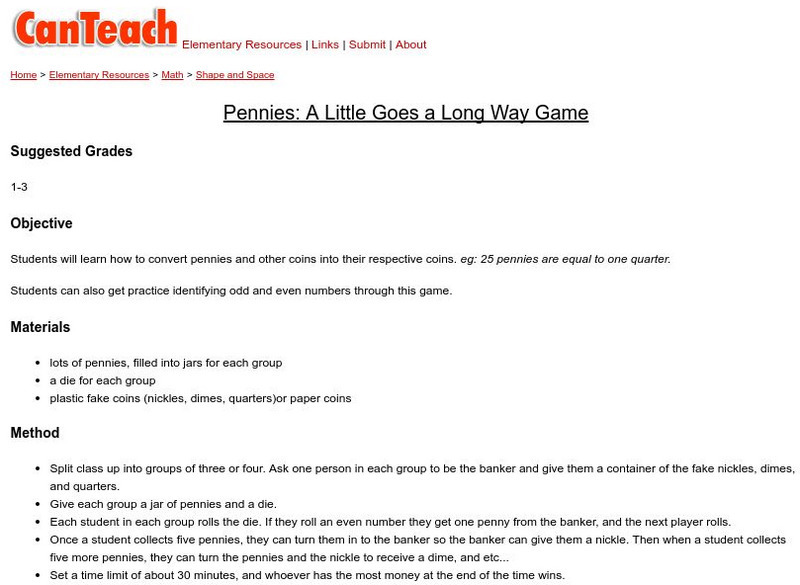
Can Teach
Can Teach: Pennies a Little Goes a Long Way Game
Use this fun learning game in your classroom to help students understand the value of money. Groups of students will be exchanging pennies for other types of coins.
ABCya
Ab Cya: Learning Coins
Explore a tutorial to learning facts about the coins and their value then play a game to sort the coins by value.
Education Development Center
Tune in to Learning: Is Paying Over Time a Smart Move?
At T.V. 411 you can explore the concept of paying over time with situations involving credit cards, rent to own items, and more. This interactive lesson gives the learner an opportunity to make decisions about money management.

Scholastic
Scholastic: Adventures in Math: Lesson 1: Money Basics
Why do we use money? Learn why we need money and to identify bills and coins.
Practical Money Skills
Practical Money Skills: Peter Pig's Money Counter
Interactive learning game in which students gain practical skills in financial literacy by learning how to identify and count coins. Students choose one of three levels of difficulty.
Council for Economic Education
Econ Ed Link: Exchange Rates and Exchange: How Money Affects Trade
Students learn how currency values are set by supply and demand, and how changes in the value of currency affect international trade. Students then find the value of the Brazilian Real in 2000 and 2002, determine whether the currency has...
Council for Economic Education
Econ Ed Link: "Should You Learn to Fly?"
Students will define opportunity cost as they list various career choices and salaries, and calculate future value of money.
Council for Economic Education
Econ Ed Link: One Is Silver and the Other's Gold
Students learn about the money supply and that it can affect the value of money. Students investigate this in the 1896 presidential election (Bryan vs. McKinley, Free Silver vs. Gold Standard) and examine a political cartoon that depicts...
E-learning for Kids
E Learning for Kids: Math: Hamburger Restaurant: Operations With Money
On this interactive site students learn to round numbers to the nearest ten thousand, determine the place value of any digit, and use ordinal numbers.
PBS
Pbs Learning Media: Measuring With Mixie Bot
Children can measure with a favorite character to understand the value of standardized units of measure, such as inches and feet. This activity will help them practice measuring and understand comparing the measurements of one item to...
Council for Economic Education
Econ Ed Link: Money Comes and Goes
Young scholars read two online stories that introduce them to the elements of a budget and show that a successful budget balances money coming in (income) with money going out (expenses and savings). Follow-up activities point out the...
Council for Economic Education
Econ Ed Link: Hawaiian Economics: Barter for Fish & Poi
Use this lesson to learn more about the Hawaiian economics system. Learn how they developed and used this specialized type of money system. "In this lesson, you will learn how specialization and division of labor increased productivity...