Hi, what do you want to do?






Curated OER
Writing Memoirs Based On A Shared Event
Students share their memories of a recent event. They use Elie Wiesel's night to help them recongize a memoir. They write a memoir about a recent school event that was shared by many. They also gather evidence that supports their version...

Curated OER
Creativity and the Power of Flowers
Imaginations bloom when student art is focused on flowers.

Curated OER
"Taming the Bicycle"
Eighth graders discuss invention of bicycle and early obstacles to riding, listen to and discuss short story "Taming the Bicycle" by Mark Twain, define vocabulary words from story, and create and present humorous "how to" project to...

Curated OER
A Recipe for Success: Cooking with Your Class
When you cook with your class, you build community while improving language arts and math skills.

Curated OER
Rain Forest Adventures
Students identify and describe where tropical rain forests are located and examine the geographical correlation between rainfall and rain forest. They brainstorm what they think they know about tropical rain forests - where they're...

Curated OER
Science Center Ideas for Students Who Finish Work Early
A science center can be a great way to extend the learning of students who finish their work early.

Curated OER
Inside the Mind of the Unreliable Narrator
Create interdisciplinary connections and promote high-level inferences by studying unreliable narrators.

Curated OER
And You Were (Almost) There
Students explore the genre of biography in both its traditional and nontraditional forms. They examine Edmund Morris's unorthodox biography of Ronald Reagan. They conduct research on an historic American and write their own biographies.

Curated OER
Identifying the Theme in a Story
Middle schoolers recognize Theme through the use of simple, short stories. Using Pro Quest, students begin by researching the literary element, theme, and how it can be identified. They then identify the themes in Aesop's...

Curated OER
Over the Rivers and Through the Woods
Sixth graders examine the purpose of the keelboat used by the Corps of Discovery on the Lewis and Clark expedition. They assess its strengths and weaknesses for navigating different rivers, and describe its overall purpose for the...

Curated OER
The Change of a River
Students describe the changes that have affected the Missouri River over the past 200 years by identifying transformations in this area's atmosphere, biosphere, hydrosphere, and lithosphere. They research online in groups assigned to...

Curated OER
Made You Look
Students spend some time in the world of marketing and advertising by analyzing and creating slogans and campaigns geared toward adolescents. Students work with a partner to create their design and share with the class

Curated OER
Mission Accomplished
Second graders describe the impact of certain figures in United States history, including Meriwether Lewis and William Clark. They describe experiences of early American explorers and compose narratives from the perspectives of others.

Curated OER
Beyond Louisiana
Students examine the challenges that faced the United States as a new nation, especially those related to exploration, expansion, and international affairs. They study the chronology of events related to the expedition of Lewis and Clark.

Curated OER
Take It Or Leave It
Third graders examine the significance of the Louisiana Purchase and the journey of Lewis and Clark, and discuss "needs" versus "wants". They listen to a story, plan for a journey like Lewis and Clark, create a list of supplies, and...

Curated OER
Worth a Thousand Words
First graders examine the significance of the American bison to the American Indians of the Great Plains. They create a story in pictographs in the style of American Indians of the Plains.

Curated OER
Which Would You Choose?
Fourth graders investigate two types of water vessels that were used by Lewis and Clark during the exploration of the Louisiana Territory. They interpret data to determine which vessel was more efficient.

South Carolina Educational Television
Know It All: Non Fiction Text Features
Fifth graders will use non-fiction books to identify and explain how text features help them as individual readers.
Better Lesson
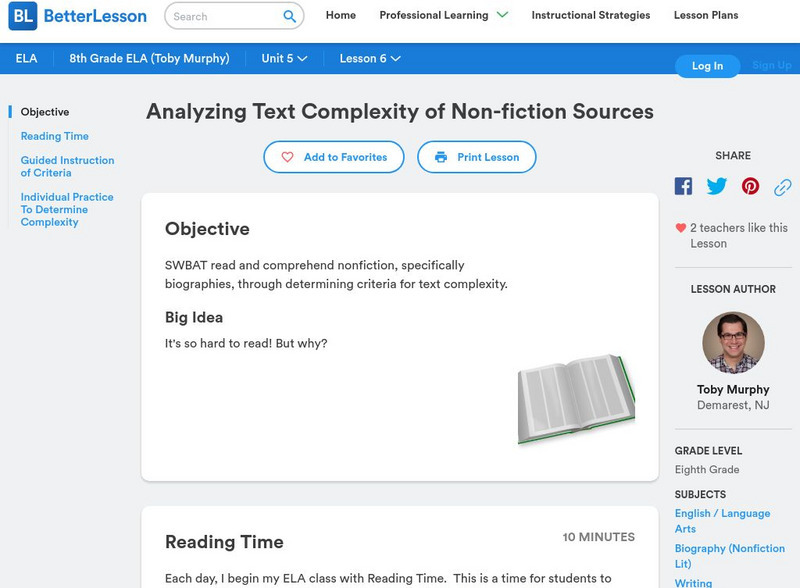
Better Lesson: Analyzing Text Complexity of Non Fiction Sources
This lesson will help students read and comprehend nonfiction, specifically biographies, through determining criteria for text complexity. Included is a PDF and Smart Notebook titled Determining Text Complexity, and an example of a...
ReadWriteThink
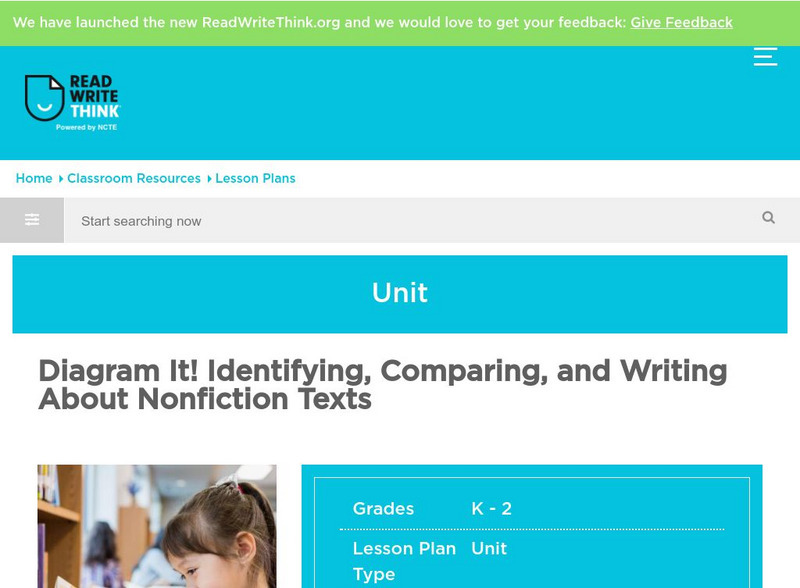
Read Write Think: Diagram It! Identifying, Comparing & Writing About Non Fiction
Introduce your students to the different types of non-fiction such as biographies, biographies, and informative books. Students will use graphic organizers, peer interaction, and hands-on experiences to further understanding of this lesson.
Read Works
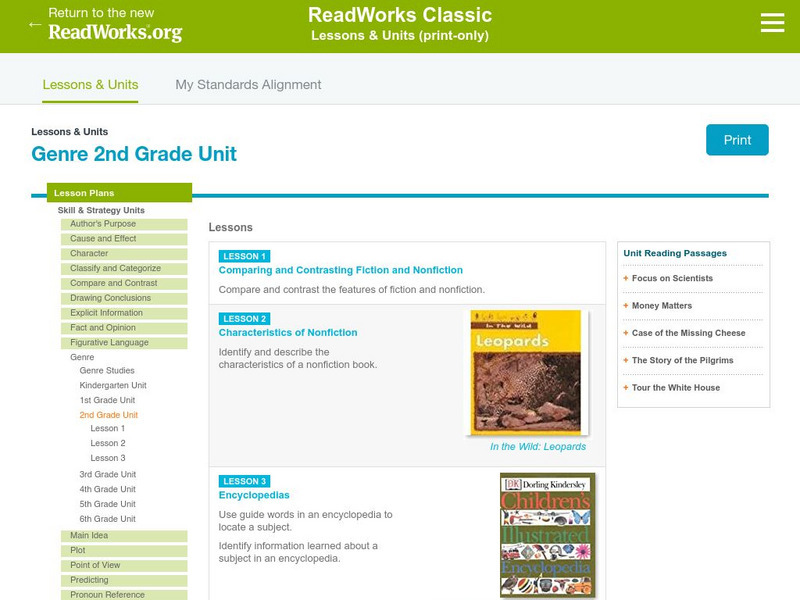
Read Works: Grade 2: Three Lesson Unit: Genre
[Free Registration/Login Required] A series of three lesson plans designed to teach learners to compare and contrast fiction and non-fiction, identify the characteristics of non-fiction, and use guide words to locate topics in an...
Read Works
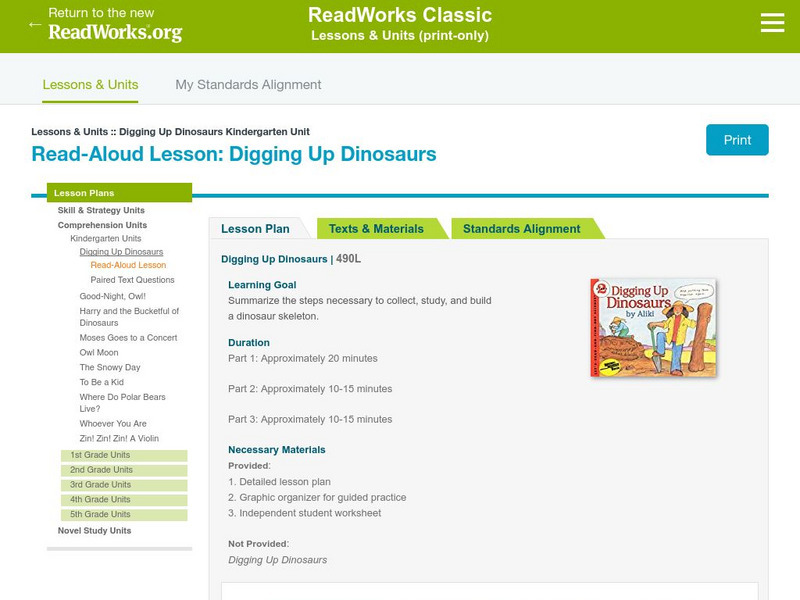
Read Works: Read Aloud Lesson: Digging Up Dinosaurs
[Free Registration/Login Required] Teachers will read "Digging Up Dinosaurs" using the close reading technique. Learners will use graphic organizers to summarize the steps necessary to collect, study, and build a dinosaur skeleton.
Read Works
Read Works: Explicit Information 3rd Grade Unit
[Free Registration/Login Required] A two-lesson unit in which students learn how to identify explicit information in non-fiction text by creating questions and then reading the text to find answers. Students also use explicit information...
Read Works
Read Works: Cause and Effect 3rd Grade Unit
[Free Registration/Login Required] A three-lesson unit on cause and effect. Students learn to use signal words to identify cause and effect relationships and to describe possible effects when given a cause in fiction. Students also learn...