Hi, what do you want to do?






Smithsonian Institution
Smithsonian Learning Lab: Contrasts in Blue: Life on the Caribbean Coral Reef and the Rocky Coast of Maine
Smithsonian Education presents Contrasts in Blue: Life on the Caribbean Coral Reef and the Rocky Coast of Maine. Teachers can download this comprehensive teaching package in which students explore two marine ecosystems, the coral reefs...
NOAA
Noaa: The Ocean Drugstore [Pdf]
Learn how organisms living in the oceans may help people cure diseases. Create a poster to display what you learn.

Alabama Learning Exchange
Alex: Diverse Life Forms of the Ocean
This lesson allows students to view and draw conclusions on the importance of life in the ocean. It uses student created movies to explore what is going on, as well as identifying the zones and diverse life associated with the oceans....
Science Buddies
Science Buddies: Swimming in Acid: Understanding Ocean Acidification
The oceans are a precious natural resource, part of Earth's carbon cycle. But what happens if the oceans absorb too much carbon dioxide? Many scientists are concerned that the increased absorption of carbon dioxide is causing them to...
Boise State University
Boise State University: Hadalpelagic Zone
View images and learn facts about this zone found deep in the ocean.
NOAA
Noaa: Motion From the Ocean [Pdf]
Reel in some information about fish from the ocean. Then create a mobile with fish that you color.
Smithsonian Institution
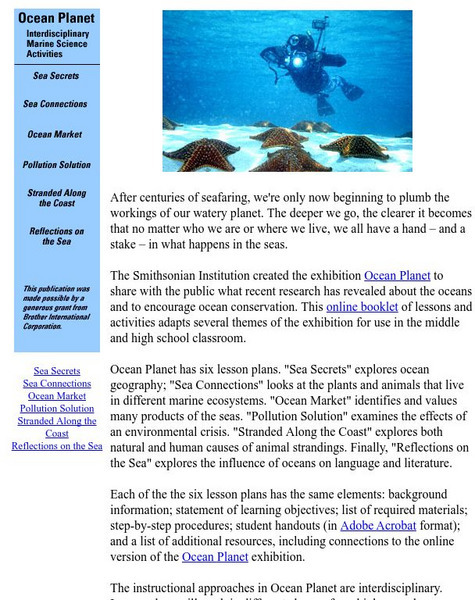
Smithsonian: Ocean Planet: Interdisciplinary Marine Science Activities
Smithsonian Institution presents ?Ocean Planet: Interdisciplinary Marine Science Activities?. Through this series of six interdisciplinary lessons, students will look at such things as the organisms in different marine ecosystems, the...
Science Struck
Science Struck: Facts About the Marine Biome
Describes the characteristics of the marine biome, the plants and animals that live in each of the four ocean zones, coral reefs and estuaries, the climate of the marine biome, and the marine food web.

National Geographic
National Geographic: The World Ocean
A collection of four lessons where students look at the vital role oceans play in our lives, at the hydrosphere and the impact humans have on it, how humans use the oceans and who is responsible for protecting them, and the rationale...
Science Buddies
Science Buddies: Harbor Porpoise Movement
In this project you can use archived satellite tracking data to learn about activity patterns of harbor porpoises. How far do they travel? Can you find patterns in the routes individual animals take? Can you correlate their route with...
US National Archives
Docsteach: The Titanic Disaster: Measuring Loss of Life, Property and Injuries
Students will analyze claims filed by survivors, families of victims and owners of cargo of the Titanic disaster. They will examine claims for loss of life, loss of property and injuries that were filed as part of 'In the Matter of the...
San Diego State University
San Diego State University: Researching Research
This comprehensive unit site from the San Diego State University is geared towards seventh grade math and science students. "Students will chose a research project currently in progress and research it using traditional techniques, the...
Woods Hole Oceanographic Institution
Woods Hole Oceanography Institute: Adaptations to Light
View several pictures of ocean life through the eyes of scientists and staff at Woods Hole Oceanography Institute. This particular slideshow highlights how ocean creatures change their colors in order to either hide from or frighten...
Science4Fun
Science4 Fun: Oceans
Learn about the five oceans of the Earth, life in the oceans, and why oceans are salty.

TED Talks
Ted: Ted Ed: Why Are Sharks So Awesome?
Sharks have been celebrated as powerful gods by some native cultures. And today, sharks are recognized as apex predators of the world's ocean. What is it that makes these fish worthy of our ancient legends and so successful in the seas?...
Australian Broadcasting Corporation
Australian Broadcasting Corporation: News in Science: Monsters of the Deep
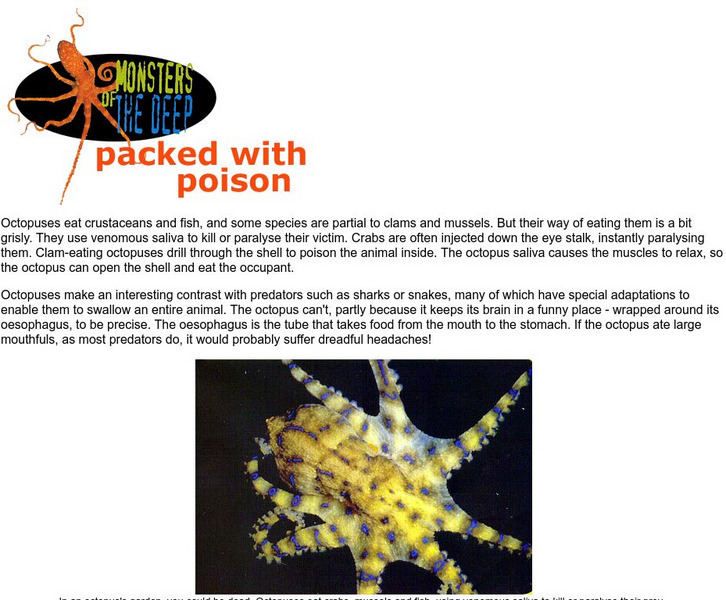
This site from the Australian Broadcasting Corporation explains the uses and effects of an octopus's poison. The information that is presented is somewhat brief, but factual, and worth checking out on the subject.
National Council of Teachers of Mathematics
The Math Forum: Exploring Ocean Data Lesson Plan
Find "oceans of data" for students of all ages. NCTM, California, and Philadelphia standards are listed for each grade level along with lesson plans and other website resources.
Cosmo Learning
Cosmo Learning: Blue Planet: Introduction to Oceanography
A collection of video lectures from an introduction to oceanography course taught at the University of California, Los Angeles. The course gives a general introduction to the processes and history of Earth's global oceanic system in...
Wonderville Media
Wonderville: Oceanographers
The planet Earth has more ocean than land, so oceanographers have a lot to work with! Whether they study marine biology, tides, engineering, or water quality, there is always more to learn about the ocean and the life within it. While...