Hi, what do you want to do?





Science Buddies
Science Buddies: Heavy Metals and Aquatic Environments
You might know that lead can be toxic, and that you can get lead poisoning from eating or inhaling old paint dust. Lead is called a heavy metal, and there are other sources of heavy metals that can be toxic, too. Silver, copper, mercury,...

Science Buddies
Science Buddies: Deep Knee Bends: Measuring Knee Stress With a Mechanical Model
Prosthetic limbs and artificial joints can help people with disease or injury lead a normal life. Sports medicine or physical therapy is also an area that relates to this experiment. Either way, this project serves as a good match if any...
Science Buddies
Science Buddies: Dog Toys: What Makes One a Favorite or a Flop to Fido?
It seems as though dogs, like people, have definite preferences for their play things. This fun project investigates what makes a toy interesting to a dog. In these experiments, you and your dog can have some fun while you learn about...
Exploratorium
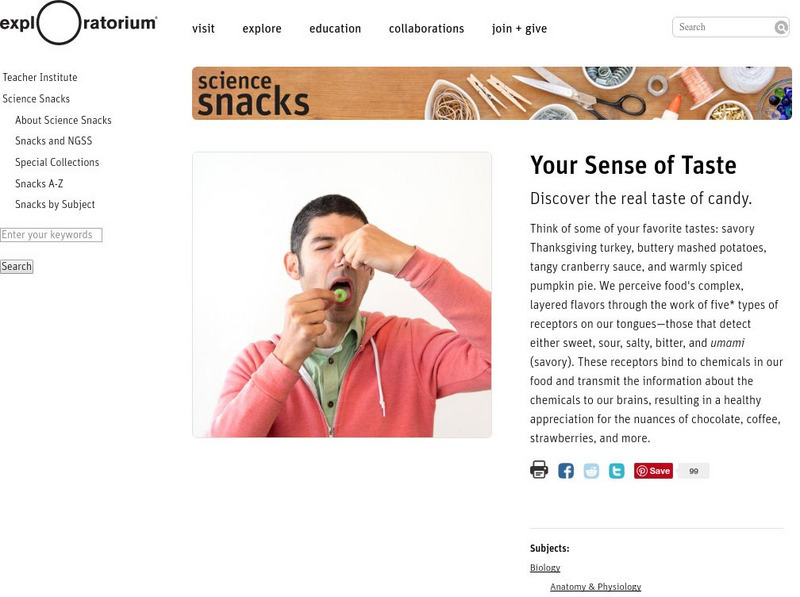
Exploratorium: Science Snacks: Your Sense of Taste
Investigate the taste receptors on your tongue in this Life Saver tasting experiment.
Exploratorium
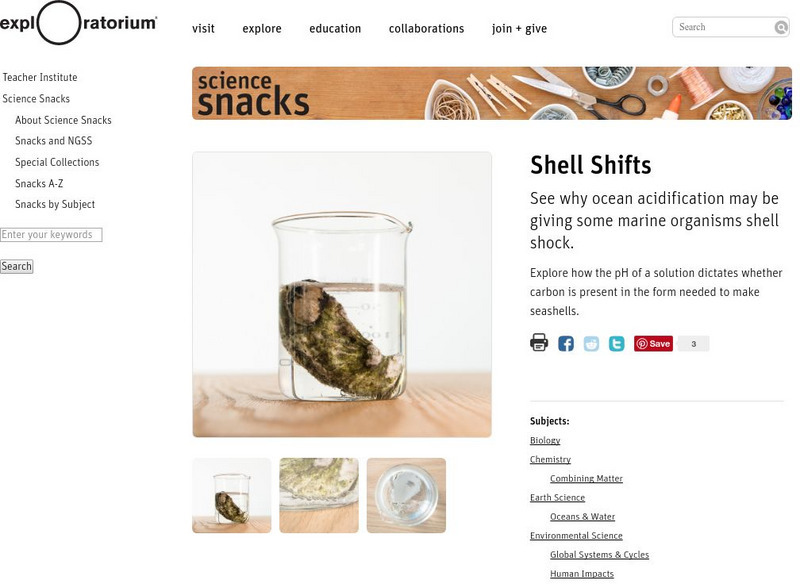
Exploratorium: Science Snacks: Shell Shifts
Investigate the damage that ocean acidification does to the shells of sea creatures.

PBS
Pbs Learning Media: Super Scientists
Grab your science tools and explore with PBS KIDS. Through hands-on activities and exciting media that transports you to space and in the Earth, this collection will bring science to life in your classroom. These resources help students...
National Institutes of Health
National Library of Medicine: Electricity, Frankenstein, & the Spark of Life
Using an online exhibition, investigate how Mary Shelley's horror science fiction story, Frankenstein, reflects the knowledge and studies of electricity, and how those fictional ideas are used in modern medicine.
BioEd Online
Bio Ed Online: Do Plants Need Light?
Plants need air, water, soil, and light to grow. Students learn about plant growth and development by conducting an experiment that demonstrates the importance of light to plants.
TeachEngineering
Teach Engineering: Life in Space: The International Space Station
Students are introduced to the International Space Station (ISS) with information about its structure, operation and key experiments. The ISS itself is an experiment in international cooperation to explore the potential for humans to...
PBS
Pbs Learning Media: Biome in a Baggie
This ZOOMSci video segment shows how to create self-contained environments and explore how plants grow under different conditions. [3:24]
US Environmental Protection Agency
Epa: Acid Rain
What are the causes and effects of acid rain in our environment? To learn more about this serious environmental issue check out this website. Contains a page with several acid rain activities for students.

Alabama Learning Exchange
Alex: Biodiversity: Local Ecosystem & Food Web
This is a hands on lesson plan in which students will explore their local community to identify living things. It can be used as part of a unit on biodiversity and energy transfer within a biology, zoology, or environmental science...