Hi, what do you want to do?






American Museum of Natural History
What is Marine Biology?
A marine environment covers the majority of the earth but is arguably the least understood. Teach young scientists about the characteristics of oceans and ocean species using an interactive online lesson. The in-person or remote learning...

American Museum of Natural History
Life in the City
Believe it or not, biodiversity exists even in areas of disturbed habitat. An interactive activity challenges learners to look for species with a magnifying lens in an image of a city habitat. Pop-up images and descriptions explain how...

American Museum of Natural History
What's This? Life at the Limits
There are some amazing ways species evolve to survive. From large ears to sneezing salt, learners read about these interesting adaptations in an interactive lesson. Great to supplement an in-class lesson, it also works well as a remote...

American Museum of Natural History
They Glow!
Would you believe marine animals can make their own light? An online resource describes the process of bioluminescence and how animals in the ocean use it to survive. The lesson features a catchy tune that describes the behavior of ocean...

American Museum of Natural History
Around the World with DNA
DNA analysis could be what saves some animals from extinction. An interactive lesson shows learners how DNA information proves variation among animals of the same species and how stakeholders use that information to make decisions. Easy...

Annenberg Foundation
Geometry 3D Shapes: 3D Shapes
Explore vocabulary related to three-dimensional shapes. An instructional website describes the characteristics of different geometric solids. Learners can use an interactive component to view nets, faces, vertices, and edges of common...

American Museum of Natural History
Climate Change
It actually is possible to have too much of a good thing when it comes to climate change. A slide show lesson describes how burning fossil fuels contributes to climate change. Individuals read about the scientific process and the...

American Museum of Natural History
What is Biodiversity?
Not all dogs are the same just like not all finches are the same. An interactive online lesson helps individuals learn about the causes and limitations to biodiversity. The clickable sections describe the basics of the genetics of...

American Museum of Natural History
Going, Going...Gone?
Young environmentalists consider how scientists are attempting to save endangered species. They read about what causes extinction and steps to take to minimize the threats.

American Museum of Natural History
Saving Species
Some scientists dedicate their lives to researching and protecting endangered species. An online lesson teaches about three scientists around the world who do just that. They learn about spiders, mollusks, and reptiles from North...

American Museum of Natural History
What's This? Sensing
There is a scallop that relies on sight so much that it actually has more than 100 eyes! There are many species that rely heavily on one sense or another. An online interactive resource has youth read about several of these animals. The...
Books in the Classroom
Carol Hurst's Children's Literature Site: Eric Carle
What do you know about Eric Carle, the author? This Carol Hurst site highlights some interesting facts about this author's life and refers to some of his books.
University of Illinois
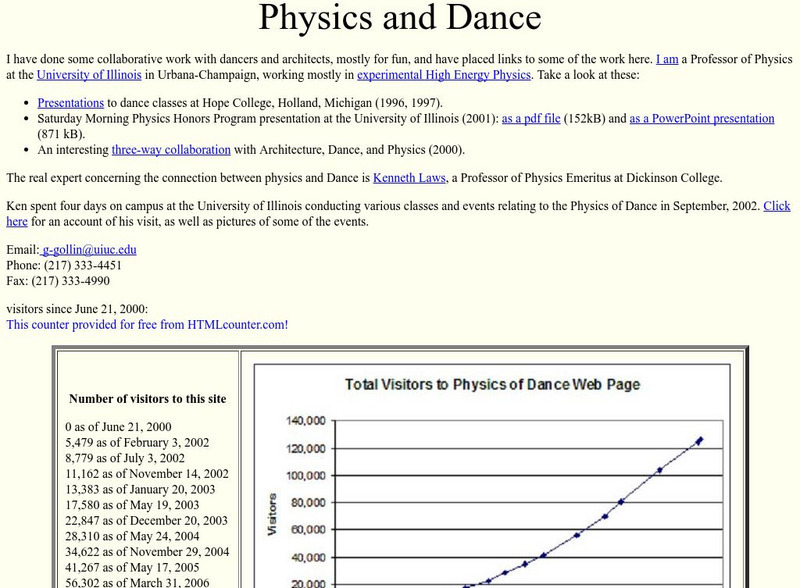
University of Illinois Urbana Champaign: The Physics of Dance
A scholarly examination of the physics of dance, this reads like the notes of a lecture, so requires some intense reading. It presents a glossary of physics vocabulary, particularly as terms (e.g., torque, static balance) relate to dance...