Hi, what do you want to do?





Texas Education Agency
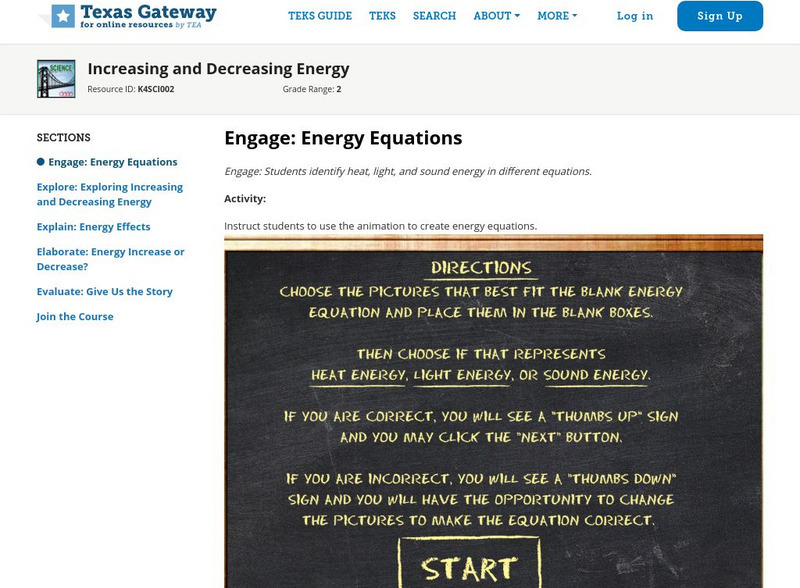
Texas Gateway: Increasing and Decreasing Energy
This tutorial will review over heat, light, and sound energy through interactive activities, videos, and quizzes.

Concord Consortium
Concord Consortium: Stem Resources: Greenhouse Light and Temperature
An interactive tool where students can create a model of a greenhouse and use a light sensor to measure the amount of light it receives from a lamp at various times of the day. Temperature is also measured. Data is plotted on graphs,...
Utah State Office of Education
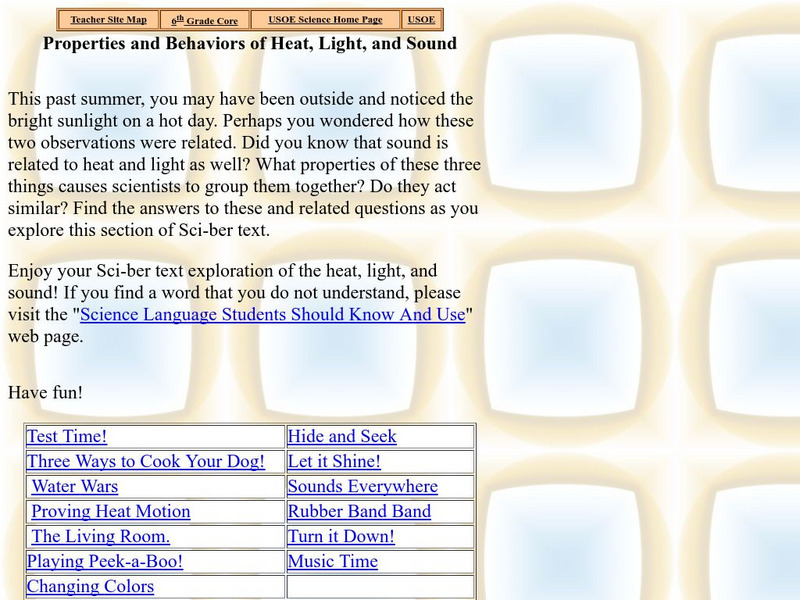
Utah Science: Properties and Behaviors of Heat, Light and Sound
How can scientists lump heat, light and sound together when investigating properties and behaviors? This learning module will address that question through a series of activities.
TeachEngineering
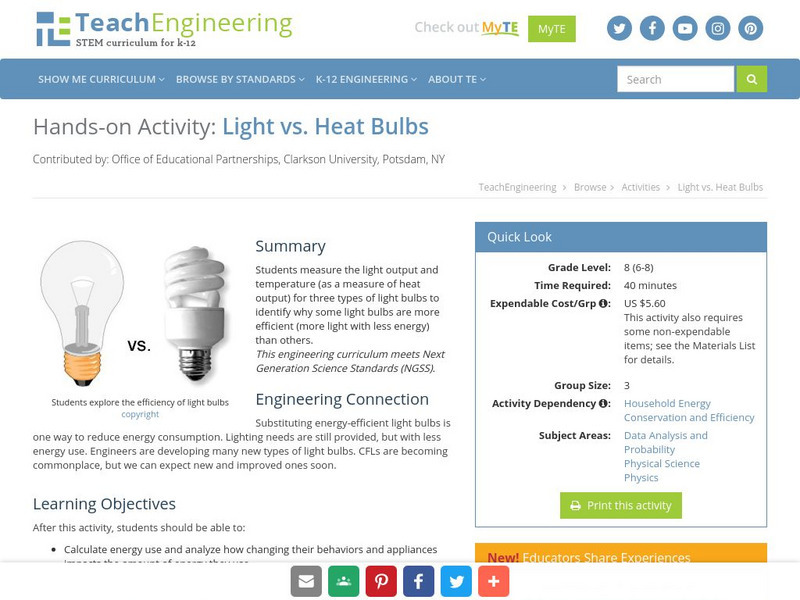
Teach Engineering: Light vs. Heat Bulbs
Students measure the light output and temperature (as a measure of heat output) for three types of light bulbs to identify why some light bulbs are more efficient (more light with less energy) than others.

Scholastic
Scholastic: Study Jams! Science: Energy, Light and Sound: Heat
A video and a short quiz on heat, covering its difference from temperature, thermal energy, and the means by which heat is transferred.
Texas Education Agency
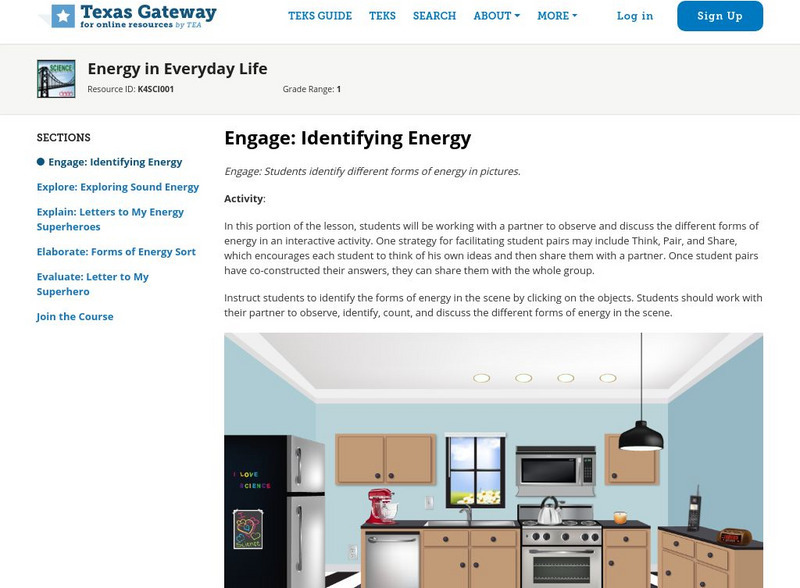
Texas Gateway: Energy in Everyday Life
In this interactive module students will identify, explore, and evaluate light, heat, and sound energy.

Utah Education Network
Uen: Trb 3:5 Investigation 6 Heat From Machines
Learn how heat energy can be produced by mechanical and electrical machines.
OpenSciEd
Open Sci Ed: 6.2 Thermal Energy
This Thermal Energy unit has students investigating two ways to transfer energy into a drink: (1) the absorption of light and (2) thermal energy from the warmer air around the drink. They are then challenged to design their own drink...

TeachEngineering
Teach Engineering: Energy
Through nine lessons, students are introduced to a range of energy types--electrical, light, sound and thermal-as well as the renewable energy sources of wind, hydro (water) and solar power. Subjects range from understanding that the...
US Energy Information Administration
Energy Information Association: u.s. Household Electricity Report
The report provides an overview of the electricity consumption in households in 2001. End-use (lighting, appliances, heating) data is presented in written, graph and table form. Background on efficiency standards and regional factors...
Utah State Office of Education
Utah State Office of Education: Force, Energy, & Motion
A unit on energy, force, and motion presented with interactive and classroom activities. Students gain an understanding of weight, mass, potential and kinetic energy, sound, and heat with this engaging resource.
E-learning for Kids
E Learning for Kids: Science: Antilles: What Are the Different Forms of Energy?
Students will learn about the different types and sources of energy, including heat and light, electrical, potential, and kinetic energy.
Concord Consortium
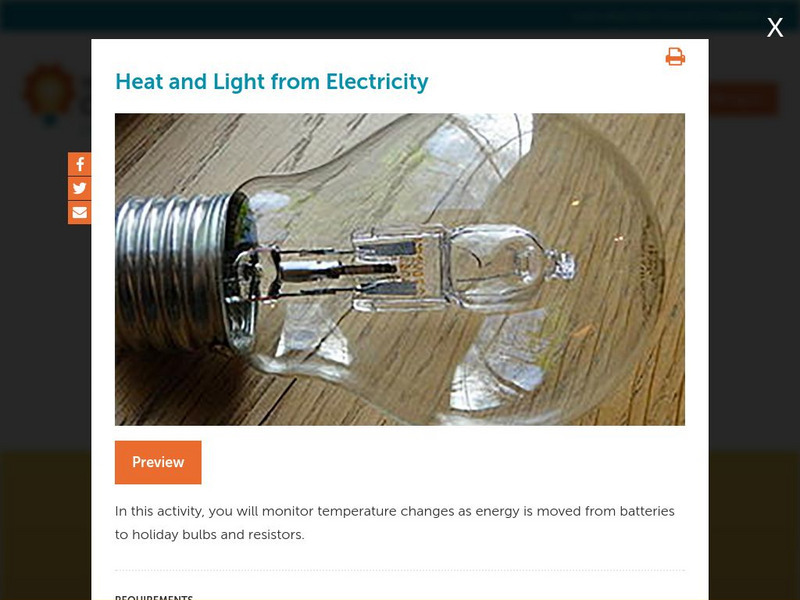
Concord Consortium: Stem Resources: Heat and Light From Electricity
Understand the energy transformations that happens when you light a bulb with a battery. Activity requires students to build a simple circuit and take temperature and time measurements. Lab includes procedure with questions that can be...
TeachEngineering
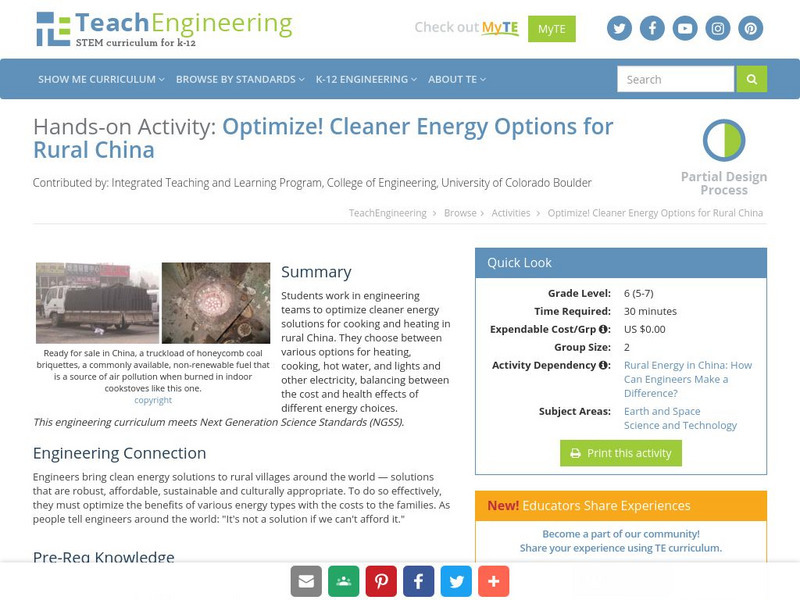
Teach Engineering: Optimize! Cleaner Energy Options for Rural China
Students work in engineering teams to optimize cleaner energy solutions for cooking and heating in rural China. They choose between various options for heating, cooking, hot water, and lights and other electricity, balancing between the...
Utah Education Network
Uen: Energy Transfers
Students will model and measure energy transfers from light to heat.
Utah Education Network
Uen: Trb 3:5 Investigation 1 Is It Hot in the Light?
Learn why things in direct sunlight are warmer than things that are not in as much sunlight.
Utah Education Network
Uen: Managing Heat
Understand the role of the sun as the source of heat and light for living things on earth.
TeachEngineering
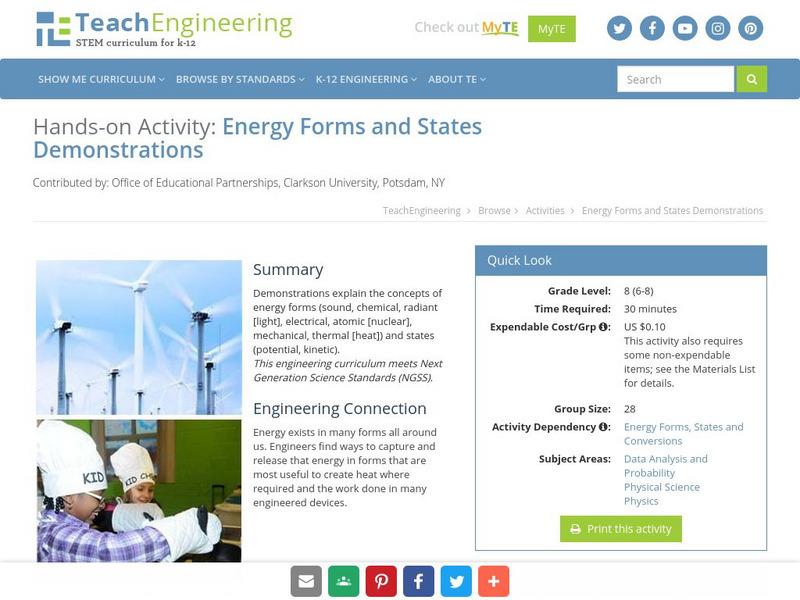
Teach Engineering: Energy Forms and States Demonstrations
Demonstrations explain the concepts of energy forms (sound, chemical, radiant [light], electrical, atomic [nuclear], mechanical, thermal [heat]) and states (potential, kinetic).
TeachEngineering
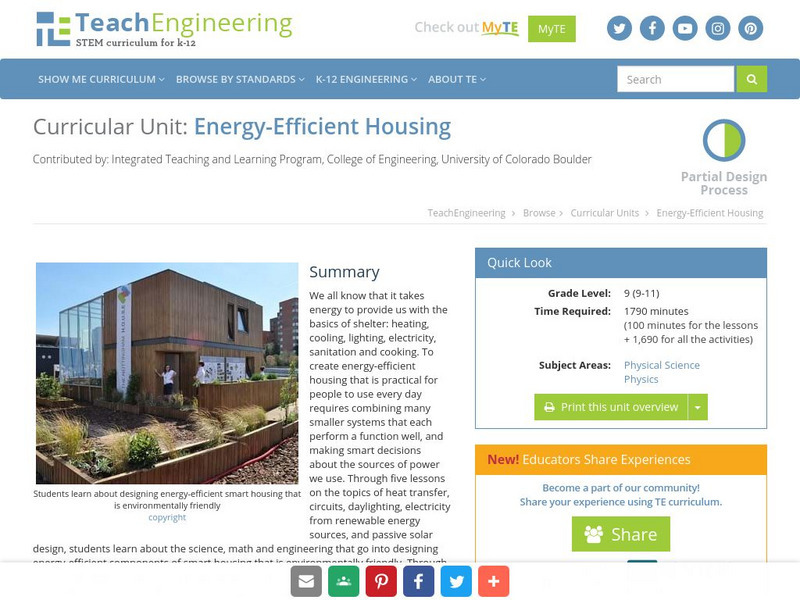
Teach Engineering: Energy Efficient Housing
We all know that it takes energy to provide us with the basics of shelter: heating, cooling, lighting, electricity, sanitation and cooking. To create energy-efficient housing that is practical for people to use every day requires...

TeachEngineering
Teach Engineering: Do Different Colors Absorb Heat Better?
Students test whether the color of a material affects how much heat it absorbs. Students will place an ice cube in a box made of colored paper (one box per color; white, yellow, red and black), which they will place in the sun. The...
US Department of Energy
U.s. Dept. Of Energy: Comparing Light Bulbs [Pdf]
A guided activity for students to compare incandescent and CFL light bulbs observing the production of heat and light.
Exploratorium
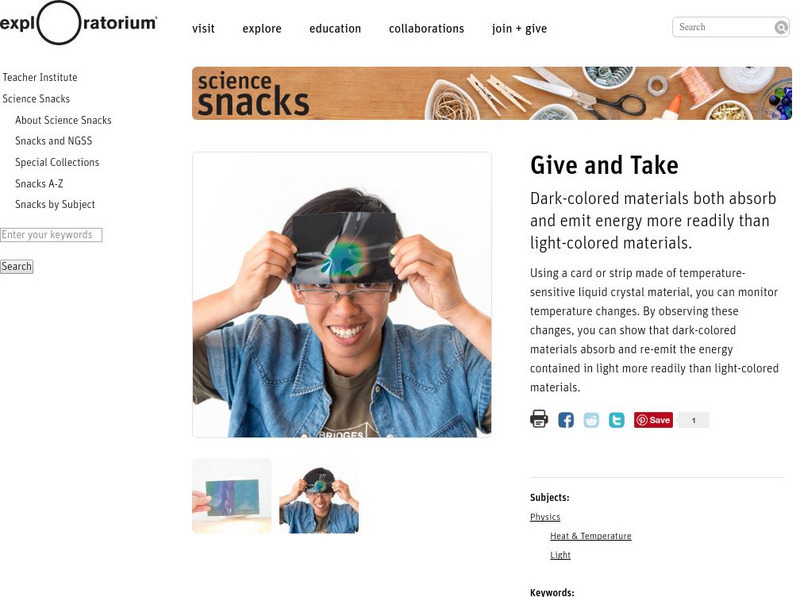
Exploratorium: Science Snacks: Give and Take
An activity for students to explore how dark-colored materials absorb and emit more energy vs. light-colored material.
Science Education Resource Center at Carleton College
Serc: Getting the Lightbulb to Light Up
Students construct a simple electrical circuit using wires, batteries, and a lightbulb. From constructing a circuit the students will discover that when energy is produced there is heat.
Science Education Resource Center at Carleton College
Serc: How Greenhouse Gases Absorb Heat
In this experiment students observe two model atmospheres: one with normal atmospheric composition and another with an elevated concentration of CO2. These two contained atmospheres will be exposed to light energy in a sunny window or...