Hi, what do you want to do?






Science Buddies
Science Buddies: Focusing Your Flash for 'Freezing' Motion
Here's an interesting flash photography project. With an inexpensive Fresnel lens, you can concentrate the light from your flash. You'll be able to shoot with a smaller aperture and a shorter flash duration. This will give you a greater...

Physics Classroom
The Physics Classroom: Waves: Waves and Wavelike Motion
Here is an introduction to the concept of waves and wavelike motion people experience anywhere and everywhere.
TeachEngineering
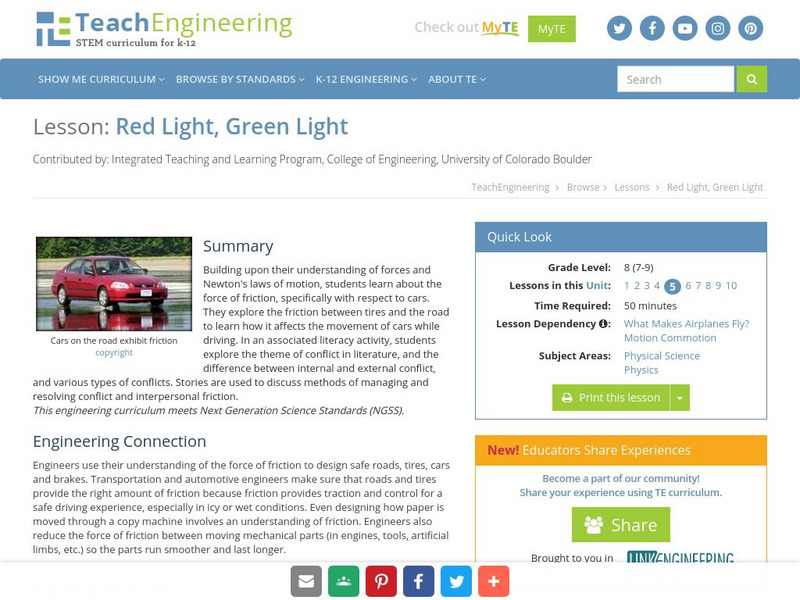
Teach Engineering: Red Light, Green Light
Building upon their understanding of forces and Newton's laws of motion, young scholars learn about the force of friction, specifically with respect to cars. They explore the friction between tires and the road to learn how it affects...
TeachEngineering
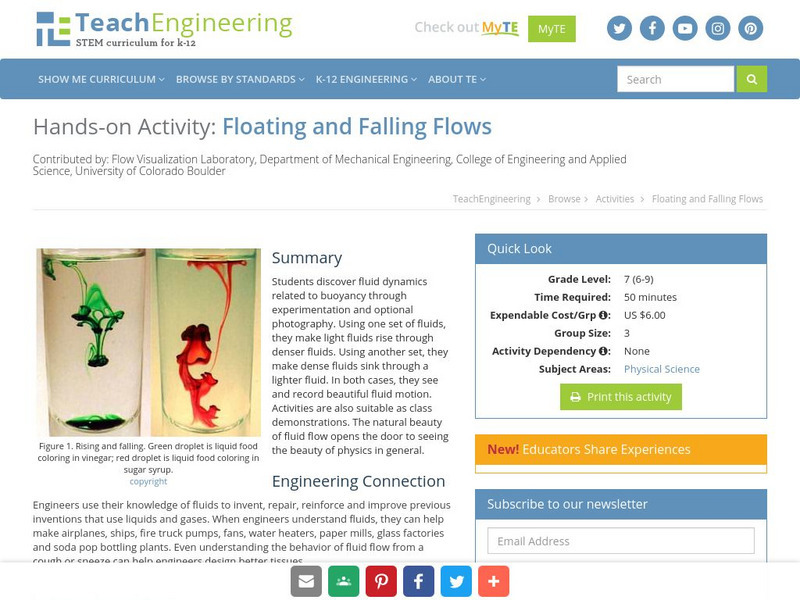
Teach Engineering: Floating and Falling Flows
Students discover fluid dynamics related to buoyancy through experimentation and optional photography. Using one set of fluids, they make light fluids rise through denser fluids. Using another set, they make dense fluids sink through a...

University of Florida
Florida Museum of Natural History: Physical Science
This guide focuses on four physical science topics that fascinate children and scientists alike. They are motion, magnets, sound, and light. With your guidance and support, these topics provide children with many opportunities to explore...

University of St. Andrews (UK)
University of St. Andrews: Special Relativity
A historical approach to special relativity, giving all the events and names in the history of discovery of special relativity. Many links to these individuals.
Science Buddies
Science Buddies: Shaking Up Some Energy
Shake N' Light flashlights have been advertised on televisions across the nation in the recent year. But many do not understand just how they get energy to light up the bulb without using batteries. Do this experiment to make your own...
Science4Fun
Science4 Fun: Thomas Edison
Brief biographical sketch of Thomas Alva Edison, inventor of the light bulb and phonograph.
Science Struck
Science Struck: Kinetic Energy Formula
Explains what is meant by kinetic energy and demonstrates how to use the formulas for a point mass moving at less than the speed of light, for rotational motion, and for a mass moving at a relativistic speed. Includes interactive...
Massachusetts Institute of Technology
Mit: Invention of the Week: Thomas Alva Edison
As the inventor of the lightbulb, phonograph, and the printing telegraph, Thomas Alva Edison (1847-1931), improved the daily lives of everyday people.
PBS
Pbs Learning Media: Spin a Spiral Galaxy
This interactive activity from NOVA Online lets you spin a spiral galaxy, including our own Milky Way. It demonstrates that what you can learn from visible light observations of a galaxy is largely determined by the angle from which you...