Hi, what do you want to do?





Georgia Department of Education
Ga Virtual Learning: Optics
Students discover how mirrors affect optics in this module through reading informational text, watching animations, and answering self-checking practice questions.
TeachEngineering
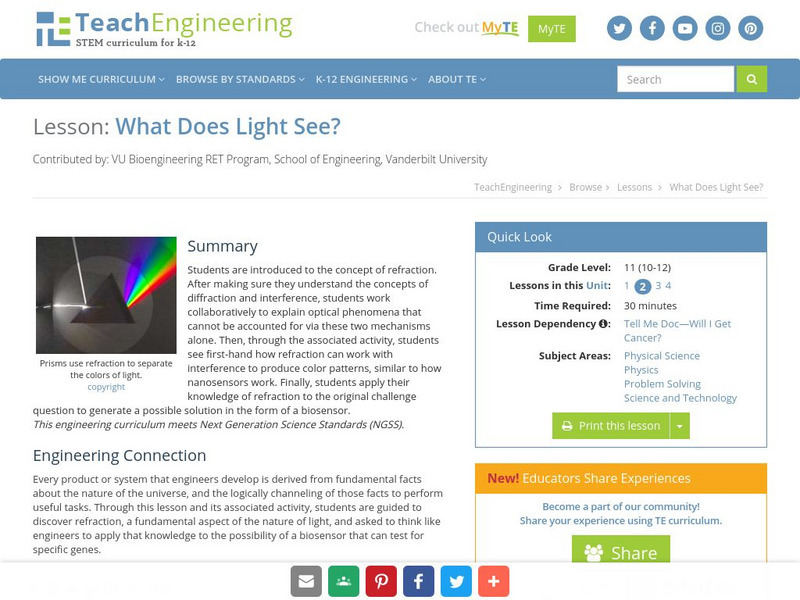
Teach Engineering: What Does Light See?
Students are introduced to the concept of refraction. After making sure they understand the concepts of diffraction and interference, students work collaboratively to explain optical phenomena that cannot be accounted for via these two...

Discovery Education
Discovery Education: 3 M Young Scientist Lab: Gelatin Optic Fibers
Strips of gelatin dessert and a laser pointer demonstrate total internal reflection.
TeachEngineering
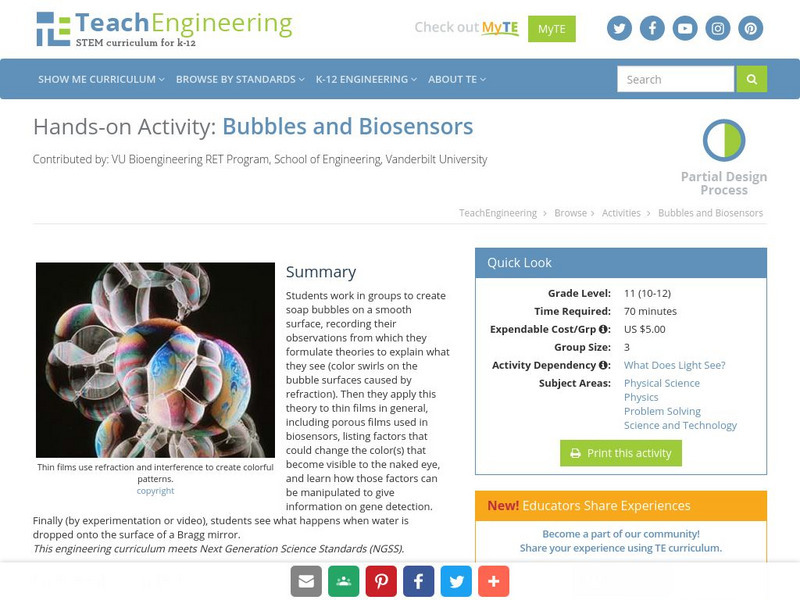
Teach Engineering: Bubbles and Biosensors
Students learn that color swirls on the bubble surfaces are caused by refraction. Then they apply this theory to thin films in general, including porous films used in biosensors, listing factors that could change the color that become...
Science Education Resource Center at Carleton College
Serc: Light & Sound, Light Reflection Relay
In this exploration, young scholars will investigate how light reflects off smooth surfaces, learn about angles of reflection, and apply that knowledge in a relay experiment.
Synopsys
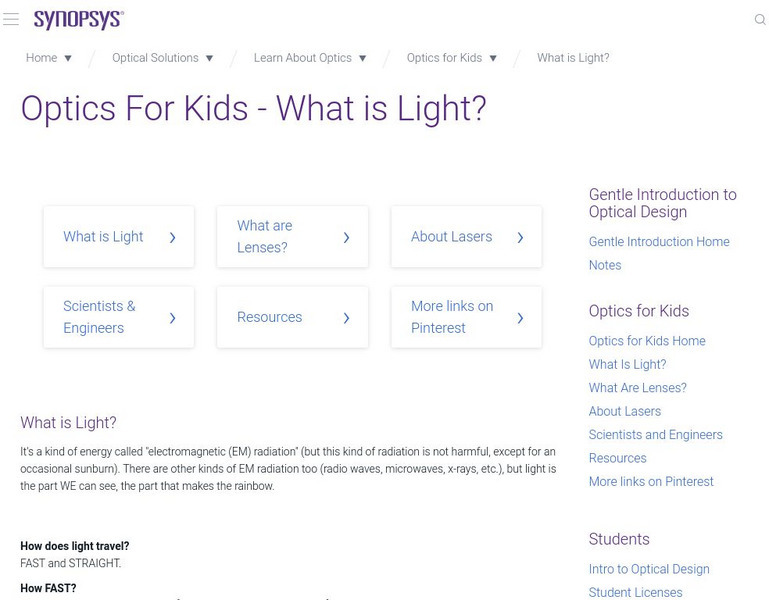
Synopsys: Optics for Kids: What Is Light?
This site provides a short explanation of light, how it travels, and the speed in which it travels. Many other concepts related to optics can be found on this site as well.
University of New South Wales (Australia)
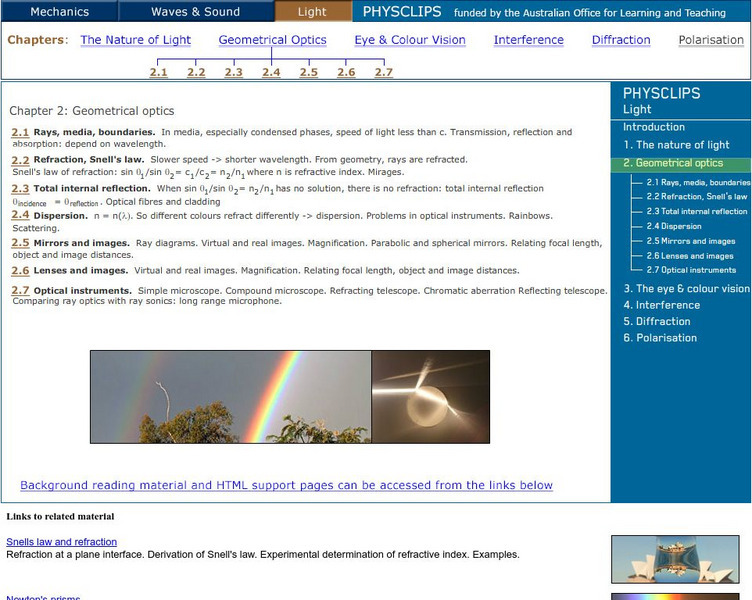
University of New South Wales: School of Physics: Physclips: Geometrical Optics
Physiclips thoroughly presents geometrical optics concepts like rays, refraction, Snell's law, total internal reflection, dispersion, mirrors, and lenses with animations and film clips.
Merck Sharp & Dohme Corp.
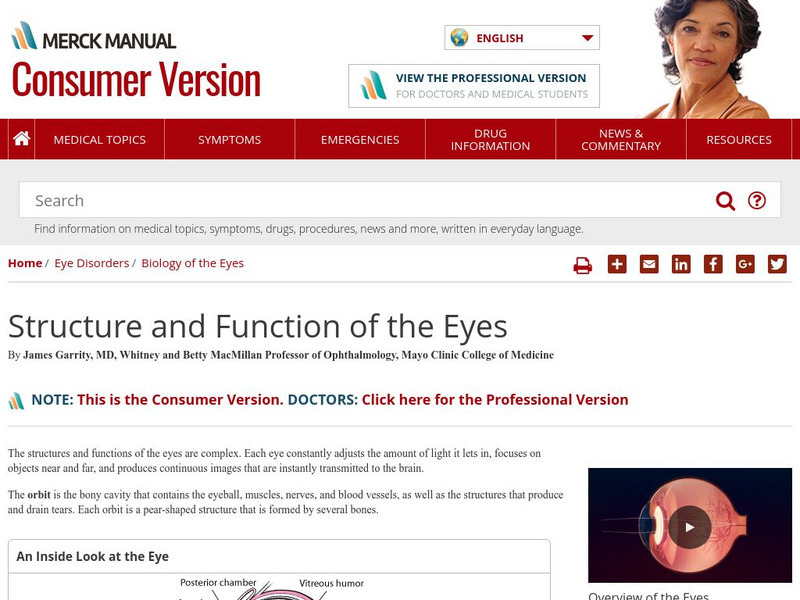
Merck Manual: Structure and Function of the Eye
This site provides a an excellent guide to the structure and function of the human eye. Content addresses how the eye is built, as well as how it works to translate light and shadow into sight. A diagram illustrating the various parts of...

Open Curriculum
Open Curriculum: Wave Optics
Learn about the diffraction of light using the wave model and Huygen's principle.
University of Colorado
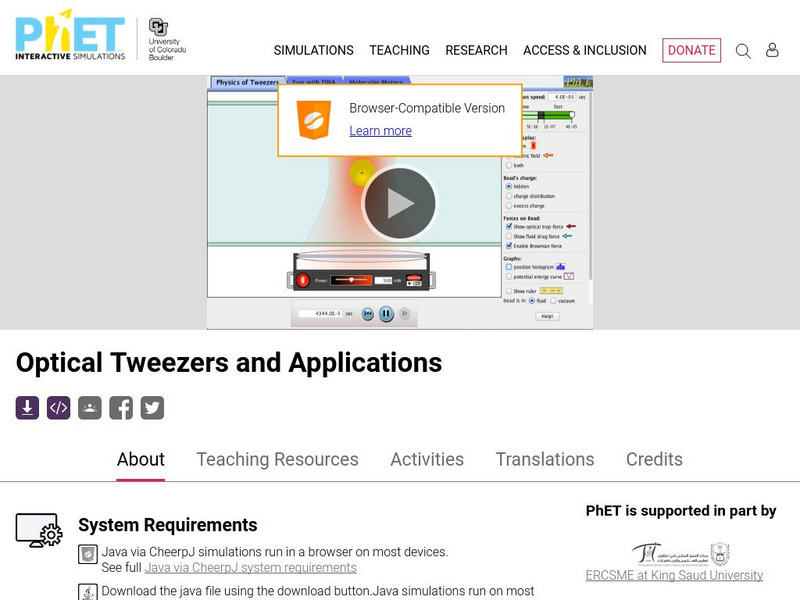
University of Colorado: Ph Et Interactive Simulations: Optical Tweezers and Applications
Did you ever imagine that you can use light to move a microscopic plastic bead? Explore the forces on the bead or slow time to see the interaction with the laser's electric field. Use the optical tweezers to manipulate a single strand of...
Physics Classroom
The Physics Classroom:refraction/ray Model of Light: Optical Density/light Speed
In order to understand refraction, students will explore the factors that affect the speed at which a light wave is transported through a medium.
Nobel Media AB
The Nobel Prize: The Dual Nature of Light as Reflected in the Nobel Archives
This article discusses the historical figures who contributed to our understanding of the nature of light, x-rays, Quantum ElectroDynamic (QED) theory, and so on.
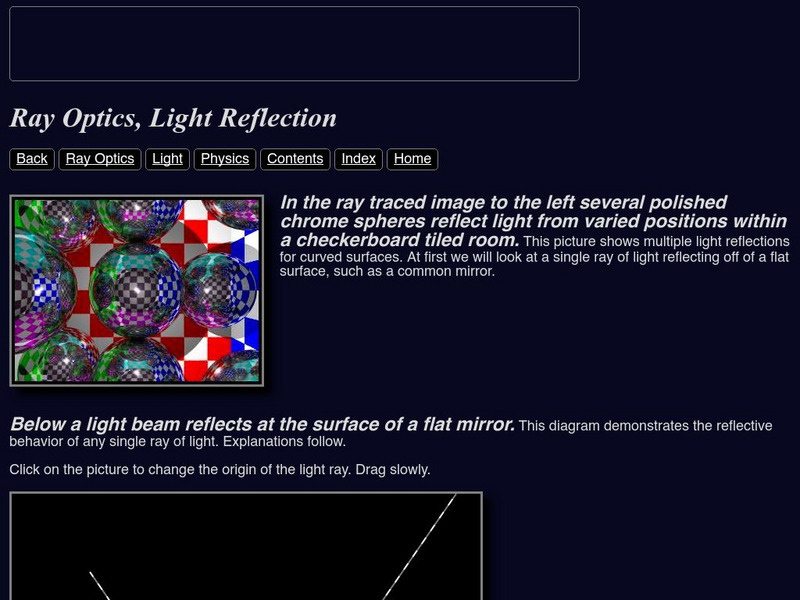
Curated OER
Ray Optics, Light Reflection
Site provides a diagram as well as a scientific explanation of light reflection. Includes links to ray optics, light and physics.
Optical Society
Optical Society of America: Optics for Kids: Make a Green Gumball Black
An experiment to investigate what colors are seen when light is absorbed or reflected by colored gumballs. With links to scientific, academic articles that explain what is happening.
Optical Society
Optical Society of America: Optics for Kids: Make Money Appear Before Your Eyes
A simple experiment that clearly demonstrates how light bends when it passes through water. Accompanied by a good explanation of what's happening, and a link to an article on refraction.
Optical Society
Optical Society of America: Optics for Kids: Mirror, Mirror on the Wall
A simple experiment that clearly demonstrates angles of reflection when light hits a mirror. Accompanied by a good explanation of what's happening, and a link to an article on reflection.

Other
National Engineers Week Foundation: Hearing the Light
Students learn how laser communication systems are built by observing how sound can be encoded into, and transmitted by a light beam.
Optical Society
Optical Society of America: Optics for Kids: Lens Activity
An investigation into how lenses behave. Students explore using convex and concave lenses in various ways and record their observations. They are then are directed to another site to try activities where they can manipulate virtual lenses.
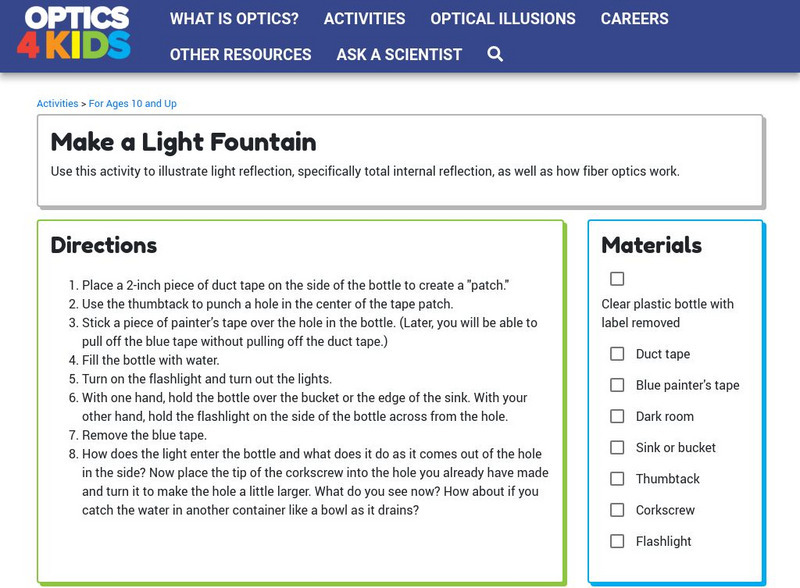
Optical Society
Optical Society of America: Optics for Kids: Make a Light Fountain
A simple experiment that demonstrates the concept of total internal reflection, and shows how light can travel around curves and corners, as it does in fiber-optic cables. Accompanied by an explanation of what's happening.
Synopsys
Synopsys: Optics for Kids: What Is Light?
An explanation of what light is and some of its properties.
Optical Society
Optical Society of America: Optics for Kids: Guiding Light Optical Fiber
This experiment demonstrates the concept of total internal reflection, using basic materials. Accompanied by a detailed explanation of what's happening, and links to articles on reflection and refraction.
University of Maryland
University of Maryland: Optics, Electromagnetic Waves
This site from the University of Maryland provides part of an anecdotal history of optics and the study of light. Extremely thorough treatment of how scientists came to believe in the wave nature of light, the idea of an electromagnetic...
University of Maryland
Optics Highlights: The Telescope
Part of an anecdotal history of optics and the study of light. Extremely thorough treatment of the invention of the telescope. Includes a short biographical sketch and discusses the work of Isaac Newton which focuses on his contribution...
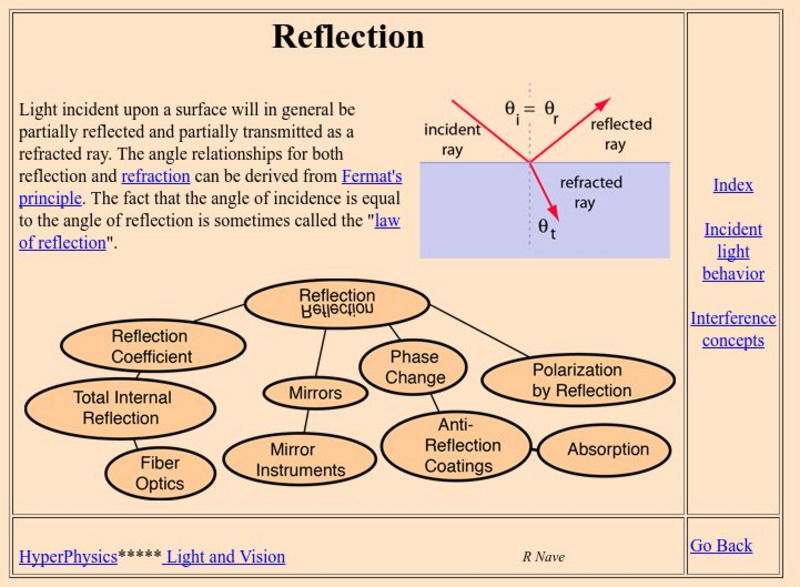
Georgia State University
Georgia State University: Hyper Physics: Behavior of Incident Light
This site from Georgia State University is an indexing page for several other pages on the topic of reflection. Topics are treated in an understandable manner and utilize meaningful graphics.