Hi, what do you want to do?






Optical Society
Optical Society of America: Optics for Kids: An Ice Lens
Instructions on how to make a lens using ice. With an explanation of what is observed, and a link to an informative article on lenses.
Exploratorium
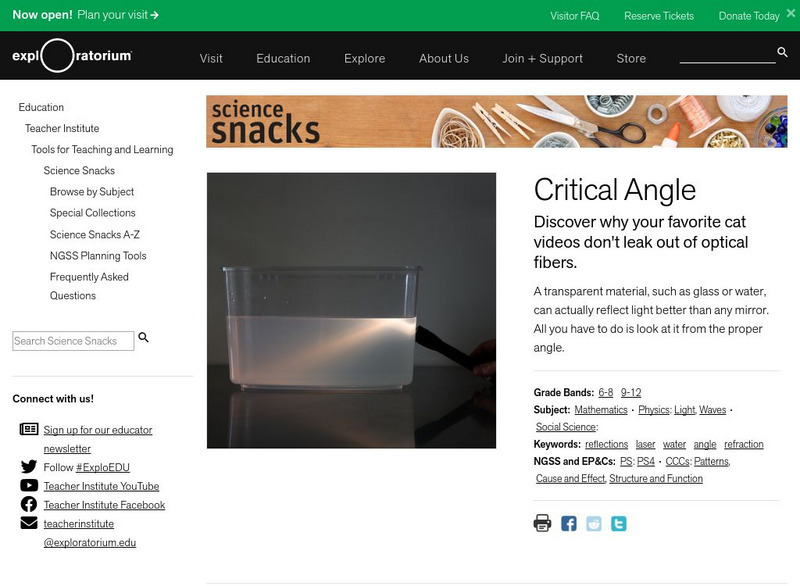
Exploratorium: Critical Angle
Students can see light reflected and refracted in this demonstration. They will also discover the total internal reflection of light.

Georgia State University
Georgia State University: Hyper Physics: Mirrors in Imaging
A discussion from Georgia State University of different types of mirrors and the images which they create. Discusses different instruments which use mirrors to produce images.
Other
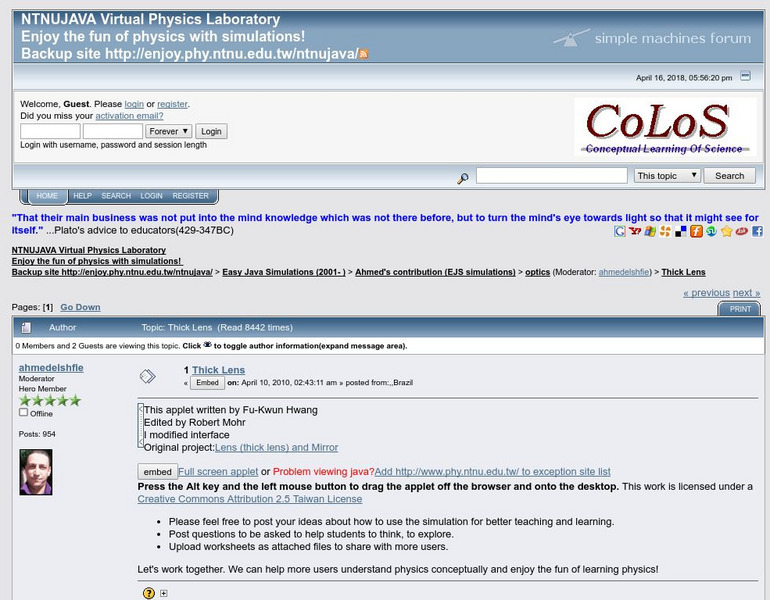
Ntnu Virtual Physics Lab: Thick Lens Java Applet
An interactive Java applet which allows the user to investigate the path of light through a lens shape object. The shape of the object, the index of refraction of the material, and the location of the incident rays can be altered.
Walter Fendt
Walter Fendt: Apps Zur Physik
This site, in German, offers numerous apps that illustrate common physics principles. Apps are organized into categories: mechanics, oscillations and waves, electrodynamics, optics, thermodynamics, the theory of relativity, physics of...
Other
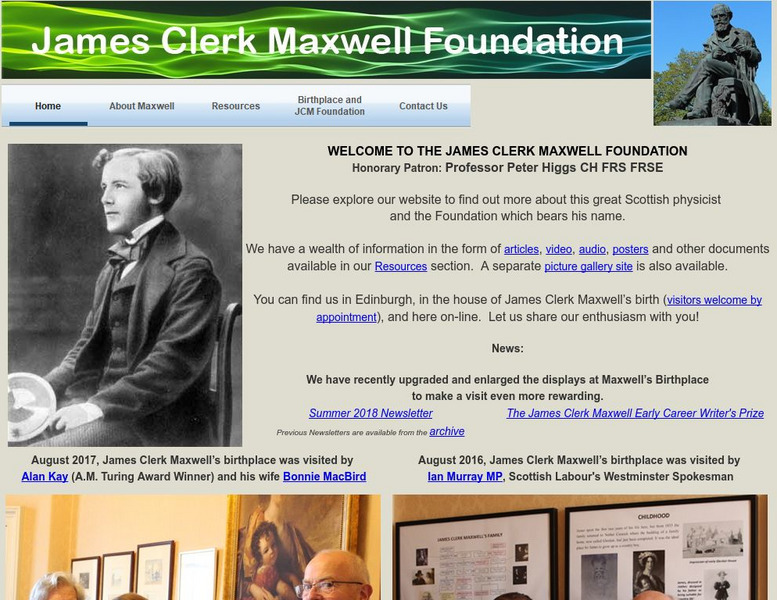
The James Clerk Maxwell Foundation
The home page of the The James Clerk Maxwell Foundation, a charitable foundation to commemorate the life and work of James Clerk Maxwell. View Maxwell's house and read about the personal life of this notable scientist.
Discovery Education
Discovery Education: The Em Spectrum: Waves of Energy
Young scholars are introduced to the electromagnetic spectrum through this group research activity. Each group investigates a different wavelength range within the em spectrum and reports back to class. Discussion ideas also included.

University of St. Andrews (UK)
University of St. Andrews: James Clerk Maxwell
Research resources for James Maxwell (1831-1879), who did revolutionary work on electricity and magnetism and on the kinetic theory of gases.
Nobel Media AB
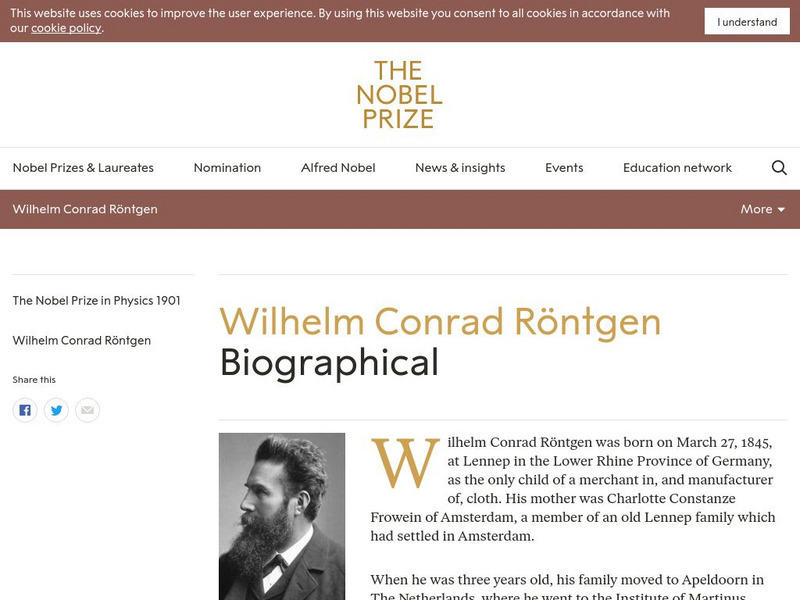
The Nobel Prize: Wilhelm Conrad Rontgen Biographical
This biographical note on Wilhelm Conrad Rontgen describes his boyhood, upbringing, education, scientific work and accomplishments. Focuses on his studies of Xrays.
NASA
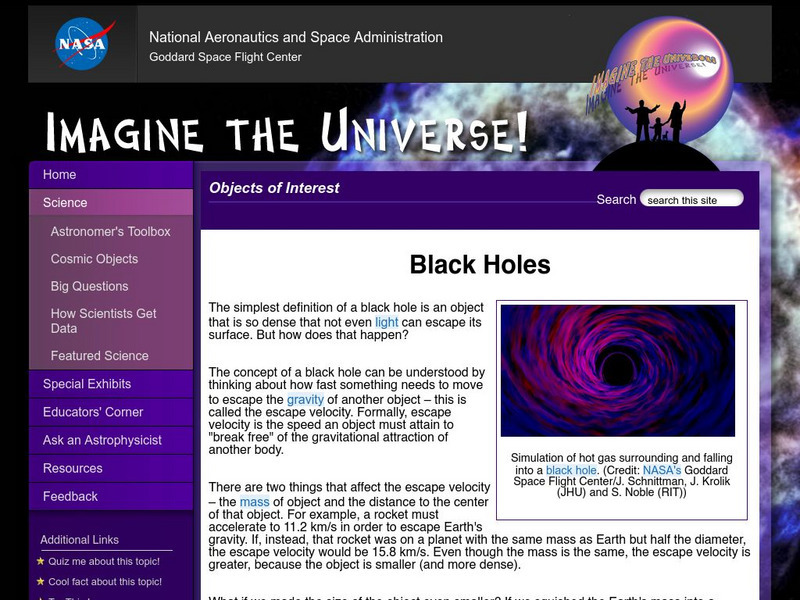
Nasa: Imagine the Universe: Black Holes
Learn what black holes are and the myths that surround them.
TryEngineering
Try Engineering: Telescoping Periscope
Working in teams of "engineers", young scholars explore how a periscope works and is used. They design, build, and test a working periscope made from everyday materials that has adjustable mirrors and be able to telescope as well.
Boston University
Bu: Optics Demonstrations: Diffraction
Short descriptions and graphics of three demonstrations which illustrate the diffraction phenomenon. Suitable as a supplement for a teacher lesson plan or as an idea-generator for a student project.
Khan Academy
Khan Academy: Thin Lens Sign Conventions
Have you ever wondered why some people need glasses and others don't? It's because of the way light is focused by the lens in your eye. This lens, like magnifying glasses, eyeglasses, and contact lenses, is considered a thin lens.
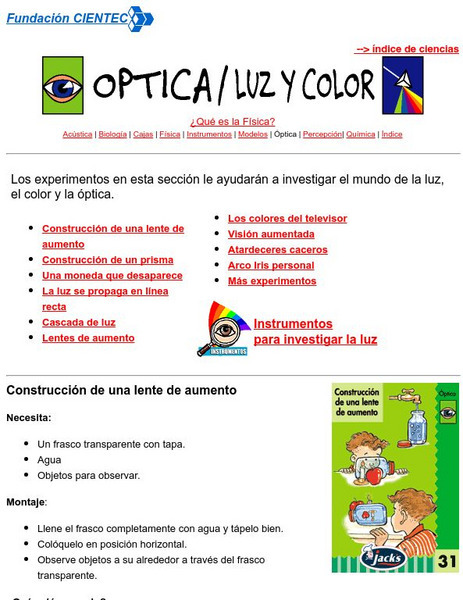
Fundación Cientec
Cientec: Optica, Luz Y Color
Different step by step experiments in Optics, Light and Color. These experiments will help the students to investigate the world of light, color and optics.
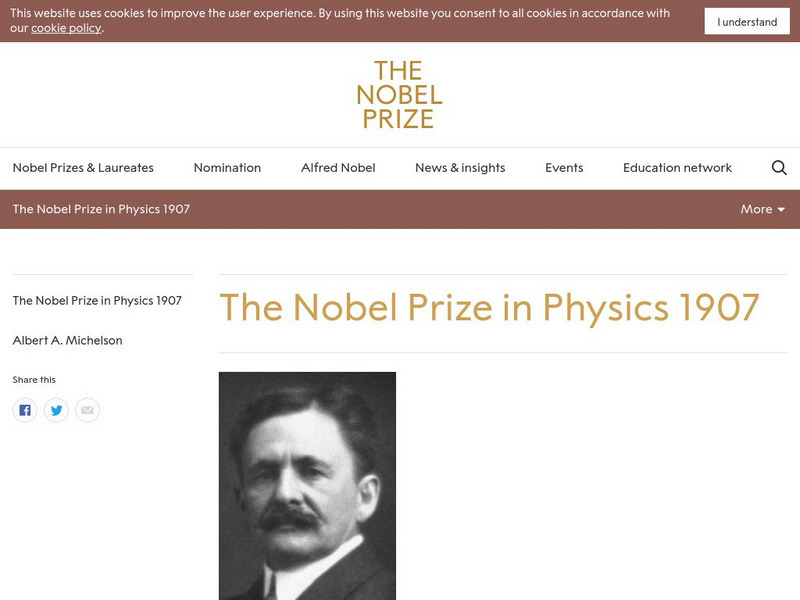
Nobel Media AB
The Nobel Prize: The Nobel Prize in Physics in 1907
At this site from The Nobel Foundation you can read about the scientist who won the Nobel Prize in Physics in 1907, Albert A. Michelson (1852-1931 CE). Here, you can read a detailed biography which provides information on Michelson's...
Science Buddies
Science Buddies: Study Chirality With a Homemade Polarimeter
Some molecules can be either left- or right-"handed." The left- and right-handed molecules have the same number and type of atoms, and their chemical structures look identical, but they are actually mirror images of each other. Many...
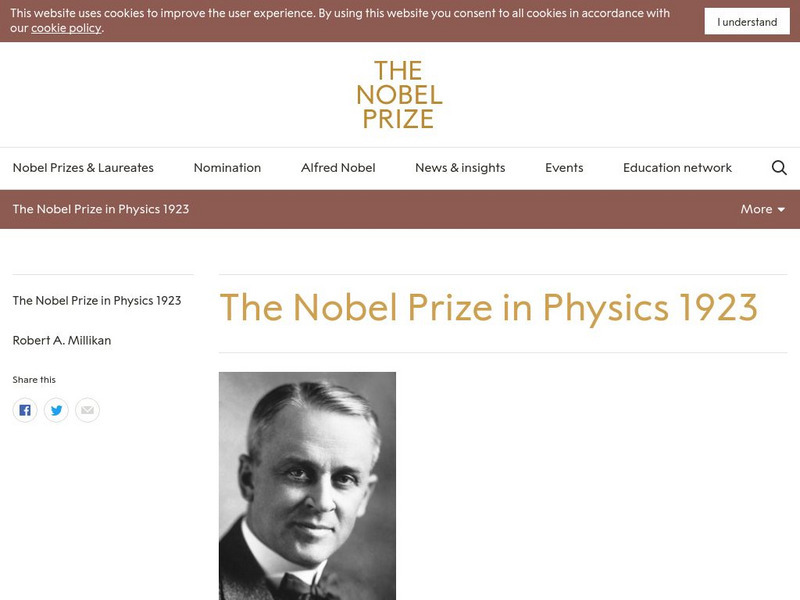
Nobel Media AB
The Nobel Prize: The Nobel Prize in Physics 1923: Robert Andrews Millikan
This Nobel website on the life and scientific work of Robert A. Millikan includes a biography, images, and internet resources for further reading and research. Also included are the 1923 "Presentation Speech" which praised Millikan's...
Georgia State University
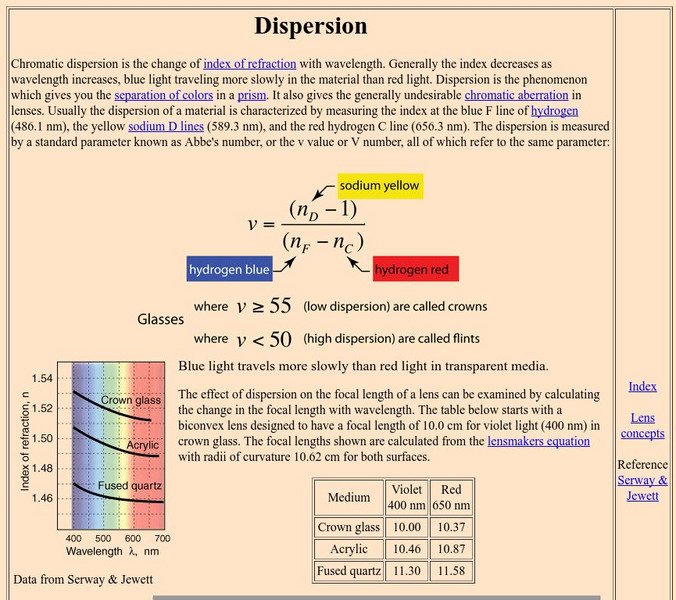
Georgia State University: Hyper Physics: Dispersion
The phenomenon of light dispersion is explained with a formula and a practice form for calculating Abbe's number.
Physics Classroom
The Physics Classroom: The Law of Reflection
The law of reflection is discussed and explained, accompanied by an animation depicting this law. Includes a list of links to detailed information about certain types of reflections.
Florida State University
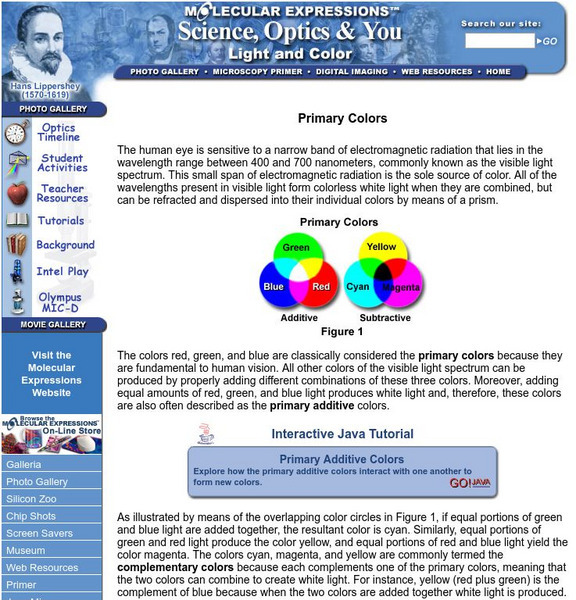
Florida State University: Molecular Expressions: Primary Colors
The concept of colors is discussed on this page. Read about primary colors, how complementary colors are created, what the process of color subtraction is, pigments and dyes, plus more. Also included are interactive Java tutorials.
Physics Classroom
The Physics Classroom: Ray Diagrams for Concave Mirrors Case B
Ray diagrams are useful tools for determining the location of an image as produced by a concave mirror. Of all the rays which emanate from the top of the object arrow and are incident to the mirror, there are two rays whose behavior at...
Physics Classroom
The Physics Classroom: Ray Diagrams for Concave Mirrors Case D
Ray diagrams are useful tools for determining the location of an image as produced by a concave mirror. Of all the rays which emanate from the top of the object arrow and are incident to the mirror, there are two rays whose behavior at...

University of St. Andrews (UK)
University of St. Andrews: Augustin Fresnel
A short biographical sketch on the life and work of Augustin Fresnel (1788-1827). Comments on a few of his scientific accomplishments.
Walter Fendt
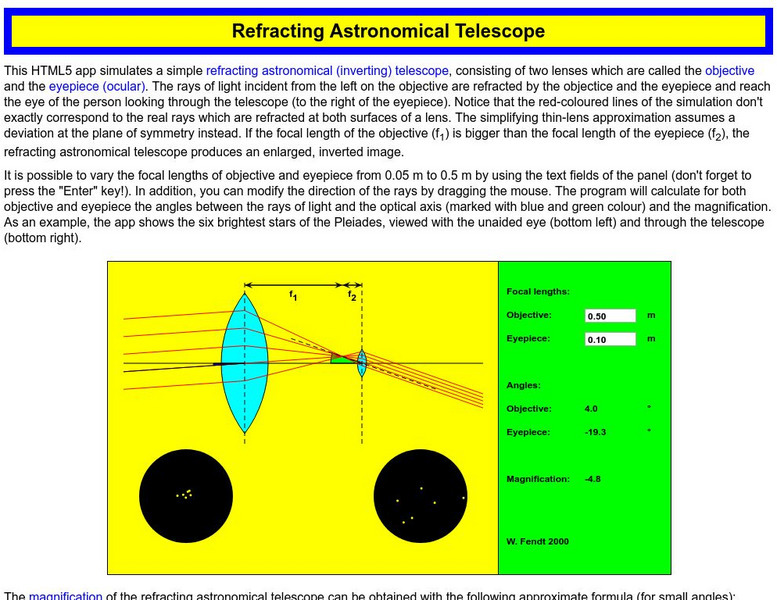
Walter Fendt: Refracting Astronomical Telescope
An app for investigating the operation of a refracting telescope. The location of the eyepiece and objective lens can be altered, and the focal point and path of light through the lenses can be observed.