Hi, what do you want to do?






Physics Classroom
The Physics Classroom: Reflection/ray Model of Light: Reflection/image Convex
In this physics tutorial, we will follow a pattern of inquiry for convex mirrors: investigating how convex mirrors reflect light and produce images.
Cosmo Learning
Cosmo Learning: Applied Science and Technology 210: Electrical Engineering
A collection of video lectures from a course that explores the application of electrical engineering topics. Webpage includes twenty-eight lectures from a professor at the University of California, Berkeley. Lectures vary in length and...
Curated OER
Ray Optics, Light Reflection
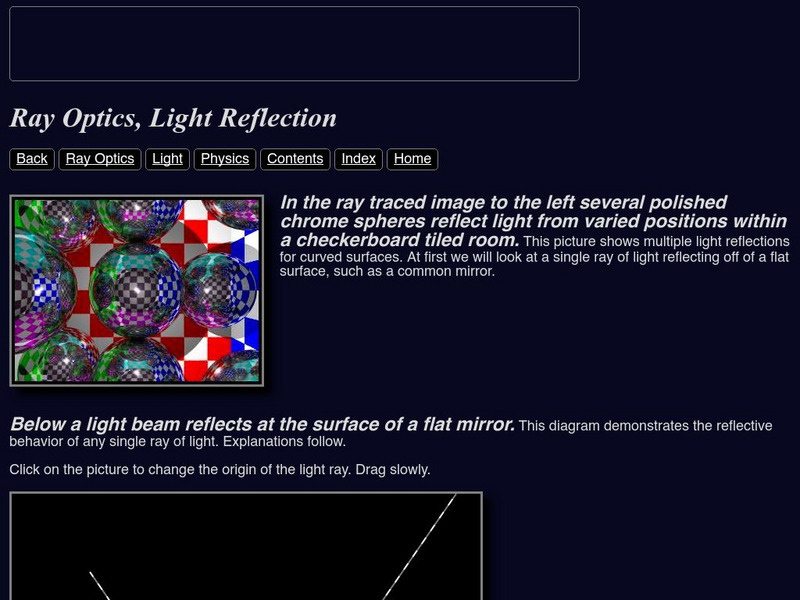
Site provides a diagram as well as a scientific explanation of light reflection. Includes links to ray optics, light and physics.
Other
Reflection of Light
Educational site provides activities to compliment a unit on the reflection of light. Offers challenge activities that are designed to motivate and stimulate interest in the classroom.
University of Southern California
Usc Viterbi School of Engineering Illumin: Reflecting on the Mirrors
Article explaining what Digital Light Processing (DLP) technology is and how it works. Includes an animation to demonstrate the technology. (Published Fall 2007)
My Science Site
Mirrors, Lenses and Your Eyes
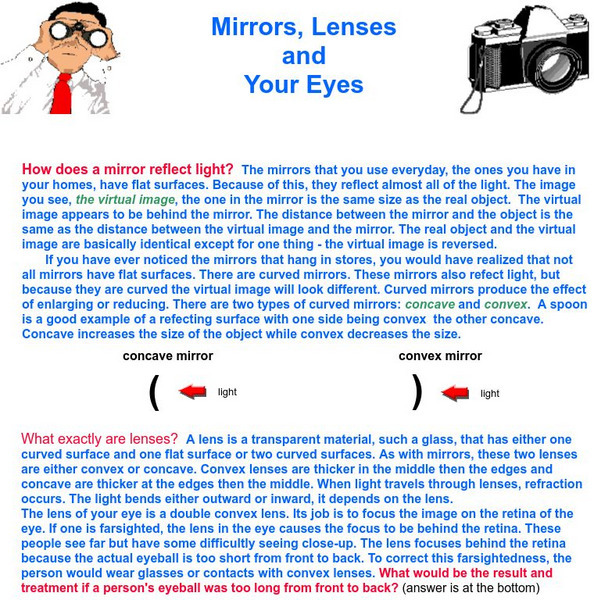
This resource explores the science behind light and how mirrors reflect it. Also contains information on lenses both convex and concave.
Teachers TryScience
Teachers Try Science: Where There's Light, There's Hot Food!!!
This unit helps students learn to apply the concept of solar energy conservation. They are introduced to angles and their effect on the amount of light reflected, and they will also design, construct, manipulate, critique, evaluate and...
CK-12 Foundation
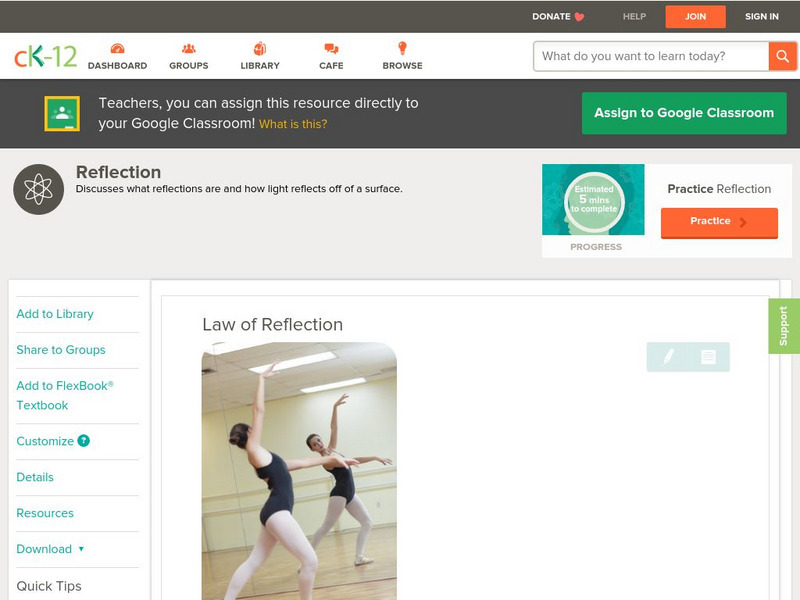
Ck 12: Physical Science: Law of Reflection
[Free Registration/Login may be required to access all resource tools.] Reflection and how it produces an image, regular and diffuse reflection and the law of reflection.
CK-12 Foundation
Ck 12: Physical Science: Reflection of Light
[Free Registration/Login may be required to access all resource tools.] Considers the reflection of light from both smooth and rough surfaces and the law of reflection.
Texas Instruments
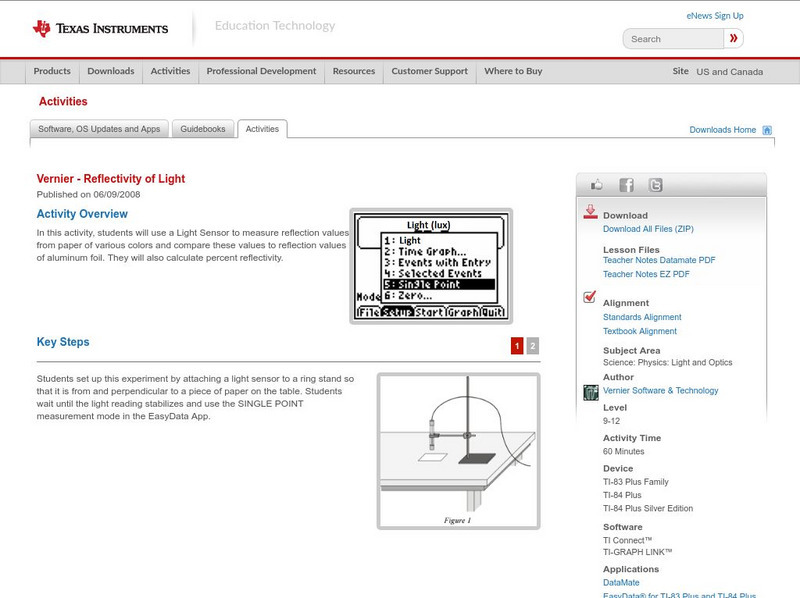
Texas Instruments: Reflectivity of Light
In this activity, students can use a Light Sensor to measure reflection values from paper of various colors and compare these values to reflection values of aluminum foil. They will also calculate percent reflectivity.

Alabama Learning Exchange
Alex: How Light Travels
In this lesson, the students will be experimenting to show how light shines in a straight line. They will also be experimenting to see how light reflects using mirrors. The students will be working in cooperative learning groups to carry...
Physics Classroom
The Physics Classroom: Refraction and Ray Model of Light: Boundary Behavior
In this illustrated physics tutorial, students investigate the connection between light reflection and light refraction.
Science Education Resource Center at Carleton College
Serc: Light & Sound, Light Reflection Relay
In this exploration, students will investigate how light reflects off smooth surfaces, learn about angles of reflection, and apply that knowledge in a relay experiment.
Other
Propagation of Light Using Geometry
A discussion of Christian Huygens' contribution to wave optics, and particularly to our understanding of the reflection and refraction of light. Excellent diagrams and a geometric proof on why the law of reflection is mathematically...
My Science Site
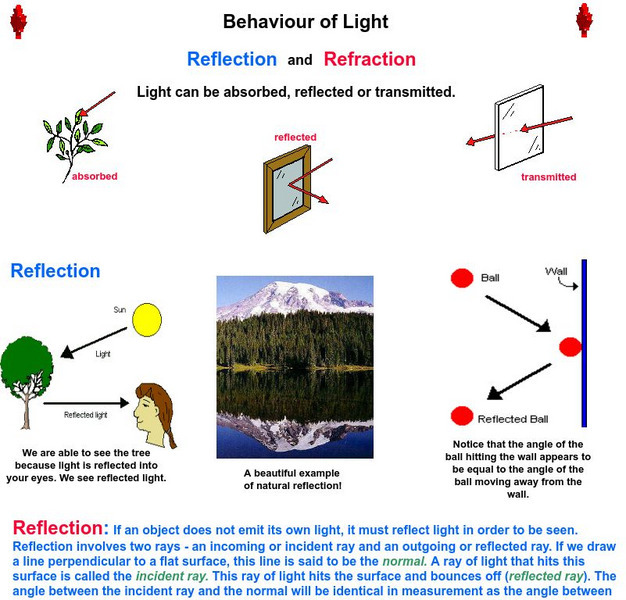
B J Mst: Behaviour of Light
This resource explores light reflection and refraction by providing colorful illustrations and examples.
TeachEngineering
Teach Engineering: Needing Illumination: Investigating Light
This is the first instructional activity of this unit to introduce light. In this instructional activity, students learn the five words that describe how light interacts with objects: "transparent," "translucent," "opaque," "reflection"...
Science Education Resource Center at Carleton College
Serc: Investigating Light Properties
Students will investigate how light travels and what it does when it hits an object. Light sources will be used to represent a beam of light. Students will direct the beam toward various objects and materials. Through observations...

Georgia State University
Georgia State University: Hyper Physics: Total Internal Reflection
This physics department site provides a definition and explanation of the phenomenon of total internal reflection. Includes a diagram and an equation for calculating the critical angle for light approaching a surface.
Science Education Resource Center at Carleton College
Serc: Investigating Light: A Form of Energy You Can See
Students will investigate how light is a form of energy that travels as waves away from the source. The basis for this lesson is taken from the Houghton Mifflin science curriculum. In the lesson experiments, students will predict if...
Other
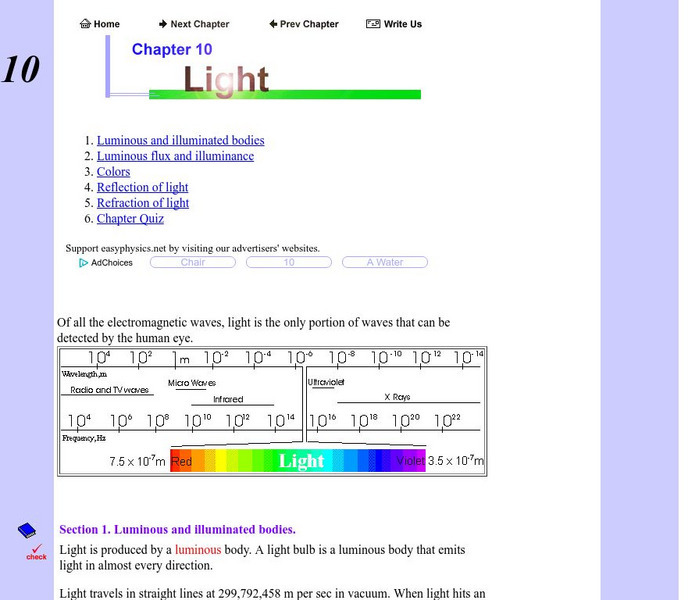
Easyphysics: Chapter 10 Light Waves
Learners investigate light waves. Some topics examined are reflection of light, illuminance, and refraction of light. The resource includes example problems with solutions and a chapter quiz.
TeachEngineering
Teach Engineering: The Energy of Light
In this introduction to light energy, students learn about reflection and refraction as they learn that light travels in wave form. Through hands-on activities, they see how prisms, magnifying glasses and polarized lenses work. They also...
TeachEngineering
Teach Engineering: Light Scavengers
In this activity, students examine various materials and investigate how they interact with light. Students use five new vocabulary words (translucent, transparent, opaque, reflection and refraction) to describe how light interacts with...
Optical Society
Optical Society of America: Exploring the Science of Light: Classroom Activities
Experiments and activities for investigating the science of light, as well as in-depth explanations of some of the light principles.
Other
Open School Bc: Sound and Light
The Sound and Light interactive investigates these two forms of energy. Students will enjoy exploring how sound and light are created, travel, and can be controlled.