Hi, what do you want to do?





Science and Mathematics Initiative for Learning Enhancement (SMILE)
Smile: Light
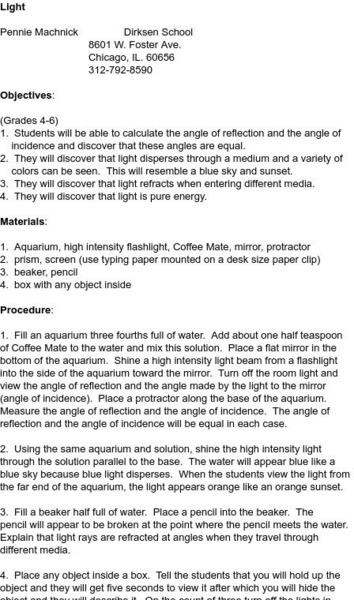
For this activity, learners actually find the angles of reflection and incidence.
Science Education Resource Center at Carleton College
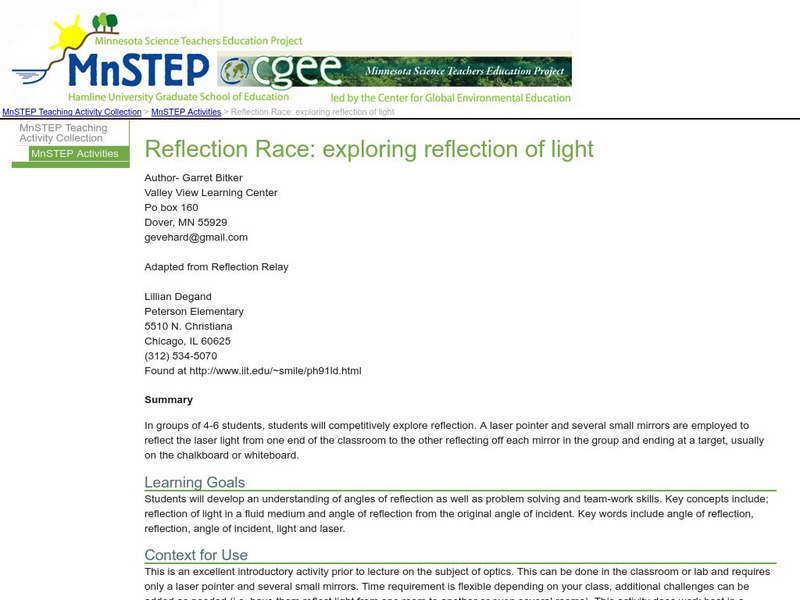
Serc: Mn Step: Reflection Race: Exploring Reflection of Light
An interesting and engaging activity where students work in groups with a laser pointer and small mirrors. They must use their knowledge of angles of reflection to bounce the laser beam from mirror to mirror until it hits a target at the...

Optical Society
Optical Society of America: Optics for Kids: Guiding Light Optical Fiber
This experiment demonstrates the concept of total internal reflection, using basic materials. Accompanied by a detailed explanation of what's happening, and links to articles on reflection and refraction.
Pennsylvania State University
Penn State Graduate Program in Acoustics: Reflection From Mirrors
Included here are illustrations of reflections from a plane mirror, a concave mirror and a convex mirror.
Georgia State University
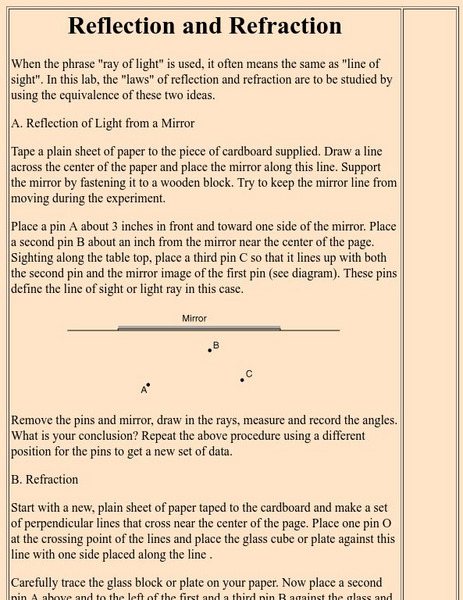
Georgia State University: Hyper Physics: Reflection and Refraction
Reflection and refraction are explained with an experiment that uses a sheet of paper, cardboard, and other common materials.
Other
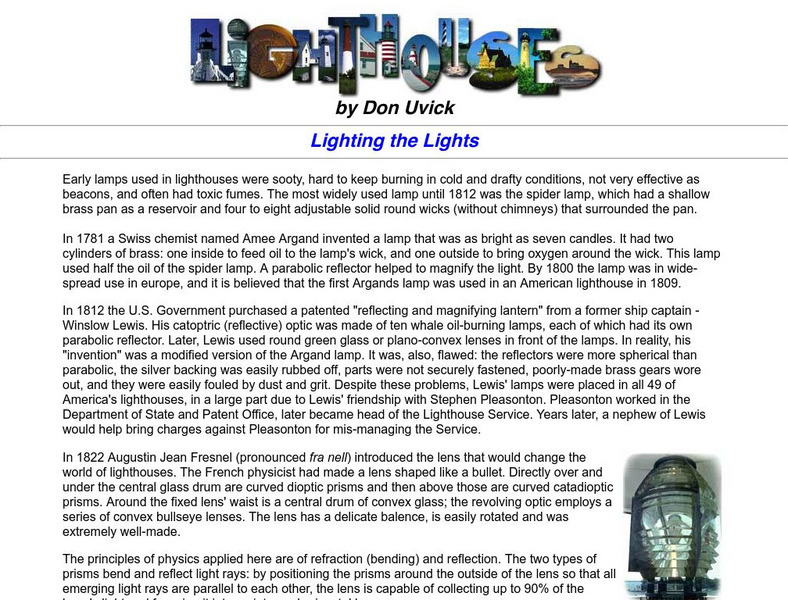
Lighthouses: Lighting the Lights
A description of the early lights used in lighthouses and how these lights evolved into what they are today. Explains the contributions of Fresnel to the development of these lights; discusses the Fresnel orders.
Other
Architectural Acoustics and Lighting: Room Acoustics
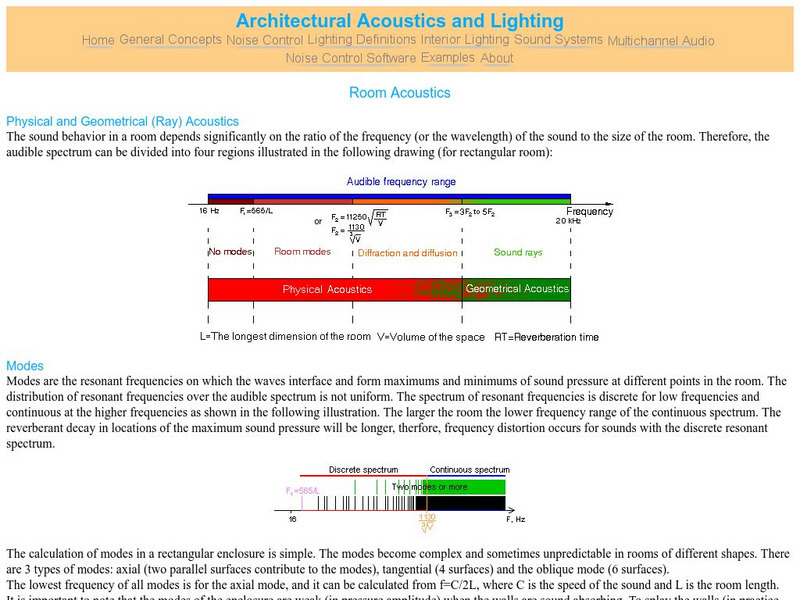
This site from Architectural Acoustics and Lighting provides a discussion of various factors affecting the acoustics of a given room. Room dimensions, the wavelength of the sound wave, the physical characteristics of the walls, the...
University of New South Wales (Australia)
University of New South Wales: School of Physics: Physclips: Geometrical Optics
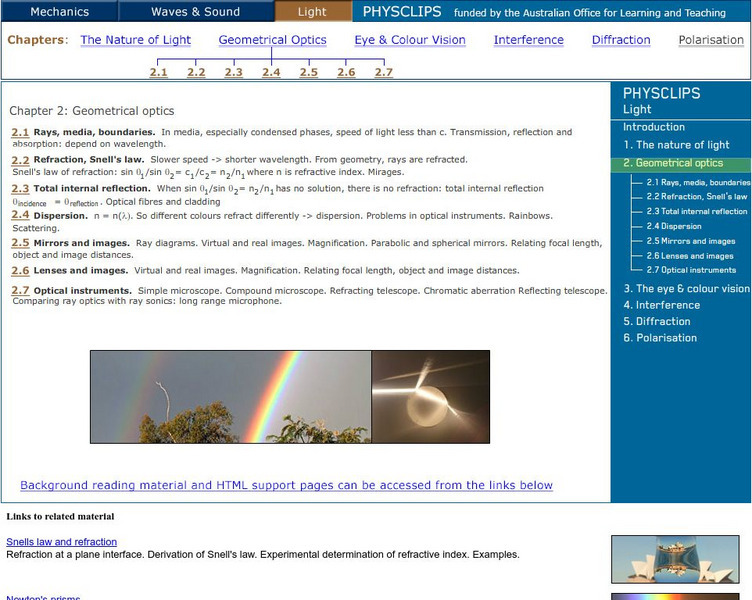
Physiclips thoroughly presents geometrical optics concepts like rays, refraction, Snell's law, total internal reflection, dispersion, mirrors, and lenses with animations and film clips.
Exploratorium
Exploratorium: Critical Angle
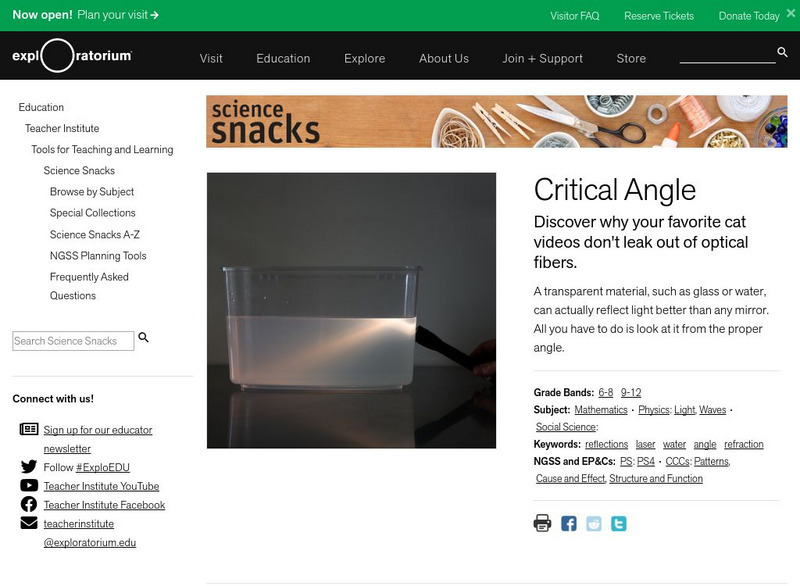
Students can see light reflected and refracted in this demonstration. They will also discover the total internal reflection of light.
University of Maryland
Optics Highlights: The Telescope
Part of an anecdotal history of optics and the study of light. Extremely thorough treatment of the invention of the telescope. Includes a short biographical sketch and discusses the work of Isaac Newton which focuses on his contribution...
Other
University of Cambridge: Alien Attack!
You are on a mission--find out which alien invader is trying to blow up Earth! Take part in wiping crime from the universe and feel good about yourself in the process.
Better Lesson
Better Lesson: Mira Mira the Amazing Mira
Using a mira, 4th graders draw symmetrical pictures and then explain how the mira works using what they know about reflection and the eye.
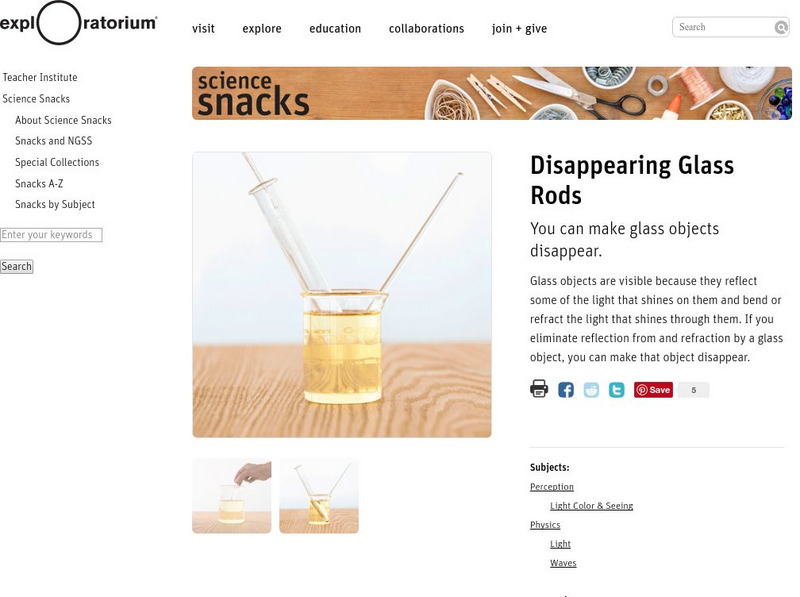
Exploratorium
Exploratorium: Science Snacks: Disappearing Glass Rods
In this activity, you will make a glass object disappear by eliminating the reflection from and the refraction by the glass object.
Center of Science and Industry
Cosi Columbus: Two Lenses in One
Investigate the behavior of a water filled vial, and discover why it acts like a magnifier. Includes full list of materials, procedures, and scientific explanation of what causes light rays to change direction.
PC Technology Guide
Pc Tech Guide: Scanners
Informative sight detailing the basics of what a scanner is and what it can do.
University of Maryland
Optics Highlights: Optics, Electromagnetic Waves, Quanta
Part of an anecdotal history on optics and the study of light. Extremely thorough treatment of the scientific evidence which led scientists to believe in the particle nature of light. Includes a short biographical sketch and discusses...

Georgia State University
Georgia State University: Hyper Physics: Mirrors in Imaging
A discussion from Georgia State University of different types of mirrors and the images which they create. Discusses different instruments which use mirrors to produce images.

Other
Guidance/the Alphabet of Art/value
An informative site that explains Value as an element of art using examples of Rembrandt's work. This is a good juxtaposition between the works "Night Watch," and "The Anatomy Lesson," by Rembrandt.
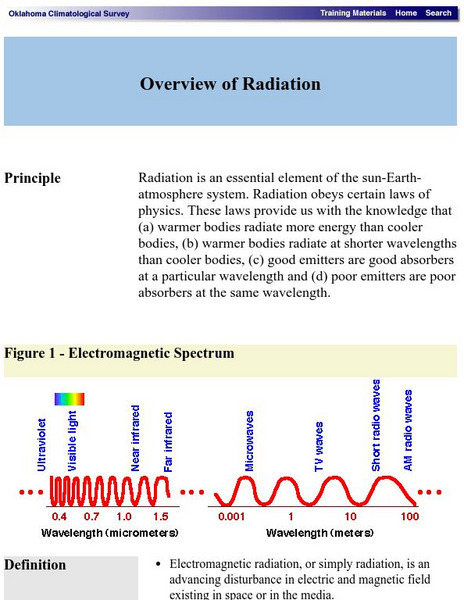
Oklahoma Mesonet
Oklahoma Climatological Survey: Overview of Radiation
This site details what radiation is, the physics of radiation, and radiative transfer as it occurs in nature. Content explores the electromagnetic spectrum, electromagnetic waves, properties of radiation, and solar radiation.
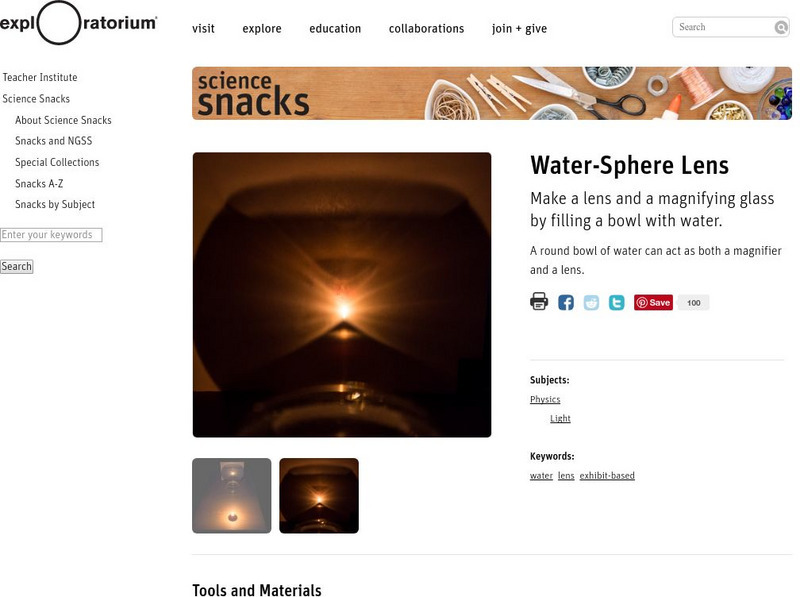
Exploratorium
Exploratorium: Science Snacks: Water Sphere Lens
Demonstrate for students how a round bowl of water can act as both a magnifier and a lens.
National Humanities Center
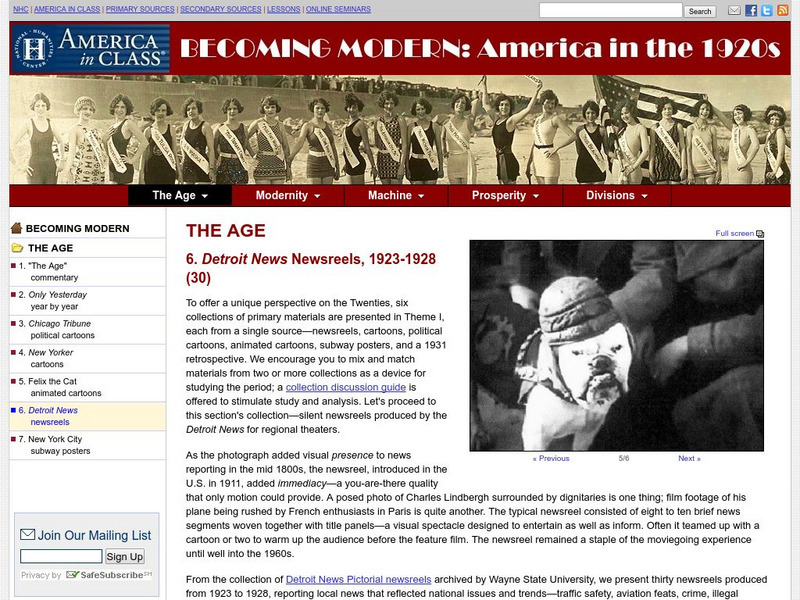
National Humanities Center: America in Class: America in the 1920s: Detroit News Newsreels
The National Humanities Center presents collections of primary resources compatible with the Common Core State Standards - historical documents, literary texts, and works of art - thematically organized with notes and discussion...
Albright-Knox Art Gallery
Albright Knox Art Gallery: Having Fun With Landscape Photography
Students will learn about horizon lines in traditional landscapes and portraits, shadows and reflected light, and John Pfahl's Altered Landscapes. They will also create their own altered landscape photographs and portraits and write...
Physics Classroom
The Physics Classroom: Reflection and Ray Model of Light: Why an Image Is Formed
This illustrated physics tutorial uses animations to attempt to explain to students why images appear.
Physics Classroom
The Physics Classroom: Reflection and Ray Model of Light: Ray Diagrams Concave
In this physics tutorial, students investigate the method for drawing ray diagrams for objects placed at various locations in front of a concave mirror.