Hi, what do you want to do?






Curated OER
Light Saver
Turn off the lights! That's right it's time to start thinking about conservation and saving electricity. Here is a very quick and very simple Earth Day craft that kids can do in a wink. They'll make light-bulb-shaped door hangers that...

New Jersey Historical Commission and New Jersey Council for the Humanities
Thomas Edison: The Wizard of Menlo Park
What would change in your daily life due to a power outage? Here, learners explore the inventions brought to us by the one and only, Thomas Edison, and imagine a day without them. Scholars take part in a grand conversation and write a...

PBS
Star Power
Let there be light—or maybe not. Pupils learn about light pollution with an investigation of constellations. They create constellation boxes and experiment with different levels of light. Observations are then made about the lighting in...

Teach Engineering
Human Power
How many humans does it take to power a light bulb? The 10th part of a 25-lesson Energy Systems and Solutions unit has learners conduct an experiment to calculate power. They then use the results to determine how many classmates they...

It's About Time
Color
How can a hand puppet's shadow look like a dog? The lesson explains the science behind shadows, combining paint colors and the colors used in old televisions. Scholars use white, red, blue, and green lights to experiment with colors...

National Park Service
The Secret of Life
Dead trees provide nutrients for the soil, food for animals, protection and a home for organisms, a seed-bed for new trees, and a place for nitrogen-fixing bacteria to live. In the activity, pupils collect decaying logs, expose them to a...

Exploratorium
Seeing Your Retina
Using a dimmed flashlight, life science learners can see the network of blood vessels that line the back of their eye. Darken the room and let them try this activity as part of your unit on the eyeball. Also consider some of the other...

DiscoverE
The Power of Graphene
When you think electric circuits, your pencil probably isn't the thing that comes to mind. A simple experiment lets learners test whether the graphene in pencil lead is a conductor or an insulator. If the LED bulb lights up, a conductor...

DiscoverE
Oranges and Batteries
Orange you glad you can make circuits using fruit? Young electricians learn about electric circuits and electricity. As part of the lesson, they build a circuit with an orange and then with a banana.

Foundation for Water & Energy Education
How Can Work Be Done with Water Power? Activity B
In this second of three activities, energy engineers plan and create a hydropower dam as they learn how hydroelectric power plants generate electricity. A hydropower puzzle is also included, which can be worked on by teams that finish...

NASA
Speaking in Phases
Hear from deep space. Pupils learn how satellites transfer information back to Earth. They learn about three different ways to modulate radio waves and how a satellite sends information with only 0s and 1s. Using sound, class members...

American Chemical Society
Energy and Entropy of a Stretched Rubber Band
Stephen Perry invented and patented the modern rubber band in 1845. Young scientists put his discovery to work as they use rubber bands to observe entropy and enthalpy. They determine the change in free energy to figure out if it...
TeachEngineering
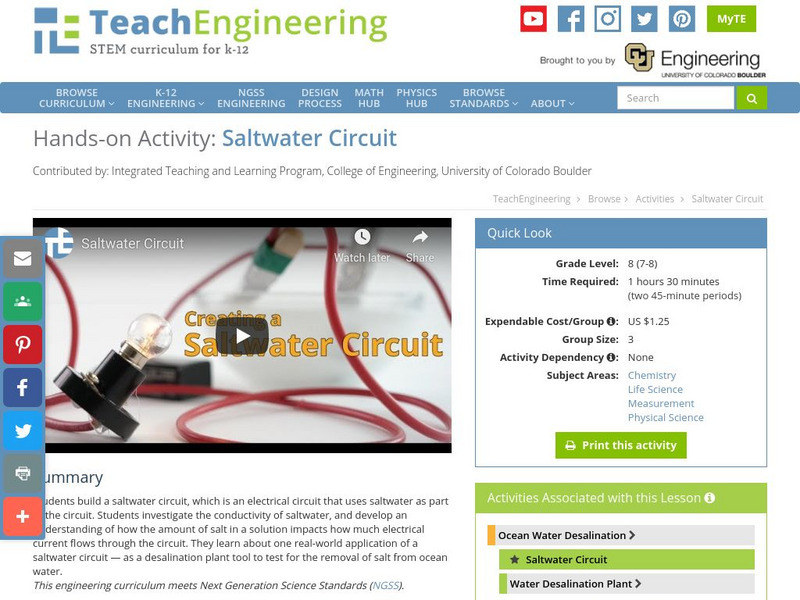
Teach Engineering: Saltwater Circuit
Students build a saltwater circuit, which is an electrical circuit that uses saltwater as part of the circuit. Students investigate the conductivity of saltwater, and develop an understanding of how the amount of salt in a solution...