Hi, what do you want to do?






DiscoverE
Make a Light Bulb
Could you reinvent the light bulb? Scholars tap into their inner Thomas Edisons to build a light bulb prototype out of a jar and some wires. They see how long the filament wire glows in the jar (batteries not included) to measure their...

DiscoverE
Oranges and Batteries
Orange you glad you can make circuits using fruit? Young electricians learn about electric circuits and electricity. As part of the lesson, they build a circuit with an orange and then with a banana.

DiscoverE
Let Your Lights Glow
Put those old holiday lights to good use. Individuals use a section of ornamental lights to create electric circuits. If the lights glow, it's a success; otherwise, it's time to try again!

Museum of Science
Circuit Board
Light up the solutions. By following a set of directions, pupils build a circuit board with six different circuits. Learners use the circuit board to create a matching activity by connecting the questions to the correct answers via a...

Exploratorium
Seeing Your Retina
Using a dimmed flashlight, life science learners can see the network of blood vessels that line the back of their eye. Darken the room and let them try this activity as part of your unit on the eyeball. Also consider some of the other...

DiscoverE
The Power of Graphene
When you think electric circuits, your pencil probably isn't the thing that comes to mind. A simple experiment lets learners test whether the graphene in pencil lead is a conductor or an insulator. If the LED bulb lights up, a conductor...

Curated OER
The Electric House Project
Students design and build a foam core house which has a light in each room. They demonstrate an understanding of series, parallel, and complex circuits. They complete a worksheet, in complete, sentences expressing these electrical concepts.

Smithsonian Institution
Lemelson Center: Spark!lab: Make a Light Bulb
This lab shows students how to make a light bulb using 6V battery, wire, cork, and a nail. Print a form where you can record your results.
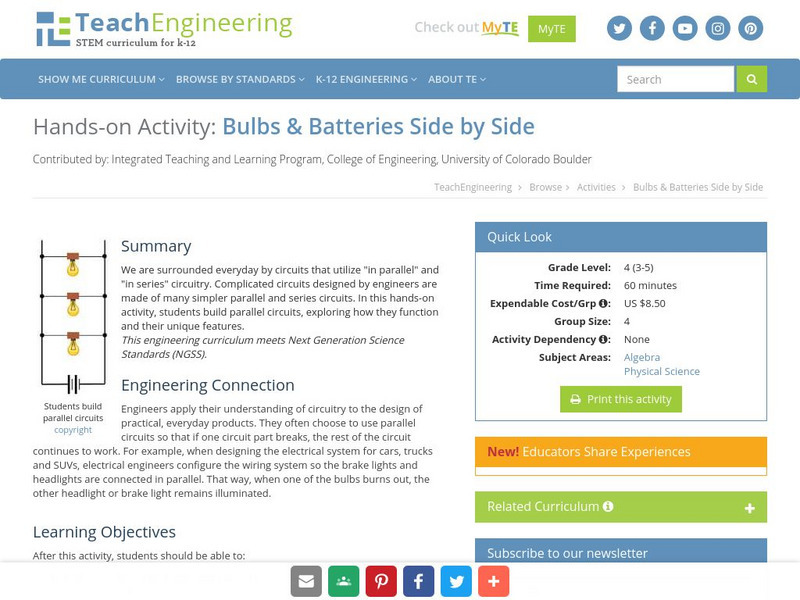
TeachEngineering
Teach Engineering: Bulbs & Batteries Side by Side
We are surrounded everyday by circuits that utilize "in parallel" and "in series" circuitry. Complicated circuits designed by engineers are made of many simpler parallel and series circuits. In this hands-on activity, students build...
Texas Instruments
Texas Instruments: Can a Lemon Power a Light Bulb
You will learn about a voltaic battery and to see if it's powerful enough to light up a light bulb
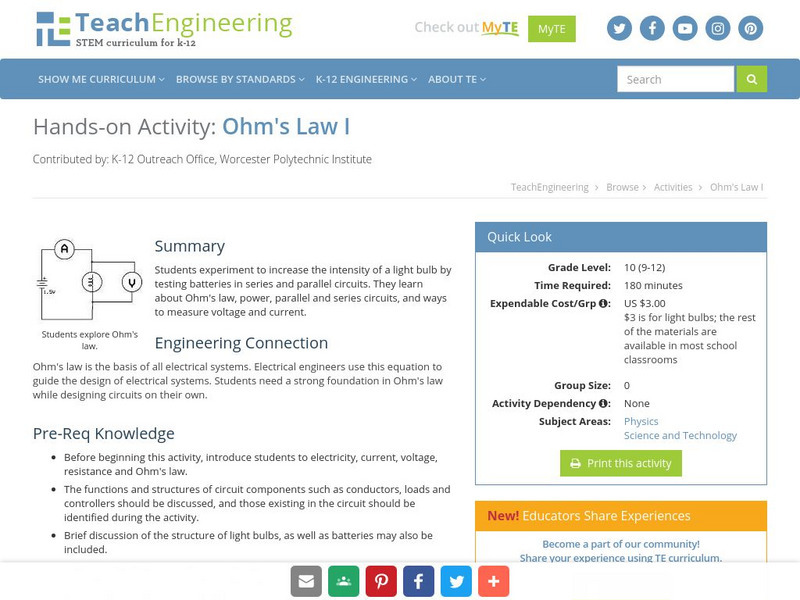
TeachEngineering
Teach Engineering: Ohm's Law I
Students will work to increase the intensity of a light bulb by testing batteries in series and parallel circuits. It analyzes Ohm's Law, power, parallel and series circuits, and ways to measure voltage and current.
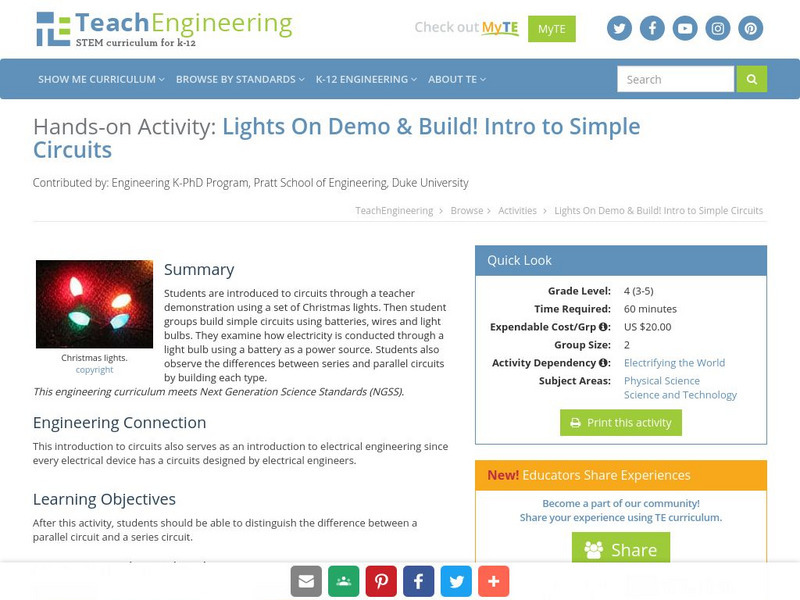
TeachEngineering
Teach Engineering: Lights On!
Students in this activity will build simple circuits using a battery, wires, and light bulbs. This activity allows students to examine how electricity is conducted through a light bulb using a battery as a power source. Students will...
Other
California Science Center: Lemon Light
Try out this great electricity activity by using lemons to make a light bulb glow. You can learn about the science behind the activity and watch an animated demonstration.
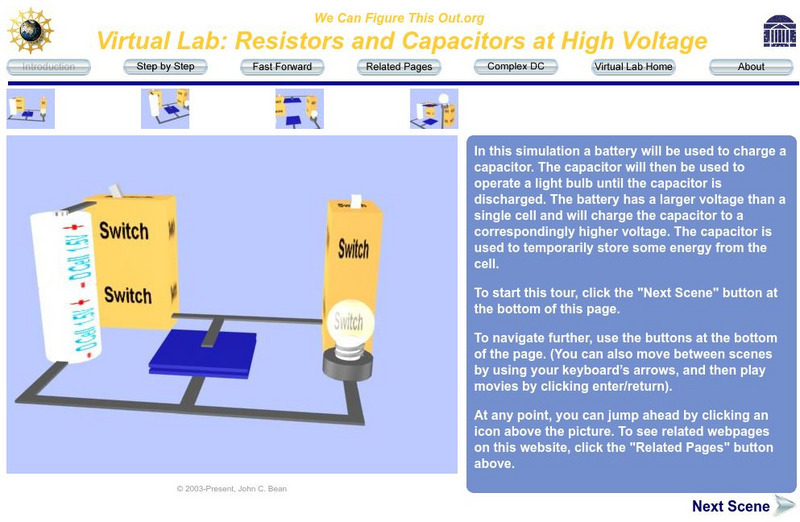
University of Virginia
Uva Virtual Lab: Resistors and Capacitors and High Voltage
In this simulation a battery will be used to charge a capacitor. The capacitor will then be used to operate a light bulb until the capacitor is discharged.
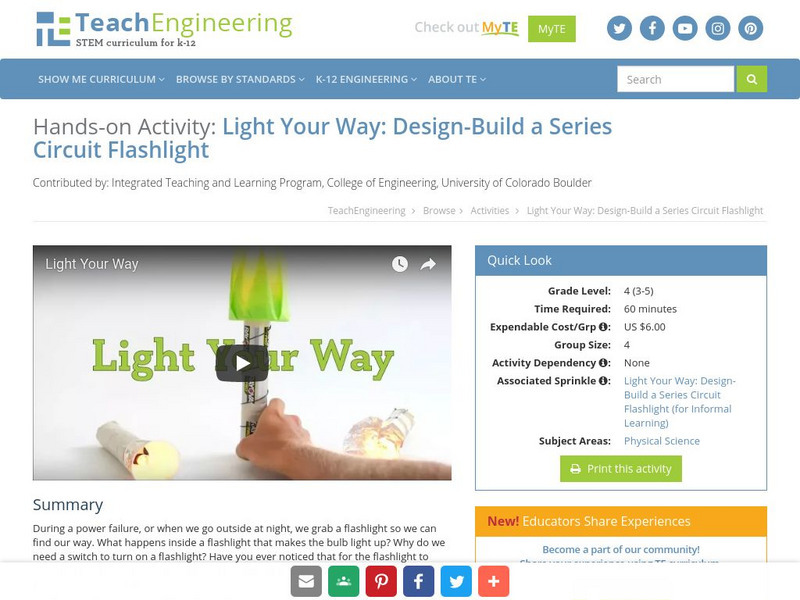
TeachEngineering
Teach Engineering: Light Your Way
When there is a power failure, or when we go outside at night, we grab a flashlight so we can find our way. What happens inside a flashlight that makes the bulb light up? Why do we need a switch to turn on a flashlight? Have you ever...
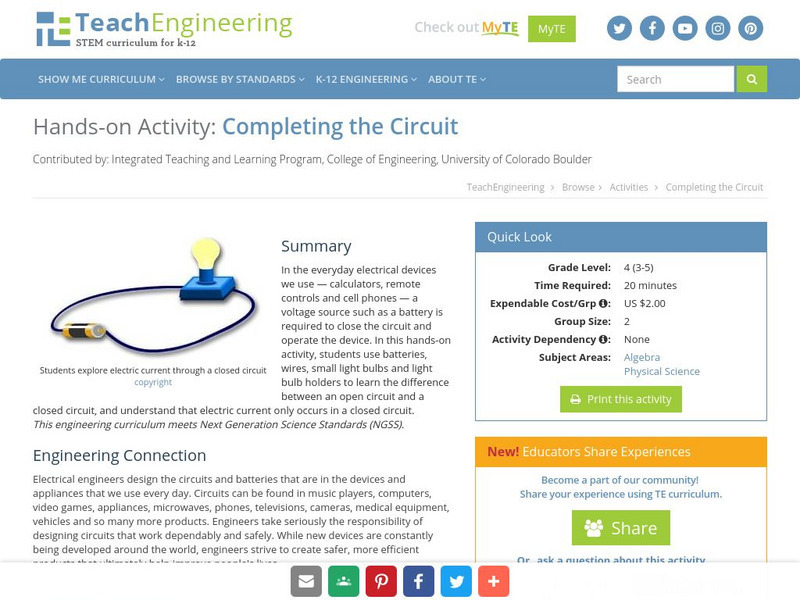
TeachEngineering
Teach Engineering: Completing the Circuit
In the everyday electrical devices we use - calculators, remote controls and cell phones - a voltage source such as a battery is required to close the circuit and operate the device. In this hands-on activity, students use a battery,...
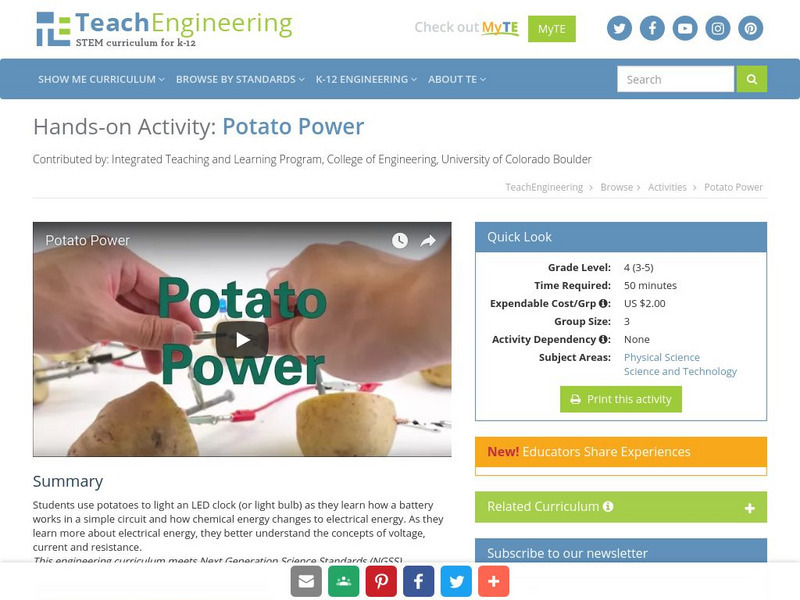
TeachEngineering
Teach Engineering: Potato Power
Students use potatoes to light an LED clock (or light bulb) as they learn how a battery works in a simple circuit and how chemical energy changes to electrical energy. As they learn more about electrical energy, they better understand...

TeachEngineering
Teach Engineering: Conductivity
Students make a simple conductivity tester using a battery and light bulb. They learn the difference between conductors and insulators of electrical energy as they test a variety of materials for their ability to conduct electricity.
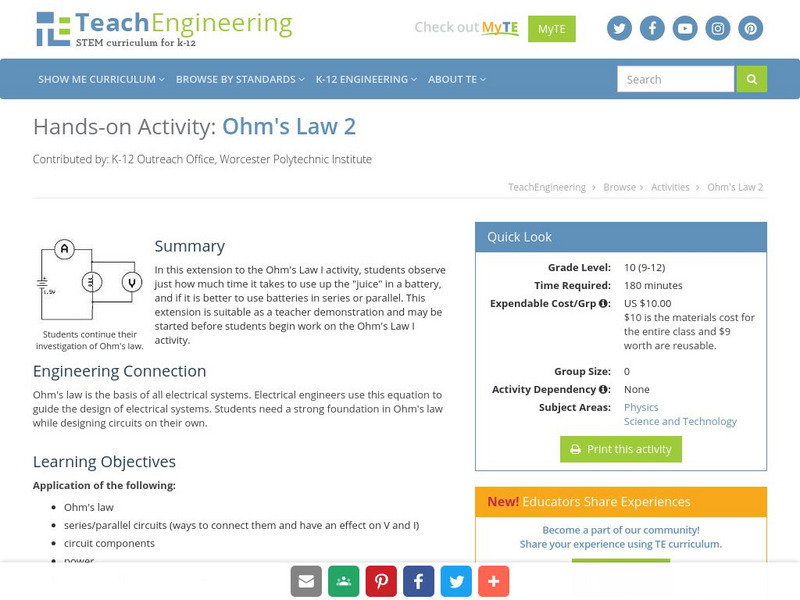
TeachEngineering
Teach Engineering: Ohm's Law 2
This extension to the Ohm's Law I activity, students will observe just how much time it takes to use up the "juice" in a battery, and if it is better to use batteries in series or parallel.
Science Struck
Science Struck: Lemon Battery Experiment
In this step-by-step experiment, you will learn how to make a battery using four lemons and use it to light an LED bulb.
Science Buddies
Science Buddies: Shaking Up Some Energy
Shake N' Light flashlights have been advertised on televisions across the nation in the recent year. But many do not understand just how they get energy to light up the bulb without using batteries. Do this experiment to make your own...