Hi, what do you want to do?






PBS
Pbs Learning Media: The Electromagnetic Spectrum: Frontline
This video segment adapted from FRONTLINE introduces the electromagnetic spectrum and explains how the various types of electromagnetic waves are distinguished by the amount of energy each wave carries.
TeachEngineering
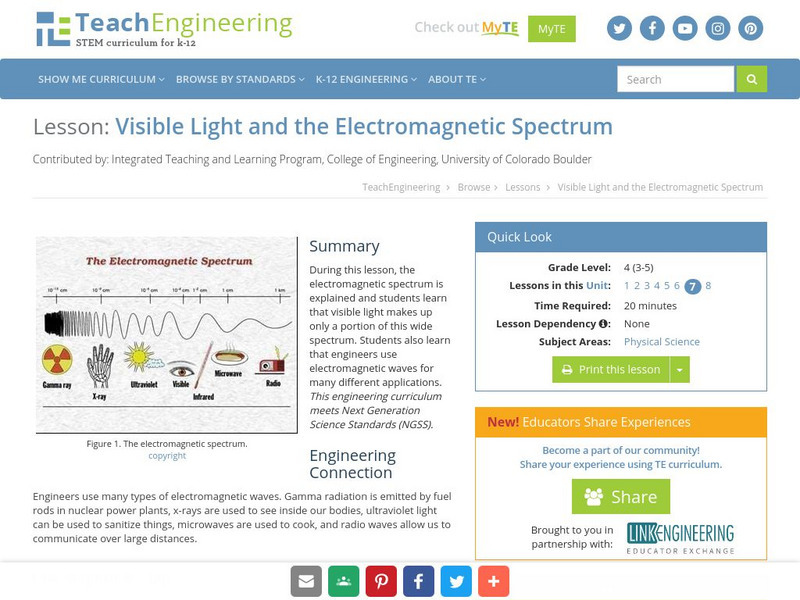
Teach Engineering: Visible Light and the Electromagnetic Spectrum
In this lesson, the electromagnetic spectrum is explained and students learn that visible light makes up only a portion of this wide spectrum. Students also learn that engineers use electromagnetic waves for many different applications.
Science Buddies
Science Buddies: How Does Color Affect Heating by Absorption of Light?
Light is an example of an electromagnetic wave. Electromagnetic waves can travel through the vacuum of interstellar space. They do not depend on an external medium-unlike a mechanical wave such as a sound wave which must travel through...
NASA
Nasa: Tour of the Electromagnetic Spectrum: Visible Light
Visible light waves are the only electromagnetic waves we can see. We see these waves as the colors of the rainbow. Each color has a different wavelength. Red has the longest wavelength and violet has the shortest wavelength. When all...
Science Buddies
Science Buddies: Measuring the Speed of 'Light' With a Microwave Oven
In this experiment, you will measure the speed of light using a microwave oven, some egg white, and a ruler. This short project proves to be an extremely interesting choice for a science lab, with pictures for illustration, and thorough...
Science Struck
Science Struck: How Does Light Travel Through Space and Other Media?
A detailed discussion of the nature of light, how it can travel through a vacuum, and how the speed of light is affected when light travels through a medium.
CK-12 Foundation
Ck 12: Electromagnetic Spectrum
[Free Registration/Login may be required to access all resource tools.] Students learn what an electromagnetic wave is, gain a feel for the main parts of the spectrum, and work on problems involving basic properties of electromagnetic...
Exploratorium
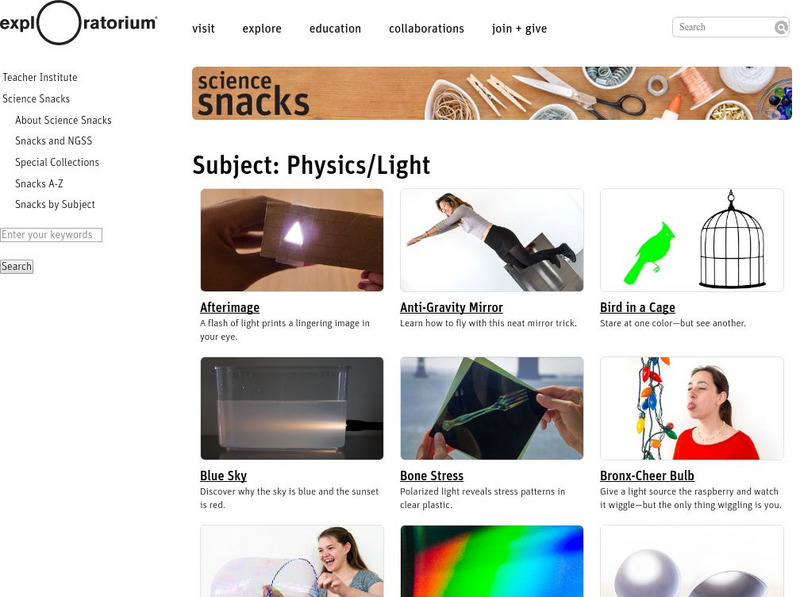
Exploratorium: Science Snacks: Physics/light
Here is a large collection of simple science class activities for understanding the physics of light.
CK-12 Foundation
Ck 12: Fundamentals of Light
[Free Registration/Login may be required to access all resource tools.] Students investigate the fundamentals of light including its source, how it is defined for measurements, how we perceive color, and the situations that make an...
TeachEngineering
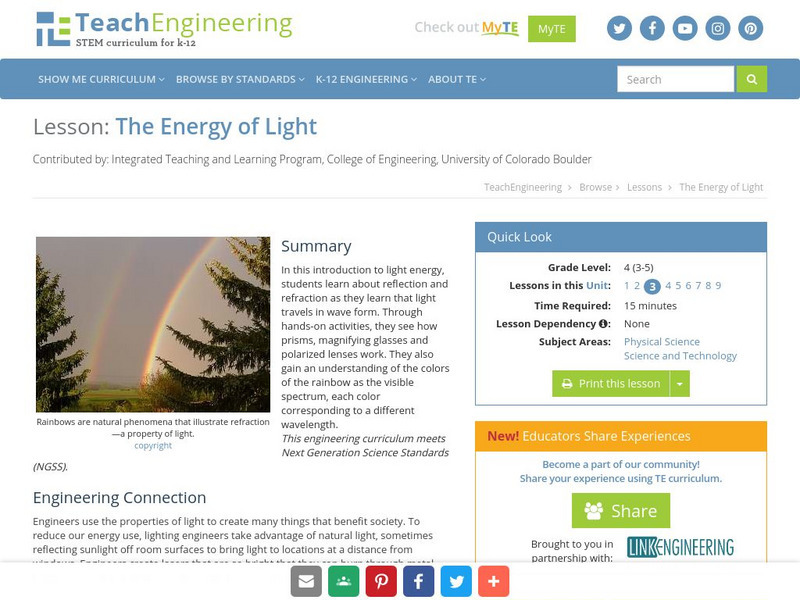
Teach Engineering: The Energy of Light
In this introduction to light energy, students learn about reflection and refraction as they learn that light travels in wave form. Through hands-on activities, they see how prisms, magnifying glasses and polarized lenses work. They also...
Physics Classroom
The Physics Classroom: Polarization
"How Do We Know Light Behaves as a Wave?" An answer is provided in this discussion of the polarization of light and the use of Polaroid filters in sunglasses. The four methods discussed on this page are: polarization by transmission,...
Science Struck
Science Struck: Wavelength of Light
Describes the characteristics of light, presents two formulas for calculating its wavelength, and provides a table of the different wavelength ranges across the electromagnetic spectrum.
NASA
Nasa: Imagine the Universe: What's the Frequency, Roy G. Biv
In this very detailed lesson plan from NASA, students investigate wavelength and frequency within the electromagnetic spectrum.

TeachEngineering
Teach Engineering: The Visual Spectrum
In this activity, students make simple spectroscopes (prisms) to look at different light sources. The spectroscopes allow students to see differing spectral distributions of different light sources.