Hi, what do you want to do?






American Museum of Natural History
Light Quest
Grab a partner and shed some light on light. A remote learning resource has scholars play a board game to answer trivia questions about light. They also read about how Einstein contributed to the understanding of light as both a wave and...

Exploratorium
Spectra
Make a class set of spectrum tubes by first purchasing some diffraction grating, and then constructing the tools with mailing tubes or shoe boxes. If you aren't up for assembling them, you could purchase prepared spectroscope kits. This...

International Technology Education Association
Make a Pinhole Camera
With a little light and a lot of time, you can create some amazing images. This NASA-related task instructs pupils to build a pinhole camera. The lesson provides suggestions for different pictures to try with the pinhole camera...

NASA
Speaking in Phases
Hear from deep space. Pupils learn how satellites transfer information back to Earth. They learn about three different ways to modulate radio waves and how a satellite sends information with only 0s and 1s. Using sound, class members...

University of Waikato
Māui and the Sun
Using a Maori legend, How Maui Tamed the Sun, youngsters are introduced to the importance of sunlight to civilization. Teach them about nuclear fusion that occurs to produce the solar energy we later receive on Earth as...

National Nanotechnology Infrastructure Network
Powers of Ten with the Blue Morpho Butterfly
Explore the powers of ten while examining a Blue Morpho butterfly wing. Learners discover there is a lot more than meets the eye when one looks close enough.
Science Buddies
Science Buddies: How Does Color Affect Heating by Absorption of Light?
Light is an example of an electromagnetic wave. Electromagnetic waves can travel through the vacuum of interstellar space. They do not depend on an external medium-unlike a mechanical wave such as a sound wave which must travel through...
Science Buddies
Science Buddies: Measuring the Speed of 'Light' With a Microwave Oven
In this experiment, you will measure the speed of light using a microwave oven, some egg white, and a ruler. This short project proves to be an extremely interesting choice for a science lab, with pictures for illustration, and thorough...
Exploratorium
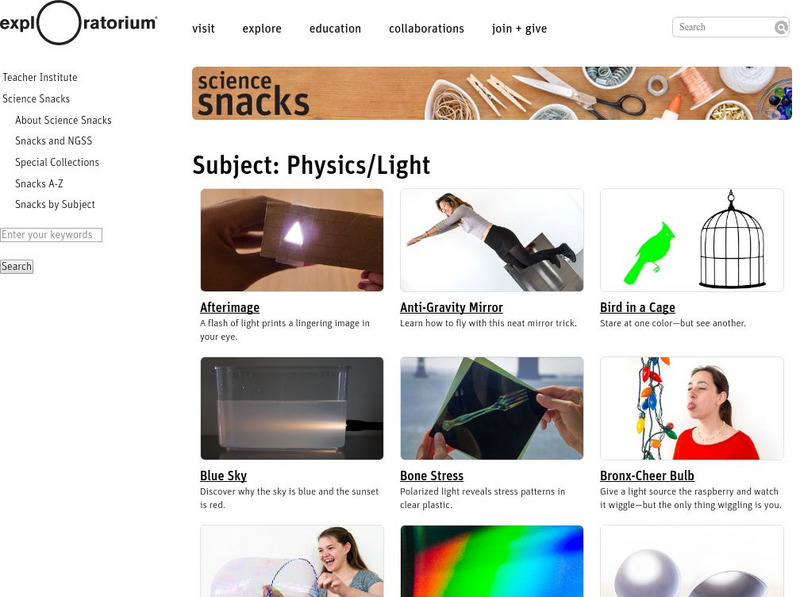
Exploratorium: Science Snacks: Physics/light
Here is a large collection of simple science class activities for understanding the physics of light.
Read Works
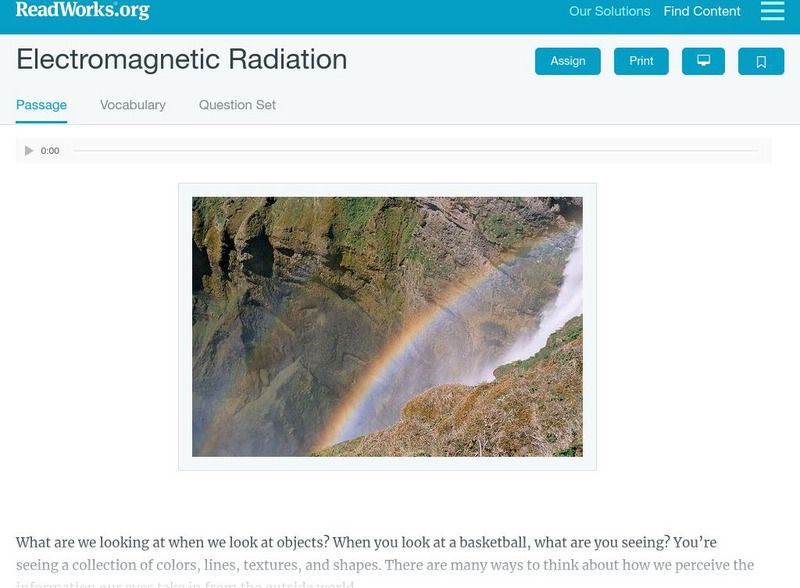
Read Works: Electromagnetic Radiation
[Free Registration/Login Required] An informational text about electromagnetic radiation and the effects it creates. A question sheet is available to help students build skills in reading comprehension.
TeachEngineering
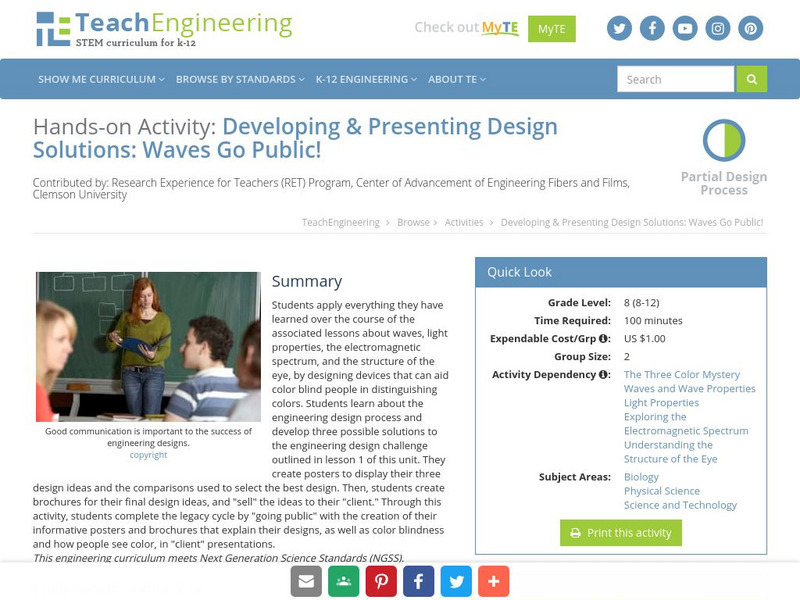
Teach Engineering: Waves Go Public!
Students apply everything they have learned over the course of the associated lessons about waves, light properties, the electromagnetic spectrum, and the structure of the eye, by designing devices that can aid color blind people in...
Physics Central
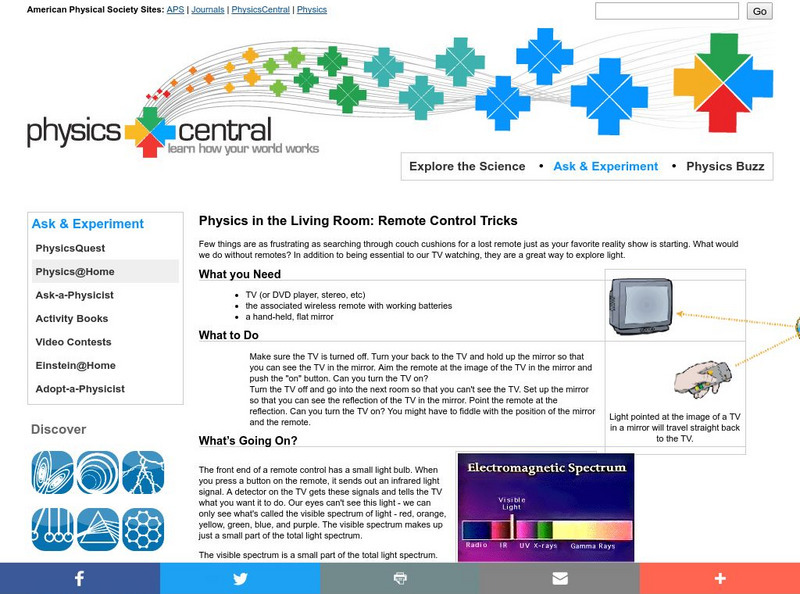
Physics Central: Physics in the Living Room: Remote Control Tricks
An easy experiment through which students learn about light rays and the electromagnetic spectrum. Requires a TV, its remote, and a hand-held, flat mirror.

TeachEngineering
Teach Engineering: The Visual Spectrum
In this activity, students make simple spectroscopes (prisms) to look at different light sources. The spectroscopes allow students to see differing spectral distributions of different light sources.
Exploratorium
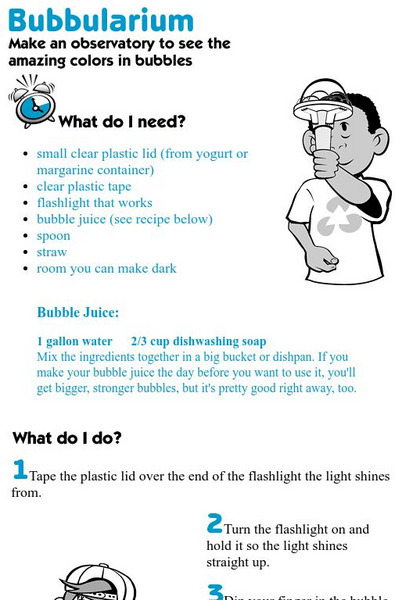
Exploratorium: Bubbularium
What colors do you see in a bubble? Why do you see colors in a bubble? Use this site to find out the answer to these questions with this easy experiment.
Boston University
Bu: Optics Demonstrations: Polarization
Several short descriptions of demonstrations pertaining to polarization principles. Suitable as a supplement for a teacher lesson plan or as an idea-generator for a student project.