Hi, what do you want to do?






Concord Consortium
Concord Consortium: Stem Resources: Greenhouse Light and Temperature
An interactive tool where students can create a model of a greenhouse and use a light sensor to measure the amount of light it receives from a lamp at various times of the day. Temperature is also measured. Data is plotted on graphs,...
Science Buddies
Science Buddies: Absorption of Radiant Energy by Different Colors
In this science fair project, use an infrared thermometer to measure the temperature of differently colored paper exposed to sunlight, and calculate energy emission using the Stefan-Boltzmann equation. Find discussion questions, a list...
Next.cc
Next: Solar Energy
Engage in the activities provided to learn how you can use the sun as a source of energy. Click on the links for further exploration.
TeachEngineering
Teach Engineering: Stations of Light
Student groups rotate through four stations to examine light energy behavior: refraction, magnification, prisms and polarization. They see how a beam of light is refracted (bent) through various transparent mediums. While learning how a...
TeachEngineering
Teach Engineering: The Energy of Light
In this introduction to light energy, students learn about reflection and refraction as they learn that light travels in wave form. Through hands-on activities, they see how prisms, magnifying glasses and polarized lenses work. They also...

Utah Education Network
Uen: Trb 3:5 Investigation 1 Is It Hot in the Light?
Learn why things in direct sunlight are warmer than things that are not in as much sunlight.
Science Buddies
Science Buddies: Shaking Up Some Energy
Shake N' Light flashlights have been advertised on televisions across the nation in the recent year. But many do not understand just how they get energy to light up the bulb without using batteries. Do this experiment to make your own...
PBS
Pbs Learning Media: The Electromagnetic Spectrum: Frontline
This video segment adapted from FRONTLINE introduces the electromagnetic spectrum and explains how the various types of electromagnetic waves are distinguished by the amount of energy each wave carries.
Next.cc
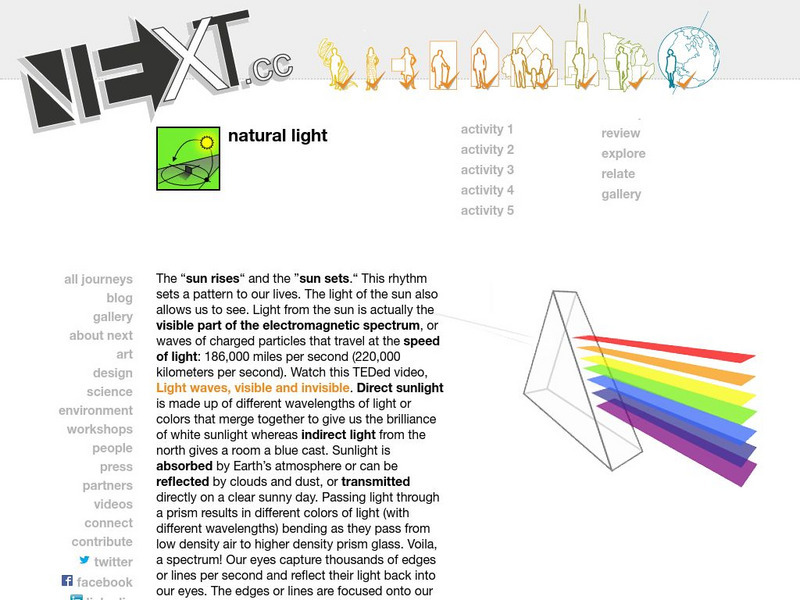
Next: Natural Light
Learn why natural light is and why it is important by completing these five activities. Click on one of the many links provided for further information.
Utah Education Network
Uen: Energy Transfers
Students will model and measure energy transfers from light to heat.
TeachEngineering
Teach Engineering: Wasting Energy at Home
People use energy in all aspects of their lives - for cooking, lighting and entertainment. Much of this energy use takes place in buildings, such as our homes. To save money and reduce the impact on our environment, many people are...
TED Talks
Ted: Ted Ed: Sunlight Is Way Older Than You Think
It takes light a zippy eight minutes to reach Earth from the surface of the Sun. But how long does it take that same light to travel from the Sun's core to its surface? Oddly enough, the answer is many thousands of years. Sten Odenwald...
Better Lesson
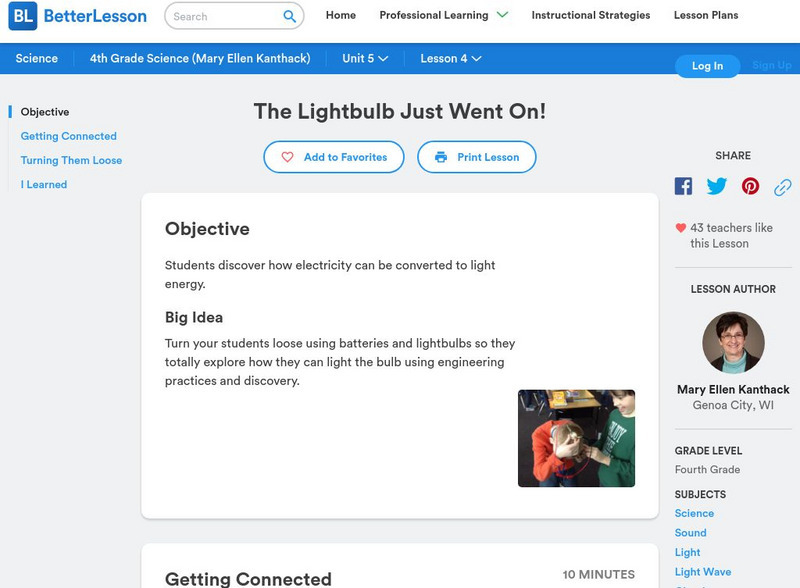
Better Lesson: The Lightbulb Just Went On!
Fourth graders discover how electricity can be converted to light energy.
Science Buddies
Science Buddies: Get Something for Nothing: Free Power From the Sun!
Taking advantage of free energy can reduce our dependence on fossil fuels, which are harmful to our environment. In this science fair project, you will work with a solar panel, which is a collector of free energy, and investigate how...
Better Planet Productions
Earth Care: Who Left the Lights On?
In this kindergarten lesson, students will learn the importance of turning off lights when they are not being used.
Science Buddies
Science Buddies: Observatory Satellite Measures Motion of Coronal Mass Ejection
The sun sometimes releases huge bursts of electrified gases into space. These bursts are called coronal mass ejections (or CMEs). When CMEs are directed towards Earth they can generate auroras, the spectacular atmospheric displays also...

Science Buddies
Science Buddies: Leaves and Light
Leaves use sunlight to make food for the plant. Sunlight contains all of the colors of the rainbow, but are all of those colors used by the leaf? Can you find out if some colors of light are more important than others?
PBS
Pbs Learning Media: Wavelength
In this interactive activity adapted from the University of Utah's ASPIRE Lab, students will learn how to measure wavelengths and see how wavelength affects the color of the light that we see.
Museum of Science
The Atom's Family: Radiometer
Help Dracula find out about light waves by using a virtual radiometer.
Exploratorium
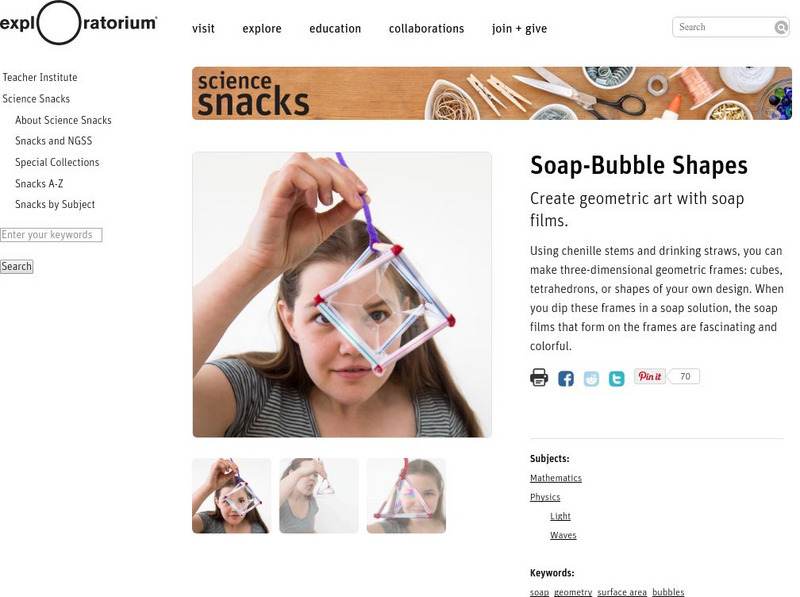
Exploratorium: Soap Bubbles: Create Geometric Art With Soap Films
In this lesson plan students will learn about reflection of light using soap bubbles.
Better Lesson
Better Lesson: Waves Performance Assessment Part 1
Students will use a variety of objects to participate in a partner activity and communicate using light and sound waves. Resources include a video, pictures and videos of the lesson plan in action, and examples of student work.
Better Lesson
Better Lesson: Refraction Extravaganza!
Fourth graders learn how light waves bend differently in different mediums.
Physics Classroom
The Physics Classroom: Blue Skies and Red Sunsets
This high school resource shows how the blue of the skies and the red of the sunsets can be explained by the interaction of sunlight with atmospheric particles which causes scattering of light.
Science Buddies
Science Buddies: Testing Sunscreen Effectiveness
The goal of this project is to measure the effectiveness of different sunscreen products for blocking ultraviolet-A (UVB) and ultraviolet-B (UVB) rays from sunlight. This project shows you how to use a UV detector to measure rays of light.
Other popular searches
- Heat and Light Energy
- Absorption of Light Energy
- Sound and Light Energy
- Heat Light Sound Energy
- Heat Light Energy
- Light Energy and Colors
- Light Energy Colors
- Light and Energy Experiment
- Light Energy & Color
- Light Energy Diagram
- Light Energy Transformed
- Energy and Light Bulbs