Hi, what do you want to do?






Physics Classroom
The Physics Classroom: Ray Diagrams for Concave Mirrors Case D
Ray diagrams are useful tools for determining the location of an image as produced by a concave mirror. Of all the rays which emanate from the top of the object arrow and are incident to the mirror, there are two rays whose behavior at...
Physics Classroom
The Physics Classroom: Reflection/ray Model of Light: Mirror Portion Required
A tutorial which demonstrates how ray diagrams can be used to determine what portion of a plane mirror must be used in order to view an image.
Physics Classroom
The Physics Classroom: Refraction/ray Model of Light: The Anatomy of the Eye
An introduction to the human eye as it relates to the physics ray model of light and image formation.
Physics Classroom
The Physics Classroom: Reflection and Ray Model of Light: Right Angle Mirrors
Discover how light reacts when it strikes mirrors which are placed at right angles to each other.
Physics Classroom
The Physics Classroom: Reflection and Ray Model of Light: The Line of Sight
Students explore this simple physics principle: In order to view an object, you must sight along a line at that object; and when you do light will come from that object to your eye along the line of sight.
Physics Classroom
The Physics Classroom: Refraction and Ray Model of Light: Refraction and Sight
Through illustrated diagrams and animations, students explore the broken pencil phenomenon and light refraction.
Physics Classroom
The Physics Classroom: Reflection/ray Model of Light: Convex Mirror Images
Students explore three different ray diagrams for objects positioned at different locations along the principal axis in a convex mirror.
Physics Classroom
The Physics Classroom: Reflection/ray Model of Light: The Mirror Equation Convex
While a ray diagram may help one determine the approximate location and size of the image, it will not provide numerical information about image distance and image size. To obtain this, students are introduced to the Mirror Equation and...
Physics Classroom
The Physics Classroom: Reflection/ray Model of Light: Anatomy of a Curved Mirror
A physics tutorial focused on the behavior of light as it relates to concave mirrors.
Physics Classroom
The Physics Classroom: Reflection/ray Model of Light: Reflection/image Convex
In this physics tutorial, we will follow a pattern of inquiry for convex mirrors: investigating how convex mirrors reflect light and produce images.
University of Minnesota
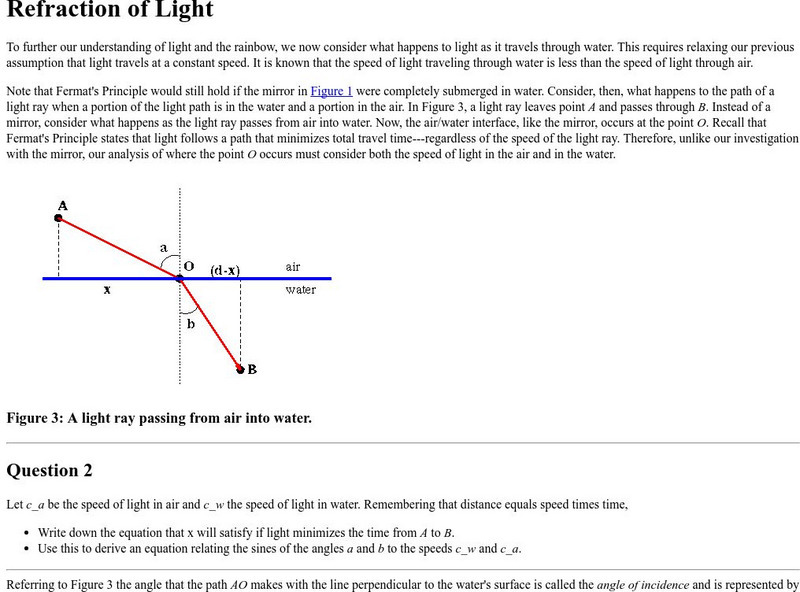
University of Minnesota: Refraction of Light
This page is a continuation of a tutorial about light reflection and refraction. It contains a diagram and suggestions on how to derive Snell's Law, which governs the refraction of light in a medium. For background to this derivation,...
TeachEngineering
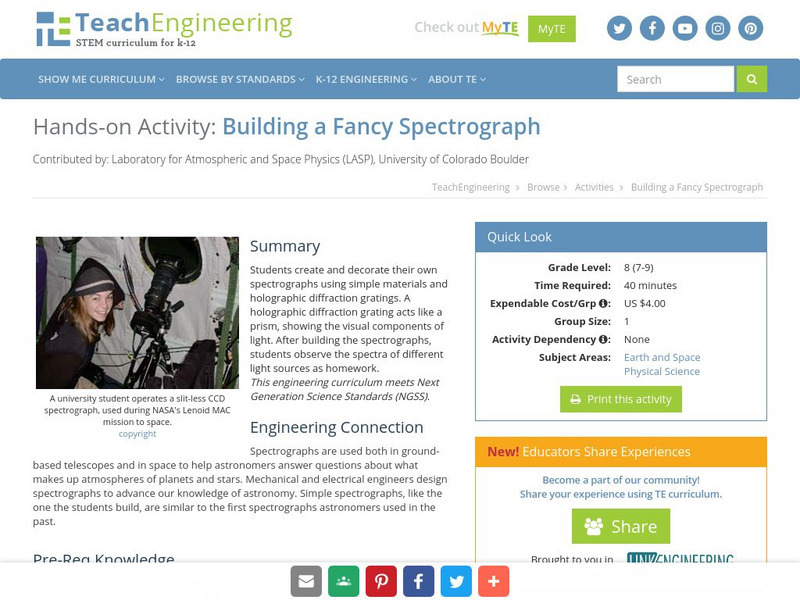
Teach Engineering: Building a Fancy Spectrograph
Students create and decorate their own spectrographs using simple materials and holographic diffraction gratings. A holographic diffraction grating acts like a prism, showing the visual components of light. After building the...
NASA
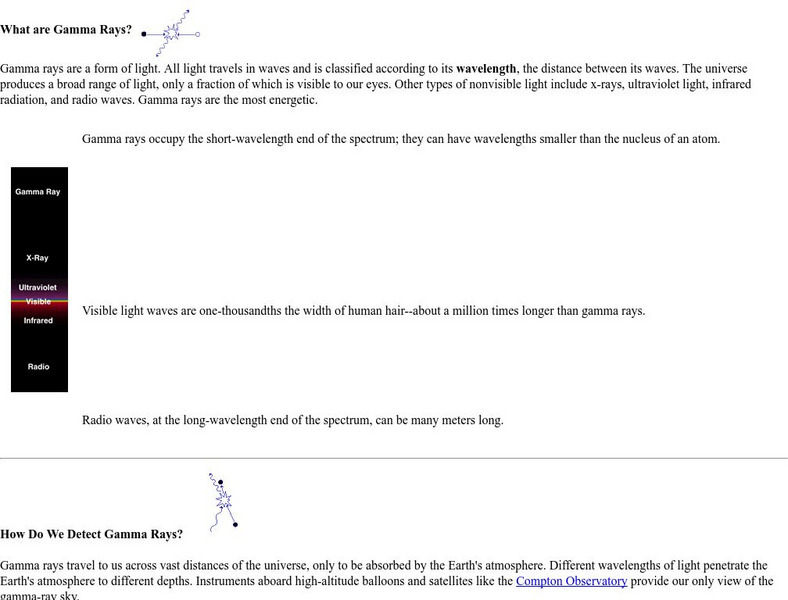
Viewing the Violent Universe: What Are Gamma Rays?
The universe produces a broad range of light, only a fraction of which is visible to our eyes. Gamma rays are nonvisible light, which also includes x-rays, ultraviolet light, infrared radiation, and radio waves.
University of Colorado
University of Colorado: Physics 2000: Cat Scans: Projecting Shadows
This page and the three pages which follow discuss how X-ray technology can be used to produce an image of the human body. Discussion is understandable and highly intriguing. Several interactive animations allow the visitor to explore...
University of Colorado
University of Colorado: Physics 2000: Electromagnetic Waves
Using a student-teacher dialogue format, this page discusses the nature of light as an electromagnetic wave and the electromagnetic spectrum.
Georgia State University
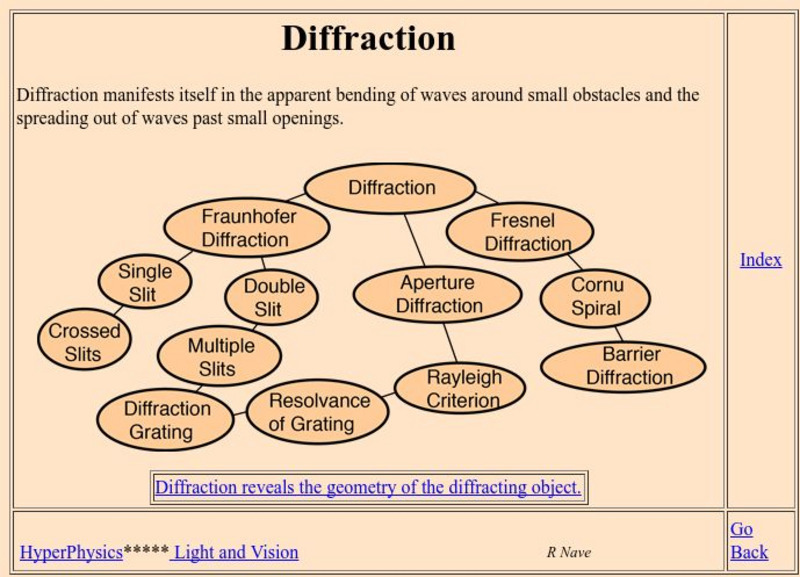
Georgia State University: Hyper Physics: Diffraction
This physics department site provides links about the diffraction of light. Each page includes thorough explanations and meaningful graphics. Some pages include interactive problem-solving practice sections.

TED Talks
Ted: Ted Ed: Why Do We Have to Wear Sunscreen?
You already know that a trip to the beach can give you a nasty sunburn, but the nitty gritty of sun safety is actually much more complex. Wrinkle-causing UVA rays and burn-inducing UVB's can pose a serious risk to your health (and good...
Georgia State University
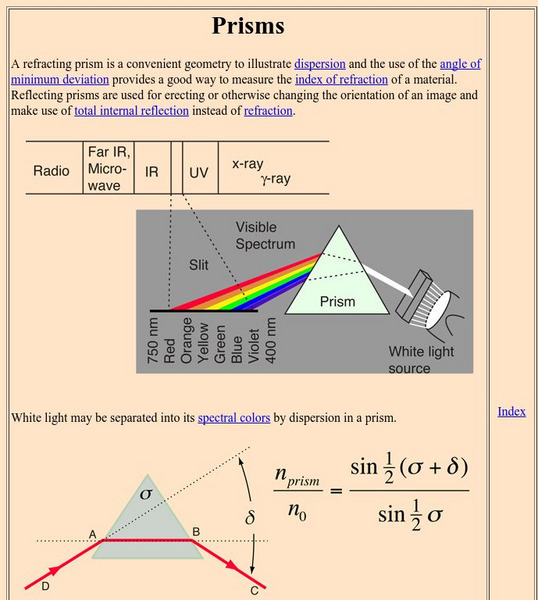
Georgia State University: Hyper Physics: Prisms
This physics department site explains how prisms work and their purpose in the dispersion of light. Explains the angle of deviation and includes an interactive form in which visitors calculate the angle of deviation and receive immediate...
Physics Classroom
The Physics Classroom: Refraction/ray Model of Light: The Cause of Refraction
Through illustrated examples and animated tutorials, students discover what causes refraction.
Physics Classroom
The Physics Classroom: Refraction and the Ray Model of Light: Snell's Law
In this interactive physics tutorial, students will learn about a mathematical equation relating these two angles and the indices of refraction of the two materials on each side of the boundary.
Physics Classroom
The Physics Classroom: Refraction/ray Model of Light: Determination of N Values
Through illustrated examples and interactive practice problems, students explore the details of Snell's Law.
Physics Classroom
The Physics Classroom: Refraction and Ray Model of Light: The Critical Angle
Illustrated examples and interactive practice problems that introduce students to the concept of the critical angle, the angle of incidence that provides an angle of refraction of 90-degrees.
Physics Classroom
The Physics Classroom: Refraction and Ray Model of Light: Refraction by Lenses
Students use this tutorial to investigate the refractive ability of converging and diverging lenses.
Physics Classroom
The Physics Classroom: Refraction and the Ray Model of Light: Converging Lenses
The purpose of this tutorial is to summarize object-image relationships by dividing the possible object locations into five general areas or points.
Other popular searches
- Light Rays and Lenses
- Monochromatic Light Rays
- Science Light Rays
- Refracted Light Rays
- Incident Light Rays