Hi, what do you want to do?





NASA
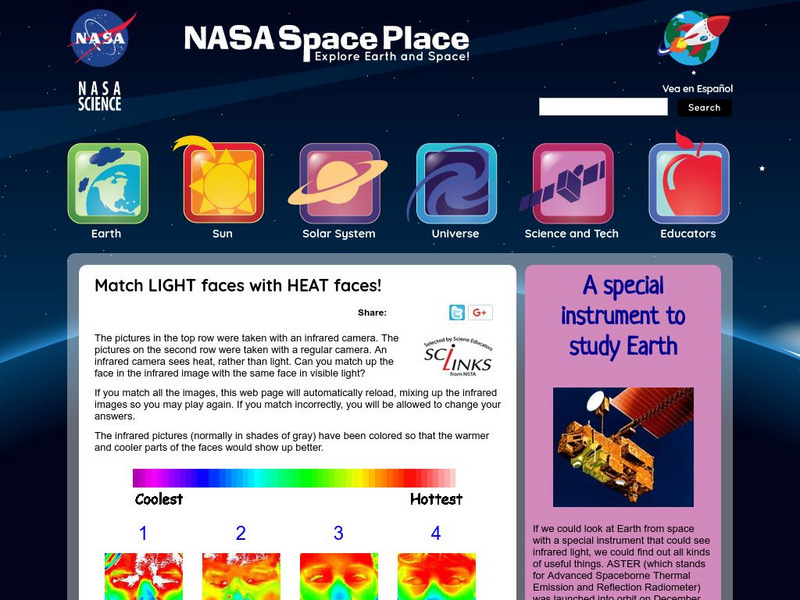
Nasa: Match Light Faces With Heat Faces
Can you picture someone in infrared? In this game, you try to match pictures taken of faces with a regular camera with those taken with an infrared camera. After the game, there is background information on infrared waves.
Georgia State University
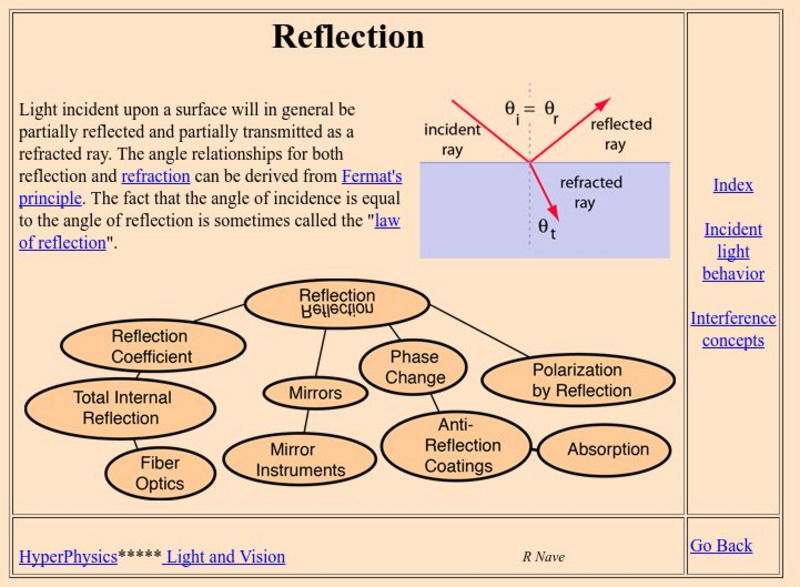
Georgia State University: Hyper Physics: Behavior of Incident Light
This site from Georgia State University is an indexing page for several other pages on the topic of reflection. Topics are treated in an understandable manner and utilize meaningful graphics.

Physics Classroom
The Physics Classroom: Reflection/ray Model of Light: Reflection Rules Concave
Students learn two rules of reflection as it has to do with concave mirrors. These two rules will greatly simplify the task of determining the image locations for objects placed in front of concave mirrors.
Physics Classroom
The Physics Classroom: Reflection and Ray Model of Light: Why an Image Is Formed
This illustrated physics tutorial uses animations to attempt to explain to students why images appear.
Physics Classroom
The Physics Classroom: Reflection and Ray Model of Light: Image Characteristics
Through illustrated examples and interactive practice problems, students learn about real and virtual images.
NASA
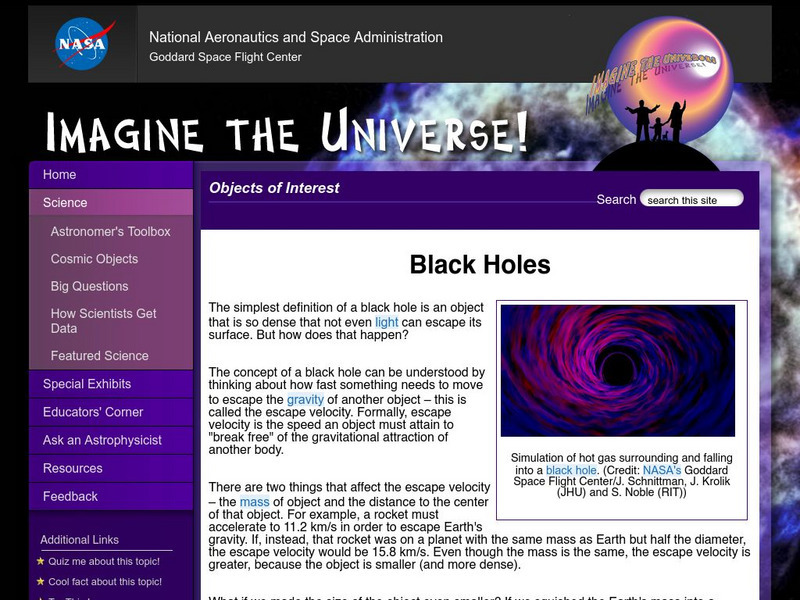
Nasa: Imagine the Universe: Black Holes
Learn what black holes are and the myths that surround them.
Physics Classroom
The Physics Classroom: Refraction and the Ray Model of Light: Rainbow Formation
Understand the physics behind Roy G. Biv, and how rainbows are formed by drawing upon our understanding of refraction, internal reflection, and dispersion.
Physics Classroom
The Physics Classroom: Refraction and the Ray Model of Light: Anatomy of a Lens
Illustrated diagrams in this tutorial help students understand the properties and functions of lenses.
Physics Classroom
The Physics Classroom: Reflection and Ray Model of Light: Spherical Aberration
An illustrated physics tutorial which explains the spherical aberration, an intrinsic defect with any mirror that takes on the shape of a sphere.
Physics Classroom
The Physics Classroom: Refraction/ray Model of Light: Image Formation/detection
Students discover the four parts of the eye are the most instrumental in the task of producing images that are discernible by the brain.
Physics Classroom
The Physics Classroom: Refraction/ray Model of Light: Farsightedness/correction
A brief introduction to the physics side of farsightedness, and how lenses correct this vision defect.
Physics Classroom
The Physics Classroom: Refraction/ray Model of Light: Nearsightedness/correction
A brief introduction to the physics side of nearsightedness, and how lenses correct this vision defect.
Nobel Media AB
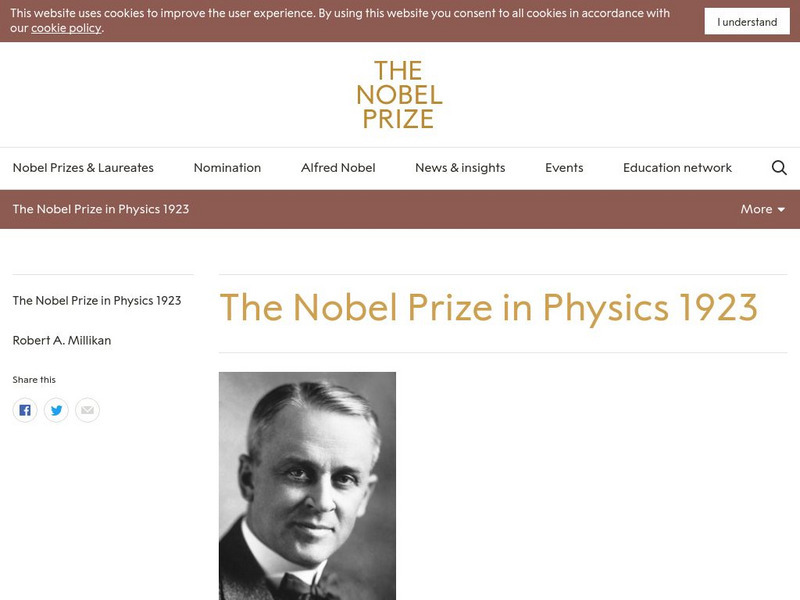
The Nobel Prize: The Nobel Prize in Physics 1923: Robert Andrews Millikan
This Nobel website on the life and scientific work of Robert A. Millikan includes a biography, images, and internet resources for further reading and research. Also included are the 1923 "Presentation Speech" which praised Millikan's...
Physics Classroom
The Physics Classroom: Lesson 3: Concave Mirrors
Lesson 3 of this tutorial on refraction is on concave mirrors. Content that is covered includes the anatomy of curved mirrors, reflection of light and image formation, ray diagrams, image characteristics for concave mirrors, plus more.
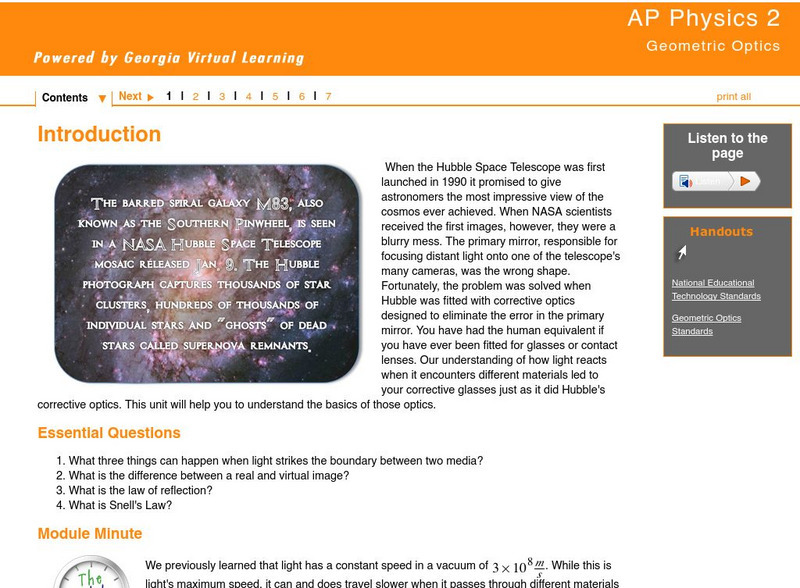
Georgia Department of Education
Ga Virtual Learning: Geometric Optics
This interactive unit will help students to understand the basics of geometric optics. Learn what happens when light strikes the boundary between two media as well as the difference between a real and virtual image? Also explore the law...
BBC
Bbc: Gcse Bitesize: General Properties of Waves
Light travels as waves. Waves can be described by their amplitude, wavelength and frequency. The speed of a wave can be calculated from its frequency and wavelength.

Khan Academy
Khan Academy: Thin Lens Sign Conventions
Have you ever wondered why some people need glasses and others don't? It's because of the way light is focused by the lens in your eye. This lens, like magnifying glasses, eyeglasses, and contact lenses, is considered a thin lens.
Science Buddies
Science Buddies: Testing Sunscreen Effectiveness
The goal of this project is to measure the effectiveness of different sunscreen products for blocking ultraviolet-A (UVB) and ultraviolet-B (UVB) rays from sunlight. This project shows you how to use a UV detector to measure rays of light.
TED Talks
Ted: Ted Ed: If Superpowers Were Real: Invisibility
What if invisibility wasn't just the stuff of epic comic book stories? Is it scientifically possible to be invisible? In this series, creator Joy Lin tackles six superpowers and reveals just how scientifically realistic they can be. [4:33]

NASA
Nasa: Imagine the Universe: "Nasa Detects One of Closest"
Site provides the article, "NASA Detects One Of Closest And Brightest Gamma Ray Bursts." Provides links to learn more about gamma rays and black holes as well as other resources.
Walter Fendt
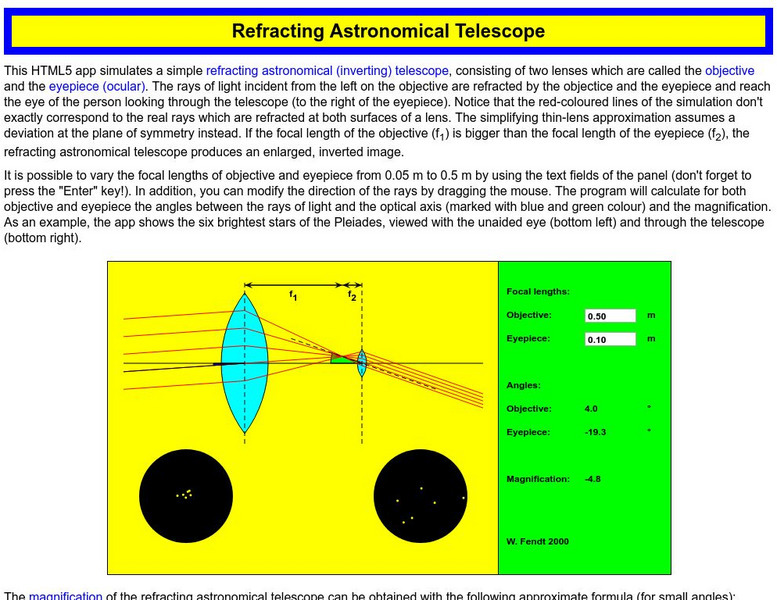
Walter Fendt: Refracting Astronomical Telescope
An app for investigating the operation of a refracting telescope. The location of the eyepiece and objective lens can be altered, and the focal point and path of light through the lenses can be observed.
Science Struck
Science Struck: Visible Color Spectrum Wheel
A brief explanation of the visible color wheel.
PBS
Pbs Learning Media: The Electromagnetic Spectrum: Frontline
This video segment adapted from FRONTLINE introduces the electromagnetic spectrum and explains how the various types of electromagnetic waves are distinguished by the amount of energy each wave carries.
Nobel Media AB
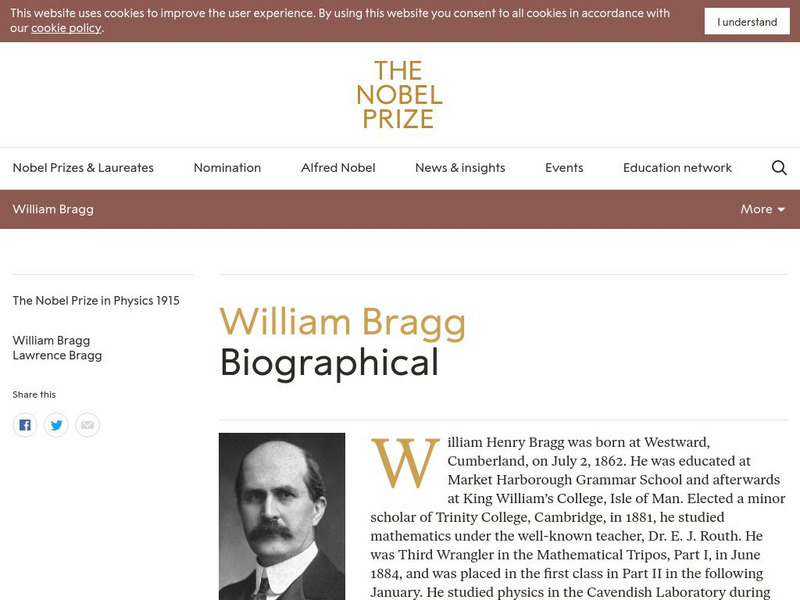
The Nobel Prize: William Henry Bragg Biographical
The Nobel Foundation provides a biography of Bragg. This site focuses primarily on his activities and accomplishments as a scientist.
Other popular searches
- Light Rays and Lenses
- Monochromatic Light Rays
- Science Light Rays
- Refracted Light Rays
- Incident Light Rays