Hi, what do you want to do?





Science Buddies
Science Buddies: Project Ideas: Grow Fungi That Fires at Light Sources
In this science fair project, grow a culture of Pilobolus fungus and experiment with its ability to shoot spore sacs at light sources. The Science Buddies project ideas are set up consistently beginning with an abstract, objective, and...
TeachEngineering
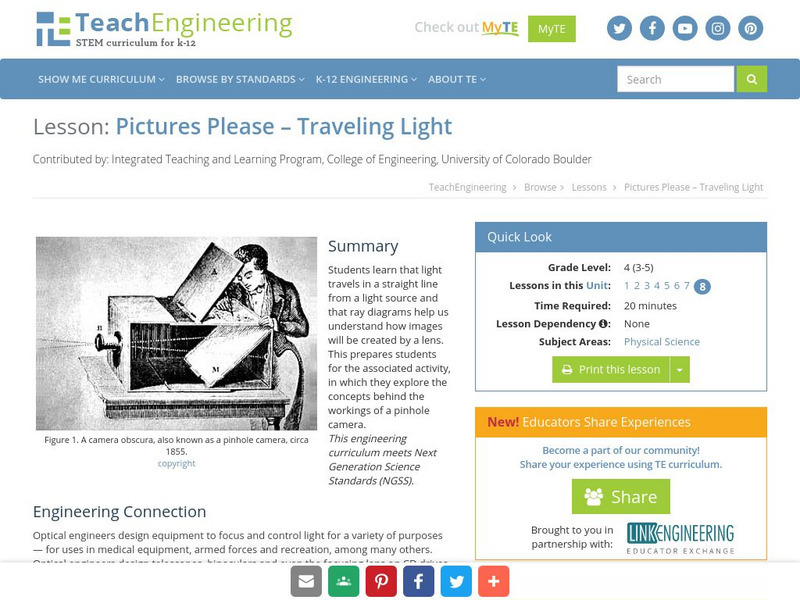
Teach Engineering: Pictures Please: Traveling Light
For this lesson, students learn that light travels in a straight line from a light source and that ray diagrams help us understand how an image will be created by a lens. In the accompanying activity, students explore the concepts behind...
CK-12 Foundation
Ck 12: Fundamentals of Light
[Free Registration/Login may be required to access all resource tools.] Students investigate the fundamentals of light including its source, how it is defined for measurements, how we perceive color, and the situations that make an...

eSchool Today
E School Today: Your Cool Facts and Tips on Light Pollution
What is light pollution and why should we care about it? Learn what it is, the different types, sources of this type of pollution, the impact it has, and ways to combat it.
TeachEngineering
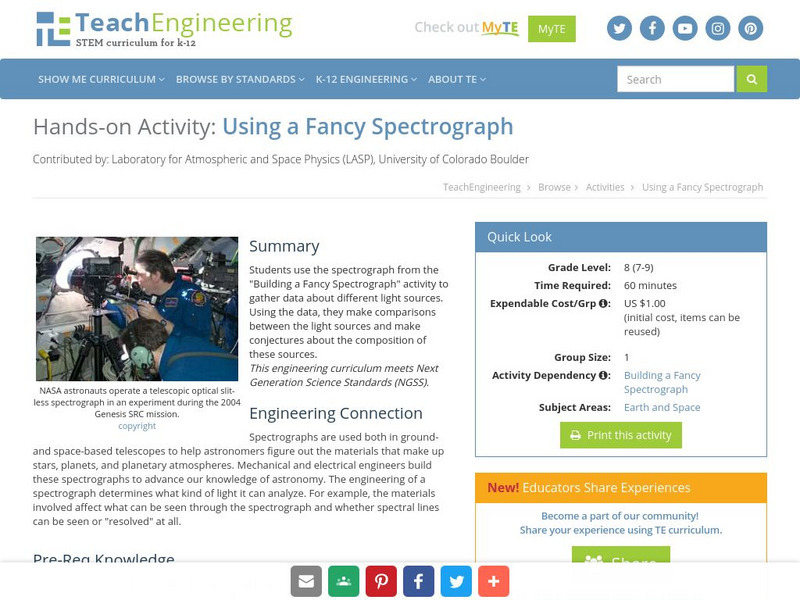
Teach Engineering: Using a Fancy Spectrograph
Students use the spectrograph from the "Building a Fancy Spectrograph" activity to gather data about different light sources. Using the data, they make comparisons between the light sources and make conjectures about the composition of...

TeachEngineering
Teach Engineering: The Visual Spectrum
In this activity, students make simple spectroscopes (prisms) to look at different light sources. The spectroscopes allow students to see differing spectral distributions of different light sources.
TeachEngineering
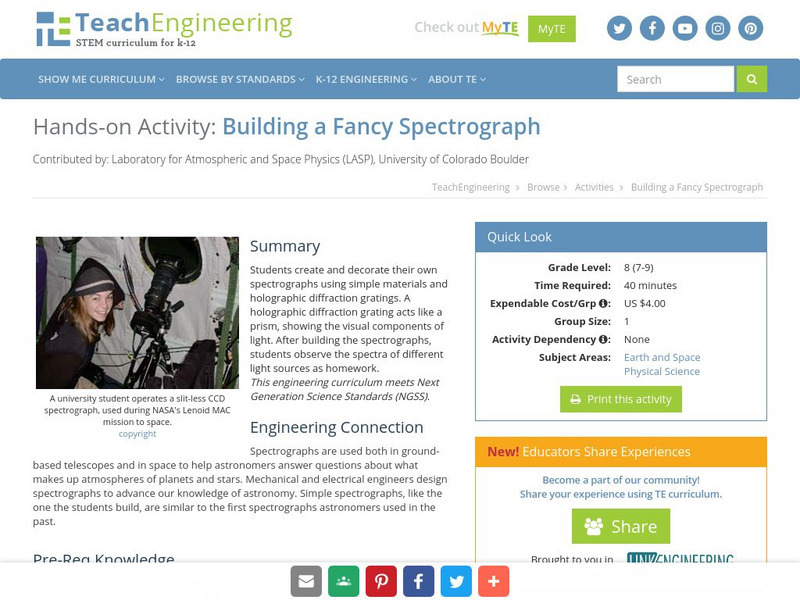
Teach Engineering: Building a Fancy Spectrograph
Students create and decorate their own spectrographs using simple materials and holographic diffraction gratings. A holographic diffraction grating acts like a prism, showing the visual components of light. After building the...

The Wonder of Science
The Wonder of Science: 1 Ps4 2: Illumination and Darkness
This NSTA vetted source includes resources to allow students to make observations that prove objects in darkness need light to be illuminated. Included are assessment ideas, videos, examples, lesson plans, and photos of student work.

US National Archives
Nara: Teaching With Documents: Telephone and Light Patent Drawings
A lesson plan about Alexander Graham Bell's patent for the telephone and Thomas Edison's patent for the electric lamp. Contains good background information and historically pertinent documents. It also discusses the role corporations...
PBS
Pbs Learning Media: Thomas Edison: Inventor and Entrepreneur
Through a video and primary source activities, students will learn about Edison's remarkable business of innovation and some of his 1,093 patented devices.
Next.cc
Next: Solar Energy
Engage in the activities provided to learn how you can use the sun as a source of energy. Click on the links for further exploration.
PBS
Pbs Teachers: Scientific American: Spider Web Making Stratagems
Investigate spiders in Panama that use UV-reflecting silk in their webs to attract their prey. Build a device that traps flying insects, experimenting with different light sources to choose the best lure.
Utah Education Network
Uen: Managing Heat
Understand the role of the sun as the source of heat and light for living things on earth.
Other popular searches
- Natural Light Sources
- Sources of Light
- Science and Light Sources
- Science Light Sources
- Childrens Light Sources
- Alternative Light Sources
- Man Made Light Sources
- Secondary Light Sources
- Chileans Light Sources
- Children's Light Sources
- Chilrens Light Sources
- Natural Sources of Light